

Super PAC Network Backing Connie Chan Received Hundreds of Thousands from AIPAC
AIPAC’s United Democracy Project, along with its offshoot DMFI, has funneled money to a network of Super PACs now backing the San Francisco supervisor.


Drop Site is reader-funded. No paywalls. No advertisers. No billionaire owners. Just journalism that answers only to you. If you value this work, please consider making a tax-deductible donation today.
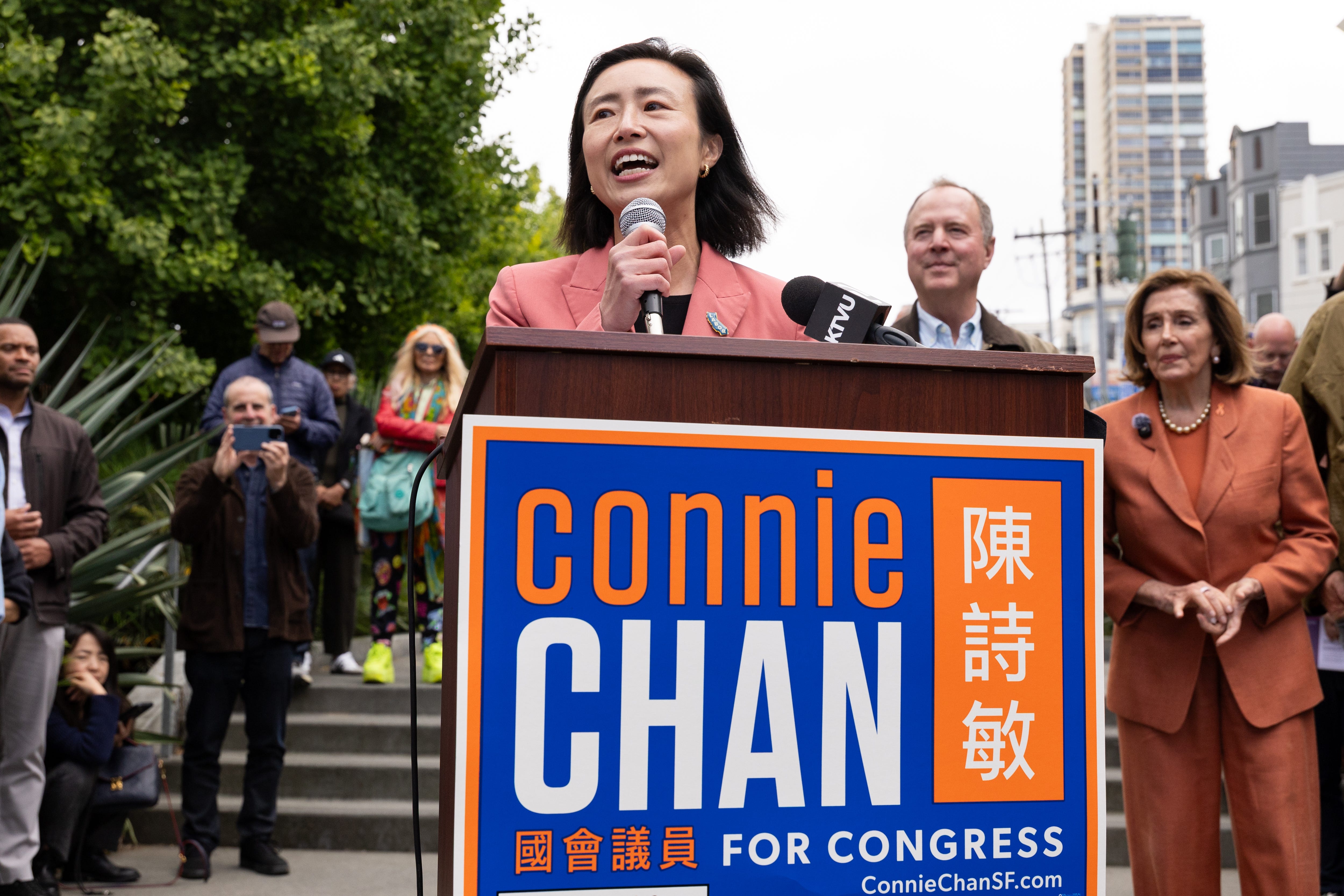
San Francisco Supervisor Connie Chan has pledged not to accept support from “AIPAC or its lobbyists and representatives” in her bid for California’s 11th congressional district, but federal campaign records show that the pro-Israel organization is working behind the scenes to funnel money to support her candidacy.
The money from AIPAC and its offshoot Democratic Majority for Israel (DMFI), which is approaching $500,000, has taken a circuitous route to San Francisco. Following the money trail requires sifting through several layers of complexity, but the picture that emerges at the end is clear.
On April 13, DMFI sent $22,500 to a super PAC called EDW Action Fund, which has been used in previous campaigns as a front for AIPAC spending. Ten days later, on April 23, it gave another $15,250, bringing the total month’s transfer $37,750.
AIPAC sponsors its own super PAC, called United Democracy Project, and UDP got into the game too, dropping $250,000 into EDW Action on April 14, a day after DMFI’s initial dump. EDW Action thus received $287,750 from AIPAC-aligned super PACs that month.
But EDW Action had previously been exposed by Drop Site and others as a known AIPAC pass-through. On May 1, a new PAC was formed, called Pro-Choice Majority Action. That PAC is legally affiliated directly with EDW Action.
Given that Pro-Choice Majority Action registered with the FEC on the first of the month, its first disclosure date falls on June 20, allowing the organization to evade filing requirements until more than two weeks after the California primaries conclude on June 2. Such vehicles are known as “pop-up PACs,” since they can pop up right before an election, spend huge sums of money, and avoid disclosing donor records until it’s too late to matter to voters.
Pro-Choice Majority Action has already spent a total of $475,000 supporting Chan, with much more likely to come through Election Day on Tuesday. Because the new PAC is formally affiliated with EDW Action, the two can transfer unlimited sums of money between themselves. As of April 30, EDW Action’s largest contribution had come from the “Kimbark Foundation,” a nonprofit that itself popped up just before moving money to EDW, which has raised only $1.25 million for the cycle. Kimbark’s only other contribution, also for $500,000, was to 314 Action Fund, another known AIPAC vehicle, which spent heavily to support Ala Stanford in her failed bid against Chris Rabb in Philadelphia. AIPAC has consistently denied it played a role in that race.
Though AIPAC’s Twitter account spent much of Saturday complaining about Drop Site News, the organization did not respond to a request for comment on its newly discovered spending. On Twitter, AIPAC argued that scrutiny of its shell PACs was “[p]art of an orchestrated campaign to single out and demonize individual pro-Israel Americans for supporting candidates of their choice,” representing a “level of scrutiny not applied to any other group of citizens.”
In a statement issued Sunday, Chan said she urged any PACs supporting her to abide by her values and eschew pro-Israel money. “Connie has also been clear from day one of this campaign that she would not accept a dime from AIPAC and she has stayed true to this throughout,” said a campaign spokesperson. “PACs act independently of our campaign and we would urge any organization supporting Connie to respect the very clear values she has laid out not to accept donations from AIPAC.”
EDW Action Fund previously spent just over $500,000 supporting Laura Fine in a Chicago-area congressional race. Fine had the backing of AIPAC but lost. EDW Action used Symmetry Media LLC to make its ad buy in that race; the documents show that Symmetry Media was also used to make the new expenditures on behalf of Connie Chan.
Lenny Young, listed in public filings as a representative of EDW and Pro-Choice Majority, said that “Pro-Choice Majority Action is not a ‘pop-up’ it’s just an affiliate and will be active for cycles to come. Launching it has been in the works for months.”
He did not directly address questions about AIPAC, but said that in general it makes sense to team up if multiple groups support the same candidate. “Obviously there are groups out there who have their own priorities, who also happen to support the same women candidates we support. In those cases, it’s clearly much more effective to combine resources to carry a message,” he said.
Chan, who has the endorsement of outgoing Rep. Nancy Pelosi, faces state Sen. Scott Wiener and Saikat Chakrabarti, a co-founder of Justice Democrats and the former chief of staff to Rep. Alexandria Ocasio-Cortez.
Chan’s campaign recently picked up momentum after receiving the key endorsement from Pelosi, whose retirement opened up the vacancy. For most of the race, Chan has been polling in third place behind Wiener and Saikat Chakrabarti. Recent polling, however, shows Chan moving into a close contest with Chakrabarti for second place and a spot in the general election against Wiener.
The latest poll from EMC Research places Wiener firmly ahead of the pack at 38% support, with Chan and Chakrabarti trailing behind at 22% and 21% respectively.
While serving as Ocasio-Cortez’s chief of staff, Chakrabarti clashed privately and publicly with Pelosi, urging her and the party to move faster and push harder. Animosity toward Chakrabarti among the party leadership remains intense. An advisor to Democratic Leader Hakeem Jeffries told Drop Site the party brass was glad to see him go, and isn’t interested in seeing him return as a member of Congress. “Frankly, the problems we had with her in the beginning were more her chief and not her,” he said, referring to AOC and Chakrabarti. “Then he left and everything got much better.”
This story was updated to include comment from Chan and Lenny Young.
 | A guest post by
|
What this reporting shows is not a “mystery” or a “gotcha” — it’s the standard operating procedure of AIPAC’s influence machine. When a candidate publicly vows not to take AIPAC money, the network simply routes the same dollars through a chain of pop‑up PACs, nonprofits, and shell entities until the original source is buried under paperwork. By the time voters see the ads, the money has already done its work and the disclosure deadline is safely after Election Day.
The Connie Chan case is a textbook example. DMFI and AIPAC’s UDP quietly seed EDW Action Fund. EDW spawns a new PAC with a voter‑friendly name. That PAC floods the district with nearly half a million dollars in support — all while maintaining the fiction that the candidate is “not backed by AIPAC.” The structure is designed to preserve plausible deniability for the politician and perfect opacity for the public.
This isn’t about one race in San Francisco. It’s about a political ecosystem that allows a single interest group to shape primaries across the country while evading the scrutiny every other donor network is expected to face. If a candidate benefits from AIPAC’s money — whether it arrives directly or through a daisy chain of intermediaries — voters deserve to know before they cast a ballot.
The AIPAC octopus has its tentacles all over the place, blatantly interfering in elections. Then again, is isn't at all surprising: the US and "Israel" have functioned as one irredeemably evil Zio-fascist entity for decades. This dual entity must fall if humanity has a hope of surviving and thriving.