

Javier Milei Is Set to Roll Back Argentina’s Historically Strong Labor Rights
Unions stage general strikes as outrage grows against the regressive labor reforms pushed by Milei

The DNC commissioned an autopsy—they called it an “after action report”—of the 2024 election, that found the party’s support for genocide in Gaza had materially harmed Kamala Harris. But we don’t know anything more than that, because DNC Chair Ken Martin has refused to release it.
Without transparency there can be no serious democracy. Drop Site partnered with Breaking Points to put together a petition calling on the DNC to release the autopsy.
The DNC knows Gaza cost Harris the election. Tell Ken Martin to release the full report:
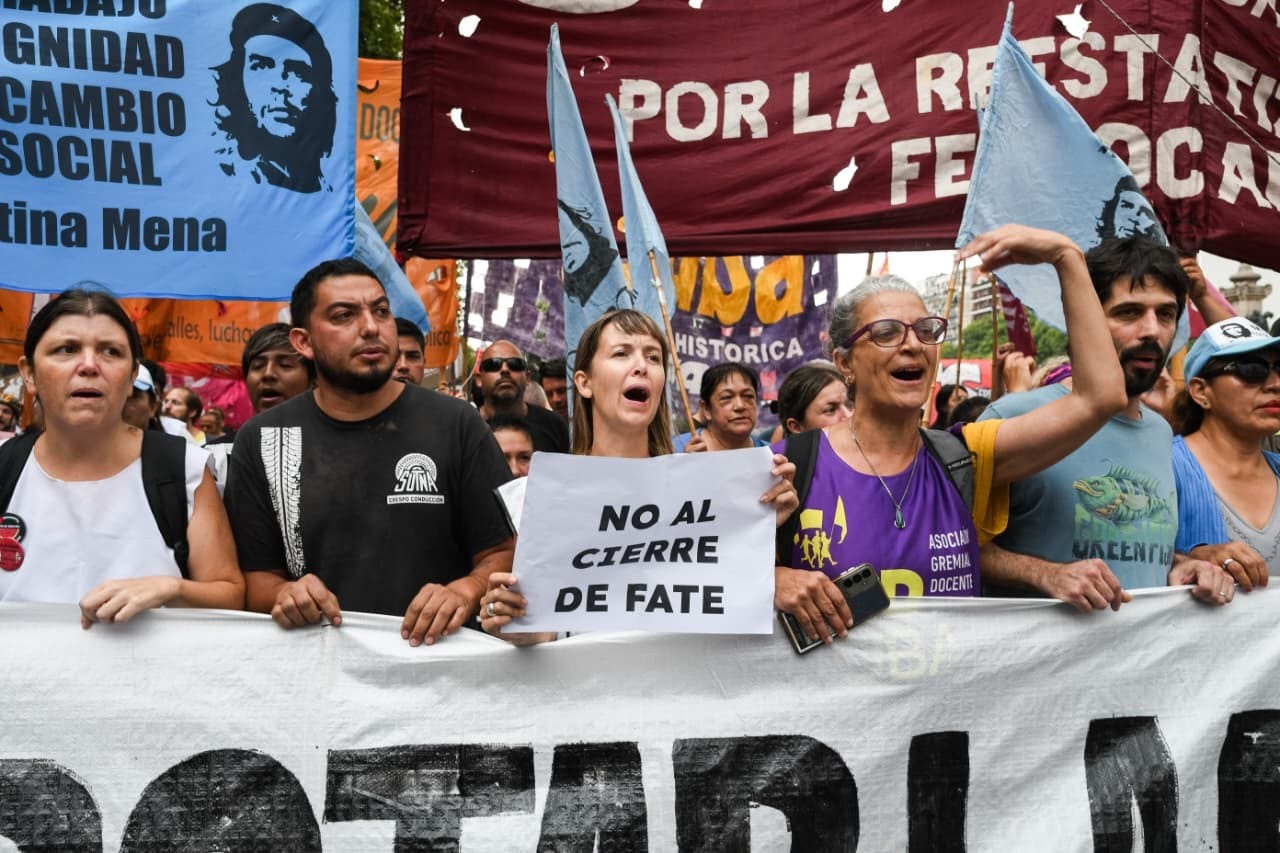
Javier Milei Is Set to Roll Back Argentina’s Historically Strong Labor Rights
Story by Sam Carliner
Argentina’s Chamber of Deputies passed a bill Friday that would massively overhaul the country’s labor relations in an unprecedented rollback of workers’ rights. The 135-115 vote came after a marathon midnight session lasting from Thursday into Friday as trade unions again wielded their ability to bring out striking workers across Argentina and shut down ports, public transit, schools, and hospitals to protest the bill.
The lead-up to the vote was marked by the country’s fourth general strike since President Javier Milei took office. The CGT, the country’s largest federation of trade unions, called the 24-hour work stoppage following weeks of growing outrage as more and more workers learned of the severity of the attacks in the labor reform. The country, which has a unionization rate of around 27% nationally, was brought to a standstill.
Julián Aguirre, Director of the International Relations Secretariat from the CTA Autómoma labor federation which represents workers in industries ranging from healthcare to sugar production, told Drop Site that the reform has broader implications for labor in Latin America.
“It sets a worrying precedent for the region,” Aguirre said. “Argentina today is a laboratory for a project that is not only economic but also social and cultural. In this case it aims to dismantle 100 years of labor rights in Argentina.”
The bill will return to the Senate on February 27 and labor leaders have pledged to maintain their protests. Although the bill is expected to become law, the right-wing Argentine government will have to face off with an increasingly mobilized and militant labor movement.
Argentina has generally been considered to have some of the strongest labor rights in the region. The bill includes a barrage of pro-big business measures which would make it cheaper and easier for employers to fire workers, standardize a 12-hour workday, reduce overtime pay and severance, and restrict paid time off. This is characteristic of the “Chainsaw Agenda” which is at the center of president Javier Milei’s economic policy. The bill also restricts workers’ rights to strike and engage in collective bargaining. The lower house eliminated one of the more controversial proposals that would have reduced by half the salaries of workers on leave due to injury or illness.
Businesses have already begun laying off workers in anticipation of the law. Just days before the vote, FATE, the largest tire factory in the country, announced it would be closing after over half a century of operations, firing hundreds of workers in the process. In response, a group of workers entered the factory and set up an occupation on the roof, which is ongoing at this time of writing.
Victory Ottobino, a FATE worker of three years who is participating in the occupation, told Drop Site that the closure is connected to Milei’s larger agenda.
“There are already hundreds of thousands of people who have been laid off across the country, mainly as a result of this government’s economic policy, a government that is totally aligned with the Trump administration in the United States, with the policies of financial capital, the IMF, etc.”
The occupation at FATE draws from recent history in Argentina. At the start of the 2000s, there was a wave of occupations in which workers took control of factories throughout the country, fighting for several years to bring them under workers’ control. Raúl Godoy, a labor leader who led the worker takeover of Zanon, a ceramics factory, told Drop Site that this history still inspires workers.
“This is a fight that is open and etched in the historical memory of the workers of our country,” Godoy said. “They are a very important achievement and a symbol in the face of closures: to occupy, to produce, to resist, and to have an alternative from the workers.”
Milei’s U.S.-Backed Agenda
Milei campaigned in 2023 as an outsider who would improve the living conditions of workers. His campaign took advantage of economic concerns in a country plagued by runaway inflation, fueled largely by an imposing debt from the International Monetary Fund.
As president, he has been attempting to completely reorganize Argentina’s economy for the benefit of big business by gutting long-standing protections for workers, privatizing public services, and opening the country to foreign capital, with a focus on attracting U.S. investment. Milei’s policies have not only worsened living conditions for most Argentines but have also gutted the country’s small and medium businesses. The new labor reform is the most extreme measure to date.
While many workers and small business owners voted for Milei, his administration has seen growing discontent reflected in plummeting approval ratings and large protests.
Despite this, Milei’s party received a boost in recent parliamentary elections. The win was largely the result of direct interference by the United States, with Trump announcing days before the election that he would condition $40 billion in aid to Argentina on Milei’s party La Libertad Avanza (Freedom Advances) winning sufficient seats to push forward liberalization of the country.
Milei’s party did not have enough votes in the Chamber of Deputies to pass the labor reform on their own. The vote passed with the support of other right-wing parties including Propuesta Republicana (Republican Proposal) and Unión Cívica Radical (Radical Civic Union).
In addition, several Peronist deputies provided the numbers needed to pass the bill. Some voted in favor of the bill after modifications had been made; others didn’t vote for it, but their presence allowed for the necessary quorum needed for the debate to commence. Peronism is the country’s longstanding populist movement which ranges from center-right to center-left. Many different groups, often with conflicting interests, make up the base of Peronism, which partially explains some of the representatives helping to advance the bill.
Aguirre told Drop Site that there is a “divorce” between the growing opposition in the streets and the political representatives in Congress.
“In all these demonstrations that have been massive on many occasions—whether to repudiate the attack on the university system, to repudiate the attack on the public health system—they have been massive marches, but they have perhaps not yet found a national leadership with a proposal that represents them.”
Worker Opposition
Along with the strike, workers, socialists, and broader activist sectors engaged in combative protests. On the morning of February 19, protesters set up several roadblocks at major transit arteries including the Pan-American Highway and the Pueyrredón Bridge. Early in the afternoon, a large crowd convened outside of Congress, enduring a militarized police presence which has been a staple of Milei’s repressive response to opposition. Later into the night neighborhoods were filled with the sound of cacerolazos, a popular protest in which people bang on pots and pans.
The day marked the culmination of outrage that had grown in waves since Milei first began preparing to pass the labor reform at the start of January. Just one week before the Deputies held their vote, the public became aware of Article 44, a section of the bill which undermined sick leave, rapidly increasing outrage over the reform.
Godoy told Drop Site that more left-wing sectors of the labor movement had launched a campaign to inform workers about the impact of the labor reform and organize for unions to take action against it.
“Campaigns were held in plazas, on beaches, in vacation spots, on trains, in subways, in public squares to inform the union leadership, the official union offices, especially the CGT, about the seriousness of this situation,” said Godoy.
Unlike previous work stoppages, the latest strike saw all of the country’s trade union confederations “set aside partisan and ideological differences in pursuit of a common goal,” according to Aguirre, with chatter among trade unions that the time has come for an indefinite general strike.
The ongoing occupation at FATE shows another side of the labor movement, in which some workers are responding spontaneously to the impact of Milei’s policies. In January, Lustramax, a cleaning and paper goods manufacturer, tried to illegally fire several workers known for their union activity, which resulted in a factory occupation and ended in the workers getting their jobs back.
Ottobino, the FATE worker, told Drop Site that these initiatives play an important role in activating the labor movement.
“All these sectors and movements that exist and are being monitored and attacked by the government must join forces to develop a widespread struggle to impose on the union bureaucracy until we bring down the economic plan of the government of the big bosses and the IMF,” said Ottobino.
 | A guest post by
|
America is a 1 party system that finances 2 political parties
True. DNC has still not realized that if they support Israel and Zionism blindly they will lose elections again. The democrats who have won the seats recently are progressive democrats who are not using AIPAC and pro Israel campaign funds . I did early voting in my state and voted only for candidates not taking money from corporations and pro Israel groups. End Citizens United Act of 2010.