

Eject Elbit Is Pushing Capital One to Drop $90M Loan to Israel's Largest Weapons Manufacturer
Protesters across several cities are acting against the bank for funding Israeli arms manufacturer Elbit Systems, as company employees face censorship for talking about the genocide in Gaza.

Drop Site exists because readers like you make a different kind of journalism possible.
We made a commitment from day one: no paywalls. Ever. Someone living paycheck to paycheck can access the same reporting as anyone else. Our journalism isn’t just for people who can afford it—it’s for everyone who needs it.
That commitment is what allows us to amplify the voices of journalists risking their lives on the ground in Gaza, Venezuela, Sudan, Pakistan, Syria and elsewhere. It’s what gives us the editorial independence to publish stories that have real-world impact, stories that powerful interests don’t want told. It’s what lets us compete against billionaire-controlled propaganda machines.
But here’s the reality: we can only do this with your support.
Corporate outlets answer to advertisers and investors. We answer to you. While legacy media is being bought up and controlled by billionaire oligarchs, we’re holding them accountable. Your tax-deductible donation isn’t just supporting our work, it’s choosing truth over propaganda, independence over corporate control.
Together, we’re proving that independent journalism backed by thousands of readers is stronger than journalism controlled by a handful of billionaires. Can you make a donation today to help us grow even stronger?
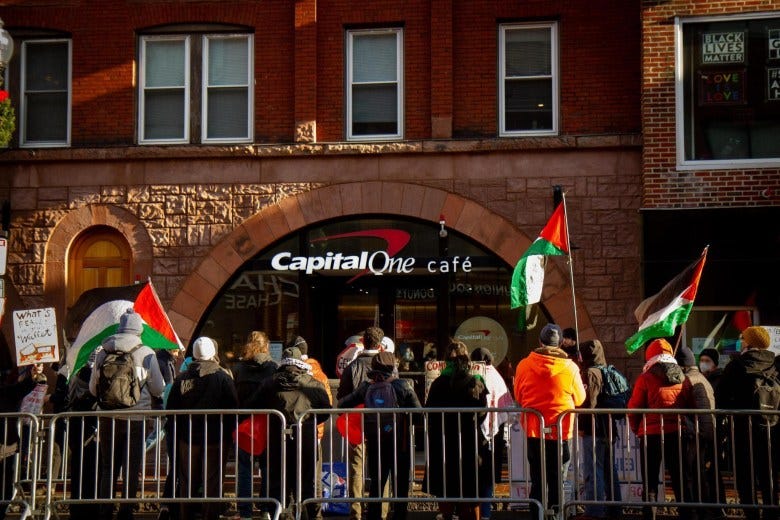
Last Tuesday, during the morning rush hour, 15 individuals from a group called Eject Elbit staked positions in the four-lane access road to the headquarters of banking giant Capital One Financial Corporation in McLean, Virginia. They mounted ladders in the road and climbed atop them, unfurling a banner from their perches that read “CAPITAL ONE FUNDS GENOCIDE.” They stretched across the road a second banner, fifty feet wide, that said “DIVEST FROM DEATH.” Another protestor, a disabled woman, blockaded the road while locked to her wheelchair.
Max, a former employee of the company who only used his first name for security reasons, said they flooded the streets to “shake people awake,” regarding Capital One’s $90 million loan to Israeli arms manufacturer Elbit Systems, the largest supplier of the Israeli Defense forces. Elbit produces everything from precision-guided rockets and bombs to state-of-the-art artillery ammunition, guidance systems for aircraft and helicopters, and killer drones that have been deployed in the genocide of Gaza.
Eject Elbit launched its new campaign against Capital One earlier this month across northern Virginia, Boston, Philadelphia, DC, Seattle, and New York City. A thirty-year-old queer activist named Cassian, who was posted atop one of the ladders that blockaded the McLean site last week, helped launch the Eject Elbit campaign in Washington, DC, after years of participating in protests with pro-Palestinian groups. “If the US government was not going to stop sending weapons for the genocide, then the people were going to have to stop it,” Cassian said.
For an hour and a half, the bank’s opulent campus—with its mini-golf course, sculpture garden, baseball field, and concert hall—was inaccessible as traffic backed up and irate motorists leaned on their horns and shouted.
Last September, in a special report titled “From Economy of Occupation to Economy of Genocide,” UN Special Rapporteur on the Occupied Palestinian Territories Francesca Albanese investigated the “corporate machinery sustaining Israel’s settler-colonial project of displacement and replacement of the Palestinians in the occupied territory,” in which Elbit Systems featured as a primary contractor to the Israeli state. Detailing how “the military-industrial complex has become the economic backbone” of Israel, the UN report says that Elbit Systems provides “a critical domestic supply of weaponry, and reinforce[s] Israel’s military alliances through arms exports and joint development of military technology.”
Eject Elbit’s actions at Capital One come as the Boycott, Divestment, and Sanctions (BDS) movement, advocating for states and companies to divest from Israel, has become a prominent expression of political agitation. Insurance companies Allianz and Aviva late last year decided they would stop insuring Elbit Systems after months of direct action and protests organized by the group Palestine Action.
“Capital One gets away with so much shit, because they’ve got slick ads—a very positive feel-good brand,” said Max. “Obviously there’s a moral repugnancy in working for a company that funds genocide. But I won’t pretend that I immediately stood up and quit my job after I learned about Capital One’s relationship with Elbit. I had to pay rent like everybody else.”
Max worked as a software engineer for five years at Capital One before resigning in 2025, writing in a post on an employee Slack channel that he was leaving because his company was “actively aiding an arms dealer that profits off war, genocide, and the deaths of children.” He recalled that the annual message from company CEO and multimillionaire Rich Fairbank—whose total compensation in 2023 was $29 million and who received a $30 million bonus last year—typically ended with sentimentalism that “tugg[ed]at the heartstrings about when he was younger and in college, he really wanted to work with kids,” Max said. “This guy is helping to pay for drones that fly into children and blow them up.”
“This is what happens when we base our whole society on profit,” Max continued. “If you are the CEO of Capital One, you are legally obligated to make the most money for your shareholders, whether it’s through hiking credit card rates or giving a loan to a weapons manufacturer. The shareholders see what’s happening in Gaza as an opportunity to profit on the hundreds of billions of dollars churned out for the killing machine.”
Support From Workers Inside Capital One Met With Censorship
A Palestinian-American manager at Capital One named T, who did not use their full name for security reasons, said that many rank-and-file employees celebrated the protest. “We were pretty excited about the commotion internally it caused,” he said. While there were “hundreds of reactions on Slack of people supporting the protest,” T said, company higher-ups went silent. “There was no engagement from management at all.”
Instead, human resources administrators at Capital One expanded a campaign of censorship on Slack that had been ongoing for months. “HR deleted entire threads on Slack showing the level of enthusiasm,” said T. “All of our channels of meaningful outreach on Slack now have been shut down.”
Max described how the censorship program had functioned since mid-2025 to elevate pro-Israel voices and silence any dissent. A letter sent to Fairbank and the board of directors that criticized the company’s relationship with Elbit, first published in the summer of 2024 on an internal message board called Pulse, was taken down last summer. The letter was titled “No Financing for Apartheid” and garnered more than 300 employee signatures. “We are writing as Capital One associates from a wide range of religious and national backgrounds who are concerned about the violence being inflicted upon the Palestinian people,” the letter stated. The signatories called on the company “to act in accordance with the [International Court of Justice] by divesting from any and all weapons manufacturers supplying the Israeli military.” The company censored any links to the Pulse letter in Slack profiles.
“Cap One had an interesting view of discussion on Slack [about] politics and world events,” Max said. Various executives posted messages following the Oct 7, 2023, attacks by Hamas that expressed support for Israel. But there were no expressions of empathy or solidarity with the tens of thousands of Palestinians killed by Israel in the Gaza War that followed, according to Max. “A small group of very determined Zionist employees at Capital One on Slack would immediately shut down the argument, aggressively accusing people of antisemitism, citing pro-Israel outlets, and denying the reality of the genocide. It made it impossible to have any conversation.”
“The Zionist apologetics got grim,” he said. “One Zionist member of the chat, when we were discussing how it’s bad when children get killed, compared the massacre of children to elimination of cells during cancer treatment. There were tense debates around the use of dehumanizing language. At one point, the argument was that whatever happened in this conflict was always to be blamed on the Palestinians.”
The answer from the company in the end was to shut down as many of the offending Slack channels as possible, including two called Associates for Racial Justice and Associates for Social Justice, Capitol One employees told Drop Site. The company censored an internal company podcast featuring Palestinians who described their traumatic personal and family histories, all links to Palestinian human rights organizations and websites recounting Palestinian history, along with any other Slack channels that engaged in discussions of the genocide, October 7, Zionism, and Palestinian rights.
According to another Capital One employee currently with the company, all recent threads about the McLean protest, including discussion of the purpose of the protest, ended up deleted. “The word ‘Elbit’ now seems to be banned, even when talking about Capital One’s own loans,” the employee said. A Slack profile that said “stop censoring us,” with an image of a Palestinian flag, was reported and censored, as was a profile that said “For Refaat Alareer,” the Palestinian poet assassinated by the Israeli military in December 2023. Prior to his murder, Alareer wrote “If I get killed by Israeli bombs or my family is harmed, I blame Bari Weiss,” in reference to Weiss inciting against him on social media. The writer of the Slack profile commemorating Alareer was hit with a “community engagement expectations violation.”
Capitol One did not respond to inquiries from Drop Site about the protests and demands that the company divest from Elbit and the claims by Capital One employees that the company has censored internal communications.
“If you post happy Halloween, they don’t give a shit, but if you post ‘Free Palestine,’ you will be reprimanded,” said T.
For these employees, Eject Elbit’s escalation to disruptive action at the McLean campus was a long time coming and needed more than ever. “They’re not letting Capital One get away with it,” Max said. “Eject Elbit is doing what a functioning government should do, which is to hold powerful people and powerful companies accountable for the harm they do while blindly chasing money.”
 | A guest post by
|
Thank you. I am closing my account and transferring my banked assets to another account.
I too will be closing my account and moving my money. Would like to let Capital One know. Who can I call or write?