

Maine Ballot Measure Is Testing the Power of Graham Platner’s Volunteer Army
Canvassing teams trained by the campaign contacted 40,000 voters across the state in just two days to vote against billionaire-backed voting restrictions.

Programming note: Drop Site will be streaming starting at 7:30 p.m. ET Tuesday, covering the New York City election as well as other contests. RSVP here and you’ll get an email or text when we go live.
Although we put this all out for free, it’s not free to put on. If you support our journalism and want to see more of it reach a bigger audience, please make a one-time donation, or even check the box to make it recurring if you’re feeling extra generous.
PORTLAND, Maine—On Tuesday, Mainers will vote on Question 1, a billionaire-backed referendum seeking to radically alter the state’s election laws, cracking down on absentee ballots and making it more difficult to vote on Election Day. The measure is the brainchild of conservative megadonor Leonard Leo, the architect of the right’s decades-long effort to take over the courts and reshape the electoral process.
In an unusual turn of events, arguably the most well-organized opposition to the ballot question has come not from the Democratic Party, but from Graham Platner’s upstart Senate campaign—which is still less than three months old. By the end of this weekend, more than 3,000 volunteers across 23 locations had attended an organizing training event put on by Platner’s campaign. Platner, an oysterman and military veteran from eastern Maine, is vying for the Democratic nomination to take on Republican Sen. Susan Collins in the general election. According to numbers shared by the campaign, canvassing teams, trained by the campaign, contacted 40,000 voters through door-knocking and phone-banking over just two days, in towns from northern Aroostook to southern York counties.
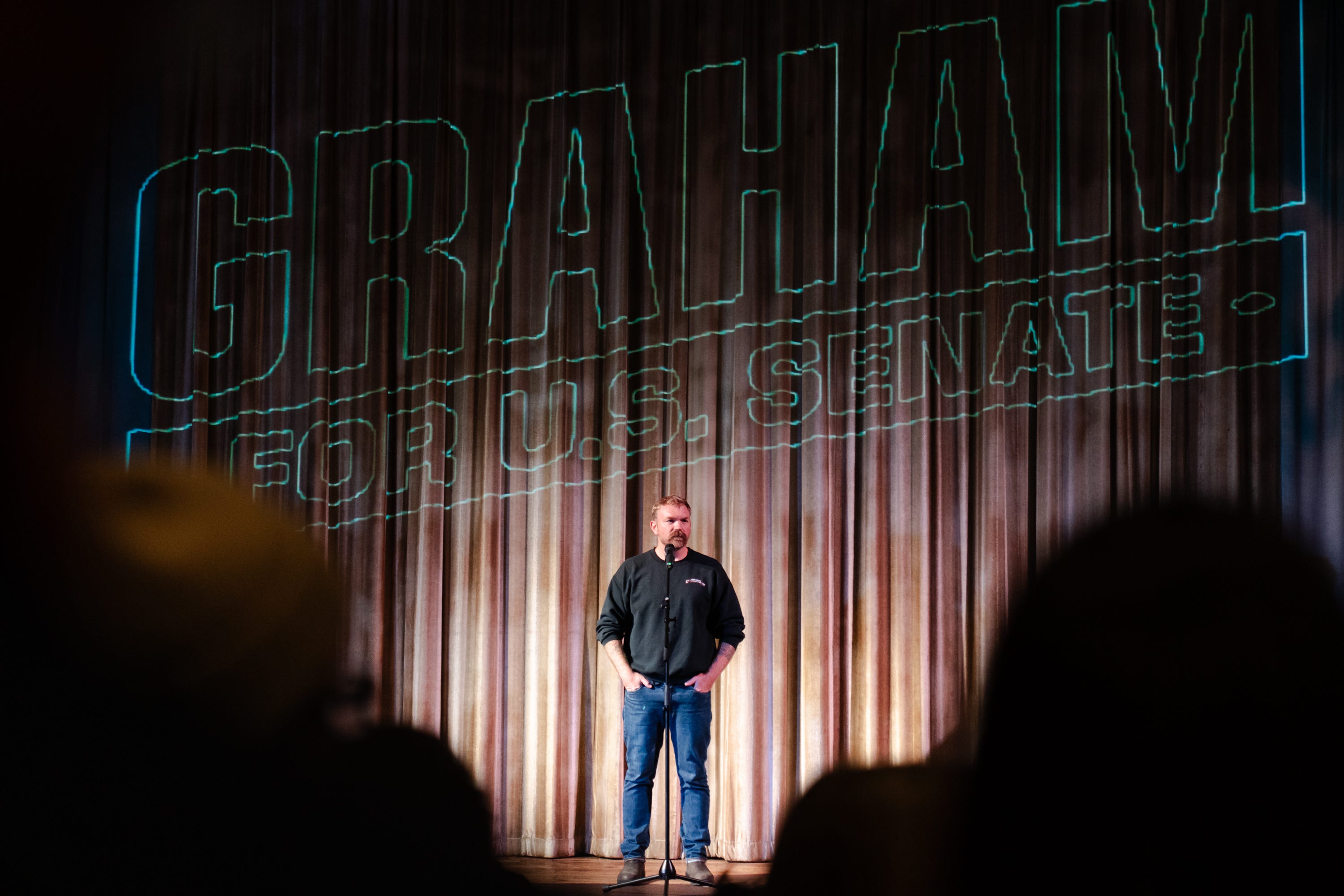
On Sunday afternoon, Platner filled the State Theatre, an historic art deco venue in Portland in Maine’s largest city, with close to 1,000 people eager to hear how the campaign planned to save absentee voting in the Pine Tree State. The voter suppression initiative would hobble absentee voting in the state with the oldest population in the country, enact strict voter ID requirements, and severely limit access to ballot dropboxes. In the last election cycle, more than 40% of Mainers used absentee voting. Polls have shown voters evenly divided on the measure, which could have considerable implications for the 2026 general election.
The ballot question is an early test for the Platner campaign, which has pledged to invest an unusually significant proportion of its campaign budget on grassroots organizing, making the case that defeating Collins is just one part of a longer and deeper project of building power. The statewide organizing effort is also Platner’s answer to a developing national narrative that the Platner campaign is in chaos, with the loss of its political director, campaign manager, a fundraiser, and the replacement of its treasurer.
“The reason we are in this room together today is because there is a move to steal democracy from us, to restrict access to the ballot for Mainers of all stripes,” Platner told the Portland crowd. “To defeat it, we must engage in what many of us have not done before. And that means getting involved.”
“It requires you to go out into your community; it requires you to have conversations with people you know you are going to disagree with, and you have to have them anyways. You have to remain open, empathetic, and compassionate. Understanding that not everyone is where you are now, but that there is hope. There is hope in the ability of people to change.”
In late October, the campaign released its own ad against Question 1, complete with the class-inflection that has been a hallmark of Platner’s stump speeches. “Don’t let a right-wing billionaire on Mount Desert Island screw up absentee voting in Maine,” he says in the ad.
Leo, who has a mansion in Bar Harbor on Mount Desert Island, is a major donor to Collins, and he has deployed several secondary vehicles to put space between himself and the ballot measure. The “Yes” campaign is being run by a group called Voter ID for ME, which in turn is largely funded by the Republican State Leadership Committee. The RSLC, meanwhile, is largely funded by the Lexington Fund, a dark money group backed by Leo, and First Principle PAC, a super PAC linked to the Lexington Fund. Maine unions and the ACLU have combined to oppose the measure.
For many people—including James Macon, 36, and Diana Macon, 35, from Portland—the State Theatre matinee was the first time seeing Platner in person. “I wanted to hear Graham’s thoughts live, rather than something filtered through an algorithmic or mediated platform,” James Macon told Drop Site. “I’m getting a labor-focus from Graham—how we can raise up a working class, and middle class that’s been compressed. I’d like to see ways we can have federal and state support for an evening of the playing field, an equity- and justice-first platform.”
For Diana, it was her first live political event. “He seems to be bringing together people with mixed views and backgrounds. I find that very refreshing. We all have something in common,” Diana Macon added. “Let’s get away from the computer—stop scrolling and form our own opinion.”
They were both “absolutely voting no” on Question 1, but were still deciding on who would be Maine’s best democratic candidate for the U.S. Senate.
Sunday’s State Theatre rally capped a weekend of “No on 1” organizing. Each of the 23 canvass sites was led by a “volunteer leader or captain” who delivered an introduction to organizing training, taught best practices for data collection and directed door-knocking exercises for new volunteers.
“We are using this weekend as an opportunity to practice what it looks like to have a completely volunteer-run, fully independent leadership team structure across the state,” Spencer Toth, organizing director for the Platner campaign, told Drop Site. Toth says all the campaign’s volunteer leaders received special training and attended workshops prior to this weekend, empowering them to recruit canvassers, capture field data, and troubleshoot issues on the fly.
One of the training events was held at Platner campaign HQ in downtown Ellsworth, a small town of 8,000 known as a gateway to Bar Harbor and Acadia National Park. On a windy Saturday morning, more than 35 volunteers piled into the retrofitted Main Street storefront to learn about building power through conversations with their neighbors.
Platner, wearing a Dropkick Murphy’s hoodie, launched the organizing training with a stump speech delivered from a window ledge full of lobster traps, with an American flag rippling behind him outside. “This is politics. Politics is not campaigns; it’s not the news media, not this theatrical side of things. In my opinion, it’s about building power, building power through networks in your communities, building trust with your neighbors. And that’s what canvassing is. It’s about building trust amongst yourselves. It’s about learning a different way of thinking about power, and finding out that you, as an individual, actually hold an immense amount of power when you organize with your neighbors in your community. This is happening all over the state of Maine this weekend.”
“The fact that many of you are here for the first time doing this, this is it,” Platner continued. “This is how it starts, but this is not how it ends. We need to use canvassing, this moment, to build something significant and deeper.”
Following Platner’s pep talk, an introduction-to-organizing presentation was led by Sue Collins, a mid-sixties volunteer leader who coincidentally shares her name with Maine’s current five-term Republican senator, and Platner’s potential general election opponent. Before being trained by the Platner campaign over the last month, Collins had only been a canvasser once.
“I was inspired by Graham to make myself uncomfortable and do this. No one is coming to save us, so we have to save ourselves,” Collins told the room full of volunteers. “We’re not asking for perfection. Just be yourself, be authentic. Ask people what would change their life. What would really make a difference for their happiness, their comfort.”
Collins provided the volunteers with details on the “No on 1” campaign, preparing them for conversations they may have at local doors. She emphasized that many people have already heard of Platner – a recent survey found Platner was already at 85% name recognition – but that volunteers should still use the “No on 1” canvass as a means to introduce the candidate and learn about the issues that matter most in each household.
“We’re not necessarily campaigning for Graham, we are asking people if they know his name. What we are campaigning on is ‘No on 1,’ but you want to see if they have heard of Graham Platner,” Collins explained.
Before volunteers were sent into the community to door-knock, Collins introduced them to Minivan, a data canvassing application used to guide door-knockers on targeted routes. She emphasized gathering key issues from the households, which could help drive future conversations and inform policy positions for the campaign.
While there were many first-time canvassers in attendance, others in Ellsworth were seasoned organizers. These volunteers were paired with newcomers in the field, helping to ease their transition into organizing.
Samuel Dibella, 76, from Hancock, a bayside town of 2,200 people in Downeast Maine was one such experienced guide. He currently serves as Hancock County Commissioner, is a frequent Majority Report listener, and has known Platner’s family for years.
“Graham used to make speeches at our local rallies, and I thought he’s great. After one rally, we marched around the block and I popped into his mom’s store,” Dibella said. “Then he came in and we started chatting, and we were on the same level of liberalism. And I talk to a lot of people, but they don’t know anything; they’re liberals, but they don’t know anything.”
At the Ellsworth canvass, Dibella was proudly wearing a Palestine pin on his flannel. He was equally proud that Platner didn’t hesitate to denounce the genocide or call out AIPAC’s toxic influence on the political process. “It’s a genocide, how could it not be?” Dibella said. “The place is leveled, and that’s their own words.”
“Controlling that whole area is geopolitical; it’s about the land; it’s strategic,” Dibella continued. “And Israel… they had what’s his name, Jeffrey Epstein; he was working with them!”
43-year-old Anna Viertel of Blue Hill was another experienced organizer volunteering for the campaign. Along with Sue Collins, she is a volunteer canvass captain working out of the Ellsworth office. Prior to the Platner campaign, Viertel had done community organizing work for almost twenty years and volunteered with both Obama campaigns on the south side of Chicago. She was inspired by Platner’s focus on organizing on an individual level, which she believes works exceptionally well in rural areas.
“It’s less about a monolithic voting bloc, and much more about all different kinds of people, who can be all kinds of ways, can all network and knit together to organize for the things that matter most: healthcare, class issues, the wealth gap,” Viertel said. “It’s about people empowerment, talking to your neighbors, speaking authentically about what I need as an individual, not what my party says I need. I think that’s really powerful. And it’s what is really needed today.”
Viertel believes the campaign’s early, and growing, organizing success is because of its genuine authenticity. “It’s just come as you are. We don’t need people to mimic an ideology. We need people to be themselves and talk to their neighbors. It’s real authenticity, which comes straight from Graham. We want people to speak as themselves. We want to hear what people want their elected officials to fight for—talk about what is going on in people’s lives.”
Beyond the Ellsworth office, other volunteer leaders held successful canvassing events. In Skowhegan, a central Maine factory town of 8,500, the team led by 42-year-old Ryan Warren from Fairfield knocked on 300 doors in their community for “No on 1.” He ran canvassing training out of a local cafe on Saturday and Sunday.
“People wanted to talk. Many had a profound sense of the challenges we face, along with a hopeful sense that we’re up to the task of finding solutions. Nearly everyone I spoke to, and evidently the majority of voters we spoke to as a group, placed healthcare as their primary concern. The closing of Waterville’s Northern Light hospital came up, along with the absence of quality elderly and hospice care,” Warren told Drop Site. “Without prompting, several voters expressed concern about Mills starting her Senate career at 77.”
Governor Janet Mills, the Democratic Senate candidate running against Platner, told WGME she has “been actively campaigning across the state urging Mainers to reject the measure.” However, the only major public event Governor Mills did this weekend was a press conference for local TV news media held Saturday in Portland.
“It’s 15-pages, fine print, small font, single-spaced. Okay?!” the 77-year-old Mills said in a sound bite running on News Center Maine after the presser, referring to the hard to read referenda text. The press conference was attended by just over ten people. Her campaign did not respond to a request for comment.
Meanwhile, back in Portland this Sunday, Platner closed his speech to a crowd of close to 1,000 by offering a very different vision of organized opposition.
“We are going to build power again with working people. We are going to build power again in our communities. We are going to retake our politics away from those who would rather see us all divided. We are going to do it, and we are going to show the rest of this country the path forward. Because as Maine goes, so goes the nation. Solidarity forever, power to the people.”
*On Friday, we sat down with Platner for an hourlong interview, and talked about his time overseas with the U.S. military, as well as his stint doing security contracting for the State Department in Afghanistan. His experience, he said, turned him against the military-industrial complex as it did for Smedley Butler, a general-turned-war-critic whom Platner described as a personal hero.
 | A guest post by
|
For those who don't know of him, Smedley Butler (1881-1940) was a Marine Corp general, who, thinking back over his career intervening for the US in other countries said, "I was a gangster for capitalism"
I live in Illinois but I have donated to Platner. How about you?
Platner rocks!