

Trump Claims Victory in Colombia as Right-Wing Populist Wins Presidential Election
The U.S. president also appeared to condition the future of bilateral relations on the outcome of the election.

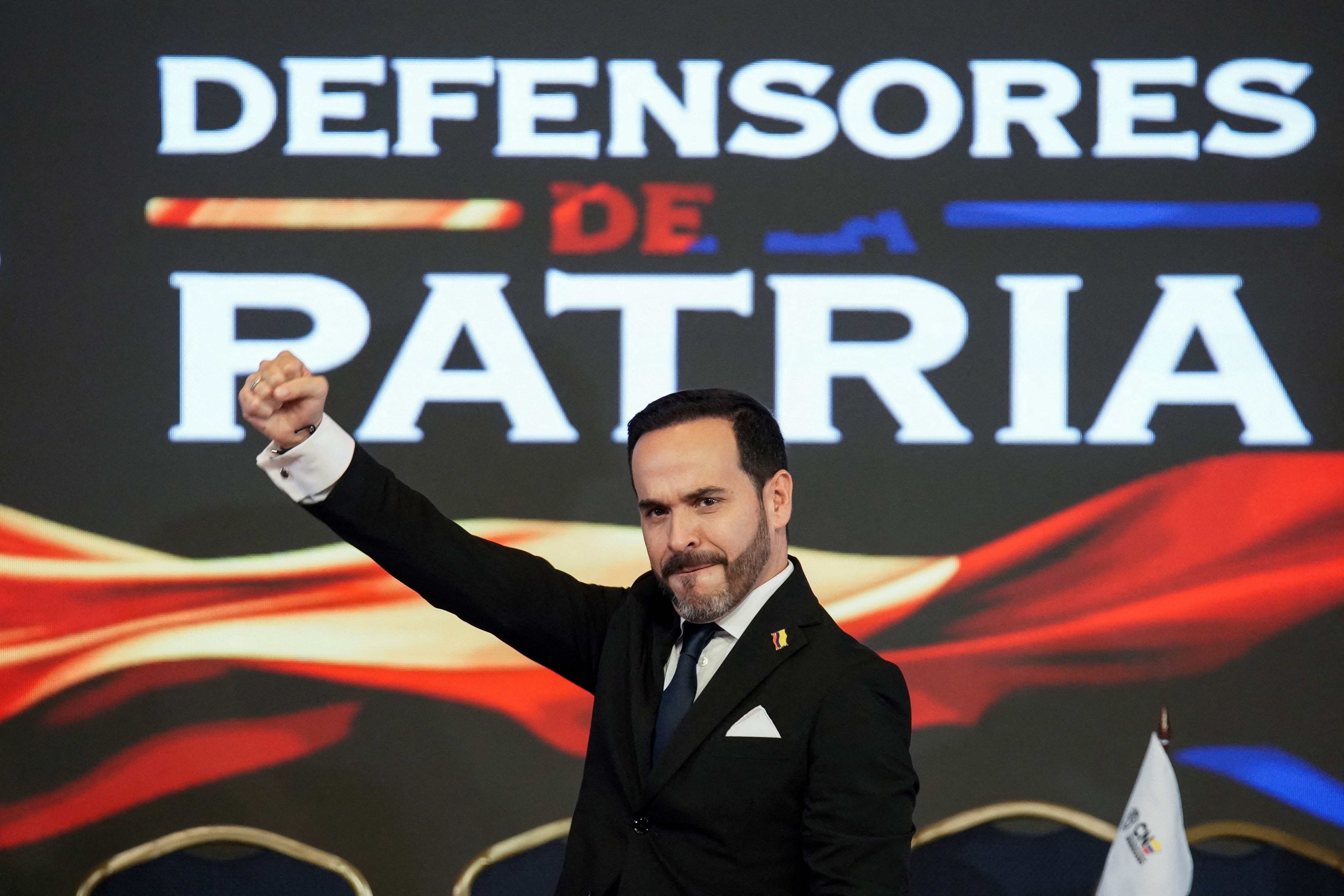
BOGOTÁ—On Sunday night, U.S. President Donald Trump congratulated far-right populist Abelardo de la Espriella, the winner of Colombia’s presidential election.
Trump’s congratulations marked the culmination of more than a year of interference in Colombian politics by the president and senior Republicans, from sanctioning the leftist government to openly endorsing and incentivizing a swing to the right.
The stakes were high for the White House, which considers Colombia a key strategic outpost for advancing its hemispheric agenda of countering drug production and promoting U.S. hegemony, according to experts.
“For the U.S, the interest is to have economic and security dominion over the region,” said Gimena Sánchez-Garzoli, director for the Andes at the Washington Office on Latin America (WOLA).
De la Espriella’s rival in the race, leftist Senator Iván Cepeda, conceded defeat on Wednesday morning.
De la Espriella, who has adopted the moniker “El Tigre,” is a high-profile criminal defense attorney with law offices in Colombia and Miami and a history of working with important figures from Colombia’s violent past. The 2026 election marked his first stab at politics, playing off his outsider status to pledge a crusade against government corruption and strict measures to tackle the country’s increasingly powerful insurgent groups.
His campaign borrowed policies from prominent figures of Latin America’s populist right, from Javier Milei’s government spending cuts to Nayib Bukele’s megaprisons and iron-fisted crackdowns on organized crime groups.
But de la Espriella has faced criticism for defending some of Colombia’s most infamous criminals, including former paramilitary commanders tied to crimes against humanity, a man who scammed 200,000 people in the country’s largest ever Ponzi scheme, and Alex Saab, a key political and financial operator for ousted Venezuelan President Nicolas Maduro.
A campaign of interference by Washington
Despite his controversial background, de la Espriella got Trump’s stamp of approval just days after winning the most votes in the election’s first round.
“Because of his tremendous accomplishments in life, and his political support for me, personally, it is my Honor to give Abelardo my Complete and Total Endorsement,” wrote Trump on Truth Social on June 2.
The U.S. president also appeared to condition the future of bilateral relations on the outcome of the election; a strategy reminiscent of his successful foray into the Honduran election late last year.
“The results of this Election are very important to the future of Colombia and its relationship to the United States which, if Abelardo wins… will have the total support and strength of the United States behind him,” he wrote.
These statements were widely publicized in Colombia, where Washington’s influence is felt heavily in political discourse. “To understand the weight of these statements from the United States, it’s important to remember just how important the U.S. relationship is for Colombia,” explained Elizabeth Dickinson, deputy director for Latin America at the International Crisis Group, a Brussels-based think tank.
As Colombia’s largest export market, aid benefactor, and security partner, Washington’s approval reverberates deeply in the country, said the analyst. So too does its stricture; in addition to endorsing de la Espriella, the White House has actively targeted Colombia’s left wing.
Since his inauguration, Trump has personally sparred with incumbent President Gustavo Petro on issues ranging from deportation flights to drug control. Their online spats escalated last October when the White House added him and his wife, son, and the interior minister to the U.S. Treasury Office of Foreign Assets Control’s “Clinton List” of sanctioned individuals, freezing their assets and effectively banning them from the U.S.
Tensions rose again after Petro denounced Washington’s capture of Maduro in January, with Trump warning the Colombian President “he’ll be next.” While a phone call and subsequent meeting at the White House de-escalated tensions, the fractious relationship loomed large over the election.
“This level of interference runs against the 200 plus years of bipartisanship both countries have respected,” said WOLA’s Sánchez-Garzoli.
Members of the right wing argued that only a conservative can be trusted to repair relations with Washington, dismissing Cepeda, a human rights advocate representing Petro’s Historic Pact coalition.
“The White House has taken sides. That is not diplomacy, it is interference. And Latin American history is full of the consequences of that kind of interference,” María del Mar Pizarro, a Historic Pact congresswoman, told Drop Site News.
U.S. political pressure has come in other forms too; in recent weeks senior Republican figures have repeatedly expressed concerns over the integrity of the democratic process in Colombia.
While Sunday night’s nonbinding quick count indicated a razor-thin victory for the right-wing candidate, Cepeda initially refrained from accepting defeat, stating that his team had submitted over 57,000 complaints over alleged irregularities. He later conceded on Wednesday after the first round of verification corroborated the initial result.
Some Abelardistas even credited U.S. involvement for their candidate’s victory: “Thank you to the U.S. government, President Trump, and all the senators that supported this movement,” Diana Tellez, a voter from Bogota, told Drop Site News.
On Monday, Trump himself seemingly congratulated himself for de la Espriella’s win, telling reporters in the Oval Office, “He was in tenth place, I endorsed him, and he won the election.”
But analysts warn that Washington must be careful about its involvement in Colombian politics given the country’s extreme polarization.
“In this current moment, it’s critical that the United States understands just how delicate of a situation Colombia finds itself in,” said Dickinson, who warned of the possibility of demonstrations breaking out against de la Espriella.
In 2021, a mass protest movement known as the Estallido Social erupted after right-wing ex-president Iván Duque (2018-2022) attempted to raise taxes on basic goods amid a cost of living crisis. There are widespread fears that a similar movement could grip the country again.
“Even though we’re going to accept [the result], that doesn’t mean we’re just going to sit idly by,” said Sara Cano, who called for peaceful protests.
While Petro’s base supported the left-wing candidate, many say his failures hindered Cepeda in the election, with de la Espriella capitalizing off the government’s divisive rhetoric and unpopular policies over the past four years—particularly around healthcare and security—to drive voter turnout.
Although the electoral map largely remained the same at the departmental level, with the left holding onto its strongholds in Bogotá and the peripheries of the country—particularly the Caribbean and Pacific coasts—its margin of victory shrunk.
In Bogotá, for example, Cepeda received a similar number of votes as Petro did in 2022, but almost 500,000 more ballots were cast for Abelardo than Petro’s then-opponent, right-wing Rodolfo Hernandez. In Atlántico, a province on the Caribbean coast, de la Espriella clinched an additional 200,000 votes compared to 2022.
A new era for the Colombia-U.S. alliance
With de la Espriella poised to take office on August 7, Washington has a clear path to use Colombia to advance its hemispheric policy goals, according to experts.
While the Petro administration openly opposed the White House’s military intervention and drug eradication policies, de la Espriella “is likely to do the U.S.’s bidding,” according to Sánchez-Garzoli.
In recent years, armed insurgent groups—many of them U.S.-designated terrorist organizations—have grown in size and influence, controlling vast swaths of Colombia and profiting off the cocaine trade and illegal mining.
On the campaign trail, Abelardo pledged a total offensive against these groups, splitting from the Petro administration’s largely unsuccessful policy of negotiating peace agreements with rebels.
De la Espriella has also promoted Washington’s preferred counter-narcotics strategy of supply-side eradication, marking a shift from Petro’s focus on using crop substitution to tackle the socioeconomic causes of the drug trade, which led Trump to call the president “an illegal drug dealer.”
The Petro government’s investments in the countryside translated into support for Cepeda, who dominated the peripheral, rural, and coastal regions like Cauca and Atlántico; whereas de la Espriella performed much better in Colombia’s more affluent, urbanized interior, where voters were convinced by his heavy handed security pledges and pro-business policies.
Abelardo’s proposals fit neatly into the White House’s bellicose counter-narcotics policy in the region, which has seen a prolonged bombing campaign against alleged drug-trafficking vessels in the Caribbean and eastern Pacific and, recently, a strike inside Venezuela targeting the leader of the Tren de Aragua gang.
De la Espriella is also expected to be invited to join Trump’s ‘Shield of the Americas’ anti-crime alliance, which had excluded the Petro government.
But experts warn ramping up military offensives has historically failed to stamp out rebels and drug production. “Colombia is likely to revert to violence, repression and intolerance. None of which will help the country’s security situation nor address its illicit economies,” said Sánchez-Garzoli. “The Bukele model is not going to work in Colombia due to its size, complicated geography and the fact that the State does not control all of the country.”
Many of Abelardo’s policies are modeled after ex-president Alvaro Uribe (2002-2010), who endorsed the candidate ahead of the second round of voting. In the early 2000s, Uribe teamed up with Washington to launch a crackdown against the now-demobilized Revolutionary Armed Forces of Colombia (FARC), a bipartisan strategy that was termed ‘Plan Colombia’; Abelardo has floated the idea of a Plan Colombia 2.0 to combat resurgent rebels.
But while the offensive succeeded in weakening rebel forces, it also brought with it widespread human rights violations, many perpetrated by members of the AUC paramilitary force, whose commanders de la Espriella represented in court.
As such, most of the provinces affected by the armed conflict oppose Abelardo’s proposals. “For most in conflict zones the idea of militarization is traumatizing given past hardline policies that generate many rights abuses like the extrajudicial killings,” explained Sánchez-Garzoli.
Others are doubtful that the Trump administration would provide the funds necessary for a military operation of the scale de la Espriella is pledging. “There are many people who hope for extensive cooperation in terms of funding, capabilities, and intelligence, but that’s not going to happen,” said Laura Bonilla, deputy director of the Peace and Reconciliation Foundation, a Bogotá-based think tank.
Abelardo’s pledges to pare back state spending may eventually clash with his promise to restore order through force, especially given his lack of a congressional majority. But for the White House, domestic security results may not be as important as their rhetorical alliance with Colombia’s incoming government.
Abelardo has echoed Trump’s disdain for international institutions, pledging to withdraw from the Organization of American States and United Nations, the latter of which currently has Colombia as a member of the security council. He has also backed Israel and pledged to resume fracking and promote traditional Catholic family values.
“This is not just a security coalition alignment… but an ideological alignment,” said WOLA’s Sánchez-Garzoli.
 | A guest post by
|