

Millions in Public Funds, Zero Public Input: Flock's Surveillance System Might Already Be Overseeing Your Community
The $7.5 billion surveillance company Flock Safety is operating in 49 states and over 5,000 communities, but the residents of Scarsdale, NY, are fighting back.

We have a commitment to ensuring that our journalism is not locked behind a paywall. But the only way we can sustain this is through the voluntary support of our community of readers. If you are a free subscriber and you support our work, please consider upgrading to a paid subscription or gifting one to a friend or family member. You can also make a 501(c)(3) tax-deductible donation to support our work. If you do not have the means to support our work financially, you can do your part by sharing our work on social media and by forwarding this email to your network of contacts.
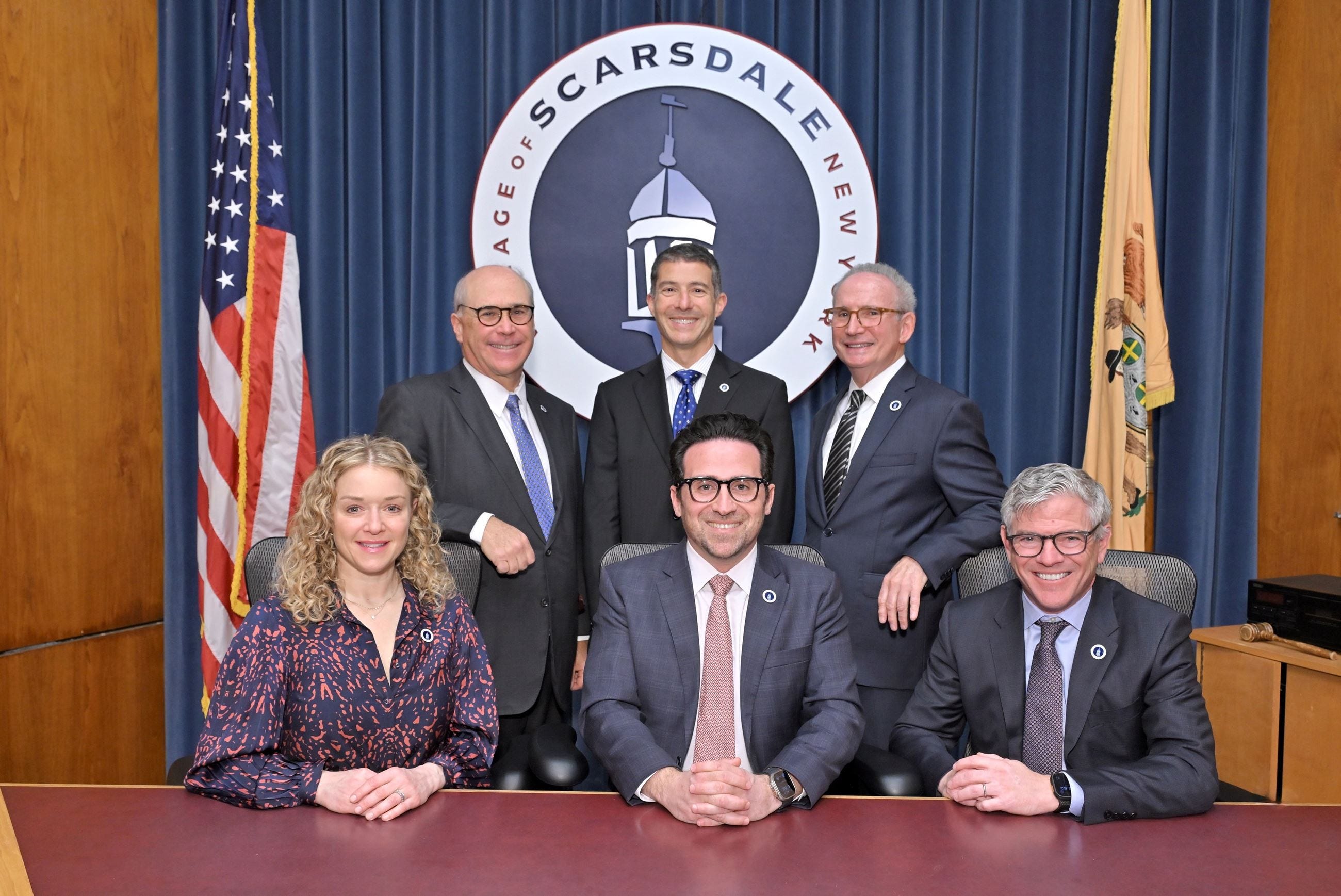
Scarsdale Village in the state of New York is the wealthiest suburb in the U.S., but it now finds itself on the frontline of the fight against mass surveillance. Average household income in the New York hamlet is $569,000 and typical home value is $1.4 million. Town meetings typically revolve around discussions of tree placement and after school programs. But, since the village’s board of trustees surreptitiously voted on April 8 to adopt a $2.1 million contract with Flock to “aid public safety,” mass surveillance has been the main subject of public comment.
After residents found out about the contract that had already been inked, they began showing up to speak their mind at the next Village Board on April 22. The issue has become the main topic of contention in subsequent meetings since. One of the more poignant public comment speeches came from a former NSA employee and Scarsdale resident, Charles Seife, at the June 10 village board meeting. “The system that Scarsdale wishes to implement is extremely dangerous.… The records are kept for several weeks. At the very least, they allow retroactive surveillance,” Seife said, adding, “These systems are immensely popular with politicians and law enforcement, even though they do real and palpable damage to the citizenry.”
Flock is a $7.5 billion surveillance technology company, operating in over 5,000 communities across 49 states. Flock has a proven playbook to expand through securing local government contracts, often behind closed doors.
Flock’s technology has been used to assist with everything from ICE investigations in Illinois to abortion investigations in Texas. “Local police around the country are performing lookups in Flock’s AI-powered automatic license plate reader (ALPR) system for ‘immigration’” related searches and as part of other ICE investigations, giving federal law enforcement side-door access to a tool that it currently does not have a formal contract for,” 404 Media reported in May. A Johnson county sheriff searched over 83,000 cameras to prosecute a woman traveling over state lines to obtain an abortion, including searches of thousands of cameras in Washington and Illinois where abortion is legal, according to data obtained by 404 Media.
The technology brings into question the presumption of innocence, the legal principle that people are innocent until proven guilty. Charles Siefe, the former NSA employee who spoke at the June 10th meeting in Scarsdale, explained to Drop Site how Flock provides a system of "persistent severance” through interconnected Live View Cameras (LVCs) and License Plate Readers (LPRs). “You can actually go into the database and look for stuff to see if you can tag that person with a crime.” He compares this to traffic stops, saying, “police officers know if you follow someone in a car for a couple of miles, the likelihood is you'll be able to pull them over for something.”
Siefe, an expert in general surveillance, explained what systems like Flock are doing in the U.S., “we're creating that database so that we can always do that for anyone, that you're constantly tracking people's movements. You have that system in place so that you don't need to articulate the suspicion before you're gathering that on someone, before you're actually trying to tag someone with wrongdoing. When you have that system there, all someone has to do is say, I don't like that person. And then you've got that surveillance already established.” As Scarsdale resident Josh Frankel put it to Drop Site, “The way I see it, it is not a matter of if this data will be abused and misused, only a matter of when and by whom.”
“Freedoms don't come back and privacy doesn't come back, and we are taking these irreversible steps so blithely for no real reason.” Siefe told Drop Site. Some residents take issue with any mass surveillance in Scarsdale, others are specifically concerned with the lack of guardrails against misuse of the system, but most residents who spoke out against the Flock contract are outraged with how the board adopted this contract in secret.
On the evening of April 8th, the Scarsdale village board met to discuss “public safety equipment,” according to the work session agenda. “I don't think that anybody who looked at the agenda in advance would have thought that public safety equipment involved live cameras, license plate readers, drone technology, basically a mass surveillance system.” Frankel told Drop Site. He continued, “maybe you're thinking public safety equipment is a traffic light, a crosswalk, a yield sign, something along those lines, but not mass surveillance.”
Shortly after the 6pm meeting started, Scarsdale Police Chief Steven Delbene took the floor and gave a powerpoint presentation. Chief Delbene provided an overview of Scarsdale’s future application of Flock’s surveillance technologies, or as he called it, “an ecosystem of interconnected tools: LPRs (license plate readers), live-view cameras, and DFR (drone as a first responder) technology.” This meeting was the first time Flock was mentioned by officials in a public setting in Scarsdale. After the presentation ended, the Mayor held a vote on a motion to enter into executive session, it passed, and the village board met privately until 8pm.
That same night, during the village board of trustees meeting scheduled for 8pm, Mayor Arrest entertained a motion to amend the agenda and add a resolution to authorize the execution of the Flock contract, it passed 6-1. The entire process took 35 seconds total. Typically, voting on a motion without prior notice is reserved for urgent matters. Frankel told Drop Site, “Why was it so time sensitive? Why did it need to happen without proper notice all in one night? And I don't have a good answer for that.” The lack of answers aren’t for not trying, Frankel has, “corresponded with the mayor and the board and the village manager. Most of my questions, very specific questions, straightforward questions, most of them have gone unanswered,” he told Drop Site.
In addition to public comment before adopting a major resolution, Scarsdale residents expect a competitive bidding process for any major public contract. Public officials, despite demands from the public, have not produced evidence of any contact with vendors other than Flock. Frankel told Drop Site that “there should be” a request for proposal, as it is “part of New York State law.” He continued, “Typically what you want to see is a competitive bidding process, requests for proposals, that type of thing.”
When asked why there was not a request for proposal, Village Manager Alexandra Marshall told Drop Site News, “the Police Department arranged several demonstrations with vendors including Flock, Motorola, Midl, and Hanwha. There was a fifth vendor, Verdaka, who did not respond to the Village's request for demonstration.” Drop Site News has asked for any documentation of those demonstrations, but has yet to hear back.
A FOIL request for “Any market research, vendor analysis, or documentation evaluating alternative providers of similar technology or services” only rendered a Sole Source Justification Letter signed by Flock’s CEO. “The board took the police chief's word that Flock is the one that we need, the Flock is the one that we want… I don't know that the law really allows for the board to take the police chief's word,” Frankel told Drop Site.
Attorney Robert Berg, a Scarsdale resident, told Drop Site, “Chief DelBene is not qualified to determine that Flock’s services/products are so unique that Flock meets the standard of a sole source vendor under New York law and Scarsdale Village policy.” Berg has addressed the Village Board regarding the Flock contract adoption. Berg explained, in a statement to Drop Site, “four members of the Board, including the Mayor, are attorneys.” Berg was incredulous that four lawyers “would vote to approve an illegal no-bid, sole source contract with Flock, that plainly violates State law and the Village’s own formal policy, and to do so secretly when the company is already embroiled nationally in lawsuits and controversy over its violations of privacy laws.” He told Drop Site.
After doing some research, Frankel found that “Flock produces its own document to give to municipalities to justify sole sourcing with Flock.” Different versions of the same sole sourcing justification letter, signed by Flock CEO Garret Langley, can be found on the official government websites of the State of California, Sussex County Virginia, Woodburn Oregon, and the State of Mississippi.
The April 8th meeting was not highly attended, but one key villager was present, Joanne Wallenstein. She runs an online blog, Scarsdale 10583, covering local events. Wallenstein’s articles on the April 8th meeting are how Scarsdale residents like Josh Frankel first heard about the Flock contract.
“The board had a work session on April 8th where they discussed it. Then an hour later they went into the official board meeting and approved it,” Wallenstein recalled to Drop Site. “To be honest in the beginning I didn’t really think there was anything interesting about it. But they did everything so fast, with no public comment. And the agenda, where's the agenda item?” She’s produced countless articles since April 8th, covering her own correspondence with the board, press releases, and board meetings.
“Village officials blamed the lack of notice on the demise of the Scarsdale Inquirer,” Wallenstein told Drop Site. “However, Scarsdale 10583 has been covering the news and published weekly since 2009. In this case, the reason no one knew about the Flock contract was because no advance notice was given. The resolution was not included in the agenda and there was no public hearing. It had nothing to do with the loss of the local newspaper.”
Since 1901, village meetings had been covered by the local paper, the Scarsdale Inquirer. But, on January 16, 2024, it went out of business. The void of local news coverage is not unique to Scarsdale; over the past two decades, over 3,300 local newspapers have vanished. 5,600 newspapers remain, 80% of which are weeklies, according to the Local News Initiative at Northwestern Medill.
While mass surveillance is a nationwide concern, achieving a national network requires local authorities’ approval. In the case of Scarsdale’s Flock contract, it weren't for one independent journalist’s local reporting, it’s likely the Flock contract adoption would have been buried in meeting minutes, largely unknown to Scarsdale residents.
When Drop Site news reached out to village officials for comment, the Mayor deferred to the Village Manager, who sent along a link to an FAQ. The unauthored document, dated June 12th, says, “the Village Manager, Police Chief, Mayor and Village Board always have communication and transparency in mind and recognize we can always do better…”
According to communications obtained by Drop Site News, the earliest contact between Scarsdale officials and Flock dates back to January 15, 2025—meaning village officials had been discussing the contract with Flock for nearly three months behind closed doors.
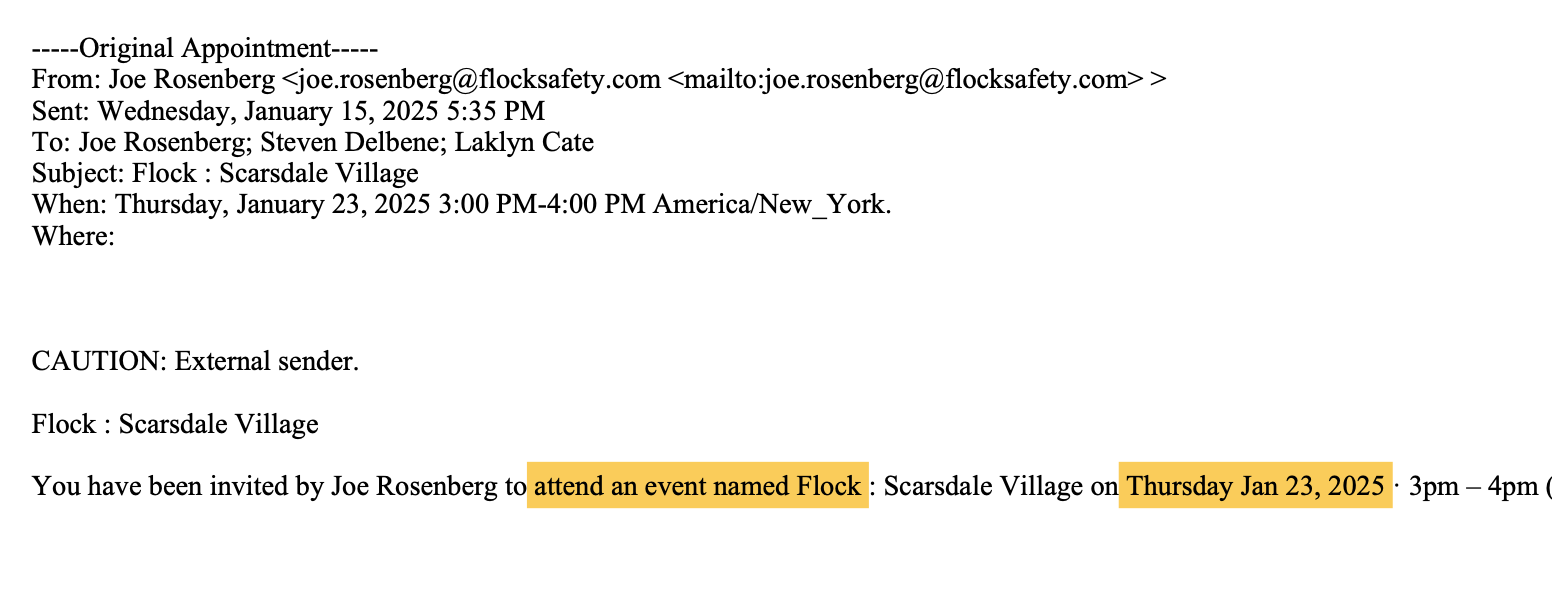
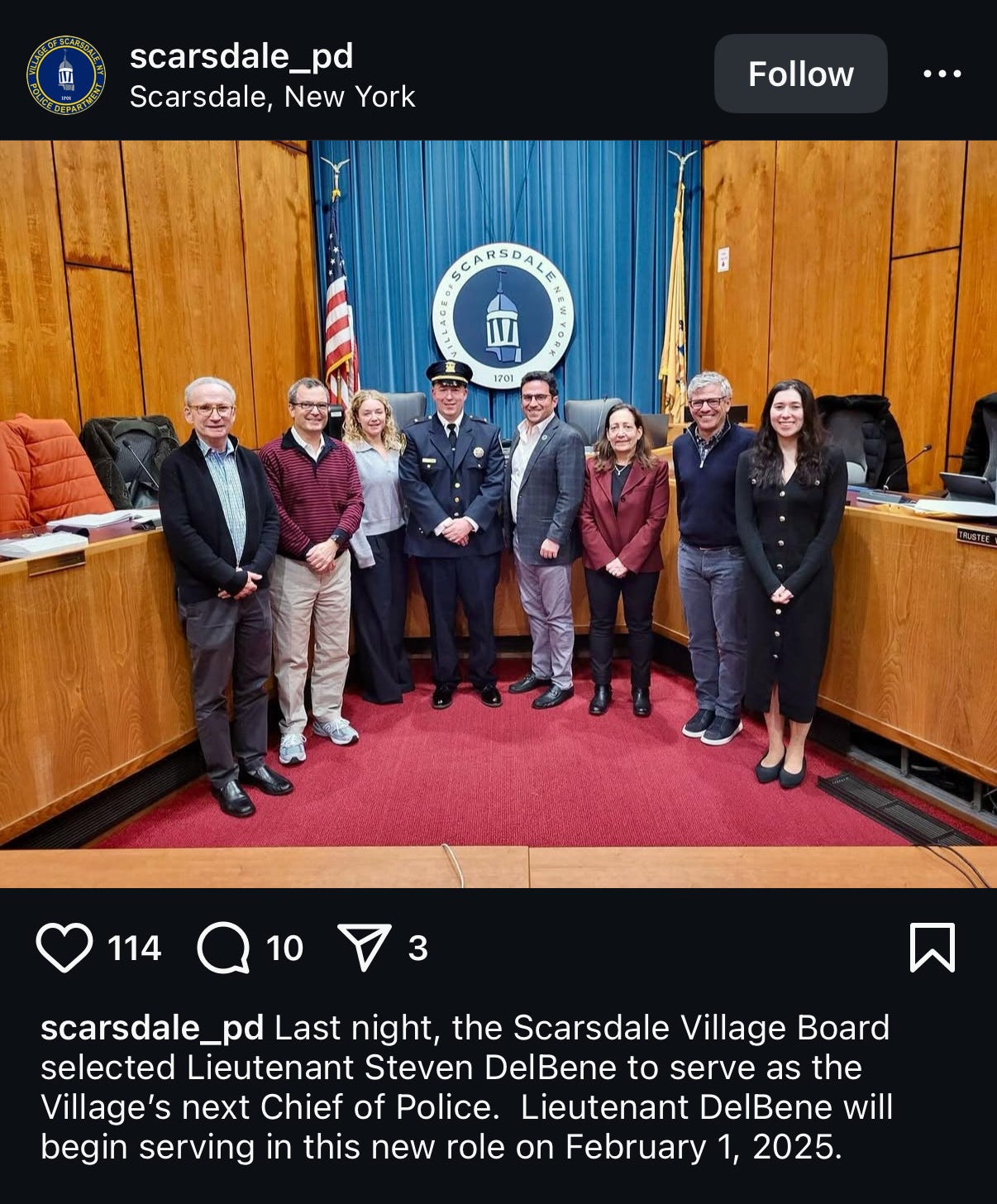
Steven Delbene was selected to serve as police chief by the Scarsdale Village Board on January 14, 2025. The documents obtained via FOIL show Delbene was invited to a meeting with Flock the very next day, January 15, 2025. However, he did not officially assume office until February 1.
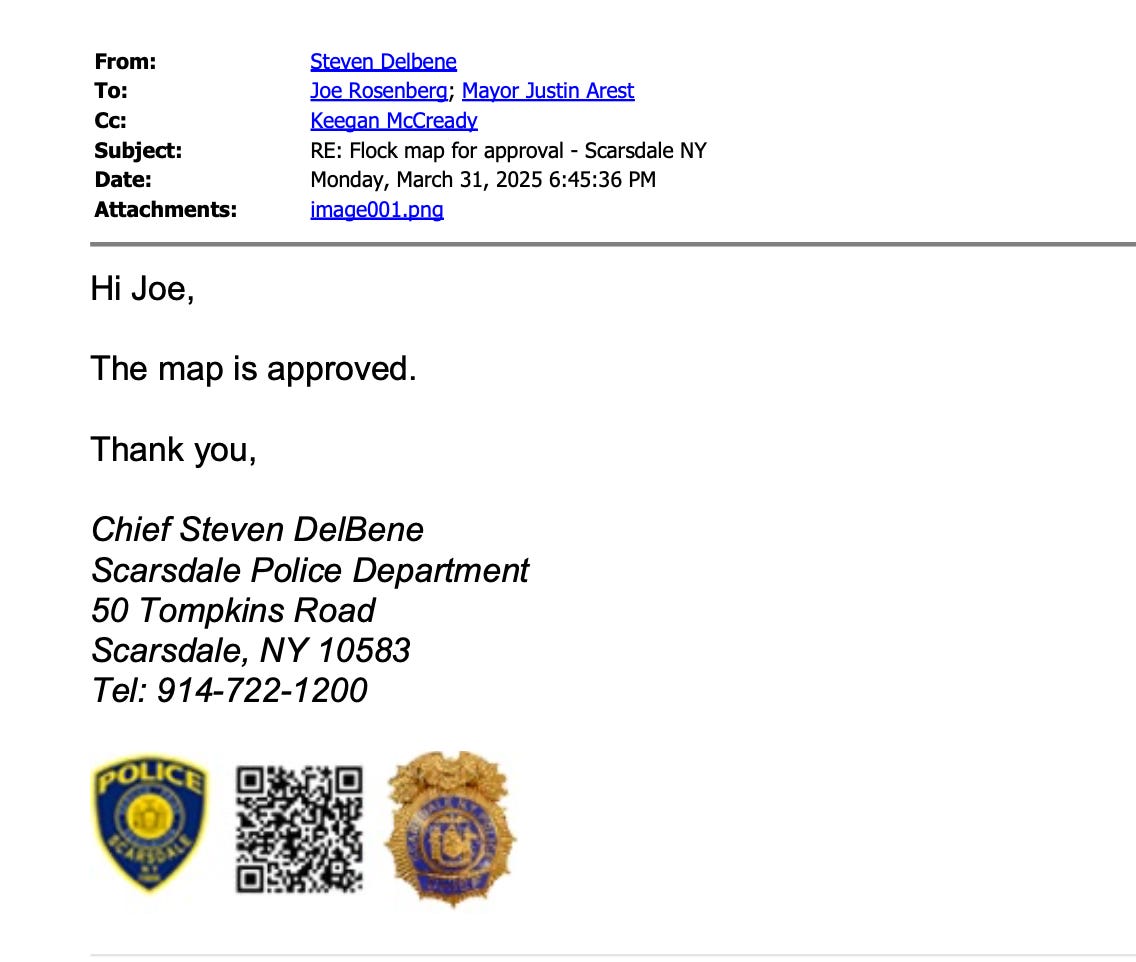
Chief Delbene, Mayor Arrest, and Flock Sales Representative Joe Rosenberg coordinated the placement of cameras before ever discussing the Flock contract in a public setting. Chief Delbene sent an email to Flock, saying “the map is approved” to Flock sales representative Joe Rosenberg, on March 31, 2025. The locations where Flock cameras would go was decided by Flock and Scarsdale officials before the village board ever brought Flock up as an official matter in a public meeting.
Scarsdale isn’t the only town where officials quietly signed a Flock contract without public input. The description of how Flock secured a contract in Sedona, Arizona, is eerily similar to the story in Scarsdale. Red Rock News reported on June 20: “The city never agendized the installation of the cameras for discussion by City Council and the public and instead mentioned an indefinite plan to acquire such cameras only briefly during the city’s most recent budget work sessions on April 30 and May 1, without providing either written or verbal specifics.”
Contracts being signed without much community oversight has seemingly been Flock’s hallmark for years. In Washington state, four jurisdictions quietly signed contracts with Flock – Kennewick, Pasco, Richland, and West Richland – in 2022. One year later, the Tri-Cities Observer reported that only two of the four jurisdictions “publicly approved the grants.” Scarsdale is unique in requiring requests for proposals and honoring a tradition of public comment for all major resolutions. In the two Washington towns where the Flock contract did appear in meeting minutes, public comment was neither expected nor required, “the matter was on the consent calendar with other items that received no discussion and one vote,” per the Tri-Cities Observer. In municipalities across the country, there are laws that allow councils and boards to pre-approve agendas, and vote for a series of resolutions all with one vote. This is typically called a consent agenda, and is intended to pass non-controversial or routine agenda items.
As a result of passing resolutions in bulk, on at least one occasion, local officials voted for a Flock contract by accident. Last week, in Lucas County, Ohio, commissioners moved to adopt a $250,000, four-year contract with Flock. On July 15. President Pete Gerkin introduced the motion, and it passed unanimously without debate or question. On Tuesday, July 22, Gerkin moved to rescind the resolution, acknowledging he previously voted yes. Gerkin voiced his concern with how Flock operates, “They are indiscriminate in their gathering of data… even if drivers haven’t committed any offense or are suspected of committing any offense.”
After introducing and voting yes on a motion to adopt a contract with Flock just a week prior, Gerkin took time to explain why he was introducing a motion to rescind approval of the resolution. “We’re living in a time where mass surveillance has now become a federal policy, it has had chilling effects on our population, especially the minority population in our community. People may avoid visiting here because they don’t want their license plates recorded,” he said. Gerkin’s motion to rescind the contract passed—he noted it was "inappropriate for the sheriff, under a time of budget constraints on all of us, to spend $250,000 to mass surveil our community without any intended outcome.”
A representative from Flock, when asked if the consistently furtive approval of their contracts was a company strategy, told Drop Site News, “there’s no specific strategy around how we work with cities on contracts because it’s very dependent on the city.” After reaching out to the sales representative who sold the Flock contract in Scarsdale, Joe Rosenberg, Drop Site News was referred to Holly Beilin, Director of Communications at Flock.
When asked about the Scarsdale contract, Beilin told Drop Site News, “We were working with the mayor and the PD, they were able to get the funding and then it was passed by the board, I believe unanimously. So I don't think this was particularly controversial.” The vote was not unanimous, Scarsdale does not have the funding, and the vote was followed by weeks of backlash from the public.
The vote was 6-1, Trustee Jeremy A. Gans cast the lone no vote. He explained why during the April 8 meeting: “I have questions on privacy and surveillance that were expressed earlier. I don't need to go into detail, and I appreciate the money from the federal government, but I wish they would spend it on places other than surveilling their own citizens.”
As for the funding, Scarsdale applied for a grant through Senator Gillibrand's office, and at the time of the contract signing there was no response. During a meeting on July 8, Mayor Arrest announced the grant intended to fund the Flock contract was denied. Mayor Arrest explained that the “agreement with Flock Safety has not been canceled, but no further steps will be taken until all options for public safety upgrades are reviewed at a public meeting in September.”
“We also don't categorize Flock as mass surveillance,” Beilin told Drop Site News. “We're a system of public safety technology,” she said. When asked about the integration of Flock’s cameras across communities, Beilin told Drop Site: “that is a capability on the Flock system. But it's all opt in.” Surveillance cameras can be bought anywhere, but Flock offers a network of cameras in 5,000 communities across 49 states – if you opt-in. When asked, “it seems that the main argument in the sole source contract is that no one else makes what Flock makes. Would you say that's an accurate read?” Bellein answered, “Yes, I would say that's an accurate read.”
Whether or not Flock contracts are intentionally approved in a surreptitious fashion, the company has kept a low profile relative to its scale. Implementing a national network of surveillance cameras in the United States sounds like an endeavor that would involve high-profile debate on national news, and would necessitate legislation passing through Congress with the president’s signature. The reality is Flock’s network is expanding one community at a time, it only takes the police chief’s signature, and the village board’s blessing. It’s not the work of an authoritarian dictator and his army, either. It’s the Mayor of your town, and a corporation that emailed him. This is how mass surveillance takes hold: cameras installed in every community, as a service to the public, in the name of safety.
We keep seeing Peter Thiel of Palantir's dirty anti democracy fingers in every tech assault on our freedom. It's worth noting that Thiel has been connected financially to Epstein and his espionage efforts. Connect the dots folks.
(Here is an excerpt from the ACPC)
Flock’s surveillance tech backed by investors with anti-democratic views
Flock’s initial venture capital came largely from members of the so-called “PayPal Mafia”: Former PayPal CEO Peter Thiel’s Founder’s Fund and several other Thiel-associated firms, including Bedrock Capital, Y-Combinator and Initialized Capital.
Critics termed members of this Silicon Valley-based capital formation the “Broligarchy” and have accused them of ushering in “technofascism” through a sweeping, cross-jurisdictional, AI-powered police state.
Thiel and the cadre of other early Flock investors envisioned surveillance technology as a “dual-use” product. Their idea is that governments, private businesses and even neighborhood organizations can buy and utilize surveillance technology as a “force multiplier”.
Some of Flock’s funders, including Thiel, have expressed anti-democratic views.
In 2009, Thiel wrote, “I no longer believe freedom and democracy are compatible.”
Marc Andreessen—whose venture capital firm Andreessen Horowitz is another Flock funder—previously called one of the early 20th century architects of fascism a “saint.” Andreessen has publicly espoused a political theory known as the Iron Law of Oligarchy, which holds that all organizations inevitably move toward oligarchy. (I added: Andreessen is one of the largest investors in Substack.)
“Democracy is fake,” Andreessen said on the Lex Friedman podcast. “There is always a ruling class. There is always a ruling elite, structurally… the masses can’t organize. The majority can’t organize. Only the minority can organize.”
Excellent report, Jessica.
One question: Do the Flock contracts with cities include any provision that says they cannot use the data acquired from the city for any other purpose than serving the city's needs?
It's easy to see Flock creating a national database that, when combined with other intelligence data bases, can not only be financially lucrative, but used for nefarious purposes.
The fact that Silicon Valley financiers are behind Flock makes it extremely suspicious.