

Garbage Is Poisoning Gaza
With Israel controlling all of Gaza’s major landfill areas, 900,000 tons of solid waste have been dumped across the enclave, exacerbating a public health crisis.


Drop Site is a reader-funded, independent news outlet. Without your support, we can’t operate. Please consider making a 501(c)(3) tax-deductible donation today.
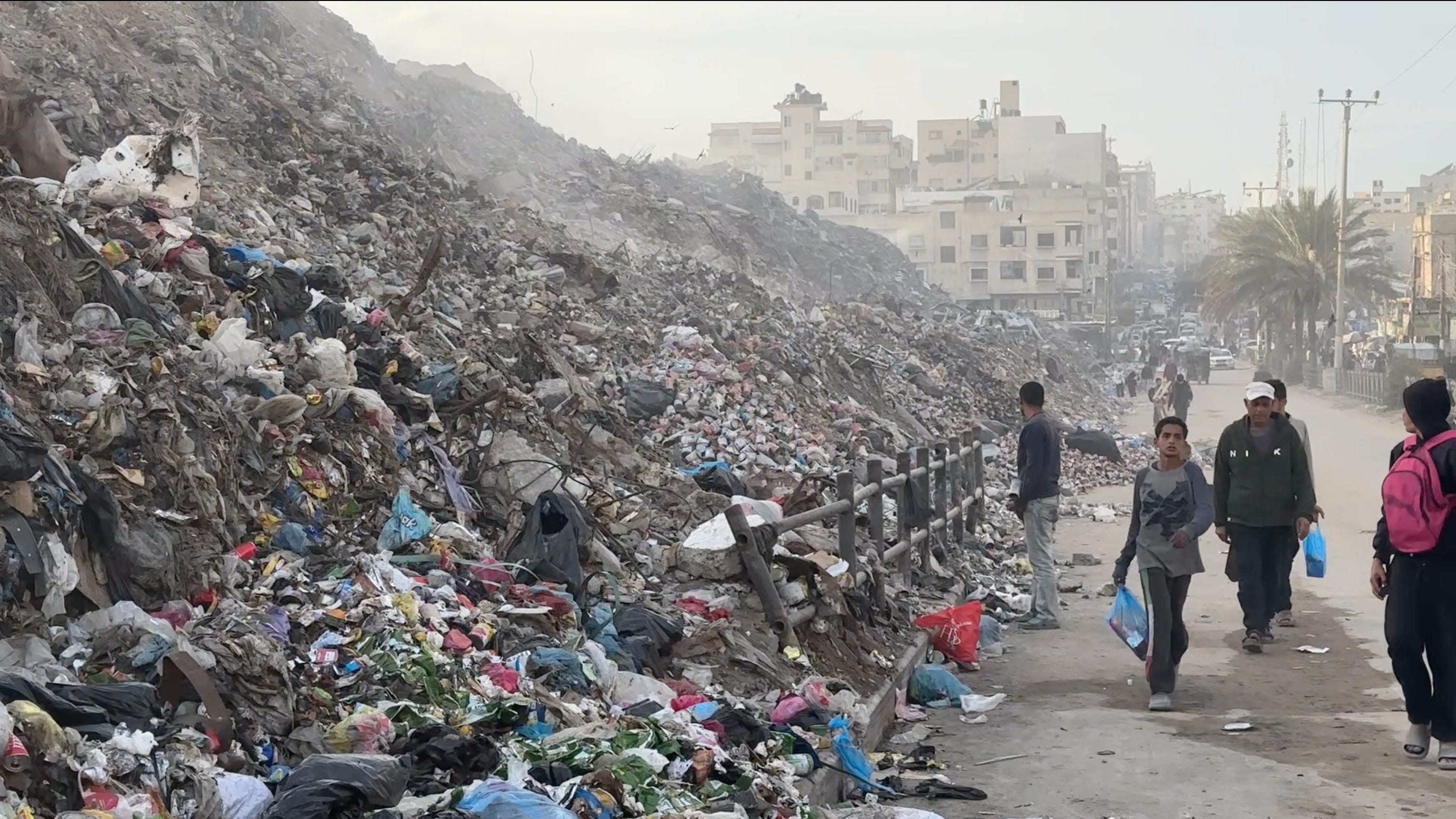
GAZA CITY—Amin Sabri’s battered tent was among several sitting at the foot of a hillside of rotting garbage towering some 25 feet in the middle of Gaza City. Barefoot children, their clothes caked in grime, scampered nearby. Flies were everywhere, and the stench of fetid waste blanketed the air.
"This is my tent and this is the garbage dump I’m living across from,” Sabri told Drop Site. “We don’t sleep—not at night, nor during the day—because of the garbage. The smell comes at us constantly, and our children are ill. They suffer from severe headaches. We’re dealing with an infestation of germs and insects.”
Over the past two years, Gaza’s civilian infrastructure has been systematically destroyed by the Israeli military, including waste management services. Massive piles of garbage have accumulated across the enclave. Once busy markets and tree-shaded streets have turned into endless mountains of trash, severely exacerbating Gaza’s environmental and public health crisis.
Before the war, waste collection in Gaza City was coordinated through the Yarmouk waste transfer site, located near the city stadium, and would be transported to the Johr El-Deek landfill. With Johr El Deek inaccessible—lying east of the “yellow line” with occupying Israeli military forces—the Yarmouk facility has now been transformed into a massive dumping site.
The few landfill vehicles still operating in Gaza climb to the top of the Yarmouk site and dump more untreated garbage every day. Some communities resort to burning waste, sending toxic fumes into the air. Children run across the hills of rotting waste looking to scavenge what they can.
"We were displaced from the city of Beit Lahia in the northern Gaza Strip, and we came to Gaza City. We found that the displaced were crowded in every corner of the Strip. We were forced to live among garbage, in the Yarmouk garbage site of the Gaza municipality,” Sabri said. "We had thought we’d stay somewhere safe, somewhere decent. But we were forced here; there is nowhere else to go. We were forced to stay at this dump, among the garbage and waste…I am suffering because of this dump. Suffering from the germs, the rats, and dogs. Every day, I find 20 or 30 rats inside my tent, right inside of it. I don’t even have a tent fit for human life.”
Sabri said the recent winter storms and flooding in Gaza are wreaking even more havoc. "Our children have developed illnesses; they’ve endured, but this strong, revolting smell continues to blow towards us—beyond what you could imagine. When it rains, the sewage flows down onto us. When it rains, all of this comes down on us,” he said.
Amin Sabri is just one of many displaced Palestinians in Gaza that is forced to live next to a makeshift garbage dump. Gaza City. December 10,2025. (Video by Abdel Qader Sabbah.)
Even before the war, Gaza faced severe waste management issues, with only three major landfills that were already operating beyond capacity. All three of those landfills remain inaccessible, even after the “ceasefire,” lying in areas now controlled by the Israeli military. Throughout the war, dozens of temporary and overfilled dumping sites in densely populated areas have been used instead. Between October 2023 and November 2025, approximately 900,000 tons of solid waste have been generated and dumped in temporary dumping sites across Gaza, according to the UN Development Program (UNDP).
The vast majority of waste collection and transfer vehicles in Gaza, which were already in short supply before the war, have also been destroyed, with 261 before the war to just 48 now, according to UNDP. The number of waste containers went from 7,300 to 900 while the number of landfill machinery units went from 18 to zero. Despite the ceasefire agreement from two months ago, Israel has prevented new supplies from coming in: "The entry of waste collection trucks, medical waste collection, and treatment machinery and tools is still suspended, along with other critical supplies such as spare parts for waste collection points and waste containers,” UNDP said in a report this month.
The UNDP report also issued a dire warning regarding winter rains and floods that have been battering Gaza over the past couple of weeks. "As winter approaches, the situation presents new challenges. Rainfall and flooding may spread accumulated waste into surrounding communities and contaminate water sources,” the report said. “Blocked drainage systems and uncollected waste increase the risk of waterborne diseases and hinder access to shelters. Without sustained waste collection and safe disposal, public health risks are expected to escalate this season.”
Some 350,000 tons of solid waste have accumulated in Gaza City alone, according to Hosni Mhana, the spokesperson for the Gaza Municipality. "Gaza City today is suffering from a series of serious crises, chief among them the crisis of extreme quantities of accumulated garbage,” Mhana told Drop Site. "The Israeli occupation [has prevented] municipal crews from reaching the main landfill east of the city, in the Johr El-Deek area. As a result, the municipality was forced to store the waste in the city’s center, and thus, this accumulated waste has become a ticking time bomb placed centrally amidst the city’s residents.”
With Gaza’s landfills made inaccessible by the Israeli military, mountains of garbage have accumulated in the middle of Gaza City. December 10, 2025. (Video by Abdel Qader Sabbah.)
Mhana stressed the crises as a result of the solid waste accumulation. "First, as an environmental and public-health danger because of the accelerated spread of disease and consequent epidemics to the surrounding residents. Second, in terms of the extreme spread of insects, rodents, and foul smells. Today, this waste threatens the lives of residents and the displaced living around it, especially in light of the water crisis, which continues to be necessary for cleaning and disinfection.”
The Israeli military also destroyed hundreds of thousands of meters of Gaza’s sewage drainage network, along with nearly all of its sewage pumping and treatment facilities. "The Sheikh Radwan reservoir has now become a fertile environment for the spread of disease and epidemics, as a result of the accumulation of sewage water and its leakage into this reservoir, which was designated for collecting rainwater,” Mhana said.
"More than 95 percent of the total infrastructure in Gaza City has been destroyed as a result of the genocidal war waged by the Israeli occupation over the course of two full years. As a result, we are talking about an incredibly dangerous reality, a near-complete collapse of essential services,” he added. "The municipality today faces major challenges, foremost among them addressing the crisis of waste accumulation in the city’s center.”
Rayan El Amine contributed to this report. Sami Vanderlip edited the video.
 | A guest post by
|
"I am suffering because of this dump. Suffering from the germs, the rats, and dogs. Every day, I find 20 or 30 rats inside my tent, right inside of it."
That kind of "living" if we can call it that, and the apocalyptic scenes in the two videos, with children growing up in sordid surroundings -- these are our "tax dollars at work," approved by Congress and gifted to Netanyahu by both Biden and Trump.
Let's all take a vow never to vote for any politician who financed such evil with our tax dollars.
The level of cruelty is breathtaking. What kind of madness has overtaken the government of Israel and all those who carry out their cruel policies? I am Jewish and this is not what Judaism is about. But it still may end up being the death of Judaism since more and more hatred will be generated.