

In Gaza City, I Have Surrendered to an Unknown Fate
I am camped out on the rubble of my home as the Israeli army gets closer every day

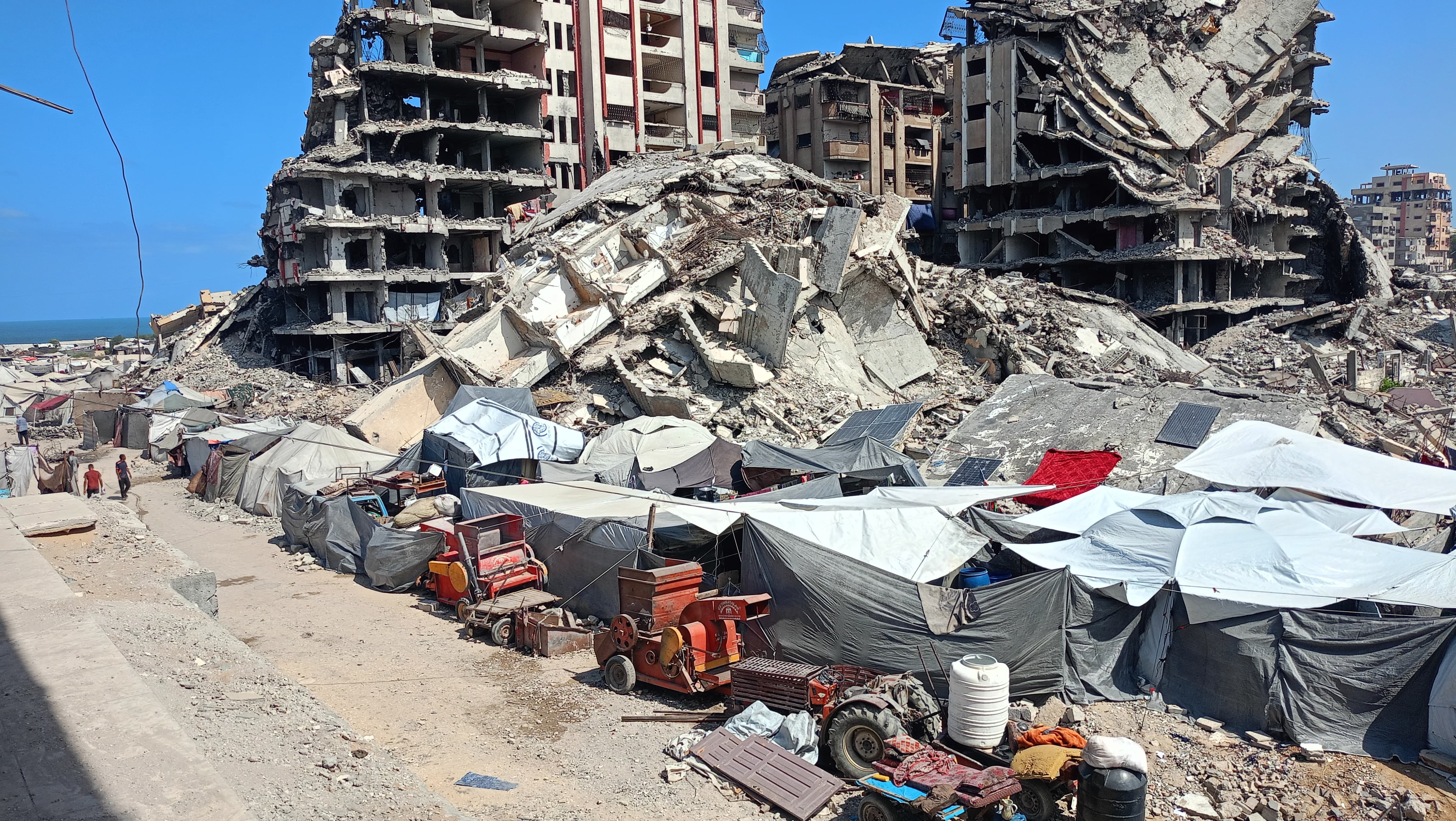
GAZA CITY—We refuse to move south. We have made our decision.
Like so many other Palestinians in Gaza, I have ended up in a tent—the enduring symbol of displacement. I am camped out on the rubble with my husband and five children in western Gaza City. The merciless Israeli military machine is bearing down on us, getting closer every day and there is nothing we can do. But we won’t leave here.
Not long ago, we were living in my friend’s house in northern Gaza City. Our home was destroyed by Israel a few weeks into the war, in early November 2023. My friend fled to Egypt in December 2023.
But earlier this month, the Israeli military began to implement Prime Minister Benjamin Netanyahu’s plan to invade, seize, and ethnically cleanse Gaza City and force over a million Palestinians southward. On August 19, as the bombs and shells rained down and the tanks and troops approached, we were forced to leave my friend’s house and move into this tent that my husband set up on the ruins of our destroyed home in western Gaza City.
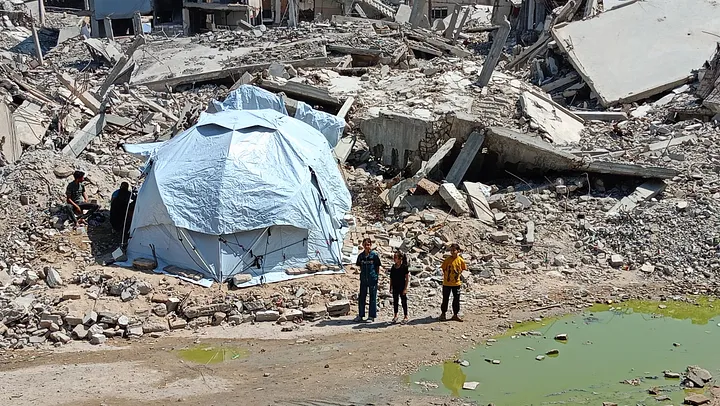
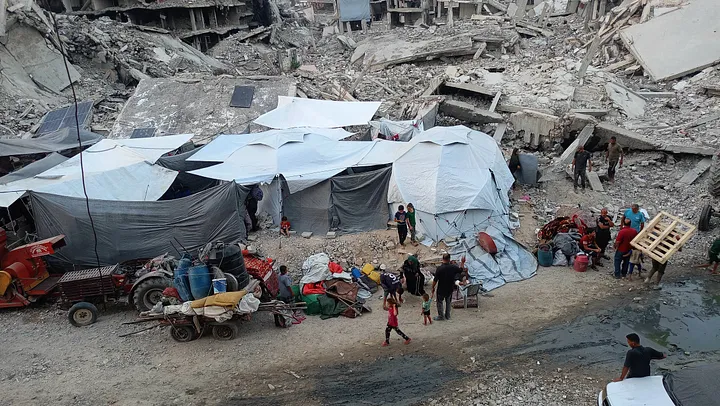
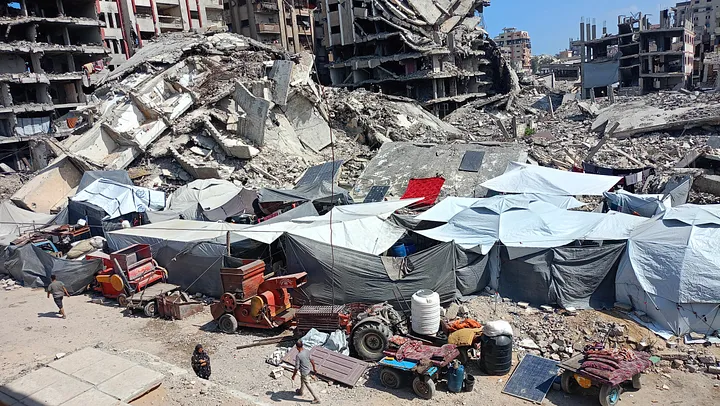

We were displaced to southern Gaza before—it was a bitter experience that lasted 15 months. We were forced from our home in October 2023, after Netanyahu ordered all Palestinians to displace to the south a few days after the war began. Like hundreds of thousands of others, we were only able to return to the north after the January 2025 ceasefire agreement. That ceasefire only lasted until March 2025, when Israel broke it and resumed its scorched earth campaign.
Our experience in the south will never fade from my memory. We never knew any kind of stability. We were forced to move no less than 13 times between different neighborhoods and cities—fleeing bombardment, or searching for water, or privacy, or a semblance of life in overcrowded shelters.
Our decision not to go south again was not driven by courage as much as it was by a refusal to repeat this tragedy. Do you know that feeling when you’re stuck between two non-choices? To either stay where you are without knowing what will happen, or to leave for another place without knowing what awaits you?
At night, violent explosions from the eastern and northern areas of Gaza City thunder through the darkness, especially in the neighborhoods of Jabaliya, Al-Saftawi, and Abu Iskandar, just a few kilometers away from me, now emptied of residents.
The aim of the Israeli army in these residential areas is not just to invade and occupy them, but to systematically destroy them.
The army deploys robotic vehicles loaded with explosives into the heart of residential blocks and detonates them, causing massive destruction. Then they go to another neighborhood and do the same thing. Killing anyone who remains there. Their goal is to erase Gaza City entirely through this method.
I feel that our neighborhood’s turn is coming soon. Our neighborhood where we now live in a tent on the ruins of our home along with thousands of others who fled their homes in areas of the city to the east and to the north.
The explosive-laden robots are not even the most frightening thing. There are the quadcopters—small, unmanned aircraft that are armed with bombs and bullets and remotely controlled by Israeli soldiers.
The quadcopters fill the skies everywhere in Gaza. They fire at displaced people and drop bombs on the rooftops of houses where families are still sheltering, forcing them to flee.
We decided to stay in Gaza City, but I really don’t know how long this decision will last. As the Israeli army draws closer and closer from the east, I feel that our escape to the south might only be a matter of time.
It is a mistake to believe that the south is safer than the north. Just a couple of days ago, a husband and wife who had fled Gaza City to the Nuseirat refugee camp were killed in an Israeli airstrike. The Israelis also killed my colleague, journalist Hassan Douhan, who worked for the newspaper Al-Hayat Al-Jadida, fatally shooting him on August 25 while he was inside his tent in the Mawasi area of Khan Younis. That same day, also in Khan Younis, they bombed Nasser hospital twice, killing 22 people, including five journalists.
My 13-year-old daughter Saida asked me: “Can we return to Gaza City if we are displaced south once more?”
I had no answer.
What drives many people here to stay and refuse displacement is the feeling that if they leave this city, they will be expelled from the Gaza Strip forever.
A few minutes after my daughter asked me this, I received a call from the sister of my friend whose house I had recently been living in. She asked if she and her family of four could come and stay in our tent.
This 16-meter-square tent cannot possibly accommodate two families—a total of 11 people—but I could not refuse her. I felt I owed it to my friend, who once gave me her home to live in, to host her sister in return.
My husband, shocked by my lack of objection, asked me, “Where will they live? Where will they sleep? How will this tent hold out?” Again, I had no answer and stayed silent.
There is an acute shortage of tents in Gaza City. Most displaced people do not even have one, and Israel falsely claims it is flooding Gaza with tents.
The price of a tent has reached about $900. It cost no more than $70 just a few weeks ago.
Everything here has become insane.
Soon afterward, my friend’s sister called again and told me she would not be coming after all. Her family had decided to flee south instead of staying in Gaza City. She told me: “You should think like us. They will destroy what remains of the city.”
Dozens of displaced families continue to arrive in the western neighborhoods of Gaza City, fleeing the Israeli invasion.
My neighbor—someone I recently met who now lives in the tent next to mine—asked me, “Will we stay here or will we move south?” She expected me to give her an answer rooted in reality since I am a journalist following events closely.
I tried to reassure her. I told her, I didn’t think the Israeli invasion would reach the western neighborhoods where we were. That this invasion was just to pressure Hamas at the negotiation table to accept Israel’s conditions to end the war, the most important being disarming Hamas and ending its presence in Gaza.
I think Israel is using Palestinian civilians as bargaining chips and political pressure tools to achieve what it cannot achieve militarily.
In March 2025, Israel imposed a famine on the people of Gaza by preventing the entry of all food and aid in order to force Hamas into submission. To date, 322 Palestinians, including 121 children, have died from Israel’s starvation policies. Meanwhile, ceasefire negotiations remain stalled.
Although Israel decided at the end of May to reopen the crossings and allow a meager amount of aid trucks into Gaza, the aid does not reach the population. People are shot by Israeli soldiers every day trying to get food. Or armed gangs loot the trucks, which are left without any protection as the Israeli military deliberately targets any protective units provided by the clans or Hamas security forces.
These gangs then sell the stolen food in local markets at exorbitant prices that far exceed the purchasing power of most families, who have lost their sources of income during the war and now depend almost entirely on humanitarian aid.
In the face of all these dilemmas, and the pressing question of whether to remain in Gaza City or flee south again, I feel lost in a vast maze, unable to find any way out.
I no longer have the strength to make the right decisions. There are no right decisions to make. I have surrendered to an unknown fate.
*This article was amended to correct the date of the ceasefire and Israel resuming the war from January 2024 and March 2024 to January 2025 and March 2025.
 | A guest post by
|
Thank you all for your kind words and for your invitations to host me in your homes and countries. I feel your compassion for us amid everything we are going through, but unfortunately, there is no way to escape death… my people and I are heading into the unknown.
Unbelievable in this day and age !! All paid and supported by the US !! Shame.