

Gaza’s Deir Al-Balah Holds First Election Since 2005
While the vote was lauded as a step forward, it came in the context of an ongoing genocide and occupation and a recent law limiting which candidates can run.

Drop Site is a reader-funded, independent news outlet. Without your support, we can’t operate. Please consider becoming a paid subscriber or making a 501(c)(3) tax-deductible donation today.
Story by Mohamed Suleiman
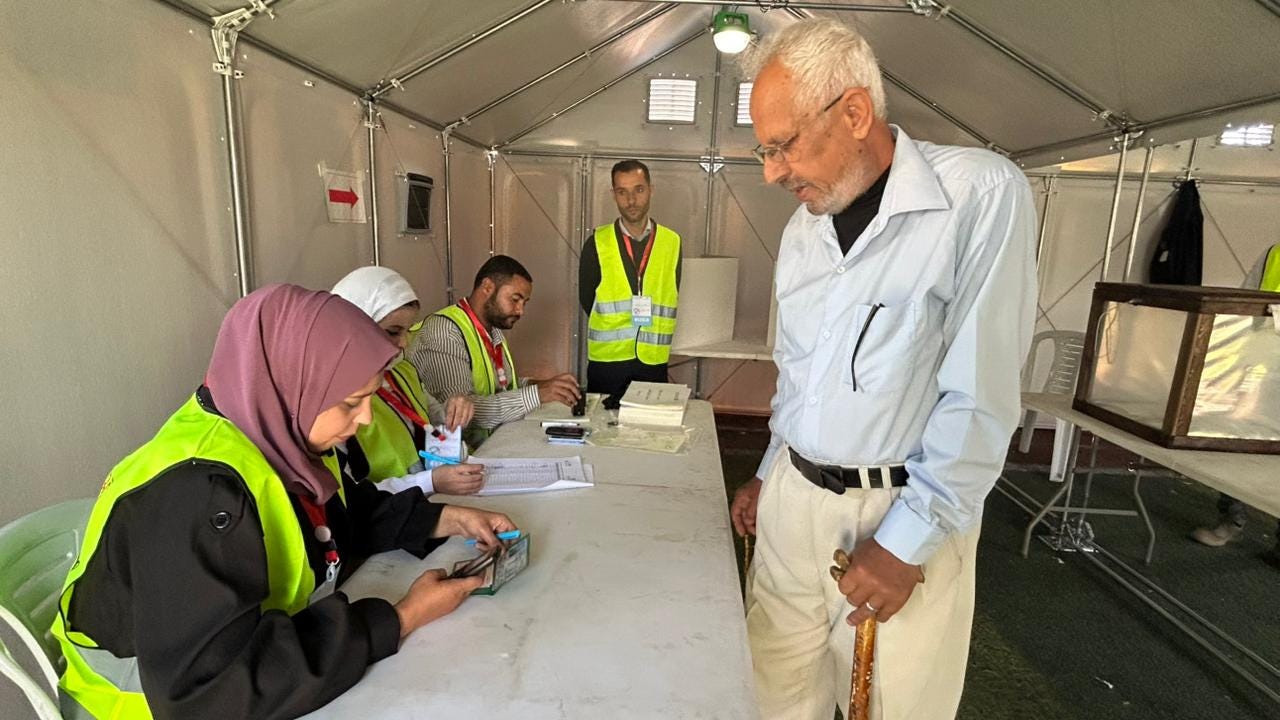
DEIR AL-BALAH, Gaza—Leaning on a small cane, 73-year-old Mohammed Rihan was determined not to let the broken road stop him from casting his ballot in municipal elections in Deir al-Balah in central Gaza. A retired Arabic language teacher for whom walking is difficult, Rihan covered more than a kilometer between his home to the polling station on foot, because, he said, he had no other choice.
“It doesn’t matter that we’re voting in tents,” Rihan told Drop Site News. “What matters is that we express our opinions and take our right to elections and to change.”
On Saturday, Deir al-Balah became the first and only municipality in Gaza to hold local elections in over two decades. Polling stations opened across 12 centers, nine of them in tents supplied by UN agencies to the Central Elections Commission, set up inside a rented five-a-side football stadium with a handwritten banner marking the entrance. Only three polling centers operated in actual buildings.
The vote was the first municipal election held anywhere in Gaza since 2005. At the same time, 420 local elections took place across the West Bank. While the elections were lauded as a step forward, they came in a context of an ongoing genocide and occupation of Gaza, a recent law limiting which candidates can run, and a severe escalation of violence and expulsion of Palestinians by Israeli settlers and soldiers in the occupied West Bank.
Turnout was low in Deir al-Balah: a participation rate of 22.7%, according to official figures. The “Rise of Deir al-Balah” slate—whose candidates are considered close to Fatah—won six of the fifteen council seats. Independent “Future of Deir al-Balah” won five. Independent “Peace and Construction” and “Deir al-Balah Unites Us,” whose candidates are known to be close to Hamas, each won two.
Saeid Abu Rahma, a political analyst, attributed the low turnout to a deeper fatalism: people believe that Israel ultimately controls every aspect of life in Gaza and will prevent any elected council from properly functioning.
“Israel controls the crossings, electricity, water, and access to reconstruction materials and more,” Abu Rahma told Drop Site. “Without sustained international pressure, local bodies will be unable to fulfill their mandate regardless of their democratic legitimacy, and the elections will yield no tangible value.”
But he did not dismiss what the vote represented. “Despite this weakness, no one can deny that what happened was a democratic celebration, but a sad one, from the weight of pain and the absence of hope. The message of the elections is that Gaza is still alive, even if it is in the intensive care unit.”
Voting in Tents
The election infrastructure told its own story. Israel blocked the entry of basic electoral supplies, like ballot boxes, special ink, locks, and paper into Gaza, according to Jamil al-Khalidi, regional director of the Central Elections Commission in Deir al-Balah. The commission sourced substitutes locally: boxes lined with thick transparent nylon, paper printed at Gaza’s remaining print shops, and improvised ink alternatives.
Inside the tent polling stations, constructed from fiberglass panels rather than the nylon or fabric more common in Gaza, the process was, by multiple accounts, orderly. Voters had their details verified against the registry, crossed off their names, cast their ballots behind a cardboard privacy screen, and deposited them in the box.
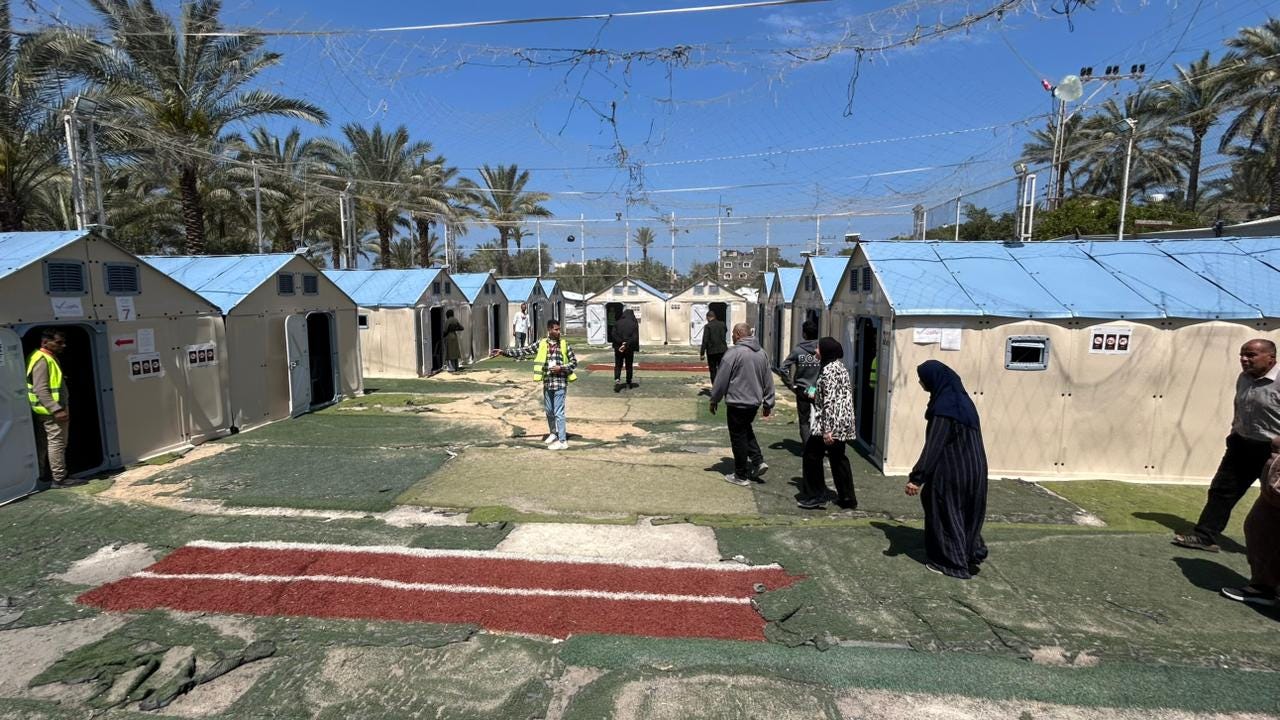
More than 500 government employees from across ministries and institutions in Gaza participated in organizing and securing the vote in Deir al-Balah, according to the Government Information Office.
In Deir al-Balah, just 15,962 out of 70,449 eligible voters cast a ballot. In the 2005 elections, 16,576 people voted out of 30,530 registered, meaning the eligible population has more than doubled—much of it as a result of mass displacement from other parts of Gaza—yet the number of people who actually turned up at the polls actually dipped slightly. Turnout in the West Bank stood at 56%, according to official figures.
The vote was also controversial for coming in the wake of a decree-law issued by Palestinian Authority (PA) President Mahmoud Abbas in November 2025 that imposed new regulations for local elections. The law states that all candidates for office must “commit to the Palestinian Liberation Organisation’s program platform—its international commitments and the decisions of international legitimacy.”
That clause essentially prohibited Hamas, and other political factions, from fielding candidates. At the time, Hamas blasted the decree, saying it effectively made “recognition of the Israeli occupation a prerequisite for candidacy [and] constitutes a serious infringement on citizens’ right to freely choose their representatives,” charging that it “represents a clear attempt to exclude national and Islamic forces as well as independents…. and aligns with Israeli and American pressure.” A coalition of secular and nationalist parties, known as the Democratic Forces, also denounced the law as did a coalition of dozens of major Palestinian NGOs, civil society groups, and women’s rights organizations.
Dr. Mustafa Barghouti, Secretary-General of the Palestinian National Initiative, on Sunday praised the symbolic significance of holding any vote in Gaza while sharply criticizing the structural weaknesses of the broader municipal election process, noting in an interview on Al Jazeera Mubasher that out of 429 local councils in the West Bank, competitive elections took place in just 83, while 197 councils saw only a single list submitted and 49 had no candidates at all. He also noted that local elections were not a substitute for legislative and presidential elections.
Meanwhile, the spokesperson for Hamas in Gaza, Hazem Qassem, said in a statement that the vote was “an important and necessary step” and called for presidential and legislative elections to follow.
In Deir al-Balah, all four competing lists, “Peace and Construction,” “Deir al-Balah Unites Us,” “Future of Deir al-Balah,” and “Rise of Deir al-Balah,” campaigned as independents. None of the Palestinian factions formally endorsed a slate. But voters and analysts drew their own maps.
“All the lists and their candidates carry independent names,” said 62-year-old Abd al-Majid al-Kurd as he sat at a small street stall trading in gold. He was skeptical about holding any elections in Gaza but said he would take part anyway. “The truth is that Deir al-Balah’s people know that the majority of candidates belong to various Palestinian factions, including Hamas and Fatah and others. The factions, for many reasons, don’t want to announce that officially”.
Political analyst and writer Mohammed Joudeh, who lives in al-Zawayda just north of Deir al-Balah, agreed. The factions stayed quiet partly out of security concerns, he said, partly because “people are furious at factional alignments and consider factional infighting to be what destroyed Gaza.”
“The elections are an indicator of what is coming,” Joudeh added. “At minimum, any future election could produce the same scene. People are now inclined toward independence and choosing independents and technocrats.”
First-Time Voters
Nineteen-year-old Sajaa Bashir, a student of occupational therapy at Al-Aqsa University in Gaza, voted for the first time on Saturday. She said she came not to express political affiliation but to choose who would represent Deir al-Balah’s municipal council based on announced programs.
“We didn’t come to elect parties or express political positions,” she said. “We came to exercise our right to choose who represents us.” Bashir also voiced a hope that went beyond sanitation networks and roads: that a democratically elected body might offer some protection.
“We want to present Deir al-Balah as a model city for life and recovery and reconstruction, through an elected administration that the world recognizes, and that stops using the excuse that the municipal council is unelected or appointed,” she said.
Rowan Abu Moussa, 24, and Iman al-Nakhala, 22, walked to the commission’s office together to collect voter information pamphlets before casting their ballots, also for the first time. Abu Moussa, a graduate in accounting from Palestine University, said the image of the election itself carried meaning.
“The scene of the elections gives people hope that it is possible to stop this war and return life to what it was,” she said. “Any result is also an opportunity for the world to find an elected body that removes the excuse from all those who talk about Gaza needing elections before it can be helped.”
Both women noted the timing alongside the vote in the West Bank. “It is a confirmation of the unity of the Palestinian homeland,” Abu Moussa said, “which the occupation wants to sever, to erase the Palestinian Authority’s official role in administering Gaza.”
The Weight of Twenty Years
Assad Mohammed, 48, described the elections as a rejection of years without democratic representation—and a reckoning with what those decades cost him personally.
“We were lost throughout the previous period and I don’t want my children’s futures to be lost,” he said. He has three children, all currently enrolled in universities whose buildings were targeted and destroyed by the Israeli military.
“I understand that reality is difficult and the world is not so easy that it will support us,” he said, “but at least we withdraw pretexts and say to donors: here is an elected municipal council, elected in a free and democratic way, you must support it and support the city.”
Faten Harb, 52, a community and family welfare practitioner and a mother of four and grandmother to six children, won one of the seats on the “Rise of Deir al-Balah” list that was considered aligned with Fatah.
“The claim that the lists are independent is not true, even if they include independents,” she said. “The larger number of candidates across the four lists are affiliated with specific political entities.” She said the decision to distance from factional branding was a collective choice, shaped by electoral calculations and wartime conditions.
Harb campaigned with limited resources, spending most of her days and nights on door-to-door visits, without any material support from Fatah. She holds a bachelor’s degree in education and is completing a master’s in administration and leadership.
“These elections are different because they come after a break of around twenty-two years, and because they come amid a war of extermination and the continuation of Palestinian division,” she said. “They are important with the hope that they become a spark for providing elected bodies across all areas of Gaza.”
“Gaza Is Still Alive”
Dr. Hassan Hammad, assistant coordinator of the civic campaign monitoring the local elections, took a more forward-facing view.
“Municipalities have a fundamental role in the recovery and reconstruction phase,” he said. “That is why it is important to conduct these elections and extend them to the remaining municipalities in central Gaza—which have seen less destruction—and eventually to all twenty-five municipalities in the Strip.”
He noted that international institutions had long claimed the appointed, politically affiliated status of Gaza’s councils as an excuse to withhold infrastructure funding. The election, he said, removed that justification.
Al-Khalidi, the elections commission official, confirmed that the commission intends to expand elections to other Gaza municipalities as conditions allow.
Rihan, the retired teacher who walked more than a kilometer on a cane to cast his ballot on Saturday, held out some hope for the future. “Elections in Deir al-Balah strengthen democracy and the people’s right to choose. Deir al-Balah is the least damaged in terms of destruction, but it has been scorched by the reverberations of war. No electricity, no fuel, no hospitals, no infrastructure. Everything has been wrecked since before the war,” he said.
“The hope is great for the possibility of change in the city.”
What happened in Deir al‑Balah wasn’t a “step toward governance.” It was a population forced to improvise democracy out of fiberglass tents and nylon boxes because the same states lecturing them about “reform” won’t even allow paper and ink into the Strip. And still, people showed up. The election exposes the absurdity of the narrative: Palestinians are expected to perform democracy under occupation while the world bankrolls the machinery that ensures any elected body will be strangled before it can function.
I feel like I should say "this is great news". But I think that would miss the point, slightly.
Democracy **follows** humanity - without **basic** moral decency, democracy is just a slogan at worst, perhaps a contrived ritual at best.
I think what is promising about the Deir Al-Balah elections really comes down to this: Israel has **not** managed to kill the humanity within Palestine. Amidst genocide, these people are showing the world that they still find it worth the trouble to build stability, community, and ideas of "future".