

Tents in Gaza Collapse From Rain as Palestinians Struggle With Massive Flooding
Heavy winter storms in Gaza put hundreds of thousands of Palestinians in tents at risk as Israel continues to restrict emergency aid.


We have a commitment to ensuring that our journalism is not locked behind a paywall. But the only way we can sustain this is through the voluntary support of our community of readers. If you are a free subscriber and you support our work, please consider upgrading to a paid subscription or gifting one to a friend or family member. You can also make a 501(c)(3) tax-deductible donation to support our work. If you do not have the means to support our work financially, you can do your part by sharing our work on social media and by forwarding this email to your network of contacts.
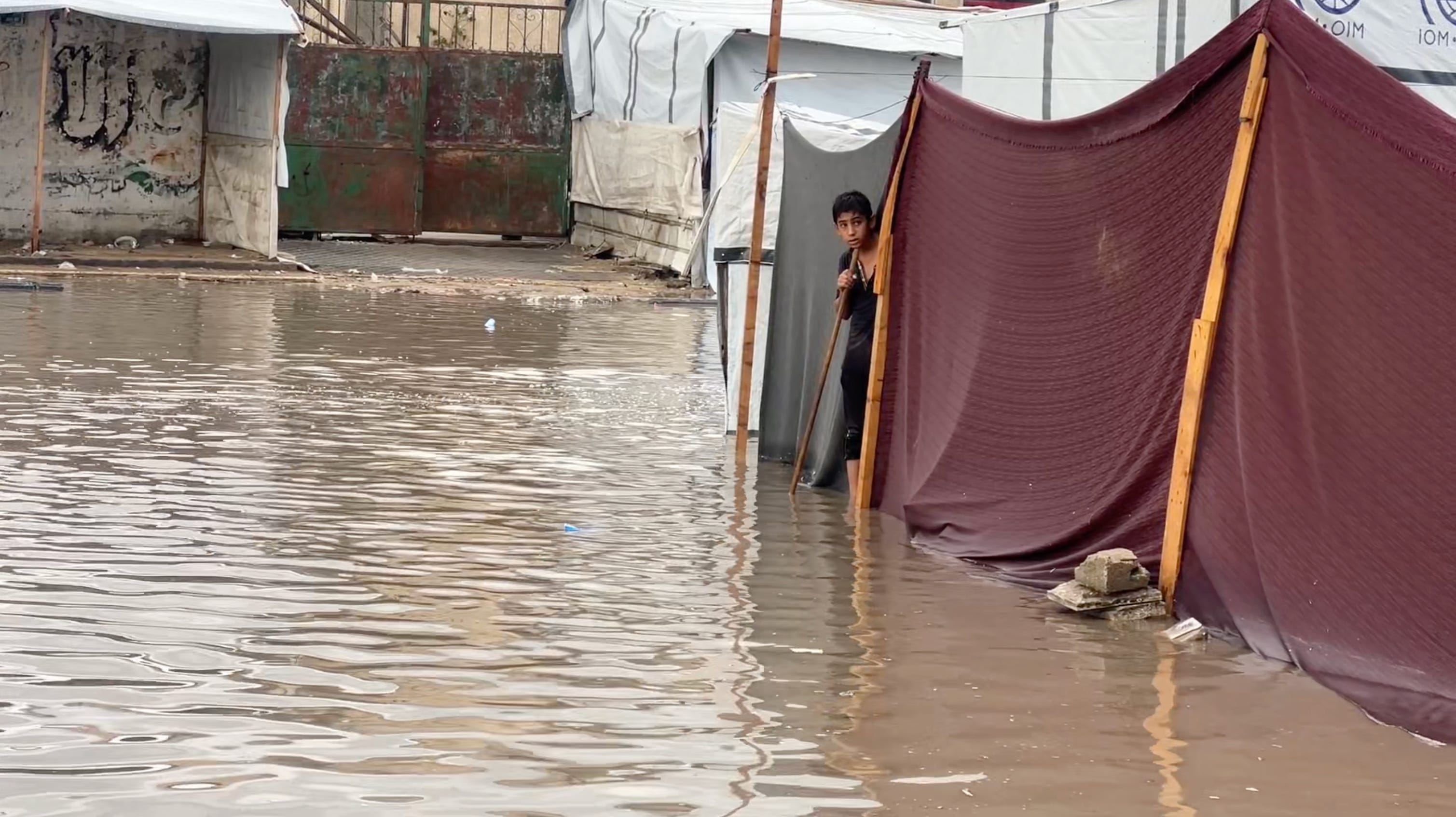
GAZA CITY—Palestinians in Gaza woke up Friday morning to heavy winter rains flooding streets, mixing rubble into mud, and drenching tents—creating an even more dangerous and miserable situation for the hundreds of thousands of people displaced by Israel’s genocidal war and living without adequate shelter.
“We were flooded by the rain, us and our young children,” Raed Al-Kafarna, who was displaced with his family from Beit Hanoun to Gaza City, told Drop Site. “Our tent was flooded and ruined. There is nothing to protect us from the rain. Our clothes are wet. The floor of the tent is all water.”
Al-Kafarna’s young children stood beside him, barefoot in the mud, as he spoke. Inside his tent, sand and mud had spread across the ground, soaking the family’s scant belongings. The Palestinian Meteorological Department issued warnings of more flash floods in areas across Gaza, with strong winds, heavy rain, and thunderstorms expected over the coming days.
“The winter season has begun and all the tents are ruined. There are tents that collapsed on top of the people inside from the amount of rain that came down. We are displaced, now we have rain, we have to search for a morsel of food, we have to search for water to wash our children or to drink. We have nothing,” he said. “Our nerves are shot. Every minute we wait for what is going to happen to us next. What is happening now is harder than the displacement itself.”
Rainfall and flooding in Gaza City on November 14, 2025. (Video by Abdel Qader Sabbah.)
The surrounding streets were completely flooded—transformed into shallow rivers with mounds of rubble on the banks. People dug simple trenches in between crowded rows of tents in a futile effort to redirect the water away from their places of shelter. “We are digging trenches to try and divert the water away from us, but it’s hopeless,” Al-Kafarna said. “We are working with buckets and our hands. We are unable to do anything.”
One man used a broom to try and sweep away water that kept pouring back into his tent.
“Today, people in the streets and alleyways have only one concern: preventing rain and drizzle from entering their tents,” Eyad Amawi, a representative of the Gaza Relief Committee in Deir al-Balah, wrote in a message on Friday. “As an eyewitness documenting these events, I can say that people woke up at dawn—many families likely did not sleep at all—because rainwater entered their tents, flooding them and soaking the ground beneath them.”
Civil Defense reported receiving distress calls throughout the day from displaced families in encampments and shelters across Gaza. “The flooding of tents in Gaza City is concentrated in the areas of Al-Nafaq, Al-Daraj, Yarmouk, Al-Zaytoun, and Al-Shati Camp. In the central governorate, flooding has occurred in the Al-Baraka and Al-Bassa areas of Deir al-Balah, and around the Islamic Bank on Salah al-Din Street west of Al-Bureij Camp, as well as in some camps for displaced people located near the Nuseirat market area,” the agency said in a statement. “We urge the immediate delivery of houses, caravans, and tents to these displaced families to help alleviate their suffering, especially as we are at the beginning of winter.”
Over 90% of Palestinians in Gaza have been displaced by the war and nearly 1.5 million Palestinians in Gaza are in need of emergency shelter items, according to the United Nations. Meanwhile, over 80% of all structures in Gaza have been destroyed or damaged leaving most people with inadequate shelter or protection from the elements. The UN estimates that about one million people are currently residing in 862 displacement sites across the Gaza Strip.
Rainfall and flooding in Gaza City on November 14, 2025. (Video by Abdel Qader Sabbah.)
Israel has continued to heavily restrict the entry of tents, food, and other aid in violation of the ceasefire agreement that went into effect last month. Since October 10, more than 6,490 tons of UN-coordinated relief materials have been denied entry into Gaza. Sewage infrastructure has been destroyed or damaged. The few plants still operating are struggling with fuel shortages and the increasing risk of massive sewage overflow.
At the Patient’s Friends Benevolent Society Hospital in Gaza City, nurses and parents were forced to carry sick children up the stairs as the ground floor flooded. “The situation is very dire inside the hospital,” Hassan al-Shaer, the director of the hospital said in an interview broadcast online. “The only children’s hospital in Gaza City and in northern Gaza Gaza. Children were trapped inside their rooms on the ground floor and now we are working on transferring the children to other floors. A large portion of the patients are suffering from malnutrition and have very little immunity and this sudden flooding could seriously affect them.”
Mohammed al-Kafarna, a relative of Raed’s, was also displaced from Beit Hanoun to Gaza City and is living with his family of six in a flimsy tent. “It rained on us and our tent flooded and our children were drenched. I had to start digging in the ground to try and divert the water and pile up sand to stop it coming in. But we are unable, it’s too much rain. All our clothes are wet, our blankets and we hope someone can come help us,” he told Drop Site. This tent doesn’t protect us from rain, or the cold or the heat or anything. But me and my family of six live in it and no one is coming to help us,” he added.
“As you can see from the moment it started we have been covered in water and sand and mud. My children were soaked, our food was ruined, our sheets and beds were ruined. Everything was ruined.”
Sami Vanderlip edited video for this report.
 | A guest post by
|
It is terrible for these poor people and the world just looks on.
America will never recover from it support of this tragedy.