

The Man Who Walked Toward the "Yellow Line" in Gaza—and the Son He Carried With Him
Osama Al-Shafi's mental deterioration from the stresses of war culminated in him wandering in a disassociated state towards Israeli soldiers who detained him and his infant son.

Drop Site is a reader-funded, independent news outlet. Without your support, we can’t operate. Please consider becoming a paid subscriber or making a 501(c)(3) tax-deductible donation today.
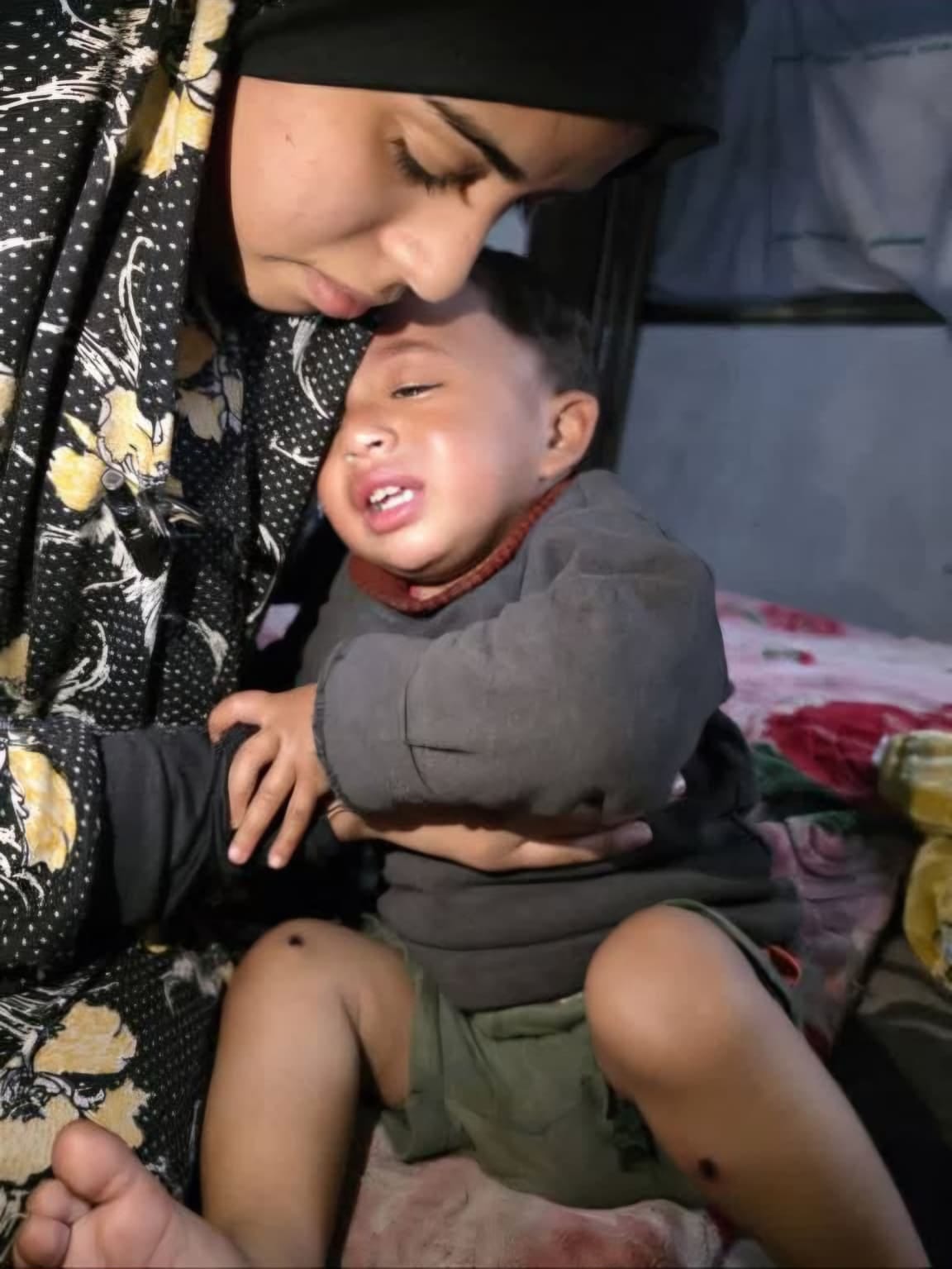
Story by Mohanad Maher
AL-MAGHAZI REFUGEE CAMP, Gaza Strip—At midnight, Waad al-Shafi was still awake, sitting on the floor beside her 22-month-old son, Jawad. The room was small and worn down by Israeli shelling. Long cracks run across the concrete and flakes of paint hung from the corners. The dim light cast shadows on the wall behind her.
She held a cloth dampened with cool water, which she dabbed lightly on Jawad’s feet as he slept. Every few moments, she placed her hand on his chest and felt his breathing. Jawad stirred before his eyes snapped open. He let out a low whimper before the words came out in broken pieces: “Bang. Blood. Tank.”
Waad didn’t ask him what he meant. She knew. She leaned toward him and smoothed his hair with one hand, keeping the other resting on him. When his voice fell quiet again, she stayed as she was, sitting beside him, awake, watching the rise and fall of his chest.
Jawad has been this way since March 19, when his father, Osama Al-Shafi, said he was going to take his son to the store to buy candy. He lifted Jawad onto his shoulders and headed out. The store was to the west, near their home in the eastern part of Al-Maghazi refugee camp, a few hundred meters from the “yellow line.” When he left the house, his direction suddenly changed and he began wandering eastward.
According to Waad, Al-Shafi had already begun showing signs of psychological distress, worn down by the harshest of living conditions and the horrors of Israel’s genocidal assault on Gaza. He had earned a meager living from a horse-drawn cart but two months earlier, the horse was killed by shelling. After that, he could no longer provide for his family. The shortages of food and basic necessities grew sharply worse.
Al-Shafi’s father, Mohammad, said his mental deterioration became visible about a month and a half after the horse’s killing. Al-Shafi would break the windows of the house and smash the furniture. He began getting into altercations with the neighbors and, at times, even with his own family. The family had been trying to find treatment for him. Mohammed said he was certain Al-Shafi was not aware of what he was doing.
That particular morning in March, with Jawad on his shoulders, Al-Shafi walked east toward the “yellow line” where Israeli forces are stationed, and which lay just 500 meters from their home. As he approached, Israeli forces in the area opened fire on them. None of the bullets hit, but he did not turn back. Neighbors later said that Osama was not fazed by the gunfire, he didn’t run or seek shelter—that he seemed to not fully grasp what was happening. He just kept walking east toward the Israeli troops as if he couldn’t hear or see what was in front of him.
“I tried to reach him,” Mohammed said, “But people held me back so I would not be harmed, because the occupation kills anyone who approaches.” So Mohamed stood there, unable to move, watching horror as his son carried his grandson and calmly walked toward what seemed like their end.
Waad heard the sound of bullets, then a small quadcopter closed in. Through a loudspeaker, it ordered Al-Shafi to take off his clothes down to his underwear and to strip the clothes off Jawad, who was not yet two years old. Four soldiers then approached and surrounded them. They ordered Al-Shafi to put the child on the ground and move slowly toward them.
According to Waad, Al-Shafi was separated from his son and restrained, and Jawad was taken away alone. The family spent the entire day consumed by fear, the father and son taken from them without a word. At 10 p.m., roughly twelve hours after the incident, a call came from the International Committee of the Red Cross (ICRC)—Israeli troops had handed Jawad back. An ICRC team then arrived near the Maghazi market, close to where the family lives, and delivered the infant to his family. The ICRC told the family that Al-Shafi had been shot in the shoulder but had no further information about his detention.
Waad received Jawad wrapped in plastic sheeting. She was told he had fallen asleep from the cold. When she held him, he broke out screaming. When she took off his clothes, she found blood, burn marks, and puncture wounds covering his legs and knees.
A medical report from the Al-Aqsa Martyrs Hospital in Deir al-Balah reviewed by Drop Site said the child arrived with swelling in his right knee and repeated vomiting, along with incised wounds around the knees and deep puncture wounds on the lower part of his body. His overall condition was stable, with no internal injuries. The family said Dr. Bisan Ahmad, who examined Jawad, found that the marks on his legs were “consistent with deliberate cigarette burns used as a form of physical torture.”
Doctors treated Jawad’s physical wounds but the psychological damage from the incident ran much deeper. His father had been broken by war and had carried his son towards the soldiers. Across Gaza, the war is unmaking many adults and the children they are meant to protect.
Over 73,000 Palestinians have been killed in Israel’s war on Gaza, including over 1,000 killed since a so-called ceasefire went into effect in October 2025. More than 173,000 have been wounded, over 3,400 of them since the “ceasefire.” Thousands of Palestinians have been arbitrarily detained in Gaza and held in Israeli prison camps without charge or trial and subject to systematic abuse and torture.
In a report titled “Torture and Genocide,” the UN Special Rapporteur on the Occupied Palestinian Territory Francesca Albanese warned that Israeli torture of Palestinian detainees “suggests collective vengeance and destructive intent.” What happened to Jawad belongs to that wider pattern, the turning of an entire territory into a space of collective punishment.
Mohammed Al-Kurd is a Gaza-based psychosocial support adviser and a psychological specialist in protection, rehabilitation, and reintegration. For years, that work has put him in rooms with children, women, displaced families, the wounded, and people carrying trauma they can’t put down. Al-Kurd said that, to understand Al-Shafi’s case, the whole picture has to be taken in at once: the losses that came before, the daily grind of staying alive, fear that never lets up, and then a sudden blow. Often, he noted, mental breaks are the accumulation of persistent trauma—the moment when everything piled up inside a person finally shows.
Al-Shafi kept walking east, toward the danger, not hearing the gunfire around him or the voices pleading for him to turn back. When a person’s exhaustion passes the point they can bear, the mind may fall back on a psychological defense mechanism known as dissociation, as if trying to shield it from more than it can hold. In that state a person can feel cut loose from reality, from their own feelings, from any sense of time and place. The body stays present. The awareness does not.
Al-Kurd said a moment like Al-Shafi’s could not be read apart from everything that came before it. Under prolonged threat, the mind started treating life itself as an emergency without end, braced against a danger that is never lifted. Over time this wears a person down in ways that go past fear. Concentration frays. Memory slips. For some, the sense that life still holds meaning begins to give way. This was the arc Al-Shafi’s father had described. His walk that morning was not separate from that unraveling. It was its furthest point.
Jawad is now also deeply traumatized. The words come out of his mouth broken. He wakes up terrified in the night. He does not fall into the deep slumber of a child. Al-Kurd said a child this young may not have the words for what happened to him, but he keeps it in his body and in his emotional memory. Severe, repeated fear holds a child’s brain in a constant state of alert, until sleep itself, which is supposed to be a refuge, turns into another threat.
Jawad’s disrupted nights are not his alone. A study by the Gaza-based Community Training Centre for Crisis Management, carried out with support from the War Child Alliance, placed Jawad’s nightly terror in a wider frame. Among the children it examined, approximately 79% suffered from persistent nightmares.
Al-Kurd said specialists have started speaking of “continuous trauma” rather than “post-trauma,” because “post” assumes the event has ended, and in Gaza it has not ended. When Jawad screams in the night, he is not remembering what has happened to him in the past, but is instead expressing a response to an ongoing traumatic experience.
Since the night of his return, Jawad’s sleep has come in fragments. His mother sits beside him through the long hours, laying cool compresses on his forehead, working ointment into the burns on his feet, waiting for him to settle. The father who should be beside them is still in detention, his fate unknown.
Mohammed said the hardest moment came when Jawad looked at a picture in a calendar on the wall, an olive tree under open sky, and said to him, “This is where the army shot us.” The boy had tied the image to what he had lived. The calendar had become a window onto that morning. He was not reaching for a memory. He was pointing at something still inside him.
Every single day, my heart breaks. How can it break so many times?
If you compare the number of civilian casualties in Ukraine with the number of civilian casualties in Gaza in a much shorter war it gives the lie to IDF claims that they are the most careful military in the world.