

Hamas Leader Khaled Meshaal: Trump Should Heed the Growing Calls Within MAGA and Reject Israel’s Agenda
In an exclusive interview, Meshaal makes the case that Trump should definitively end Israel’s multi-decade war of annihilation and open a new era in U.S.-Palestine relations.


Drop Site is a reader-funded, independent news outlet. Without your contributions, we can’t operate. Please consider making a 501(c)(3) tax-deductible donation before the end of the year, and thank you for your support.
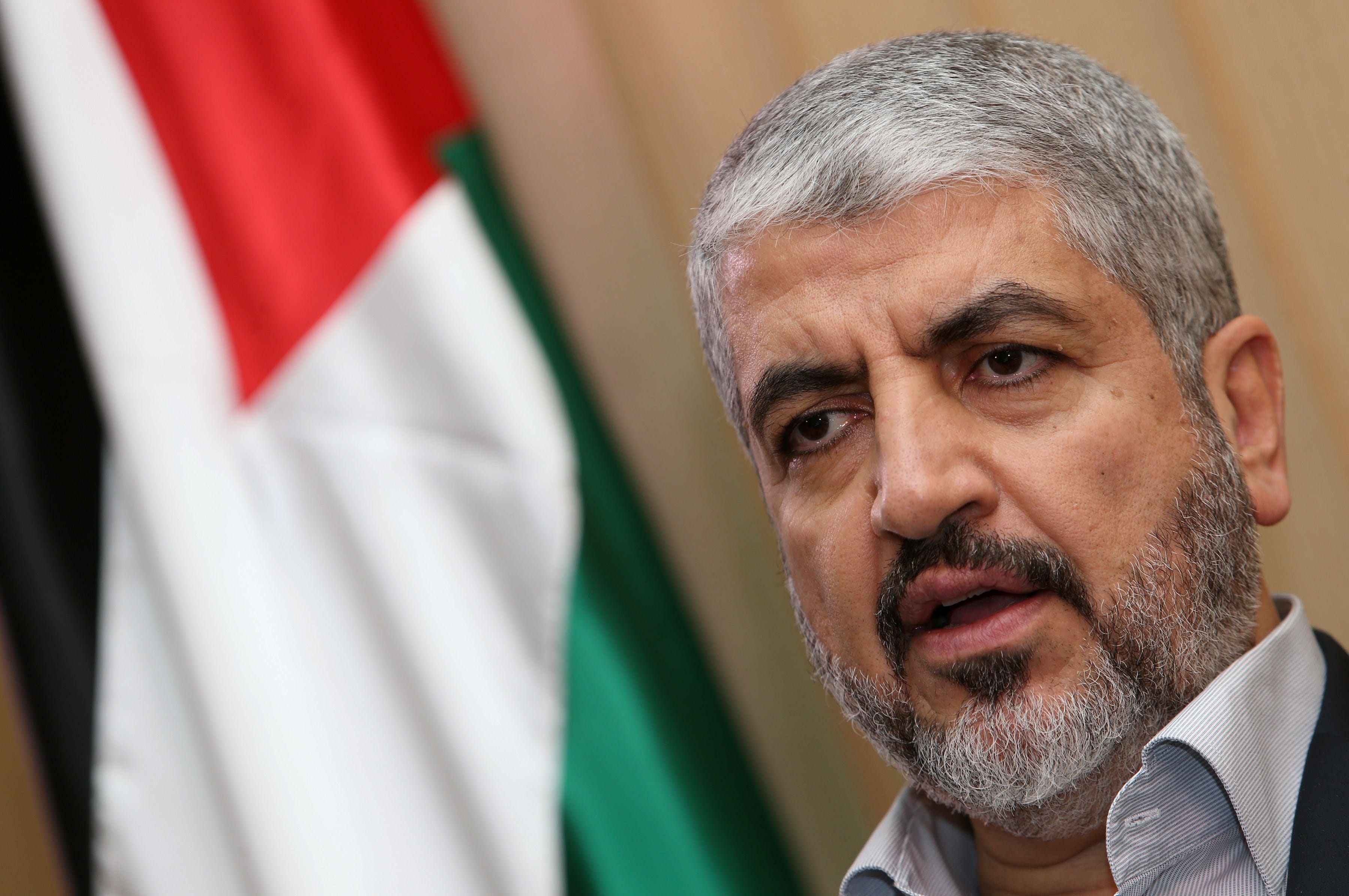
DOHA, QATAR—If President Donald Trump wants to achieve stability in the Middle East, he should put an end to Israeli interference in U.S. policy toward Palestine, senior Hamas leader Khaled Meshaal told Drop Site. Instead, Meshaal said, the U.S. should enter into a genuine process of direct negotiations with Hamas and other Palestinian political factions aimed at establishing friendly, bilateral relations.
“Unfortunately, one of the problems with the U.S. administration is that it prioritizes Israel’s interests more than the United States’ own interests. Even Trump’s people—MAGA—came to realize that Israel is a burden on them, restricting and harming U.S. interests. I am simply calling on the American people and the U.S. administration to judge based on America’s interests, not Israel’s,” Meshaal said. “If they look at us even for a moment in a fair and impartial way, they will see that the Palestinian people are oppressed under occupation, and they have the right to resist—unless America steps in and forces Israel to withdraw, in which case we would thank America.” He added, “When the world fails to help you, you have no choice but to resist the occupier until you force it to withdraw.”
Read Drop Site’s full, in-person interview with Meshaal below.
Meshaal, who is currently the head of Hamas outside of Palestine, was a founding member of the movement and is one of its most experienced and internationally well-known leaders. In the decade before Hamas launched in 1987, Meshaal was part of a group that created the architecture for the formation of a new Islamic political liberation movement in Palestine. That process crystallized in the formation of the Islamic Resistance Movement, commonly known by its Arabic acronym HAMAS. After the Israeli assassination of Hamas’s spiritual leader Sheikh Ahmed Yassin in 2004, Meshaal was widely recognized as the political leader of the movement and he served as head of its political bureau from 1996-2017.
He reiterated that Hamas is prepared to enter into a long-term ceasefire agreement with Israel, backed by a pledge that Hamas would store its weapons and commit to end all military operations targeting Israel. Meshaal also said that Hamas is ready to work closely with the U.S. and the international community in creating a stable security environment inside Gaza that will enable the reconstruction of the enclave, prepare the ground for democratic elections, and create the political conditions for negotiations addressing the future of a Palestinian state.
“The pragmatic American mindset, and President Trump’s genuine concern to achieve stability and prevent Gaza from remaining a continual bleeding wound that worries the world and deeply strikes the human conscience [can] create an opportunity for stability,” Meshaal said. “Hamas provides this opportunity with real guarantees and a record of commitment.”
Hamas remains a popular political actor within Palestine and has served as the only governing authority in Gaza for two decades—a fact that, Meshaal said, Trump needs to consider. While Hamas has offered to relinquish its governance of the enclave in favor of a technocratic committee of non-partisan Palestinians, Meshaal warned that attempting to impose a sweeping ban on anyone affiliated with Hamas from participating in the stabilization and rebuilding of society in Gaza would be counterproductive.
“Any attempt to establish a non-Palestinian authority inside Gaza is first unacceptable and second doomed to fail,” Meshaal said. “Any non-Palestinian authority—meaning foreign authorities or foreign forces inside Gaza—would be treated by Palestinians as an occupying authority, as an occupying power. This would automatically create a state of conflict because Palestinians would not accept it. Why would Palestinians reject Israeli occupation but accept another form of foreign occupation?”
During the sit-down interview with Drop Site in Doha last week, Meshaal argued that the current moment offers an opportunity for the U.S. and Europe to realign the Western approach to the Middle East. “The Palestinian people are not against American interests. We are opposed to those who interfere in our affairs and to those who support our enemy. But we are ready to open up to America, to Europe, and to the world,” he said. “What we will not accept is occupation, guardianship, or support for an occupier. We criticize the United States not because it is the United States—no—but because it provides Israel, our occupier, with complete support in all forms. Today, there is an opportunity for transformation, and I believe it is in the interest of the West to sponsor a fundamental change in [the approach to] Palestine, just as it eventually recognized the truth in South Africa and withdrew its support from that apartheid regime.”
Citing Trump’s embrace of Ahmed Al-Sharaa, the former Al Qaeda operative turned anti-Assad rebel leader who took power as interim president of Syria in January, Meshaal said the U.S. should pursue a similar path with Palestinian political leaders. “Why does the U.S. administration give Ahmad Al‑Sharaa this opportunity but does not give it to Hamas and the Palestinian resistance forces? It does not even give it today to [Palestinian Authority President] Mahmoud Abbas, who is not accused of terrorism,” Meshaal said. “It is in the interest of the United States and Western capitals to pursue positive engagement with Hamas and with the Palestinian people, because we are the future, and this occupation will become part of the past.”
A former physics teacher, the 69-year old Meshaal has spent his life building Hamas. In 1997, a year after Meshaal was named head of Hamas’s political bureau, the newly-elected Israeli Prime Minister Benjamin Netanyahu ordered Mossad agents to assassinate him in Amman, Jordan. Posing as Canadian tourists, the two operatives sprayed poison into his ear as he exited his car. One of Meshaal’s bodyguards, with the assistance of Jordanian police, captured the Israeli agents. King Hussein subsequently threatened to put the spies on trial and potentially execute them if Meshaal died and to end Jordan’s peace treaty with Israel. In response, Netanyahu dispatched the head of Mossad, Danny Yatom, to fly to Amman with the antidote to the poison. Hussein also secured the release of Yassin, Hamas’s spiritual leader, as part of the deal.
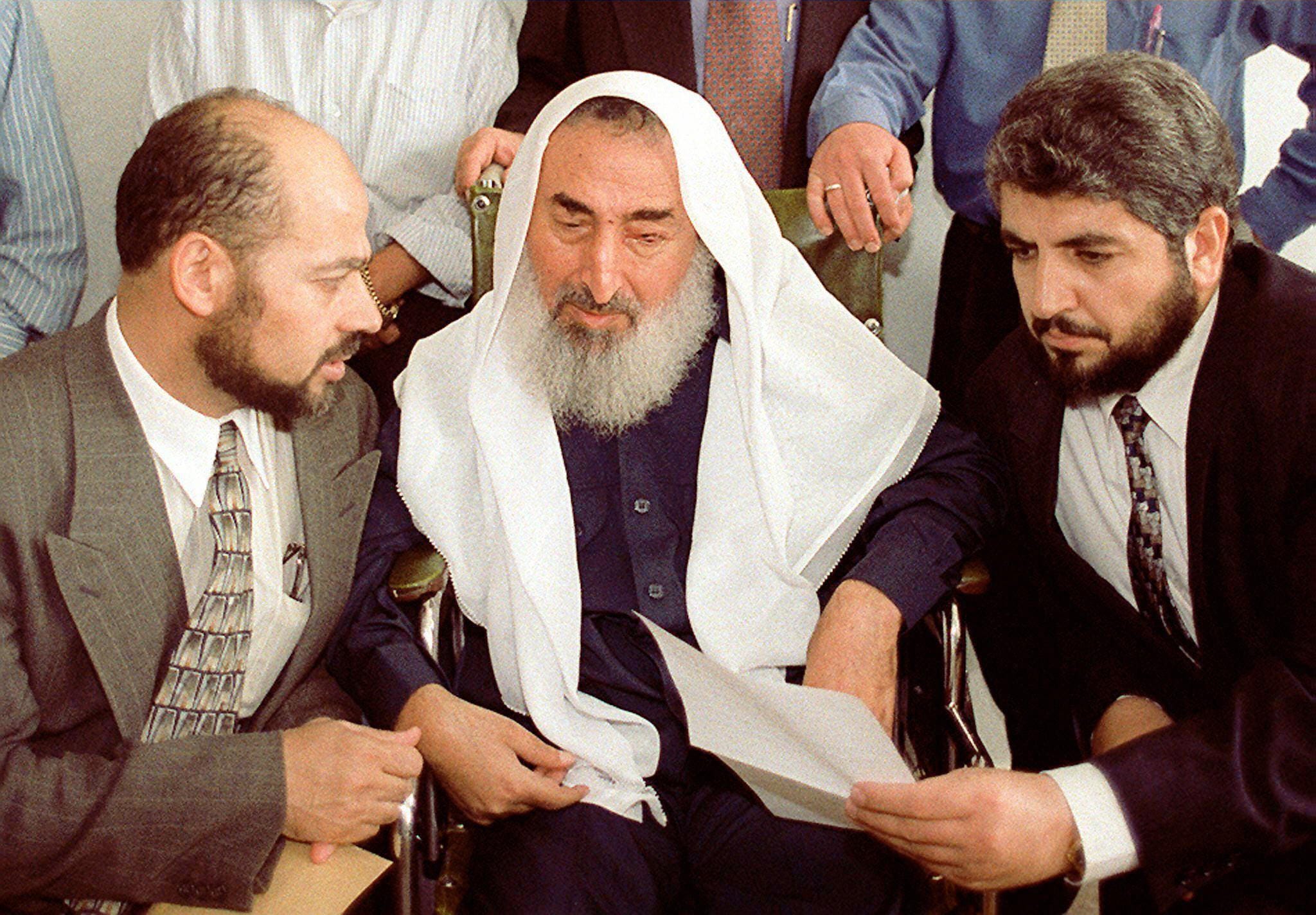
Meshaal has been widely credited with being one of the architects of Hamas’s 2006 winning campaign in the Palestinian national elections. In 2012, Meshaal—who had spent his life in exile since 1967—made a triumphant visit to Palestine where he received a hero’s welcome in the streets of Gaza. Meshaal’s last act as Hamas’s political leader came on May 1, 2017 when he presided over the public unveiling of a 42-point manifesto that stated that Hamas was willing to accept a Palestinian state along the borders that existed prior to the 1967 Arab-Israeli war.
“Without compromising its rejection of the Zionist entity and without relinquishing any Palestinian rights,” it stated, “Hamas considers the establishment of a fully sovereign and independent Palestinian state, with Jerusalem as its capital along the lines of the 4th of June 1967, with the return of the refugees and the displaced to their homes from which they were expelled, to be a formula of national consensus.” The document also sharpened language defining the national liberation character of armed struggle in Palestine, denounced anti-semitism and clarified that the enemy of the Palestinian cause was a “colonial Zionist project.”
While the manifesto did not officially replace Hamas’s 1988 charter, its language on accepting what would amount to a two-state solution was seen as a significant overture to the international community. In the ensuing years, Meshaal continued to represent Hamas internationally, but the center of leadership within the movement shifted to Yahya Sinwar and Ismail Haniyeh—both of whom Israel assassinated in the summer of 2024. Over the course of the past two years of the Gaza genocide, Meshaal receded from prominence and has seldom spoken or appeared in public.
That dynamic has changed as of late. Within minutes of Israel’s attack on Hamas’s offices in Doha on September 9, Israeli media outlets and prominent social media accounts were circulating reports that Meshaal and other Palestinian leaders had been assassinated. Those rumors were false. While the strike killed the son of Hamas leader Khalil al-Hayya, and four other office staff, it did not kill any negotiators or political officials.
And now, in the aftermath of Trump’s October Gaza deal, Meshaal has reemerged as a prominent voice representing Hamas and outlining its positions on a range of issues. He has denounced Israel’s pervasive violations of the “ceasefire” agreement and its continued killing of not just Palestinian civilians, but also members of the armed resistance who are direct parties to the ceasefire. Since October 10, Israel has killed nearly 400 Palestinians and wounded more than 1,000 and continues to block the agreed upon delivery of life essentials.
“Some in the world think the first phase was excellent or fully implemented—it was not. While the war, in terms of total annihilation, has stopped, Israeli violations continue,” Meshaal said. “Therefore, our call as Palestinians, not just Hamas, is that Israel must be held accountable for all agreements of the first phase before moving quickly to the second phase. As Hamas committed to the first phase requirements, Hamas, along with all Palestinian forces, is committed to the requirements of the second phase through this serious dialogue with the mediators to reach sound approaches—not as Netanyahu wants, but as agreed upon with the mediators.”
Meshaal has also outlined Hamas’s position that while it is open to a “freezing” or storing of its defensive weapons, it will not agree to disarmament unless it is in the context of establishing a Palestinian army or security force capable of defending itself from Israeli aggression.
Last week, Netanyahu mentioned Meshaal by name in a speech, saying that Meshaal’s rejection of Palestinian disarmament would be confronted. “This mission will be completed either the easy way or the hard way,” Netanyahu said on December 9. A day later, Meshaal sat for an hourlong special interview on Al Jazeera Arabic and Hamas widely distributed his remarks across its official platforms.
Meshaal is the second most popular hypothetical candidate for president of Palestine, according to a recent poll, should the Palestinian Authority allow fair elections. Marwan Barghouti, who has ranked as the most popular potential leader for years, is currently imprisoned on multiple life terms in Israeli prison. “We hope that Marwan will be released, that he will have the opportunity to engage in national struggle and political work, and that he will be a candidate—this is his natural right,” Meshaal said. “Hamas also has the right to nominate whomever it chooses, whether Khaled Meshaal or someone else.”
Abbas, the 90-year-old head of the Palestinian Authority, disagrees. He issued a “decree law” on November 19 that would ban Hamas-affiliated candidates and other pro-resistance Palestinians from running in local elections. It would also prohibit candidates who do not officially recognize the Oslo agreements and other deals that are widely seen among Palestinians as dangerous capitulations. The law, which was pushed by Western countries but widely denounced in Palestine, is almost certain to be applied on a national level, according to a source who has seen a draft version of the proposed decree. The source added that there is language in the draft that would also prohibit any party with an armed wing from participating in elections.
“The democracy desired in Palestine, as is unfortunately practiced in some countries in the region and the world, is that elections should produce predetermined results acceptable to those holding them. If they do not, they are canceled. That is not democracy,” said Meshaal. “If you respect the will of the people, allow them to express it freely at the ballot box. Today, everyone knows—even after the destruction in Gaza following two long years of the crime of genocide committed by Israel—that the Palestinian conscience, awareness, and, I believe, the Palestinian voter, if given the opportunity, would vote for the resistance.”
Hamas’s Message to Trump: “Power is responsibility”
Drop Site News met with Meshaal in person on Thursday in Doha. The interview was conducted as the Trump administration is pushing forward with its plan to deploy an International Stabilization Force (ISF) to Gaza and, in recent days, has been intensifying its pressure on both European and Islamic nations to commit troops. Several Arab and other Muslim countries have said they will not join a mission to disarm or battle Palestinian resistance fighters.
“We should be realistic and nuanced in expecting certain things,” said Turkish Foreign Minister Hakan Fidan in an appearance on December 6 at the Doha Forum in Qatar. “Our first objective in deploying the ISF is to separate Palestinians from the Israelis.” His remarks were echoed by Egypt’s foreign minister Badr Abdelatty. “We need to deploy this force as soon as possible on the ground because one party, which is Israel, is every day violating the ceasefire and claiming that the other side is violating, so we need monitors,” Abdelatty said.
Netanyahu has dismissed the notion that an international force would be willing, or able, to implement a disarmament operation. He suggested that Israel may eventually launch its own military campaign in the name of disarming Gaza, an objective its forces failed to achieve during more than two years of scorched earth war.
Despite clear opposition from its Arab and Muslim allies, the Trump administration continues to insist the ISF will enter Gaza with a mission to disarm Hamas. “We specifically put language in there that said, ‘by all means necessary,’” U.S. Ambassador to the UN Mike Waltz told Israel’s Channel 12 on December 11, referring to the UN Security Council resolution passed on November 17. “Now, obviously that’ll be a conversation with each country. Those rules of engagement are ongoing. I’ll tell you this, President Trump has repeatedly said Hamas will disarm one way or another, the easy way or the hard way.”
Last week, U.S. officials met with their European counterparts in Tel Aviv to discuss the ISF and reportedly threatened to permit an indefinite Israeli military presence if EU nations did not offer troops. “The message was: ‘If you are not ready to go to Gaza, don’t complain that the IDF stays,’” one European diplomat told Axios.
While citing substantial objections over the Trump Gaza plan’s vague yet sweeping nature, Meshaal said that the 20-point document nonetheless contains key concepts that Hamas, in principle, would accept. Meshaal cautioned, however, that the common ground between Hamas and Trump is undermined by attempts to impose foreign rule over Gaza, deploy an international force to disarm the Palestinian resistance, rather than serve as peacekeepers, or to enact policies that would enable Israel to continue its war of annihilation under the guise of a “peace deal.”
He also reiterated that Palestinian negotiators never agreed to disarmament or any of the terms in the “second phase” of a deal, despite U.S. and Israeli claims to the contrary. The negotiators from Hamas made clear privately and publicly in October that they only had a mandate to negotiate a ceasefire and exchange of captives and that all other issues must be handled through a consensus process involving all major Palestinian political factions.
Hamas negotiators had urged the U.S. and regional mediators to approach the issue of disarmament through technical negotiation, Meshaal said, and not through edicts that seek to achieve a surrender of the Palestinian liberation cause that Israel could not win on the battlefield. During the October negotiations, he noted, Hamas leaders informed the mediators that sweeping demands for immediate disarmament would sabotage a broader agreement and undermine Trump’s stated aim of ending the war.
“We do not want to clash with anyone or confront anyone, but we will not accept being forcibly disarmed. We told them: if you want results, let us look for a realistic approach that includes guarantees,” Meshaal said. “In truth, the major question is not the likelihood of the Palestinian side’s commitment, the problem lies with the Israeli side—because by its nature it is treacherous, this is its history. Second, it is the side that possesses lethal weaponry. The issue is not how to protect the Israeli side—it is the occupier. The issue is how to protect the Palestinian people, who are nearly defenseless. The weapons of the resistance do not mean that we are armed in the conventional sense, as states are. We are a nearly defenseless people, and we have sought weapons only to the extent possible in order to protect ourselves and defend ourselves.”
In launching his sweeping plan for Gaza, Trump was able to marshal the endorsement of dozens of Arab and Islamic countries, culminating in an unprecedented UN Security Council resolution that placed a fabricated stamp of legitimacy on an agenda that many Palestinians see as doing Israel’s bidding and colonialist in nature.
When asked whether the actions of Arab and Islamic states represented a betrayal of the Palestinian cause, Meshaal struck a diplomatic tone. “While they try to play a role in supporting the Palestinian people, standing by its cause or stopping the war, they also [consider] economic interests, arms purchases and other strategic considerations,” he said. “Since the American president is, in fact, a businessman, some countries are trying to build relationships with him that either serve their interests or protect them from potential harm, because they fear Trump’s adventures and sudden moves, as we saw in the past. This situation undoubtedly weakens strong Arab and Islamic intervention to stop the war.”
Despite the justifiable anger Palestinians may harbor toward Arab and Islamic states for their lack of intervention against Israel’s genocide, Meshaal emphasized, it is the U.S. that holds the only leverage over Israel: “Yes, more is required from Arabs and Muslims, but they are not the strongest party. As you know, no one in the world is able to compel Israel—even Europeans do not do so, or cannot do so.”
“Therefore, the responsibility of the United States is a doubled responsibility, and power is responsibility,” Meshaal said. “President Trump and the American administration alone are capable of compelling Israel and Netanyahu to respect the agreements, so they bear this responsibility before we assign responsibility to any regional or international party.”
Below is the full transcript of Drop Site’s wide-ranging interview with Meshaal on December 11, 2025 in Doha, Qatar. The interview was conducted in Arabic and translated into English by Drop Site.
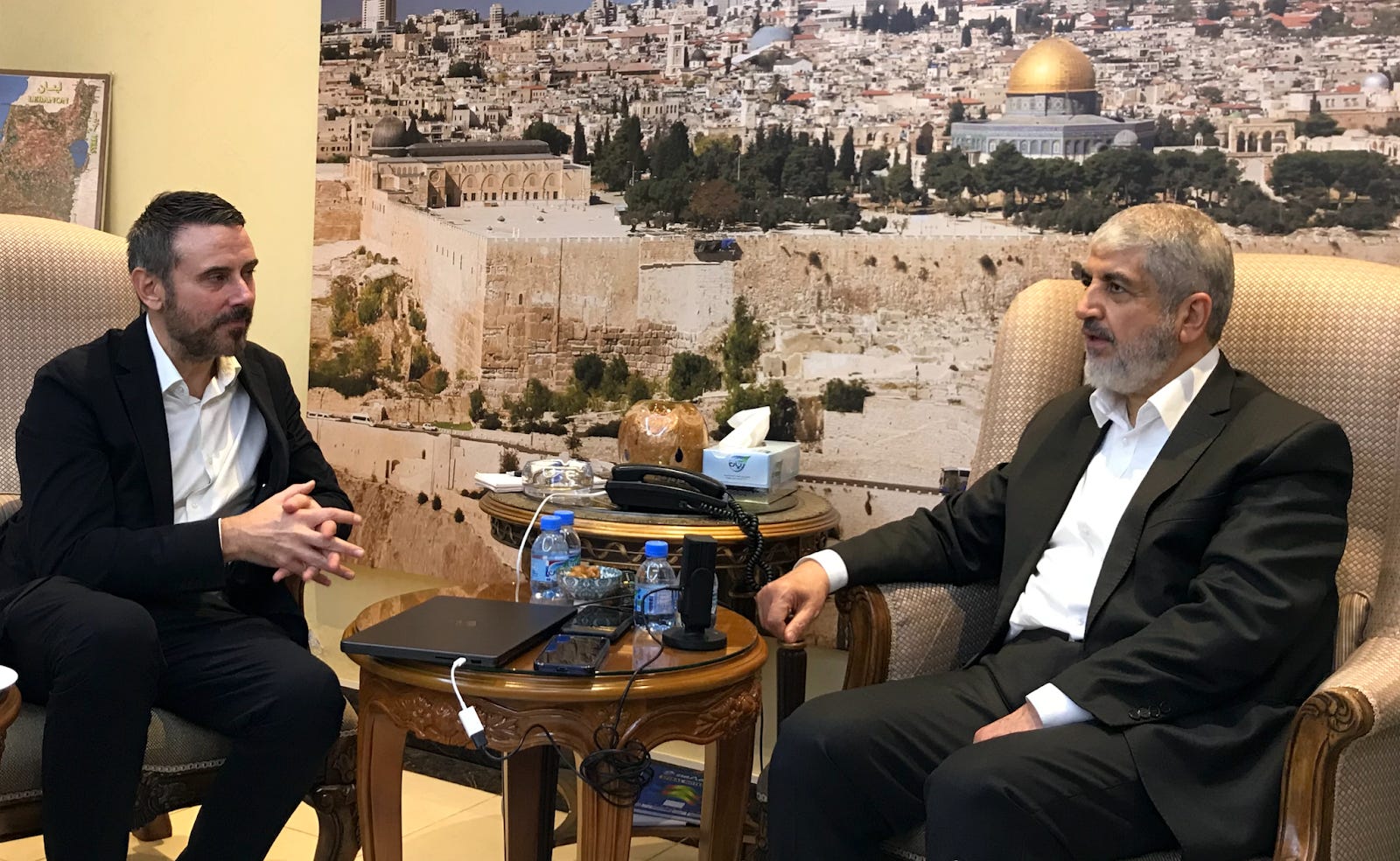
Interview With Khaled Meshaal
Jeremy Scahill: Thank you for taking the time to speak with us.
Khaled Meshaal: Thank you very much. I appreciate your keenness to conduct this interview and for providing this space and platform for me and for all those who represent the Palestinian cause.
There is no doubt that the unprecedented Israeli crime is a war of genocide, a repetition of what the Jews were subjected to many decades ago. They are now committing this Holocaust and this war of genocide against the Palestinian people and against a small area of only 365 square kilometers—using the most severe and horrific tools of destruction and killing. We are pleased to address Western public opinion through your platform so that people hear from us, not about us, and so that the true nature of this conflict is understood, about which the world has been misled for many decades. So thank you.
Jeremy Scahill: Prime Minister Benjamin Netanyahu mentioned you by name the other day in regards to the demands for the disarmament of the Palestinian resistance. Trump’s National Security adviser, Mike Waltz, said recently that Hamas can disarm the easy way or the hard way. Can you explain in detail the position right now of the Palestinian resistance on the issue of disarmament, freezing weapons, and a long term truce, or hudna? Explain the position, right now, in the face of these demands from Netanyahu and Trump’s administration.
Khaled Meshaal: Of course, Netanyahu mentioned my name as if in a context of surprise, or incitement—he is inciting. Does Netanyahu really expect the Palestinian people to simply go and give up their weapons? Netanyahu’s own history, and that of his predecessors among Israeli leaders, is full of massacres. There is no trust among the Palestinian people toward the Israelis and the occupation. Israel’s history is one of massacres, treachery, and the violation of all agreements.
Even Yasser Arafat, who signed the Oslo Accords with them, was killed by poison. Mahmoud Abbas, who dealt with them with great openness in continuing Oslo and the peace process, is now left in the headquarters in Ramallah with no real role. In fact, Netanyahu, [Bezalel] Smotrich, and [Itamar] Ben-Gvir are now disassembling the Palestinian Authority and withholding its clearance funds. Not to mention the massacres Israel has committed throughout its history in Palestine, Lebanon, and Egypt, and even in relatively recent Palestinian history—when the Palestinian resistance left Beirut, [Ariel] Sharon carried out the Sabra and Shatila massacres.
Therefore, within Palestinian culture, both historically and in the present, there is no trust in the Israeli. This is a criminal, treacherous enemy, and therefore it is only natural for the Palestinian to hold on to his weapon. This is not an extra weapon or something marginal for Palestinians—it is directly tied to our existence under occupation. Any people living in an independent state rely on the state and its army—the state is theirs, the army is theirs, and it protects them. And in any society, a citizen engages with their state through political means. But when you are under occupation, resistance is natural. Who has not resisted?
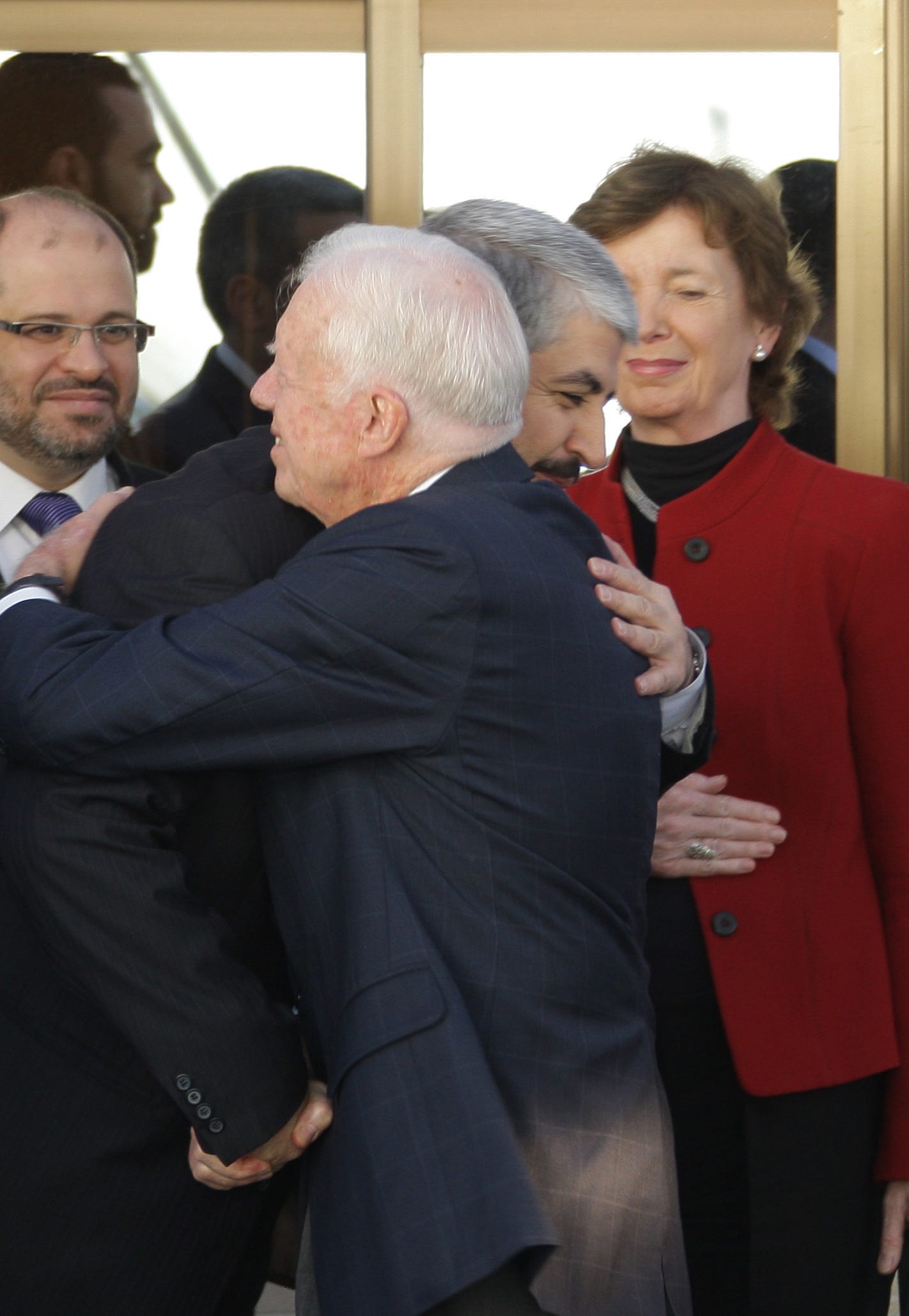
Let me tell you a story. In 2007, President [Jimmy] Carter visited me. I respected him because he conducted himself with high moral standards. He wrote books supportive of the Palestinian cause. I valued him, and he gifted me some of his signed books. I remained in contact with him. I was saddened when he passed away. This man, with his deep humanity, asked me about my parents—who were living in Damascus at the time in 2007. He asked, “Do you mind if I meet them?” I said no, so he met with them. My father, spontaneously, said to him: “Mr. Carter, listen—I fought the British Mandate. I fought the British.” President Carter replied, with a beautiful spontaneity: “And we fought the British too.”
Meaning that even the Americans fought the colonizer or forms of colonialism and guardianship over the United States. I am not speaking [only] about Vietnam, South Africa, the peoples of the world, or Cuba—I am speaking even about Western societies. You know that from the BBC in London, the British authorities allowed [Charles] de Gaulle to ignite the spark of popular resistance by the French people against the Nazis—against Hitler’s forces. So this is [part of] culture—it is something natural. Accordingly, what Palestinians do in resistance is natural, and their holding on to their weapons is natural. It is essential that this background be clear to everyone.
When Trump’s plan emerged, followed by the Security Council resolution, and dialogue began between us and the Egyptian, Qatari, and Turkish mediators, the central matter became, how do we deal with what was stated in the plan and in the Security Council resolution? Our position was clear: Do not resort to an approach of disarmament. This would lead to clashing, violence, and confrontation from the side seeking to impose it on us. We do not want to clash with anyone or confront anyone, but we will not accept being forcibly disarmed. We told them, if you want results, let us look for a realistic approach that includes guarantees. We outlined several such guarantees. The first guarantee is that these weapons—Hamas and the resistance forces would preserve and not use, display or parade them. [The weapons] would be set aside by their own decision and with full seriousness, especially given that Hamas has a record of commitment and high credibility.
Second, what has been referred to as international stabilization forces: we accept them on the borders as separation forces between the Palestinian side and the Israeli side, not as forces deployed inside Gaza, as was intended for them and as Netanyahu wants—for them to clash with Palestinians and disarm them. Third, we proposed a hudna, and this is evidence of Hamas’s seriousness and the seriousness of the Palestinian resistance. A truce of five years, seven years, ten years—whatever is agreed upon. And a hudna means commitment. All the periods of calm, as we call them, during the wars of the past twenty years—all those limited hudnas—Hamas adhered to them, and it was Israel that violated them. So, a hudna.
We do not want to clash with anyone or confront anyone, but we will not accept being forcibly disarmed. We told them, if you want results, let us look for a realistic approach that includes guarantees.
Fourth, we said that the three mediators, along with other Arab and Islamic countries that have good relations with Hamas, Islamic Jihad, and the resistance forces, can guarantee the Palestinian side to both the Israeli and the American sides—that Hamas and the resistance are committed. In truth, the major question is not the likelihood of the Palestinian side’s commitment, the problem lies with the Israeli side—because by its nature it is treacherous, this is its history. Second, it is the side that possesses lethal weaponry. The issue is not how to protect the Israeli side—it is the occupier. The issue is how to protect the Palestinian people, who are nearly defenseless. The weapons of the resistance do not mean that we are armed in the conventional sense, as states are. We are a nearly defenseless people, and we have sought weapons only to the extent possible in order to protect ourselves and defend ourselves.
I believe these are the correct approaches. I believe—as I stated in my [Al Jazeera] interview—that the pragmatic American mindset, and President Trump’s genuine concern to achieve stability and prevent Gaza from remaining a continual bleeding wound that worries the world and deeply strikes the human conscience—Western capitals, above all others, have become exasperated and fed up with what Israel is doing—create an opportunity for stability. Hamas provides this opportunity with real guarantees and a record of commitment. This is the approach—any other [approach] is impractical. It is enough for me to say it is impractical—not just unacceptable from our side.
Jeremy Scahill: I watched your recent interview with Al Jazeera Arabic and you mentioned the experience of Paul Bremer, who George W. Bush installed as the “viceroy” in Iraq during the 2003 invasion. And when the Americans implemented de-Ba’athification—where they criminalized the Ba’ath party of Saddam Hussein—they eliminated huge numbers of not only the professional military, but also civil society, government bureaucrats, and technocrats. They broke civil society because of de-Ba’athification. It seems to me that the Americans may eventually realize that Hamas is not only a resistance movement, but was a government and built civil infrastructure and civilian security forces. If they recreate a de-Ba’athification policy with Hamas and they try to remove anyone affiliated with Hamas, what would the consequences be on a security level? Because the idea is they’re going to send in a Palestinian police force—trained by the Egyptians, maybe. But the reality is that Hamas has been the security internally in Gaza for two decades. What would the consequences be if the Americans tried to adopt a de-Ba’athification approach to Hamas in Gaza?
Khaled Meshaal: From what I’ve been following in American statements, after the 2003 Iraq invasion, there have been some American reassessments about what they did in Iraq—that one of the mistakes was not just dismantling the regime. They realized that by dismantling the Iraqi state and its institutions, including the Iraqi army, they created chaos. This allowed groups like ISIS and forces the U.S. feared to emerge and it provided a pretext for prolonging the war in Iraq and the region. Therefore, I believe the American administration under President Trump should not repeat the same mistake—this is a relatively recent experience. If America seeks stability in the region, it must not make things worse or add fuel to the fire, which would further cause instability.
Furthermore, Hamas is not just a military organization or armed group—it is a resistance movement with a military dimension, but it is also a civil society movement. It is deeply rooted in the Palestinian people and is part of the fabric of Palestinian society. Its members are present across all aspects of Palestinian life. For two decades, Hamas has governed society efficiently, learning from past mistakes and gaining experience, and there was stability. The people of Gaza know that before Hamas ruled Gaza, there was lawlessness—a certain degree of chaos from rogue groups. Hamas managed this situation with high efficiency. Therefore, Hamas has a successful track record in maintaining security in the country and providing public safety. It has a successful experience in governing society, the government and providing for people’s needs, despite an unjust siege that lasted throughout this period.
Consequently, any attempt—and here I’m speaking about the principle, not just the method—to establish a non-Palestinian authority inside Gaza is first unacceptable and second doomed to fail. That’s why I said the Bremer experience is not acceptable. Looking back at Palestinian history a hundred years ago, after World War I in the early 1920s, there was the British Mandate. Practically, this Mandate was colonial, and Palestinian revolts in the 1920s, 1930s, and 1940s fought against it. The Mandate was unjust: it seized rights it did not possess, and it served as cover for the Zionist gangs that infiltrated Palestine and established Israel in 1948. Therefore, from a practical perspective, the Mandate experience and legacy is extremely negative, and in principle, is unacceptable. In principle, a mandate and guardianship are unacceptable.
As for the consequences you asked about, if such a scenario were to occur, they would certainly be serious. This would not be a confrontation with Hamas alone; it would be a confrontation with [Palestinian] society. I have said that any non-Palestinian authority—meaning foreign authorities or foreign forces inside Gaza—would be treated by Palestinians as an occupying authority, as an occupying power. This would automatically create a state of conflict because Palestinians would not accept it. Why would Palestinians reject Israeli occupation but accept another form of foreign occupation? That is unacceptable.
That is why I said that the Palestinian people are the ones who govern themselves, who make their own decisions, and who manage [their affairs]. Then Hamas took a step meant to shorten the path: it stepped away from administration—actually relinquished governance, not just in slogans—and left it to mediators such as Egypt, Qatar, and Turkey, in a Palestinian dialogue with various factions, to agree on forming a technocratic administration. This is what we have done for more than a year. What delayed this [process] is that the [Palestinian] Authority in Ramallah was not enthusiastic about it, even though we said that the reference authority of this administration would be the authority of Ramallah so that the Palestinian system between Gaza and the West Bank could be unified. Unfortunately, it stalled. Three weeks ago, this idea was finalized: 40 respectable Palestinian figures, all independent technocrats, were proposed, and eight were selected. The original plan was for this step to be implemented quickly and efficiently, but there was a delay because everyone was waiting to see what Israel would do in the second phase and whether the United States would force Israel to enter that second phase. President Trump’s recent statements indicate that the process would begin early next year, but Israel is the one causing the delay.
For your information and for the information of American viewers and followers, the first phase has not met its requirements. Israel has violated the requirements or conditions of the first phase: in relief, shelter, the entry of tents and caravans, food and medical aid, hospital rehabilitation, and opening the Rafah crossing in both directions—as stipulated in the Trump plan and the Security Council resolution. Yet Israel only mentions the remaining Israeli bodies—only one left. Hamas and the Palestinian resistance committed to everything, while Israel violated many [obligations]. This is in addition to killings under various pretexts. Even the issue of Hamas fighters in Rafah was a solvable problem, and the U.S. offered an initiative, but it was thwarted by Netanyahu. We also heard how Trump criticized Netanyahu, saying, “Why did you make this an ongoing crisis?”
Furthermore, the “yellow line,” which initially allowed Israel to control about 53% of Gaza—[Israel] is moving this line—has now shifted closer to 60% of the Gaza Strip. So some in the world think the first phase was excellent or fully implemented—it was not. While the war, in terms of total annihilation, has stopped, Israeli violations continue. Therefore, our call as Palestinians, not just Hamas, is that Israel must be held accountable for all agreements of the first phase before moving quickly to the second phase. As Hamas committed to the first phase requirements, Hamas, along with all Palestinian forces, is committed to the requirements of the second phase through this serious dialogue with the mediators to reach sound approaches—not as Netanyahu wants, but as agreed upon with the mediators. And I believe that the American side, as I said, in its pursuit of stability and its concern for results more than the ways Israel is trying to incite the U.S.—the American administration and the international community will understand the approaches that we can develop together with the mediators.
Jeremy Scahill: How, though, are you going to navigate the role of Mahmoud Abbas and the Palestinian Authority? He’s 90 years old. The last time he was elected was 2005. The Palestinian Authority was established in 1994 with a five year mandate. The Americans also punished Abbas—they banned him from attending the United Nations general assembly in New York. But also they want to use him for a sort of legitimacy stamp to say, “Ah, see, Palestinians agree with this.” Recently Abbas pushed a decree law about elections—the local elections—that would mean Hamas can’t run in the election. Even Dr. Mustafa Barghouti, a Palestinian political leader and former candidate for president who does not control any armed faction, could not run in the election. But other resistance leaders have told me that working with the PA right now in Gaza is the least bad option because at least it’s Palestinian. But, given the history, this may not really strike a lot of Palestinians as a convincing answer. What is your position on how to navigate the way the Americans want to use the PA and the broader struggle by Hamas and other movements to preserve the Palestinian cause for an independent state?
Khaled Meshaal: First, democracy is a right of the Palestinian people. Elections and building the Palestinian political system on democratic foundations are a right of the Palestinian people, not a favor from anyone in the world—not a gift we wait for from anyone. On the other hand, the slogans raised by the United States and Western capitals about democratizing the region, or their support for a democratic system—they do practice it in their own countries, no doubt about that—they must respect the choice of peoples to exercise this democratic right. The Palestinian people have a culture and a history of political engagement. Just as they excelled in the struggle, they excel in politics. They have formed parties since the days of the British Mandate. They have culture, free press, education, and universities. The Palestinian people are vibrant, educated, and well-versed in civilization. Palestine itself is the land of civilization and of the Prophets—it has a long history. It also has a history of peaceful coexistence among its different components and religious communities. Therefore, the Palestinian people do not need anyone to teach them the culture of democracy. They simply need others not to interfere with or violate this right of democracy.
The democracy desired in Palestine, as is unfortunately practiced in some countries in the region and the world, is that elections should produce predetermined results acceptable to those holding them. If they do not, they are canceled. That is not democracy.
Now, there was the Palestinian Authority, as you mentioned, [established] in 1994. In 2006, elections were held, and Hamas participated for the first time. Hamas won the elections and formed a government in 2006 and extended offers to all Palestinian partners. However, the Authority in Ramallah pressured these factions not to participate. Consequently, Hamas was forced to form the government alone with some independent figures. This was not their choice but imposed on them because Ramallah incited the participating factions. Until clashes occurred and some members of the Palestinian security apparatus at that time attempted a coup against the legitimate government led by Mr. Ismail Haniyeh—Brother Abu Al-Ubid was the Prime Minister at the time, who later became a martyr, as you know, more than a year ago. Then the Mecca Agreement of February 2007 was reached, leading to a national unity government in which Fatah and all the factions participated.
By June 2007, as a result of an attempt by remnants of the security apparatus to overthrow this government, clashes occurred, and stability was imposed in Gaza under the leadership of Hamas. Some claimed that Hamas had ousted the others, which is not true. I visited an Arab leader at the time, and he asked me, “Brother Abu al-Waleed, how is it that you fought Fatah and the others in 2007?” I replied, “We did not fight anyone. We were not opposing or fighting the authority—we were the authority. When someone rebels against the law and the authority, what should we do? Suppose, Mr. President, someone from a party in your own country came and fought you—what would you do? Retaliate? Stop them? Or just watch and smile?” The president smiled. So, Hamas did not stage a coup against anyone because it was the authority. Ismail Haniyeh [of Hamas] was the Prime Minister of the national unity government, and [Fatah politician] Azzam al-Ahmad was his deputy.
So, Hamas is committed to democracy, committed to the law, and committed to making the democratic experiment succeed. Since that time, the situation has changed. What is the main reason for this? Many Western powers—and unfortunately, some regional powers in the area—were not satisfied with the results of the 2006 elections and did not give Hamas and the Palestinian society the opportunity to make this experiment succeed. As a result, a coup was attempted against it through security and military conspiracies. Vanity Fair at the time published a detailed report about this—it is a Western magazine, as you know. Gaza was also subjected to an economic blockade. The democratic experiment was therefore fought against economically and targeted security-wise through attempts to overthrow it. The security coup did not succeed, but there is no doubt that the blockade harmed the experiment and made life in Gaza abnormal. So, this democratic experiment was perhaps targeted for failure from the very beginning, but the will of our people enabled Hamas to continue.
After that, we were called to hold elections several times, but what made this fail was President Mahmoud Abbas. We agreed several times—for example, in 2011, we agreed to rebuild the Palestine Liberation Organization (PLO) on new democratic foundations. That is, there are elections for the Palestinian Authority—which, as you know, operates in Gaza and the West Bank. The PLO is the political national reference for the Palestinian people, inside and outside [the country]. We agreed to rebuild the organization and took a transitional step by forming a temporary leadership framework, which met for only two sessions in Cairo that I attended, and then they did nothing. President Mahmoud Abbas, on his own initiative, called for municipal elections several times and then canceled them. We agreed in, I think, 2020 or 2021, on elections—they were canceled again. I asked one of the leaders in Ramallah, “Why were the elections canceled?” Of course, this was unofficial, and he said, “In short, because we are not confident in the results.”
Therefore, the democracy desired in Palestine, as is unfortunately practiced in some countries in the region and the world, is that elections should produce predetermined results acceptable to those holding them. If they do not, they are canceled. That is not democracy. If you respect the will of the people, allow them to express it freely at the ballot box. Today, everyone knows—even after the destruction in Gaza following two long years of the crime of genocide committed by Israel—that the Palestinian conscience, awareness, and, I believe, the Palestinian voter, if given the opportunity, would vote for the resistance They know that the resistance reflects their conscience and is a natural response to the occupation, and that the real problem lies with the Israeli occupation. Therefore, the Palestinian Authority has become weak because, on one hand, it no longer renews its legitimacy before its people. Secondly, it has been reduced to weak roles, especially security coordination with Israel. It has essentially become just a stamp or signature required to approve steps taken by the Israelis or the Americans. And you know—you, being part of American and Western society—that the West does not respect the weak, even if they are its followers. The world respects the strong. Hamas is strong, credible, and open to dealing with the entire world.
So today, notice in the Trump plan and the Security Council resolution—they, of course, want to end Hamas while at the same time rejecting any role for the Palestinian Authority (PA). Europeans advocate for a role for the PA, but the U.S. administration does not accept it, and Israel does not accept it. That is why we have called for Palestinian national unity, so that we are strong together and can impose our will on everyone. Hamas believes in organizing the Palestinian system around two principles: elections and a return to the ballot box, and second, partnership, meaning we do not exclude anyone. I have said this: in normal circumstances, as in the West, the party that wins the majority governs, and the rest are in the opposition or form a shadow government. But in our country, we need the energy of everyone. We hold elections, and after the elections we form a formula of national partnership across all institutions of the Palestinian political system to benefit from everyone’s efforts.
This is what Hamas proposes: it does not assert itself solely based on its popularity or majority, nor because it is the primary force on the ground. It seeks to include everyone. Hamas wants democracy because Hamas is also part of Palestinian society. It has political experience and a practical, civil presence within its community in all its aspects.
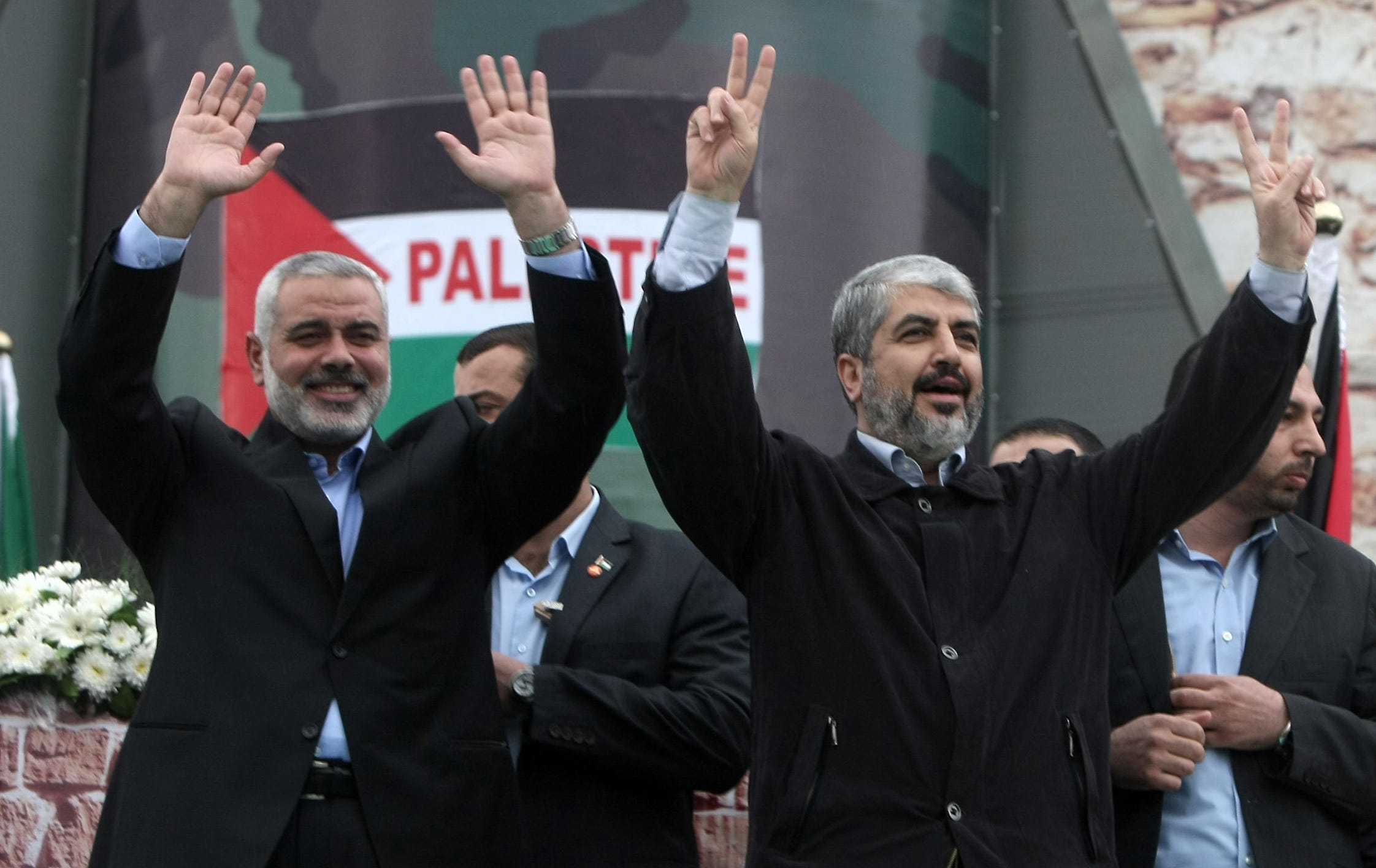
Jeremy Scahill: In the most recent polls I’ve read, Hamas is the number one most popular political party in Palestine. You are the most popular candidate for president with the exception of imprisoned leader Marwan Barghouti. But in terms of men who are not in prison right now, you’re the leading candidate. It seems like Europe and America do not want Hamas to be able to participate in elections. Given the popularity of Hamas and your popularity as a political leader according to some Palestinian polls, would you consider running for either president or to be head of the government as prime minister? And how would you do that if they make a law saying you can’t?
Khaled Meshaal: First of all, our dear brother Marwan Barghouti—who is in prison, and whom we hope will be released—we have fought for his release, as well as for [the release of] Brother Ahmad Saadat, the Secretary General of the Popular Front for the Liberation of Palestine. However, it is Israel that remains intransigent. And I am not revealing a secret when I say that some Palestinian parties were not enthusiastic about Marwan Barghouti’s release from prison—his wife knows this. Hamas, for its part, was keen, but due to Israeli intransigence and the lack of sufficient American pressure on Israel during the recent negotiations, we were unable to secure the release of Ahmad Saadat, Marwan Barghouti, Abbas al‑Sayyed of Hamas, Ibrahim Hamed, Abdullah Barghouti, Hassan Salameh, Arman, and many other Palestinian leaders. This is, of course, deeply regrettable for us. But this reflects our commitment to all the prisoners of our people—whether from Hamas, Fatah, or the Popular Front.
We hope that Marwan will be released, that he will have the opportunity to engage in national struggle and political work, and that he will be a candidate—this is his natural right. Hamas also has the right to nominate whomever it chooses, whether Khaled Meshaal or someone else. That is a decision for the movement to make at the appropriate time. Just as Hamas courageously participated in the 2006 elections, it is capable of doing so again. However, the doors are closed—not only by Israel and the U.S. administration, signaling that they would reject any election results—but, unfortunately, also by the Authority in Ramallah, which does not allow elections unless it can guarantee [the outcome]. They want elections that are carefully calibrated and whose results they feel assured about.
We understand and firmly believe that there is no solution—just as there is no solution to dealing with the occupation except for it to leave our land, whether through resistance or otherwise. Incidentally, in my meetings with regional leaders and Western leaders, I have told them clearly: our demand as Palestinians is the withdrawal of the occupation from Palestine.
Jeremy Scahill: Have you personally had any discussions—you, yourself—with EU leaders recently, with European leaders directly?
Khaled Meshaal: No, we did meet with officials from the European Union, but not at the level of heads of state within the EU—we met with ministers. For a period, we were open—there was openness toward us from Norway and Switzerland. We met with ministers from those countries. We met with officials from countries, some of these meetings were public, and others were private. Many of the meetings we held were private. We welcome any such meetings.
The main point is this: I told one of these leaders that the Palestinian people’s demand is very simple—the end of the occupation. It is our natural right. Our people do not accept living under occupation. How do we get rid of the occupation? There are two options: either we resist it, which is our natural right under international law, or others help us to get rid of it—just as the Americans have helped in the past to remove occupiers from certain countries. We said that we prefer the easier option. But as long as the international community does not act fairly toward us—while the Americans and Europeans have intervened in some cases, such as Kosovo, Bosnia, elsewhere, and Iraq, and at a certain point lifted their support from the apartheid regime in South Africa—to this day the international community and its major powers have not intervened to do us justice or to compel Israel to withdraw, at the very least in accordance with international legitimacy resolutions, which the West respects, from the West Bank and Gaza. They have not done so.
Therefore, when the world fails to help you, you have no choice but to resist the occupier until you force it to withdraw. History—Palestinian history and the history of the region—shows that there has never been a case in which an occupier withdrew from land without pressure. This was [true] during the era of British, French, and Italian colonialism in the region, and it has been [true] in our experience with the Israeli occupation since 1948. That is our demand in the context of resistance. In the political realm as well, the solution we believe in is democracy—but on the condition that it is genuine democracy, not one imposed on us in the manner preferred by Israel or the United States, where the results are predetermined. As the Palestinian people, we are capable of managing our own political system, holding free and fair elections, and governing ourselves. The outcome of such elections would be a strong, respected Palestinian leadership that represents the Palestinian people in managing both the struggle on the ground and the political battle.
How do we get rid of the occupation? There are two options: either we resist it, which is our natural right under international law, or others help us to get rid of it—just as the Americans have helped in the past to remove occupiers from certain countries. We said that we prefer the easier option.
Jeremy Scahill: Part of why I’m asking is because some European leaders and political officers have suggested Hamas could reform itself and take a more moderate position. And it seems like they understand that Hamas represents a large percentage of the Palestinian people. But there’s going to be a lot of pressure on you and other leaders to make concessions to Western countries. And given your career spent in this movement, I’m curious how you navigate this. Because Hamas has been called terrorists and this is in the mind of so many leaders in the U.S. and in Europe. But Hamas is also a popular movement. It’s also a resistance movement. So, how do you navigate this? I’m sure European leaders—the European leaders know you well. And so I’m wondering what your position is, how you deal with this pressure while staying loyal to the overarching principles of Hamas?
Khaled Meshaal: There is no doubt that how you present yourself under an initial or preemptive accusation—that you are a terrorist organization and that you are judged by Israel’s standards for classifying groups—[is difficult]. If, however, the U.S. administration and Western capitals applied the same Western standards to Hamas and the Palestinian resistance factions, they would classify them as national liberation movements—just as, for example, the Americans did 200 years ago, the French during World War II, and as all the peoples of the world have done. I am certain of this. Just like how they treated Mandela: once considered a terrorist and then he became a great man to them, and indeed he was a great man. If Western standards on democracy, human rights, and opposition to occupation under international law were applied, the West in its various capitals would see Hamas and the Palestinian resistance forces as national liberation movements. Yasser Arafat was considered a terrorist by them and later became a man of peace.
Unfortunately, one of the problems with the U.S. administration is that it prioritizes Israel’s interests more than the United States’ own interests. Even Trump’s people—MAGA—came to realize that Israel is a burden on them, restricting and harming U.S. interests. I am simply calling on the American people and the U.S. administration to judge based on America’s interests, not Israel’s. If they look at us even for a moment in a fair and impartial way, they will see that the Palestinian people are oppressed under occupation, and they have the right to resist—unless America steps in and forces Israel to withdraw, in which case we would thank America. But if they do not do so, then they should leave us to resist.
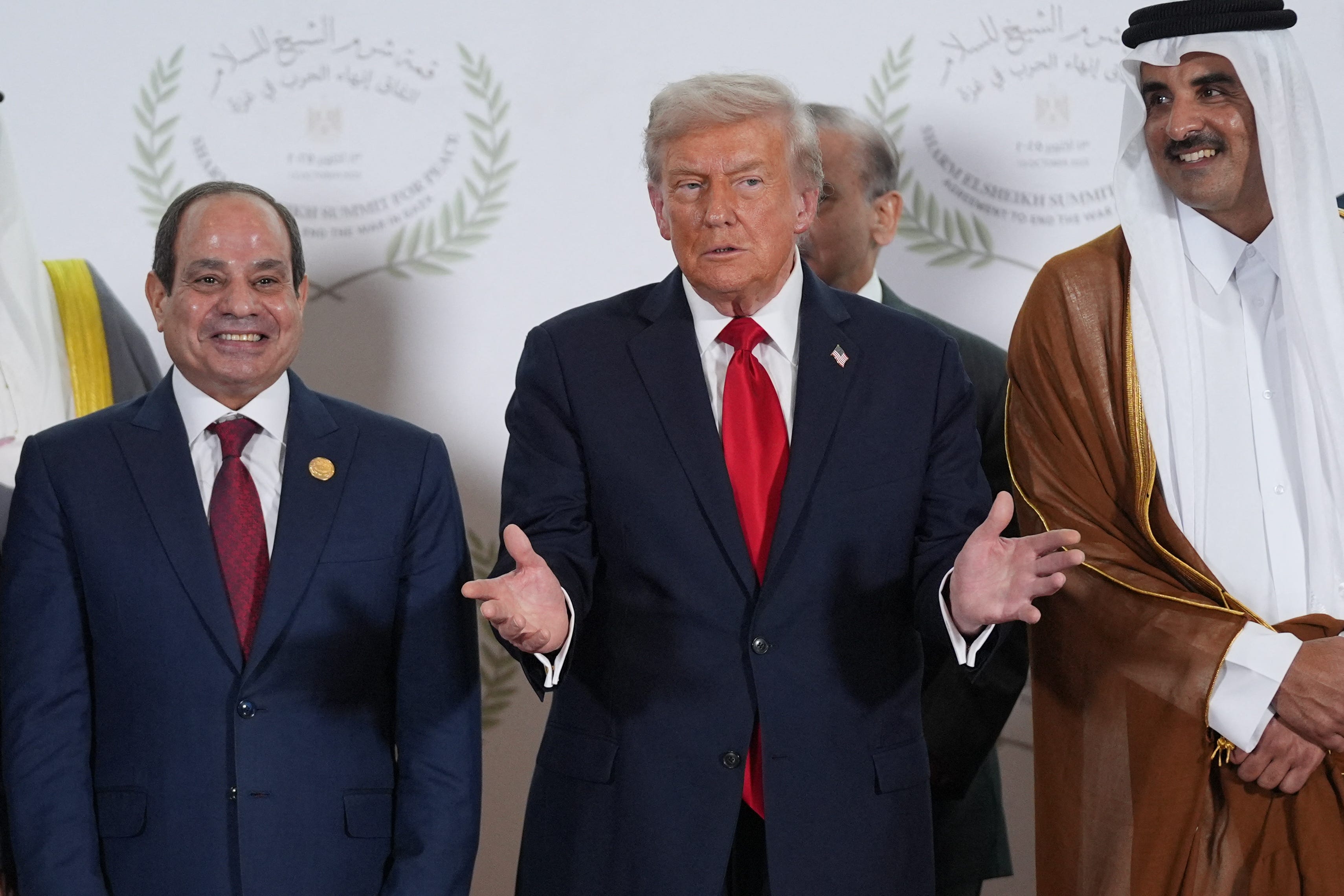
Now, what is the other standard for Hamas? The philosophy of resistance is to liberate [one’s land], which is consistent with international law and the historical Western approach to occupiers. Regarding structure—the organizational framework of any movement—what more could they ask of Hamas in terms of its democratic structure? Hamas elects its president and leadership every four years. Hamas is democratic to its core, perhaps more so than some Western parties and forces. Money is not used in our [elections] as it is in Western elections. Hamas is inherently democratic and accepts democracy with others, as shown in the 2006 elections, municipal elections, and university and union elections. Hamas practices [democracy] and abides by the results. Hamas is also a movement rooted in society and provides services to the Palestinian community. It has a civil body—it is a resistance movement, not a [purely] military organization. It is not a military group. It is a social movement that engages with all segments of society and has established many institutions, including universities and hospitals and other facilities that serve the Palestinian community.
So, Hamas is a movement that cannot be described as terrorist, because it is part of the fabric of Palestinian society. Accordingly, it should be dealt with on that basis. You can interview anyone who has met with Hamas’s leadership among Western figures. As I mentioned to you, for example, President Carter met with us. Some former U.S. ambassadors met with us through the Human Dialogue initiative in Switzerland. Others have met with us as well. All of them came away with impressions very different from the stereotypical image they had before meeting Hamas’s leadership. They discovered that Hamas’s leaders are open, democratic, and willing to engage [in dialogue]. Yes, they defend their national project and their right to independence and to ending the occupation, but they are also politically open to everyone. Therefore, this unfair, stereotypical labeling is exhausting and burdensome for us because it erects barriers between us and others.
It is in the interest of the United States and Western capitals to pursue positive engagement with Hamas and with the Palestinian people, because we are the future, and this occupation will become part of the past.
Let me give you an example: Ahmad Al‑Sharaa, who was formerly known as Al‑Jolani, was once accused by the Americans of being affiliated with Al‑Qaeda or Al‑Nusra, and suddenly he became acceptable. We are pleased that he is accepted, because in the end he is a son of Syria. He has an experience that I cannot judge, but later he fought for Syria’s freedom and led his people, together with the broader Syrian forces, to rid themselves of tyranny. That is a Syrian matter and their right. Why does the U.S. administration give Ahmad Al‑Sharaa this opportunity but does not give it to Hamas and the Palestinian resistance forces? It does not even give it today to [Palestinian Authority President] Mahmoud Abbas, who is not accused of terrorism. There is a clear double standard. I believe—and I have said this repeatedly, and I say it to you now through your platform—that the Palestinian people will prevail and will rid themselves of the occupation, and Israel’s fate will not be different from that of the apartheid regime in South Africa. It is in the interest of the United States and Western capitals to pursue positive engagement with Hamas and with the Palestinian people, because we are the future, and this occupation will become part of the past.
Jeremy Scahill: Regarding Ahmed Al Sharaa, I must say, when he took power, the Israelis bombed nearly all of the conventional military capacity of Syria. They are pressuring him to sign a normalization agreement with Israel. The Israelis have been able to occupy more and more Syrian territory. Yes, it’s an interesting example because of his history with Al Qaeda and Nusra. However, the demand in front of the Palestinians now from Europe is a disarmed Palestinian state, demilitarized—no army, no weapons. This is what they are saying—two state solution. On the other side is Israel. It’s not just Netanyahu—a large percentage of Israelis clearly want all of you gone or dead, as indicated by public polls. So you’re facing a situation where the support for Palestinians is unprecedented, huge support in the world. But the official demand from the chambers of Western power is no guns, no army, no self defense—essentially, you must always be under the fist of Israel. That’s also the emerging reality in Syria. That’s what they’re doing to the Syrians. So it’s a difficult situation you’re in.
Khaled Meshaal: That is true. And why? What is the reason behind all these abnormal situations? It is Israel. When the United States or Western capitals deal with other countries, they may not be right or fair, but they behave in a relatively reasonable manner—except in any case where Israel is involved. At that point, the West and the United States lose sight of themselves and align with Israel’s demands—demands of an occupier seeking dominance over the region. That is our problem today.
In Palestine, they first talk about a state. And I believe that, so far, the issue of a state remains a slogan—there is no real seriousness. Yes, a conference was held under the sponsorship of Saudi Arabia and France, and 159 countries recognized the Palestinian state, but this still remains at the level of symbolism. There has been no international will formed to force Israel to withdraw so that a state can actually exist—because there is no state without withdrawal. The Palestinian Authority declared the state many years ago, but it is a state in the air. We are not seeking psychological satisfaction from symbolic statehood, we are seeking freedom, independence, to live without occupation, and to build our state. Today, this opportunity is not available to the Palestinians. If the world does not want to help us achieve this, then it should allow us to resist and should not label our resistance as terrorism.
Furthermore, what does it even mean—a state without weapons? Of course, if a state is granted as a gift from others—if that were even to happen—it would come with conditions, just as conditions were imposed on the [Palestinian] Authority. The problem is that any achievement based on agreements under others’ conditions, will restrict you. That is why the Palestinian Authority has been constrained security-wise, politically, and economically. We are seeking a Palestinian authority—or more precisely, a Palestinian state—after the end of the occupation. We were not satisfied with having an authority under occupation through Oslo. It proved to be a failed authority because it was constrained, and at any moment [Israel] could intervene. Today there is a complete violation of the Authority: the Israeli army can enter Ramallah and Area A at any time, and it now seeks to restore administration even over Area B, contrary to Oslo, and may even reassert control over Area A as well. [Israel] intervenes whenever it wishes. Any Palestinian minister within the Authority is stopped at checkpoints—even Mahmoud Abbas cannot move without their permission. What kind of authority is this? It is an authority without sovereignty, without even the most basic level of respect or independent decision-making.
Therefore, for us, the proper course is that a state should be established only after the occupation ends. The first step toward statehood is not available here. That is why the Palestinian people do not wait for others. They know that the West—led by the United States—acts with absolute bias whenever Israel is part of the picture. Therefore, we decide to rid ourselves of the occupation and to create our independence just as other peoples have done. Second, why am I being asked to be disarmed? Guaranteed by whom? Who gives anyone the right to demand a state without [weapons]? A state itself decides—just as some countries choose to be non-aligned or without military capabilities. That is their decision, it is not imposed on them. We are like any other country in the world: we end the occupation, establish our state, build it democratically, and it will have its own army like any other state in the world. In short, there is a huge difference between waiting for others to deliver your national rights and demands—which I consider futile and detached from reality—and taking it upon yourself to achieve your identity, your rights, and your national aspirations. When you do that, those who reject you today will accept you tomorrow. We know the Western world well: it tries to block you, but once you prove your merit, it will deal with you. This is what we are striving for.
We say to the American people—over the past two years—we have deeply appreciated the engagement we have seen in American society: in universities, [including] the most prestigious ones, across different U.S. cities, among American elites, and among the new generation of Americans, including Jewish Americans who have shown solidarity with Palestine. Fifty-one percent of young Americans aged 18 to 24 support the Palestinian cause—indeed, support Hamas and the resistance. [Note: The poll, conducted by Harvard/Harris in December 2023, asked if the October 7 attacks “can be justified by the grievances of Palestinians?”] This is a significant shift, and we hope that the American human conscience will awaken and realize that Israel is a burden on [the United States], and that the Palestinian people are not against American interests. We are opposed to those who interfere in our affairs and to those who support our enemy. But we are ready to open up to America, to Europe, and to the world to build cultural and civilizational exchange, just as this region has historically been a cradle of civilizations, and to manage mutual interests. What we will not accept is occupation, guardianship, or support for an occupier. We criticize the United States not because it is the United States—no—but because it provides Israel, our occupier, with complete support in all forms. Today, there is an opportunity for transformation, and I believe it is in the interest of the West to sponsor a fundamental change in [the approach to] Palestine, just as it eventually recognized the truth in South Africa and withdrew its support from that apartheid regime.
Jeremy Scahill: Trump of course is a businessman. And he’s not just representing America as the president, he’s also preparing the path for business deals for his family. Many Arab countries are making big deals with Trump and they are trying to become very close friends of Trump. And in this deal on Gaza—the 20 point plan—Arab countries and Islamic countries put their stamp on it. And I heard you on Al Jazeera give credit to some of these countries—they stopped the big genocide by agreeing to it, but still Palestinians are killed every day. How do you not feel that this is one of the biggest betrayals of the Palestinian people by Arab and Islamic countries by working with Trump in this way?
Khaled Meshaal: Look, as Palestinians, we deal with our Arab and Islamic nation on two levels: one based on brotherhood—on the fact that we are one nation with a shared destiny and mutual rights—and another based on the realities of politics. As a leader, I have to balance both. Measured by the standard of brotherhood and shared destiny—that we are one nation and that the Palestinian cause has always been, and remains, the central cause of the [Arab and Islamic] nation—there is no doubt that the responsibility of the nation is great. Governments, leaders, and rulers within the nation should not have allowed this criminal war, this war of total genocide, to continue for two full years. That is why we called on many leaders of the nation, from the very first weeks and months, to move decisively and tell the Americans and the West: enough—this war must stop. There was undoubtedly some shortcoming, and the efforts fell short of what we had hoped for.
At the same time, we are aware of Arab and Islamic weakness. We know that the Arab position is not unified—there are disagreements, unfortunately, that have grown over a long period. There is no agreed-upon Arab or Islamic leadership that can command, reject, and coordinate collective action—there is fragmentation and disarray. Moreover, many states are preoccupied with their own priorities and interests with the United States and Europe. So while they try to play a role in supporting the Palestinian people, standing by its cause or stopping the war, they also [consider] economic interests, arms purchases and other strategic considerations. And since the American president is, in fact, a businessman, some countries are trying to build relationships with him that either serve their interests or protect them from potential harm, because they fear Trump’s adventures and sudden moves, as we saw in the past.
This situation undoubtedly weakens strong Arab and Islamic intervention to stop the war, and it is something we have criticized. But this does not negate the positive steps I mentioned in the interview—and I was sincere about them. For example, Egypt’s rejection of the displacement of our people from Gaza is a genuine Egyptian position because it also aligns with Egypt’s interest and its national security. Similarly, Jordan has feared—and continues to fear—the policies of Netanyahu, Ben-Gvir, and Smotrich aimed at annexing the West Bank, displacing its population, expanding settlements, destruction, seizing large areas of land, and violating Al-Aqsa Mosque, over which Jordan has a religious custodianship. These [policies] alarm Jordan deeply. Therefore, Jordan’s rejection of displacement from the West Bank is also a genuine position—it is not only about Jordanian security, but about the very existence of the Jordanian state. There are concerns for the future. We appreciate the positions taken by Egypt and Jordan. We also appreciate the significant positions taken by Qatar, despite the fact that it is not a neighboring country and is distant—it took strong and commendable positions. The same is true of Turkey. And many Arab countries as well, including Saudi Arabia, which was asked to normalize relations with Israel, establish ties and join the Abraham Accords. [Saudi Arabia] set four conditions: three related to Saudi Arabia, and one tied to ending the occupation and establishing a Palestinian state.
There are Arab and Islamic positions that I do not want to constrain [to a list]—across our region there have been commendable stances. However, they have not been sufficient given the responsibility of the [Arab and Islamic] nation toward Palestine and in light of the scale of the crime committed over two full years in the Gaza Strip. Our policy in Hamas is to thank the efforts that have been made, while [at the same time] calling for more. Even countries that supported us, such as Iran, and Hezbollah, which entered the confrontation in support of Gaza, are appreciated by us. There have been political efforts, military efforts, humanitarian relief and support inside Palestine, and popular mobilization in the Arab and Islamic streets, just as there has been in Western societies—all of this is valued. But did the international community succeed? Did the Arab and Islamic nation and its leadership succeed in stopping the crime at an early stage? The answer is no, they did not. The massacre and the war of genocide continued for two full years. That was undoubtedly extremely painful for us—yet, praise be to God.
When eight Arab and Islamic leaders went recently to New York last September and exerted pressure on the administration—they met with President Trump. This led to what became known as the Trump plan which was not sufficiently fair and contained serious gaps, but we considered it an important step toward stopping the war. That is why we dealt with it positively, intelligently, and with flexibility, which helped bring the war to a halt. Even this plan, however, is being violated by Israel. From time to time, we hear statements from President Trump and some members of his administration criticizing Israel, but the criticism is mild. Meanwhile, Hamas—which has adhered to the agreement—continues to face accusations and harsh rhetoric from time to time. This is something that must be overcome.
In short, on this point: yes, more is required from Arabs and Muslims, but they are not the strongest party. As you know, no one in the world is able to compel Israel—even Europeans do not do so, or cannot do so. Therefore, the responsibility of the United States is a doubled responsibility, and power is responsibility. President Trump and the American administration alone are capable of compelling Israel and Netanyahu to respect the agreements, so they bear this responsibility before we assign responsibility to any regional or international party.
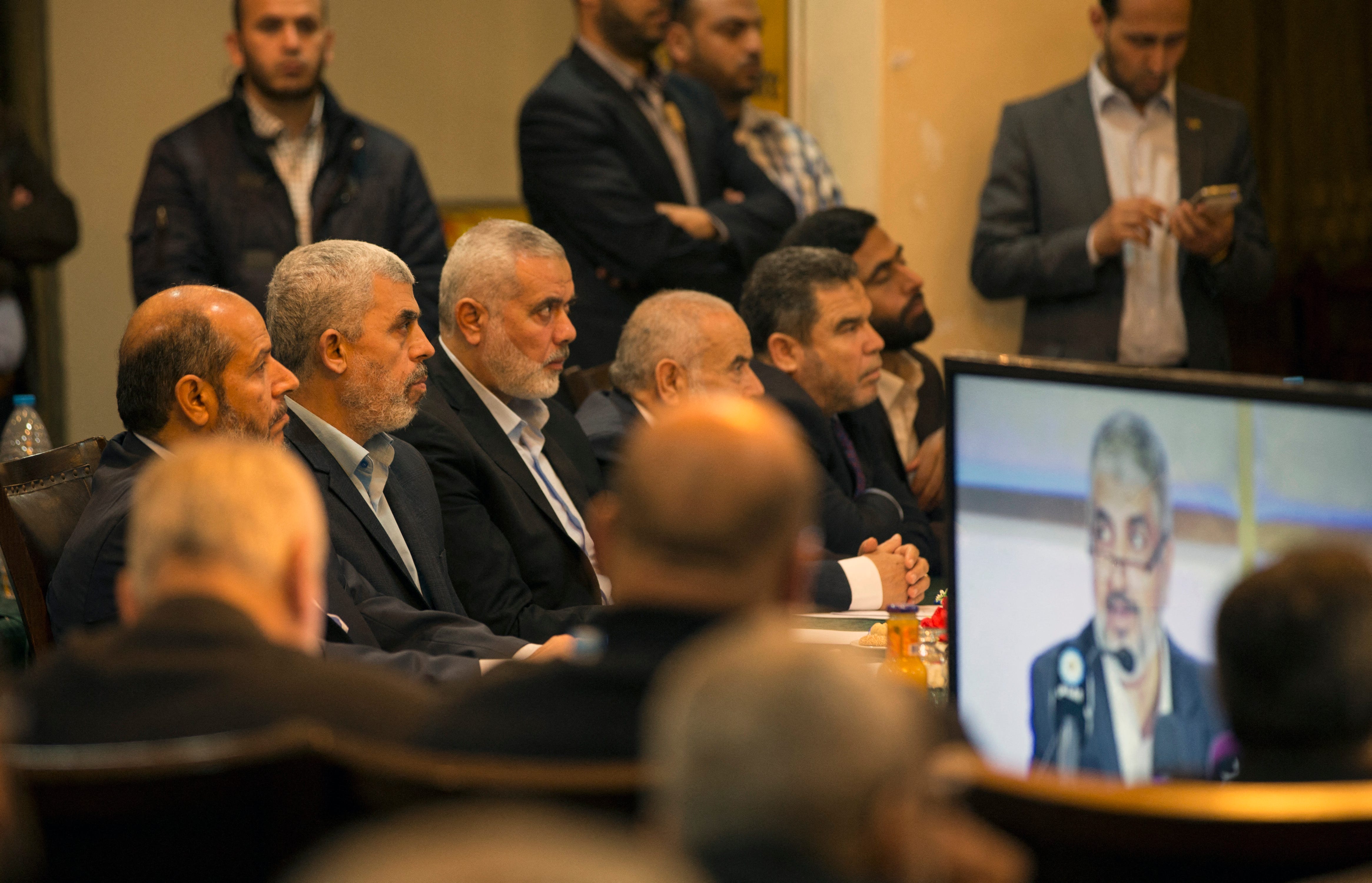
Jeremy Scahill: Hamas, in essence, updated its charter in 2017 and the official position on what the international community, particularly the U.S. and EU, calls the “two state solution” is that Hamas, if it’s the democratic will of the Palestinian people to establish a state along the pre-1967 war borders, would not object to it and would accept the democratic will of the Palestinian people. But you have an expansion of settlers in the West Bank. You have a genocidal mentality in Israeli society. Is there really a point anymore to Palestinians discussing a two state solution? Is there any relevance to this anymore in your view?
Khaled Meshaal: Look, what we announced in 2017 in the political charter was not, at that moment, a new position regarding Hamas’s behavior or political stances—Hamas had already developed and maintained these political positions since it participated in elections, even before that. For more than twenty-five years, Hamas has built a political philosophy and a system of political positions and ideas, developing them through its internal democratic structure, through dialogues with other Palestinian factions, and also with Arab and Islamic countries through discussions. This was to form a political program that aligns with its principles and constants, but also opens horizons to achieve gains on one hand, and importantly, provides a common ground for Palestinian-Palestinian unity and engagement with the official Arab position.
We wanted—especially after winning the elections—to create a joint political program where we could meet with Fatah and other factions, and also have a program with shared points with the official Arab stance, as a way to facilitate matters. But we understood that Israel would not allow this. What is called the “two-state solution” will not be permitted [by Israel]. I believe that the idea of a two-state solution is a beautiful slogan presented internationally and regionally, but Israel will not allow it because the West Bank is, for Israel, the heart of the Zionist project. Israel has historically referred to it as Judea and Samaria.
What happened in Gaza in 2005, with the Israeli withdrawal, was an exception forced upon Sharon at the time because Gaza had become a burden for them. Gaza is a limited area, and Israeli policy is fine with relinquishing small areas, especially if they have a dense population and pose a security headache, like Gaza. The 2000 Intifada, though primarily in the West Bank in terms of population and area, was addressed by Israel through withdrawal from Gaza, not the West Bank. On the contrary, they launched [Operation] Defensive Shield. Because the West Bank, in Israel’s plan, is the heart of the Zionist project. That’s why I said: when Israel withdraws from the West Bank and Jerusalem, it would mean a shift in the balance of power, and Israel would withdraw from all of Palestine—it would leave all of Palestine.
So why did Hamas accept a Palestinian state on the 1967 borders, without calling it a two-state solution? Because the two-state solution implies automatically recognizing Israel. In discussions with Westerners, we told them: no, we accept a state on the 1967 borders as a shared national project with the other Palestinian factions. As for recognizing Israel, Hamas has a [clear] position on this—we do not recognize Israel. However, we will respect the Palestinian will when it is consulted on this matter and other related issues. As for us in Hamas, we do not recognize the legitimacy of the occupation. So, why did we go with the idea of a Palestinian state along the 1967 borders? To reach a common position with our Palestinian partners and also with the Arab and Islamic countries. Hamas’s approach has been proven correct—not only what Hamas presented in 2017, but even back in 2006 in the National Accord Document that came from the prisoners’ initiative. All of this was on the table—a state along the 1967 borders. However, even the official Arab system, which presented King Abdullah’s initiative—may God have mercy on him—through the Beirut Summit in 2002, has not been able, over these past 23 years, to achieve a single step toward establishing a Palestinian state, because Israel refuses it. Israel will not give anything freely.
For Hamas, therefore, we are both principled and realistic. Principled: we reject the occupation, we reject guardianship, we reject relinquishing our rights to the land and to Jerusalem, the right of return for refugees, and the independence of our national decision-making. These are the principles and rights of our people, including the release of our prisoners. At the same time, we are politically realistic and deal with partners, including the Palestinian Authority in Ramallah and Fatah. We are realistic in dealing with the Arab and Islamic reality and the international community, and we are ready to engage with any serious project to establish a Palestinian state along the 1967 borders. Even though I realize, unfortunately, that this is impossible because of Israeli policy, not just because of today’s realities with settlers, or the policies of Ben Gvir and Smotrich—this [only] reflects the essence of the strategy. The Likud has a clear strategy: no Palestinian state between the river and the sea, and if Palestinians want a state, they should go to Jordan. That is their strategy. The difference between Netanyahu and Smotrich or Ben Gvir is only in how they present the position. But Netanyahu does not differ from them in essence—he does not recognize Palestinian rights.
Therefore, the current reality in Gaza, the settlements, the violations, the attempts at displacement, and the war crime of genocide in Gaza show that Israel does not respect Palestinian rights and does not accept a Palestinian state. Nevertheless, we Palestinians—in Hamas, along with our partners on the Palestinian scene and our Arab and Islamic countries—are ready, if there is serious regional and international commitment, for Israel to be compelled to withdraw to the borders of June 4, 1967, including Jerusalem, so that we can establish our Palestinian state. If the conditions are met, Hamas will accept this and act responsibly. We will build a real democratic Palestinian state—not like Israel today, which claims democracy while violating it even against its own citizens.
Unfortunately, Trump hasn't the slightest interest in solving the tragic situation in Gaza. His only interest, as always, is in how he can take advantage of the situation to gain more money and personal power. His meddling is sure to cause more suffering for the Palestinians.
Real journalism - you know it when you see it. Thanks for this excellent interview. I'm grateful. I have to say I agree mostly with what Meshaal is saying. And from my perspective here in the US, Israel is indeed a massive burden. In multiple ways Israel has been a corrupting weight around our neck - financially, morally, socially and in terms of national security - for decades. Add to this the farce which commands that speaking out on Israeli-made disasters makes one "antisemtic". This is a truly disgraceful tactic and is absolute bullshit.