

Internal Debate Rages in Tehran Over Deal with Trump
Some political insiders in Iran oppose the memorandum of understanding with the U.S., calling it a strategic mistake.


Drop Site is reader-funded—no corporate owners, no outside influence. Your support is what keeps this journalism independent and free. Please consider making a tax-deductible donation to support our work.
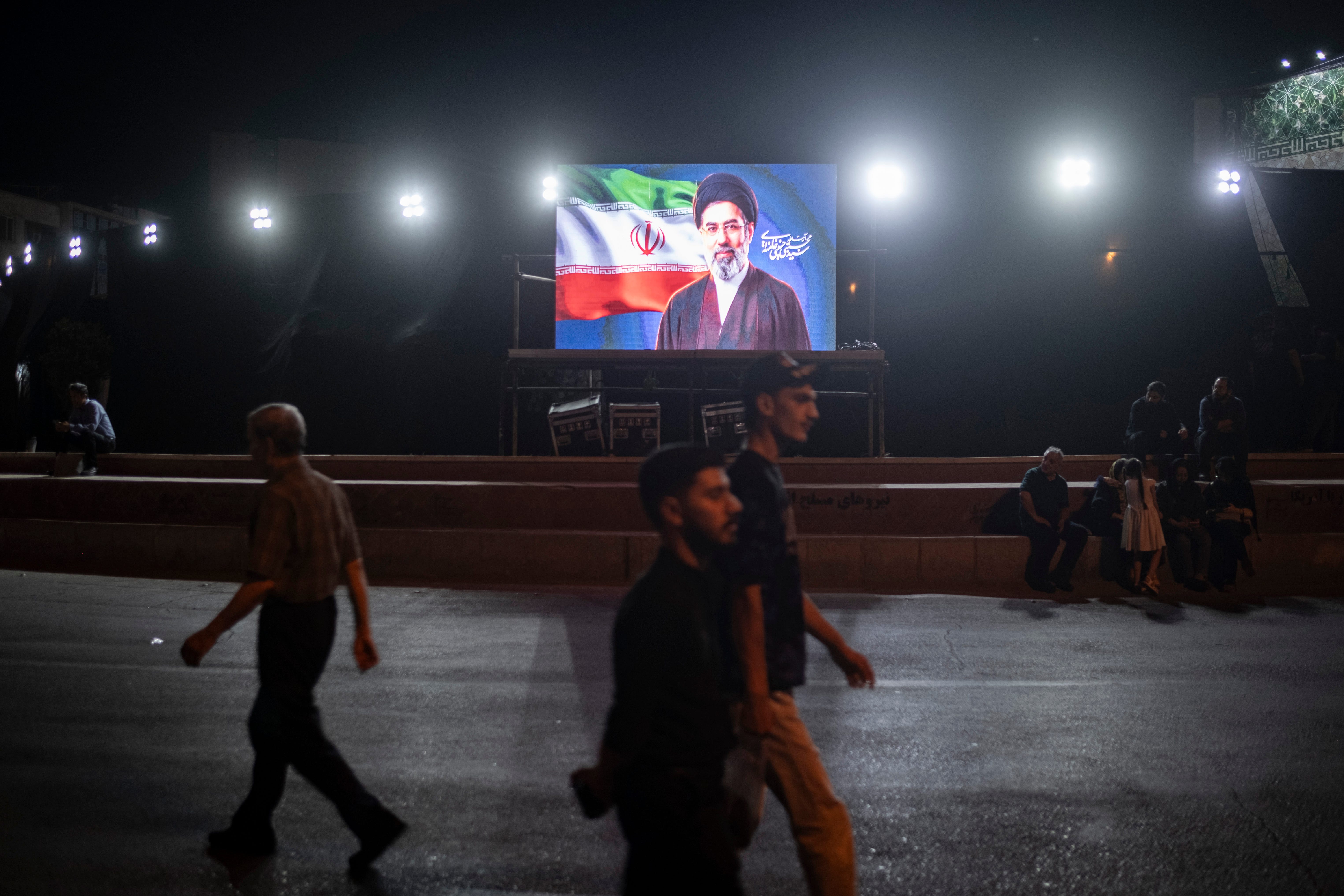
The night before the U.S.-Iran deal was first digitally signed on June 15, hundreds of demonstrators gathered in the streets of Tehran to denounce the agreement. Protesters outside the Iranian foreign ministry waved placards demanding a resumption of the war, even personally denouncing the lead negotiators of the memorandum of understanding, Iranian Foreign Minister Abbas Aragchi and parliamentary speaker Mohammed Bagher Qalibaf, as “capitulators” to the country’s enemies.
Despite a general consensus favoring the deal, which was signed separately by President Donald Trump in Versailles and by Iranian President Masoud Pezeshkian in Tehran on Wednesday, a small yet vocal subset of the Iranian political system has reacted with dismay to the agreement, characterizing it as a strategic mistake and a betrayal of Iranian national interests.
“It seems that they have become more radical than before,” Feresteh Sadeghi, a journalist and political analyst based in Tehran, told Drop Site, referring to the protesters. “Their action and protest movement got too much attention and raised alarm bells among authorities in the country, and the security forces as well.”
In a statement issued on Thursday, Iranian Supreme Leader Mojtaba Khamenei seemed to distance himself from the agreement, saying that he had authorized Iran’s political leaders to sign, while suggesting that he personally did not agree with the deal. Stating that he had a “different opinion,” Khamenei said that he nonetheless authorized Pezeshkian to go forward after “he explicitly accepted responsibility for it.”
The demonstrations in Tehran this week against the agreement were largely driven by supporters of the Front of Islamic Revolution Stability, popularly known by its Persian term, Paydari, an ideologically hardline faction. Paydari has numerous supporters in the Iranian parliament and generally rejects negotiations with the West, believing that Iran can achieve security only through continued confrontation that exhausts the will and capacity of Washington to continue fighting.
Representatives of this trend in Iranian politics also vociferously opposed the signing of the 2015 nuclear deal with the Obama administration, with members of parliament leading protests, threatening negotiators, and even breaking down in tears over the signing of an agreement that many warned at the time would not be honored and would serve only to lay the groundwork for future U.S. attacks against Iran.
The first Trump administration validated these fears in 2018 by violating the nuclear agreement despite Iranian compliance. Egged on by the Israeli government, Trump pivoted instead to a campaign of sanctions, assassinations, and military attacks against Iran termed as “maximum pressure.” That campaign failed to topple the government, but it did transform the Iranian political system—discrediting reformists and galvanizing the conservatives now leading street marches denouncing the prospect of a new deal with Washington.
The terms of the MOU include a permanent halt to the fighting on all fronts, including Lebanon, as well as commitments to end sanctions on the Iranian economy and direct foreign investment into the country, in exchange for Iranian commitments to reopen the Strait of Hormuz and that it will not develop a nuclear weapon. Detailed discussions about the Iranian nuclear program and permanent reintegration of Tehran into the global economy will take place over a 60 day period that is “extendable with mutual consent.”
Despite a broad public perception that the deal is favorable to Iran, and even represents a capitulation by Trump, opponents inside Iran have argued that the agreement actually places serious burdens on Tehran and sets the stage for future American attacks.
Mahmoud Nabavian, a member of parliament from Tehran, has given a series of television interviews opposing the agreement and explaining what he describes as an unfair sequencing of Iranian commitments. Nabavian described the deal on social media as a “pure loss” for the country. “Victory can only be achieved through resistance,” Nabavian said in public comments the day the MOU was digitally signed. “With the current approach, no victory has been won and the threat of war will not be removed from the country.”
Despite such dissent, supporters of the deal remain firmly in the drivers’ seat of policymaking. In a series of audio messages, Mahdi Mohammadi, an advisor to Ghalibaf, explained the relative benefits of the agreement, seeking to assuage critics’ concerns and comparing the MOU favorably to the 2015 nuclear deal, saying the war had given Iran powerful leverage to ensure that the U.S. would not renege on its commitments once again.
“The strait is in our hands, we can close it any time we want,” Mohammadi said, adding that unlike in 2015, the Gulf Arab countries have now also been forced to compromise with Iran, including through investments and repatriation of frozen Iranian funds intended to prevent the resumption of a war that had devastated their own economies.
These arguments appear to have been broadly convincing, even as the threat of war continues to loom over Iran after two sneak attacks by the U.S. and Israel over the past two years.
“I think the Israelis will do their best, perhaps even abetted by the neocons in Washington, to reignite the war somehow,” Ali Kolahi, former chairman of Iran’s Industry Commission in the Iranian Chamber of Commerce, told Drop Site. “But I also think the leaders of the country think that if the U.S. tries to go for the jugular again, we can again close the Strait of Hormuz and go for horizontal escalation. We may have other bits and pieces that we haven’t yet shown.”
While the original nuclear agreement made with the Obama administration was sold as the first step towards a broader reconciliation with the West, the new arrangement is being presented to supporters of the government as a purely pragmatic arrangement—entered into with “no trust” towards Washington and a continued readiness to return to armed confrontation if necessary, thus avoiding the perceived mistakes of the pro-Western reformist camp.
“The liberal camp has definitely lost the narrative in Iran compared to 2015, when they kind of had the upper hand and they were able to execute some of their policies, some of their more West-leaning, more conciliatory policies. We saw what came out of that, the U.S. did not respect any of that, and they attacked Iran,” said Navid Zarrinal, a political analyst and historian based in Tehran. “The biggest concern is essentially their naivete about the nature of the West.
We talk to a lot of these liberals. They say that if Iranians just stop saying ‘death to America’ and act like a normal country, everything would be resolved. But that’s not the case.”
Zarrinal explained, “We saw it with Syria—Syria basically surrendered to U.S. and Israeli demands, but Israel still bombed their defensive infrastructure. If the moderates get their way, I can guarantee you that Israel would still bomb Iran’s defensive infrastructure the next day.”
Economic Pressure
A major factor pushing even a government heavily influenced by the Islamic Revolutionary Guards Corps (IRGC) to seek detente with the U.S. is the dire economic condition inside Iran after years of sanctions and the destruction of Iranian civilian infrastructure during the recent war. Several million Iranians are believed to have lost their jobs directly or indirectly as a result of the recent fighting, blockade, and internet shutdown. The International Monetary Fund now projects that Iran’s GDP will contract by 6% in 2026, with consumer prices rising nearly 70% during the same period.
The Iranian economy is dominated by a network of semi-governmental institutions with ties to the security establishment. These firms largely control the flow of imports, exports, and energy resources, and are also tasked with navigating the complex web of sanctions the country faces when trading abroad and repatriating funds from the sale of oil and gas.
For conservative skeptics of the MOU, who doubt the deal will bring a durable end to the war, these powerful business conglomerates are seen as the forces pressing the government hardest to move forward. Known in Persian as “khusulati”—a blend of the words for “private” and “government”—these firms stand to regain access to billions of dollars of frozen funds, as well as new business opportunities in Iran’s oligarchical economy.
“It is likely they were behind the scenes pushing for an agreement because their trade and business interests had been jeopardized, especially in the UAE. We know that in the first weeks of the war, the UAE had confiscated their money and shut off access to their bank accounts. They are the ones who wanted this deal so their business returns to normal, and authorities listen to them because they have power in the economy,” said Sadeghi, in reference to the “khusulati” firms. “Ordinary people or even politicians who oppose this deal or memorandum of understanding are the ones who don’t have any financial interest in this matter.”
Sadeghi added that she believes that despite the seemingly attractive promises of economic relief contained in the MOU, past experience, including attacks on Iran during negotiations in 2025 and 2026, suggests the two countries will fail to find a final detente that settles the conflict or permanently lifts sanctions.
“I personally think that Iran and the United States will not reach any agreement whatsoever,” she said, adding that the U.S. was “addicted to sanctions and bullying.”
Polarization or Sedition
While the Iranian government has engaged in successive waves of crackdowns against liberal and monarchist opponents, ethnic separatists, and even disillusioned conservative political figures, the tensions with the small group of committed opponents of the current agreement with Washington may lead to a rare confrontation with a segment of the political system to its right.
Members of the broad political establishment who support the deal have warned against further public dissent, characterizing recent demonstrations as an attempt to create unrest in a country still reeling from a failed uprising that killed thousands in January. “Mossad is awake at night to create sedition,” said Hesamodin Ashna, an advisor to former President Hassan Rouhani in a public statement seen as a warning to opponents of the MOU. “Do not polarize society, Do not camp on the street.”
For the time being, proponents of the agreement appear likely to continue the peace negotiations with Washington.
The agreement, which will also require the U.S. to pressure Israel to end its assault on Lebanon, now depends on whether Iran has successfully created enough deterrence through its missile attacks and closure of the strait to prevent Trump from resuming the war later in his term.
“If Trump doesn’t experience real pain, he will be planning for his next attack,” said Dr. Foad Izadi, a professor at the University of Tehran, explaining the perspective of Iranian opponents of the deal. “What this faction wants to see is for the pain to be great enough that next time someone in the White House argues for an attack on Iran, he will be ignored.”
Thanks, Maz. Great piece. I'm not surprised at all by the range of views in Iran right now - particularly the more "hard-line". Though economic relief is without doubt necessary for average people, I can understand that some feel like there's unfinished business. When I consider that the US has been, in one form or another, attacking Iran since 1953 - it makes some type of sense that "this" isn't a just resolution, or perhaps even a decisive one. I hope for the best..
I feel like Trump has come up with a possible business venture that is more lucrative than the Mar-a-Gaza resort he touted in 2025. If so, and agreement will likely be reached. If not, not.