

Israel Bombs Palestinians in Beach Tents in Gaza
“This area is made up of tents sheltering civilians—displaced people, people who lived through oppression, humiliation, famine, war and siege. And the whole place was bombed.”

Drop Site is a reader-funded, independent news outlet. Without your support, we can’t operate. Please consider becoming a paid subscriber or making a 501(c)(3) tax-deductible donation today.
Story by Mohamed Ahmed and Abdel Qader Sabbah
KHAN YOUNIS, Gaza Strip—Eleven-year-old Ahmed Al-Raqab was playing outside his family tent pitched on Gaza’s sandy coastline in Al-Mawasi, west of Khan Younis, on Wednesday when the Israeli missile struck, killing him and severely wounding several others.
“The children were playing and they fired a missile directly on them,” Ahmed’s father, Sabri Al-Raqab, said, sobbing as he knelt on the floor of Nasser hospital with his arms across his son’s dead body in a final embrace. “He was carrying a watermelon. What was this child’s crime? He picked up a watermelon and they fired at him. Is he a fighter? He’s not a fighter. He’s a child.”
Overcome with grief, Al-Raqab buried his face into his son’s, which was caked with blood, and wept uncontrollably. In a nearby room, a six year old child wounded in the same attack screamed in pain as blood from a gaping wound in his right eye covered his cheek and ear. He was carried into the hospital in the arms of a teenage relative who laid him down shouting, “Come attend to this boy. We are losing the boy, we are losing him.”
The child’s grandfather, Ahmed Al-Jarjawi, stood nearby, the front of his jalabiya stained deep red with blood. “We were just sitting and the strike landed next to the our tent and hit three other tents,” Ahmed Al-Jarjawi told Drop Site News. “This child lost his eye. I was wounded here,” he said pointing to his chest. “My son’s wife was also wounded in the upper part of her leg.”
Dead and wounded children arrive at Nasser hospital in Khan Younis after an Israeli airstrike on a tent encampment in Mawasi Khan Younis on June 24, 2026. Video by Mohamed Ahmed.
The latest Israeli attacks on children came a day after a UN Independent International Commission of Inquiry released a report that concluded, “Israeli authorities and security forces have deliberately targeted Palestinian children, resulting in genocide, crimes against humanity and war crimes in the Gaza Strip.” The UN inquiry said that during the first two years of the Israeli assault, over 20,000 children were killed and more than 44,000 injured.
Since the so-called ceasefire went into effect in October 2025, Israel has killed at least 265 children and wounded hundreds more in Gaza, according to findings released last week by the UN children’s agency UNICEF. “During a period supposedly defined by restraint and protection, a child has been killed, on average, every single day for more than eight months,” UNICEF spokesperson James Elder said in a statement. “That is an absurd and devastating figure.”
Israel’s attacks on Wednesday targeted several areas of Gaza’s coastline where thousands of displaced Palestinians live in dilapidated tent encampments. The encampments by the sea lie as far as possible from the “yellow line” where Israeli troops are stationed and are steadily encroaching further westward. Yet Israel has repeatedly bombed Gaza’s beaches, killing Palestinians living in the barest part of the enclave.
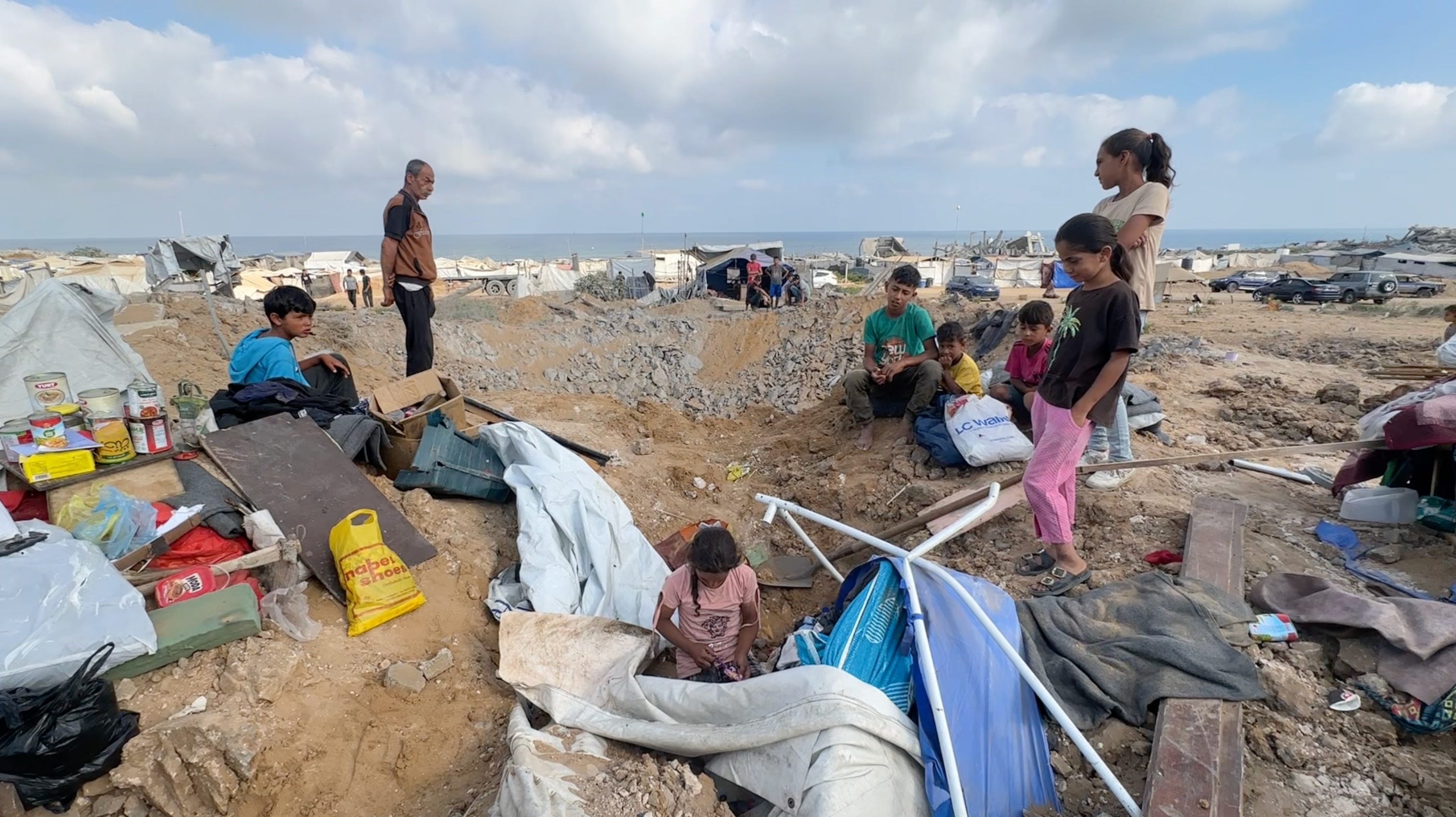
One of the airstrikes overnight hit a tent encampment on the coastline west of Gaza City. Israel warned of the strike minutes before, prompting families to flee towards the sea before the missile struck, destroying several tents and leaving a massive crater in the sand.
“We were sleeping, it was night. We heard sounds of commotion and disturbance so we went outside to see what was happening, and we found that everyone, in the whole quarter, the whole encampment, was evacuating. We left with them,” said Ahmed Yassin, who lived with his wife, five children and other relatives in two tents pitched on the sandy dunes. He spoke in a low, wearied voice. “We took our children, they were sleeping. My mother is elderly and disabled. She’s ill. We barely managed to get out in the final moments.”
Behind him, children picked through the ruins of the tents, trying to salvage whatever they could from the detritus. “We have no place, no shelter, nothing. Where are we supposed to go? We have no idea. From the beginning of the war until today, the attacks have never stopped. It didn’t stop. A truce, a ceasefire—where is the ceasefire? What are they talking about? Bombing, destruction, shelling. The war is ongoing,” Yassin said.
Members of the Yassin family next to their destroyed tents on the coastline west of Gaza City after an Israeli airstrike on June 24, 2026. Video by Abdel Qader Sabbah.
The Yassin family was displaced from their five-story home in Al-Zeitoun neighborhood of Gaza City early in the war. They went south, where they were displaced several times again before returning north after the “ceasefire” went into effect. Ultimately, they ended up in a tent on the coastline.
“Al-Zeitoun is a dangerous area, today there is no one there. The area we used to live in is basically nothing but a demolition zone,” Yassin’s wife, Rana, said. “This area here was made up of tents sheltering civilians—displaced people, people who lived through oppression, humiliation, famine, war and siege. And the whole place was bombed, the entire area was destroyed.”
She continued, “Today, as you can see, we are sitting on the rubble of the tent and one doesn’t know where to go or what to do. Everything is gone. You want tents—everything costs money. You want wood—everything costs money. You want mattresses, sheets, blankets, clothes for the children. The children only have the clothes they were wearing when we fled the area. Other than that there is nothing. There is nothing.”
As temperatures soar in the summer months, Palestinians in Gaza have little recourse from the heat and access to clean water is an ordeal. The Israeli military has targeted water pipelines, sewage systems, and desalination plants, damaging or destroying nearly 90 percent of water infrastructure in Gaza, according to Doctors Without Borders (MSF).
“Palestinians in Gaza face engineered water scarcity,” MSF said in a report. “Families often prioritize drinking over cooking or washing, limit personal hygiene, and rely on unsafe or saline sources when humanitarian deliveries are interrupted.”
For displaced families living on the coastline, water is even scarcer, causing some Palestinians to resort to digging their own wells in desperation.
Mohammed Zayed, who was displaced from Beit Lahia to a tent on the beach west of Gaza City, dug a makeshift well outside his tent using simple tools. “We were displaced from our land in northern Gaza and are now living on the seashore. We suffered tremendously, an indescribable hardship, due to the lack of water. We had to wait for water trucks, walk long distances and spend hours under the sun, just to sometimes get a single gallon of water. Other times, we would return empty handed—unable to meet our daily needs and with no water,” Zayed told Drop Site. “We were forced to go to the sea. The seawater is salty, but we would collect and use it despite the great difficulty. We tried to carry on with our lives, but we could not endure living without water or basic necessities. So, thank God, I worked hard and dug this well next to my tent.”
Mohammed Zayed dug a well by his tent on the coastline west of Gaza City where access to water is scarce. June 24, 2026. Video by Abdel Qader Sabbah.
Zayed’s makeshift well is small but effective. It stands about a foot in diameter, with plastic running down the sides leading up to a narrow open pipe jutting out of the ground. He lowered a tin can on a rope a few meters deep and brought out fresh water, slowly filling a plastic bucket. “The water is very fresh. It has eased my hardship and the hardship of those around me. Displaced people from the surrounding tents come here to fill up with fresh water,” Zayed said.
With soaring food prices, Zayed also used the water to irrigate a small vegetable garden he constructed beside his tent growing eggplants and zucchini. “I dug the well, found water, and managed to grow vegetables. This has greatly reduced the suffering of those around me,” he said. “We live in tents and in these tents we face so many hardships: Heat, cold, insects, rodents and sand. The sand itself causes us suffering. It gets into our bedding, our clothes, and affects our children…They develop itching and pimples on their bodies from the sand, the sea and the heat. May God ease our suffering.”
Sharif Abdel Kouddous and Jawa Ahmad contributed to this report. Sami Vanderlip edited the video.
 | A guest post by
|
My heart is beating so fast with sheer f.cking rage.
The did this in 2024. Same place Al Mawasi.
Its as if it is punishment for the UN Commission concluding what we all know. Genocide. Deliberate targeting of children.
I see people around me totally oblivious to the brutality and suffering that Palestinians have to suffer
Will Andy Burnham condem Israel?
I think not sadly
When a population is marinated in racist hate and supremacist ideology from birth, this is the guaranteed result. The soldiers carrying out these atrocities don't see them as wrong at all--they are gleeful that they get to participate and destroy as many lives as possible. This is why the Zionist entity must be completely dismantled and its population needs to be sent to reeducation campus to (try to) reinstitute their humanity.