

Janet Mills Is Flopping in the Fight for Maine Senate
New FEC data from the Maine governor's Senate campaign show waning voter enthusiasm.


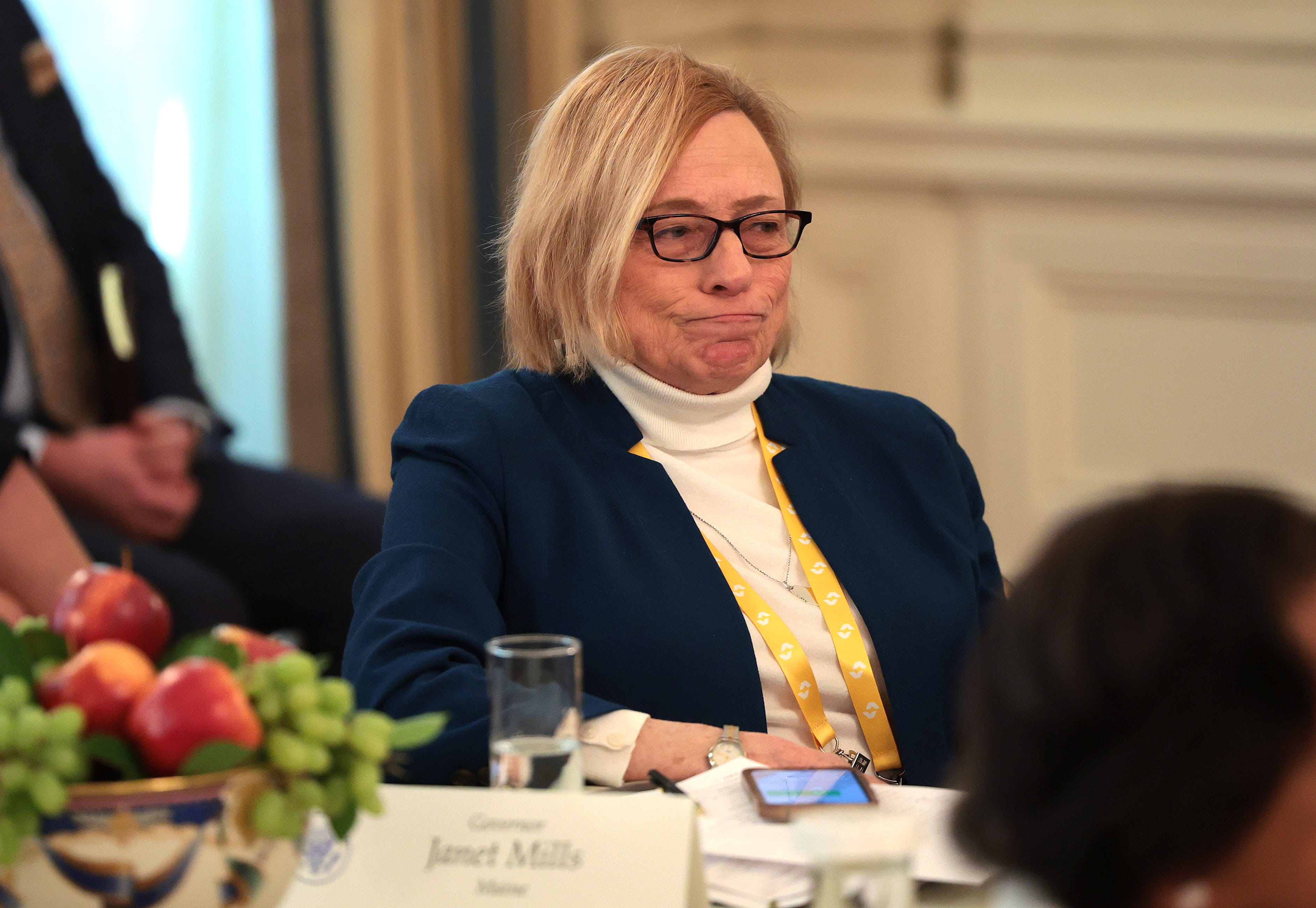
LEWISTON, Maine—The day after Janet Mills launched her Senate campaign in mid-October, she made a major announcement that spoke to the energy behind her effort to blunt the momentum of oysterman Graham Platner: She had raised a million dollars in the first 24 hours, with “98 percent of the donations $100 or less.”
But Mills has now filed her fundraising records publicly, and the numbers paint a different picture.
According to records filed with the Federal Election Commission, Mills raised $465,000 in what are known as “itemized contributions” within the first day of her campaign. To be itemized, the contribution is generally at least $200. That would suggest 46.5% of her $1 million came from larger contributions—and not those giving less than $100.
The clever ambiguity in the wording of “percent of donations,” however, could also mean that out of every 100 donors, only two were donations over $100. In other words, when Mills’s campaign wrote that only 2 percent were from those giving over $100, she’s counting a donation of $5 and a maximum contribution of $3,500 as one each. In Mills’ case, she raised the maximum allowable amount from 36 people on the first day.
But if the million-dollar claim is true, it also suggests her campaign has sputtered out. Let’s assume that she raised, as she claimed, at least $535,000 in small contributions in the first 24 hours. That’s not bad at all, even if it’s not the million from small donors that was strongly implied.
The problem is that for the entire fourth quarter of 2025, she raised just $822,000 in small contributions. That would mean that, after raising more than a half million in one day from regular people, she raised just $287,000 more over the next two and a half months. As a candidate, some drop off after launch day is expected, but to drop that far and that fast raises major concerns about how much momentum there is behind her bid, especially considering that the Democratic Party in Washington has turned on its small-dollar fundraising program for Mills. The party has carpet-bombed inboxes on her behalf, but people seem not to be responding.
The Mills campaign did not respond when asked to clarify these day-one fundraising issues.
In-state fundraising data this quarter tells a similarly worrying story for the Mills campaign. It’s nice to get money from California, but that doesn’t tell you anything about how popular you are in Maine. While the governor leads her U.S. Senate opponent Graham Platner in total dollars from within Maine, about $700,000 to $500,000, Platner has a significant advantage in volume of small-dollar donations across the state.
The quarterly report shows Platner with 2,119 donations below $150 this quarter. Gov. Mills had 1,075 small-dollar donations, about half of Platner’s base. So Mills is beating Platner when it comes to the wealthiest Mainers, while Platner is beating her handily among regular people. The problem for Mills is that she will quickly run out of rich people at the polls.
In southern Maine counties, where more than 53% of registered Democratic Primary voters live, Platner had almost three times as many small-dollar contributions as Mills. In the remaining central and northern Maine counties, Platner nearly doubles Mills in small-dollar donations, despite—or perhaps because of—Mills’s long history in the state.
“25,609 Mainers have already volunteered for or donated to our campaign,” the Platner Campaign said in a February 5 post on Twitter. “For context: Only 63,384 people voted for Janet Mills in the 2018 primary.”
The lack of enthusiasm gleaned from Mills’s fundraising data matches on-the-ground accounts from Maine. During the ICE surge, Gov. Mills’s approach to opposing the federal agency’s presence left community leaders feeling unaligned with her campaign.
Mills Out
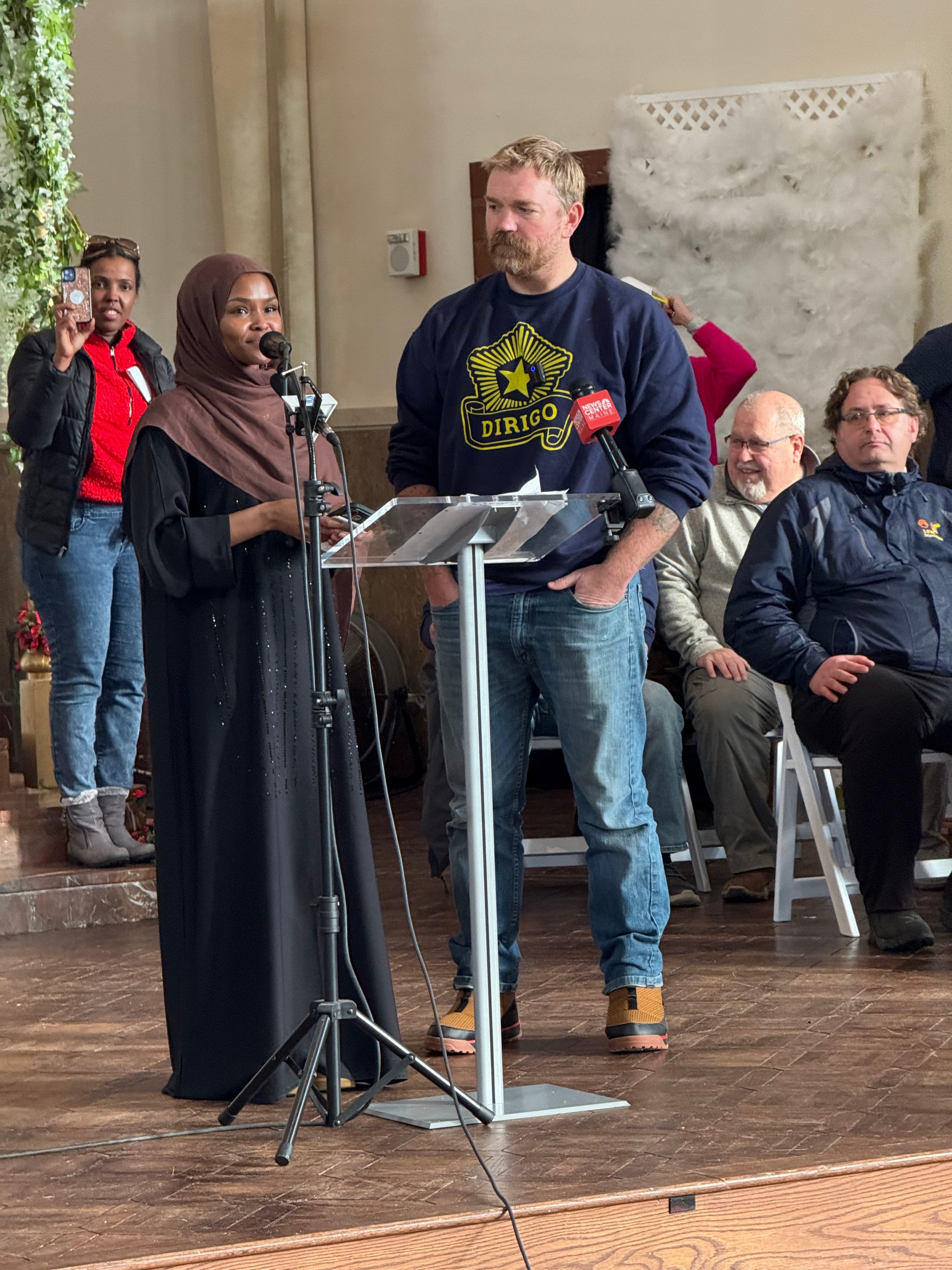
On January 24, the morning that federal agents murdered VA nurse Alex Pretti in Minneapolis, more than 500 Mainers packed into the former St. Patrick’s Roman Catholic Church, a towering gothic brick structure overlooking Lewiston’s Kennedy Park.
Despite sub-zero conditions, the crowd gathered for the state’s first large-scale ICE protest, an “ICE THEM OUT” rally. That week, masked federal agents launched “Operation Catch of the Day,” a mass deportation campaign aimed at the nearly 6,000 Somalis who live in Maine. By operation’s end, the administration claimed to arrest over 200 “immigrant offenders.” Many of these Mainers are now being held at a Massachusetts facility attorneys found to have “inhumane” conditions.
The Lewiston event featured many of the state’s prominent Democratic politicians.
Speakers included Platner, as well as gubernatorial candidates Shenna Bellows, Troy Jackson, Hannah Pingree, and Angus King III; Lewiston Mayor Carl Sheline and Portland Mayor Mark Dion, the leaders of Maine’s two largest cities; and Rep. Chellie Pingree.
Gov. Mills was notably absent.
“Governor Mills did not reach out to me, or to the organizing team ahead of the January 24 rally, and none of her staff contacted us either,” Former Lewiston city councilor and lead organizer of the ICE THEM OUT protest Safiya Khalid told Drop Site News. “There was no indication of interest from the Governor or her team.”
The day ICE launched its Maine operation, Mills was caught jetting off to California. Dinner invitations obtained by Axios reveal Mills planned to attend a trio of big-money Senate fundraisers in San Francisco and the Silicon Valley on Wednesday, and the East Bay on Thursday. The Wednesday invitation described an “intimate dinner” in San Francisco’s financial district. Suggested donations ranged from $1,000 to $7,000—the maximum donation for both the primary and general.
“Governor Mills has been focused on leading our state through this moment by standing up to Donald Trump, calling out Susan Collins’ failures, and most importantly working to defend Maine people,” said campaign spokesperson Tommy Garcia in a statement. Garcia was also employed by the state Democratic party. “Maine people know Janet Mills has their back and is focused on keeping Maine safe, not scoring political points.”
The campaign also provided Drop Site a bulleted list with links to several press statements highlighting actions Gov. Mills has recently taken against ICE. This list included details on requesting a meeting with Trump, writing a letter to the administration, and “slamming” Congress for advancing DHS funding without any reforms or measures.
For Khalid, who in 2019 overcame waves of racist smears to become the first Somali-American and youngest person ever elected to the Lewiston City Council, more meaningful actions would involve a structural “end to militarized enforcement models that destabilize communities.”
“We need leaders who are unequivocal in defending marginalized and vulnerable communities, not leaders who remain within the comfort of the political establishment,” Khalid said, “If you are running for office, you should be clear about whether you support dismantling an agency that has caused documented harm across this country.”
Platner, who spoke in Lewiston alongside Khalid, similarly believes the agency’s “institutional culture and total lack of accountability” cannot be reformed. He described the ongoing Chuck Schumer-led DHS negotiations as “acquiescence.”
“It just goes to show how out of step leadership in the Democratic Party is with membership,” Platner told Drop Site News. “I’ve been going all over the state of Maine. Every Democrat I talk to thinks ICE needs to be dismantled. People don’t think this agency deserves a single dime.”
“We watched Renee Good and Alex Pretti get shot from effectively every single possible angle,” Platner continued. “The idea one more camera would change that is insane.”
On January 30, six days after Mills was a no-show at the Lewiston rally, a city-wide service worker strike took place in Portland, Maine’s largest city. Almost 200 businesses shut their doors to protest ICE. Thousands of people marched through the city, ending at the Sailor and Soldier statue, a monument honoring Mainers who died defending our country during the Civil War, clearly symbolic of the current political moment.
At this event, one of the largest protests in Portland’s history, Mills was again absent. That evening, Mills was photographed dining at Scales, an upscale seafood restaurant in Portland’s gentrified Old Port District. The pictures from Mills dinner have now been viewed millions of times across platforms.
“Statements are not the same as standing with impacted communities. If elected officials say they oppose aggressive ICE tactics, that opposition should be visible and consistent,” Khalid said. “Right now, many people do not feel that level of alignment from the governor.”
Correction, February 14, 2026: Tommy Garcia, the Mills spokesperson, is no longer employed by the state Democratic party.
 | A guest post by
|
Mills is walking the walk of too many Democratic leaders like Schumer, Gillibrand et al. They've got to be replaced and the sooner the better with the midterms looming closer every day.
The most telling number in this piece isn’t the dollar totals — it’s the small-dollar donor gap. When a candidate relies disproportionately on maxed-out checks while their opponent is stacking up twice as many grassroots contributions, that’s not just a fundraising difference. That’s an enthusiasm difference.
If Gov. Janet Mills wants to frame this race as a defense of Maine against the excesses of Donald Trump and a rebuke to Susan Collins, then she has to actually show up where Mainers are organizing and demanding action. Fundraisers in Silicon Valley while hundreds gather in Lewiston against ICE raids send a message — whether intended or not — about priorities.
Small donors aren’t just line items in an FEC report. They’re a proxy for volunteer energy, turnout, and narrative momentum. If Platner is doubling her in small-dollar volume across southern, central, and northern Maine, that should set off alarm bells for any campaign that assumes name recognition is enough.
You can’t substitute establishment backing for visible solidarity. In this political moment, statements and letters don’t carry the same weight as standing in the cold with your constituents. If Mills wants to win this primary, she may need to rethink not just her fundraising mix — but her posture toward the grassroots energy reshaping Maine politics.