

After Trump's Bailout, Argentina's So-Called Libertarian President Issues Emergency Decree to Ramp Up Surveillance
Milei, who has regularly defended Israel’s genocide in Gaza, was also invited to join Trump’s Board of Peace.

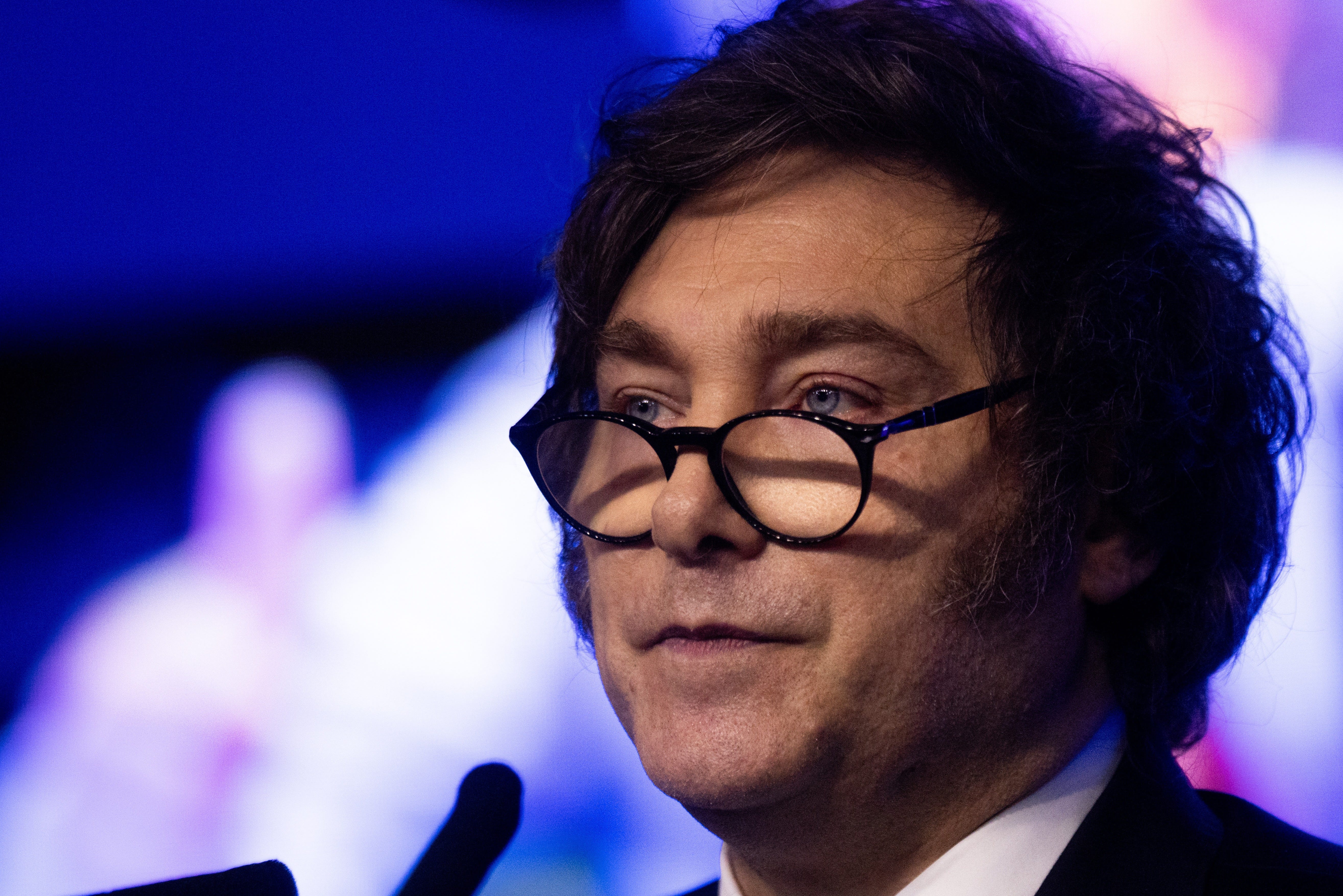
Argentine President Javier Milei closed out 2025 by quietly issuing a decree that centralizes the country’s vast intelligence apparatus and give its intelligence agencies authority to apprehend individuals without prior judicial order.
Decree 941—issued on December 31, during legislative recess—reorganizes all intelligence agencies, including military intelligence, under the State Intelligence Secretariat (SIDE), which will report directly to the General Secretariat of the Presidency. The current General Secretariat of the Presidency is the president’s sister, Karina Milei.
CELS, a leading human rights organization in Argentina, published a statement labeling the decree as “unconstitutional” and warning that the order, known as a Necessity and Urgency Decree (DNU) grants SIDE, “powers characteristic of a secret police force, including detention authority, and establishes a legal framework for the surveillance of the entire population under conditions of extreme secrecy.”
When Milei first came to power in 2023, he was a far-right outlier in South America, with most surrounding countries having center-left governments. Last year saw a shift, with far-right governments coming to power in Bolivia and Chile, but most importantly Trump’s return to the White House. Figures like Milei are emboldened, carrying out U.S.-aligned agendas which pair greater state repression with economic reforms that impose austerity on working people and open resources to foreign extraction.
Milei, who has regularly defended Israel’s genocide in Gaza, was also invited to join Trump’s Board of Peace. The international body, created by Trump with U.N. approval, was established to task foreign government’s with administering Gaza’s future. Trump has signaled that he intends for the Board to play a role in global conflicts beyond Gaza.
Governments in Latin America and the Caribbean aligned with the United States have paved the way for a more aggressive U.S. presence in the region. For example, Trinidad and Tobago installed U.S. military radar systems as part of U.S. build-up in the region, directed against Venezuela, while Panama has authorized U.S. troops to operate from strategic air and naval facilities.
“It means transforming the SIDE into a force with parapolice characteristics and greater power to persecute opponents, trade unions, and other social organizations or journalists who are not to the government’s liking,” Christian Castillo, a member of parliament for the province of Buenos Aires with the Socialist Workers Party (PTS) told Drop Site.
Castillo added that the way the DNU was passed breaks norms, as there is no apparent emergency to justify the decree, and the president is expressly prohibited from using DNUs to legislate in the criminal sphere.
At a press conference on January 2, Myriam Bregman, a PTS congressional deputy and former presidential candidate from the FIT-U coalition of left-wing opposition parties, railed against the maneuver. “Decrees of Necessity and Urgency are not meant to be put forward when Congress is in recess. That is not their function. What would be the ‘urgency’ of implementing this on the last working day of the year?” Bregman, a lawyer who formerly represented victims of Argentina’s military dictatorship, added, “in terms of legality, it is completely illegal. You cannot decree on the life, liberty, and personal information of all inhabitants.”
Under Argentina’s political system, DNUs are automatically treated as law and can only be overturned if rejected by both houses of Congress, meaning that Milei can already begin using the decree to surveil and apprehend political opponents. Milei’s ruling La Libertad Avanza party doesn’t have enough votes to uphold the decree on its own but Congress is not set to return from a legislative break until March.
This is not the first time that Milei has sought to expand repressive powers. Shortly after winning the country’s 2023 election as an “outsider” candidate, the self-described anarcho-capitalist president tried to pass an omnibus bill. Along with an array of shock-therapy deregulations to the country’s economy. The bill included anti-protest measures which threatened six years of imprisonment for participants of demonstrations as small as three or more persons. The bill was eventually defeated in Congress, but it was an early signal of Milei’s willingness to expand his power through nakedly authoritarian policies.
“There’s more repression and it’s growing,” Ernesto Semán, a historian of modern Latin America, told Drop Site. “There’s a lot of intelligence activities during the rallies. Plainclothes people, people infiltrating in the organizations, drones filming the whole thing, totally disproportionate presence of police and militarized police forces.”
Trump’s Man in Argentina
Milei is acting more aggressively after his party came out ahead in legislative elections last October. The win was a boost for Milei after a year that had been marked by plummeting approval for the president, fueled largely by his connection to a crypto-currency scam and opposition to some of his extreme austerity measures.
The Trump administration aided Milei’s victory by conditioning a $40 billion economic bailout for the country on the electoral success of Milei’s party. The administration would go on to pull a similar move in Honduras’s presidential election.
Trump has made clear in his National Security Strategy that his top foreign policy priority is establishing U.S. dominance in Latin America. Recent direct U.S. intervention in this region includes an attack on Venezuela that saw President Nicolás Maduro and his wife Cilia Flores abducted and taken to the U.S. However, Washington has also expanded U.S. influence by backing far-right presidential candidates throughout the region. Alongside other regional figures such as El Salvador’s Nayib Bukele, Milei has been one of Trump’s closest regional allies.
The two presidents have repeatedly praised one another, with Trump describing Milei’s administration as, “MAGA all the way, Make Argentina Great Again.” Milei’s economic chainsaw agenda—named because it aims to heavily slash government spending through free market reforms—is an inspiration for Trump’s ongoing deregulation of the U.S. federal government.
“What [Milei] offers is a strongest possible emphasis on social order, on restoring hierarchy, and a very strong presence of government in restoring that kind of social order,” Semán told Drop Site.
Argentina is also a strategic country for the United States. It’s home to a vast workforce and resources including some of the world’s largest lithium reserves. The country also plays an influential role in political affairs throughout South America, making it an asset for U.S. aims in the region even before Milei took power.
In 2019, under the former administration of Mauricio Macri, Argentina drew up plans for a military operation against Venezuela in support of U.S. regime change efforts during Trump’s first presidency. From April to July 2019, Argentina’s army held several military exercises which simulated invading Venezuela. These exercises took place alongside a “maximum pressure” campaign by the Trump administration intended to oust president Maduro.
Milei has offered even greater subservience to U.S. regional ambitions, but this agenda has not come without resistance from diverse sectors of Argentine society including retirees, students, workers, and left-wing opponents in government, groups that could be targeted by the expanded surveillance powers of Decree 941.
 | A guest post by
|
Poor Argentina. Just about 40 years since the last military dictatorship 1976-83, with fundamental support from the US, disappeared and killed around 30,000 people, one of whom turned up in 2025 aged 40+, he was stolen as a baby after his mother gave birth to him in a secret prison. He was reunited with his sister. Leonardo Fossati said
I”It was a gift of life to regain my identity. And it's only fair that other people who are going through the same thing know the truth. We urge the world's societies to call on Argentina to respect human rights” there are concerns that the work to trace others will be shut down by this new law, it is already tried and tested during The Dirty War.