

"Ask Jeffrey": Epstein Ran Wexner's Pro-Israel Philanthropy Machine, Emails Reveal
The Wexner Foundation has long claimed Epstein "did not make decisions regarding the use of Foundation’s funds.” New emails show that is flagrantly false.


Our latest article on the life and times of Jeffrey Epstein is based on a cache of emails obtained by the whistleblower nonprofit Distributed Denial of Secrets, which provided access to them to Drop Site News. The cache includes the undisclosed names of Epstein victims as well as explicit images, meaning it can’t simply be published in whole without some redactions. But many of the messages can quickly be made public, and to that end Drop Site is collaborating with the team that built Jmail to make new emails available and searchable there, beginning this week, and rolling out continuously as we vet the remainder of the cache. (Jmail is a searchable inbox of Epstein’s emails that mimics Gmail.)
None of this work would be possible without our growing base of subscribers. When we launched, we set a goal of reaching a million subscribers, and 20,000 paying subscribers, by our second year, which will come this summer. We’re now just under 15,000. If you can help us hit our goals, that will mean this kind of journalism can’t just be sustained, but can grow.
We have a commitment to ensuring that our journalism is not locked behind a paywall. But the only way we can sustain this is through the voluntary support of our community of readers. If you are a free subscriber and you support our work, please consider upgrading to a paid subscription or gifting one to a friend or family member. You can also make a 501(c)(3) tax-deductible donation to support our work.
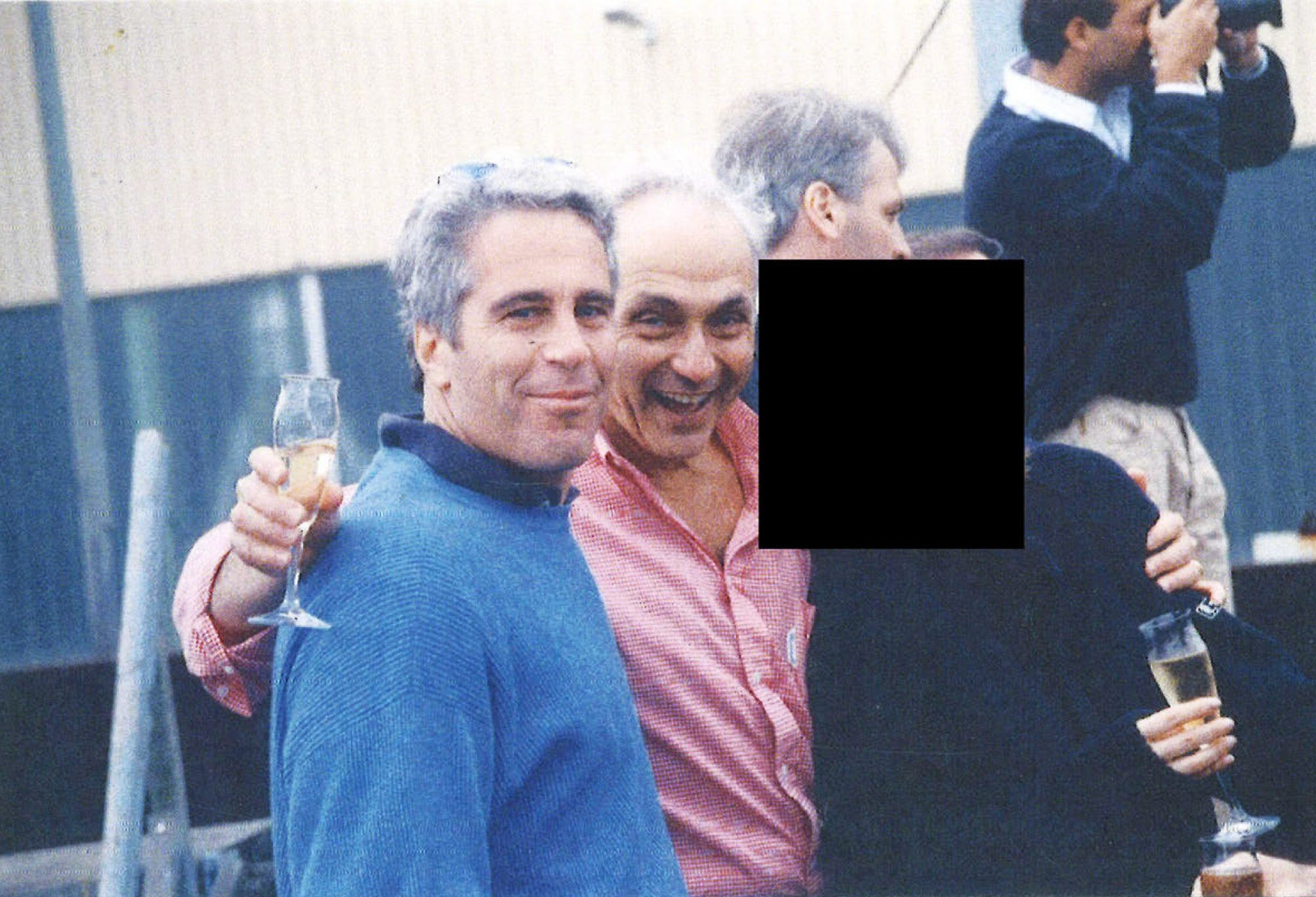
Six months after Jeffrey Epstein’s death in August 2019, the philanthropic foundation founded by billionaire fashion tycoon Leslie Wexner published an “independent review” of Epstein’s involvement in the organization, in response to concerns raised by donors and alumni of foundation-funded programs. The Wexner Foundation is one of the largest contributors to pro-Israel causes in the U.S.
The review claimed that Wexner Foundation staff had “no contact” with Epstein after his resignation as a trustee in September 2007, and, before that, he had “played no role in the management or administration of the Foundation’s operations,” had “no meaningful role in the Foundation’s budget [or] finances,” and “did not make decisions regarding the use of Foundation’s funds.” None of that is true.
Hundreds of leaked emails from Epstein’s Yahoo inbox, spanning from 2005 to 2008, contradict the Wexner Foundation report. Inside the Wexners’ family financial office in Ohio, staff treated Epstein as de facto chief financial officer, where major decisions about taxes, lines of credit, eight-figure funds transfers, and politically sensitive grants were routed through Epstein’s lawyer, and required Epstein’s approval.
The new email cache was vetted and published by Distributed Denial of Secrets, and contains many of the same forensic signatures as the dataset reported by Bloomberg earlier this year. Officials from the Wexner Foundation, the law office that conducted the review, and Epstein’s former legal counsel did not respond to requests for comment.
The emails show that Darren Indyke, who served as both Epstein’s personal lawyer and attorney for the foundation, was the “middleman” in such communications, cloaking Epstein’s foundation-related activities with attorney-client privilege. Indyke is also the executor of Epstein’s estate, which has been accused of “obstructionism” for withholding “privileged” emails from civil lawsuits and congressional subpoenas. The Wexner Foundation’s independent reviewers did not have access to the emails published here, because, according to the 2020 report, “the Foundation’s archive of emails does not go back to Epstein’s time as a Trustee.”
On paper, the Wexner family’s philanthropic foundation and their retail empire, once home to Victoria’s Secret, Abercrombie & Fitch, and Bath & Body Works, were legally separate and largely had their own staff. But, in practice, as is typical of such foundations, one small family office sat over both the family’s fortune and philanthropy. Internal emails between Epstein, Indyke, and Wexner’s staff show Epstein as the effective boss of the family office, and the real gatekeeper of the Wexners’ money.
In email after email, Wexner financial controller Peg Ugland wrote to Indyke with account balances for a web of Wexner entities—charitable trusts, private investment vehicles, and personal trading accounts—with a recurring refrain: “Please ask Jeffrey if I can transfer.”
Epstein was the final authority on which Wexner entity should cover which expense, how to move assets between entities, and whether to approve large funds transfers for the Wexners’ accounts. Epstein continued to advise on IRS filings and multi-million dollar transactions until at least December 2007—two months after he had supposedly resigned as trustee.
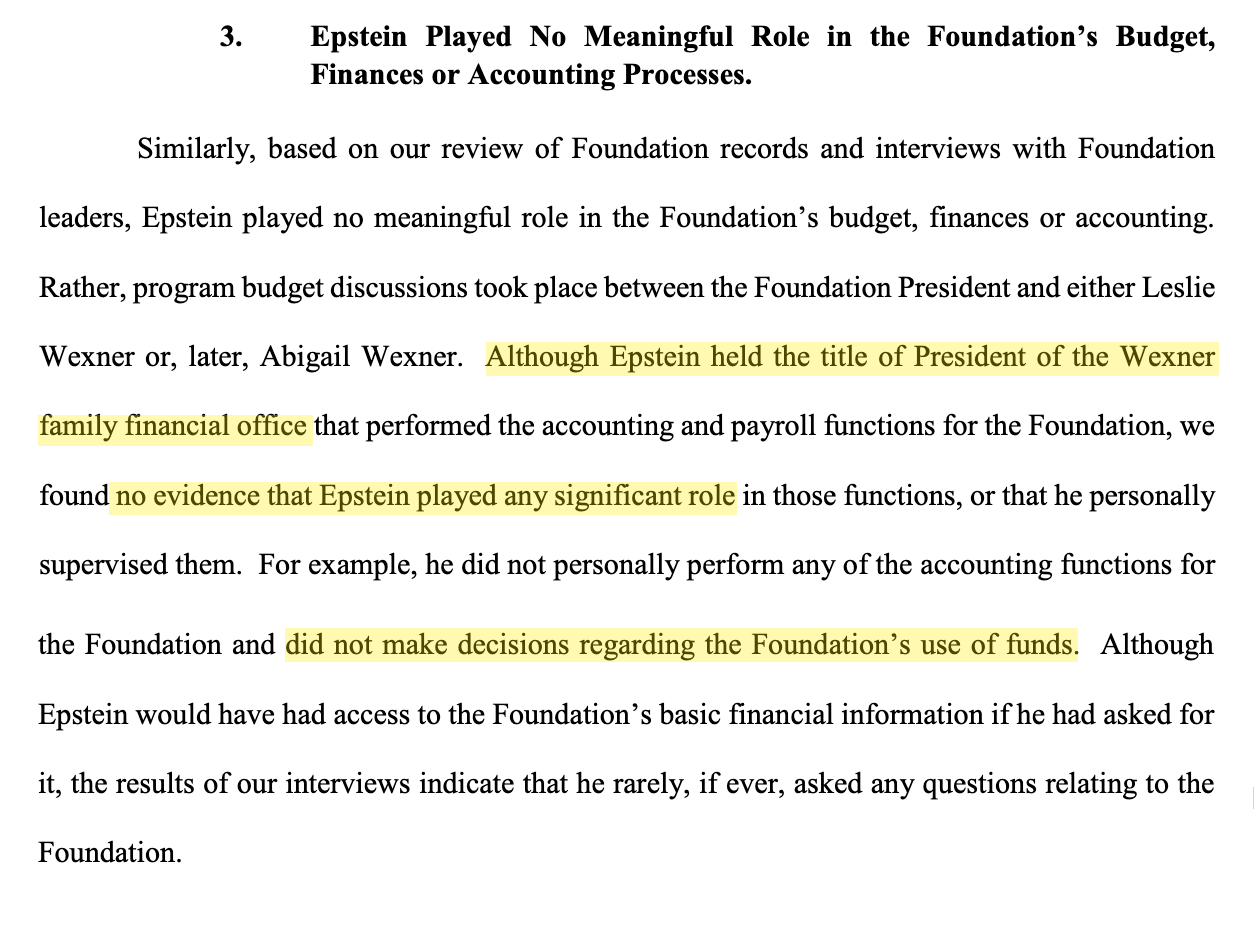
Under Epstein’s financial stewardship, and after his departure, the Wexner Foundation bankrolled pro-Israel charities like college Hillels and free “birthright” trips. These programs had a common mission of teaching young, diasporic Jews to define their religious identity by their connection to the modern state of Israel founded in 1948.
For decades, the foundation also funded the operations of Harvard’s Kennedy School of Government, including the Wexner Israel Fellowship, which sent Israeli government officials to Harvard on full scholarships. The tens of millions of dollars donated by the Foundation made Epstein himself a powerful player at Harvard. The relationship between Harvard and the Wexner family ultimately ended not because of Epstein’s 2008 conviction, but after a falling out over the university’s refusal, under pressure, to sufficiently crack down on protests in 2023 against Israel’s genocide in the Gaza Strip.
“Always Be Careful”
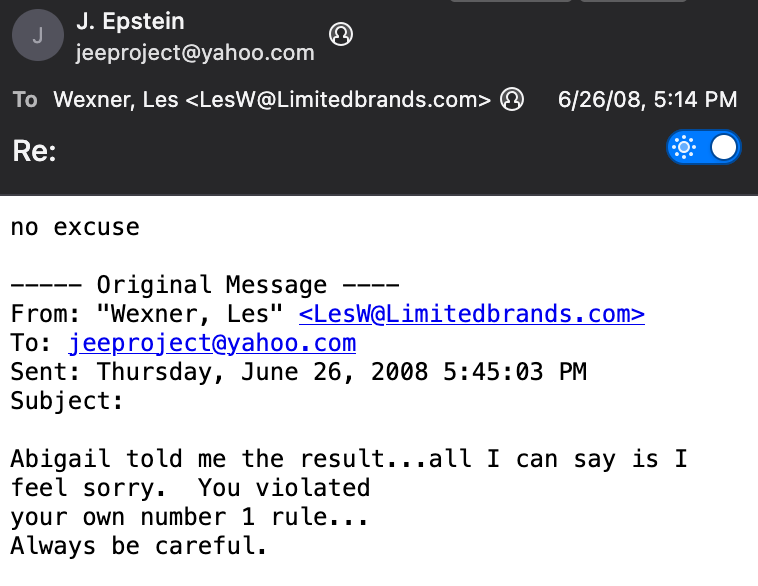
Four days before Jeffrey Epstein submitted his guilty plea to state charges of soliciting a minor for prostitution, on June 26, 2008, Leslie Wexner sent his friend an email: “Abigail told me the result…all I can say is I feel sorry. You violated your own number 1 rule… Always be careful.” Epstein’s reply to Wexner was contrite: “no excuse.”
Epstein was introduced to Wexner in 1986 by Robert Meister, whose firm provided insurance for Wexner’s clothing company, The Limited. Epstein quickly became Wexner’s most trusted investment adviser and, by 1991, Wexner had signed over to Epstein complete power of attorney over his estate and all his affairs. That year, the New York Times described Epstein as “president of Wexner Investment Company” and nobody has disputed that he had major influence there. Yet Wexner’s foundation has maintained his influence did not extend to the iconic pro-Israel philanthropy organization.
The same year Wexner gave Epstein personal control of his vast fortune, Wexner formed the “Study Group,” a group of ultra-wealthy Jewish entrepreneurs who developed philanthropic initiatives to fund support for Israel. Meister’s wife, Wendy, also introduced Leslie to Abigail Koppel, a young Israeli-American attorney, twenty-five years his junior. Epstein was named trustee of Wexner’s philanthropic foundation, and he supervised the drafting of Leslie and Abigail’s prenuptial agreement before they were married in January 1993.
The marriage cemented a deeper tie between Wexner and the state of Israel; he was marrying into Israel’s founding generation. Abigail’s father, Yehuda Koppel, was the commander of a special-operations unit of Haganah, the paramilitary army that created the state of Israel in 1948. Haganah, forming the core of the Israel Defense Forces, carried out the ethnic cleansing of Palestine later termed the Nakba.
Wexner’s new father-in-law had also played a foundational role in the birth of Israel’s military intelligence. According to the diary of Israel’s founding father, David Ben-Gurion, Koppel served in SHAI, Haganah’s intelligence arm and the predecessor to Israel’s central military intelligence directorate, AMAN. During the Nakba, his unit conducted “sabotage” operations involving vehicle hijackings and explosives. In the 1950s, soon after the Nakba, Koppel moved to New York to open an office for Israeli state-owned airline El Al, which became a front for Mossad and Shin Bet agents, according to the CIA and South African intelligence.
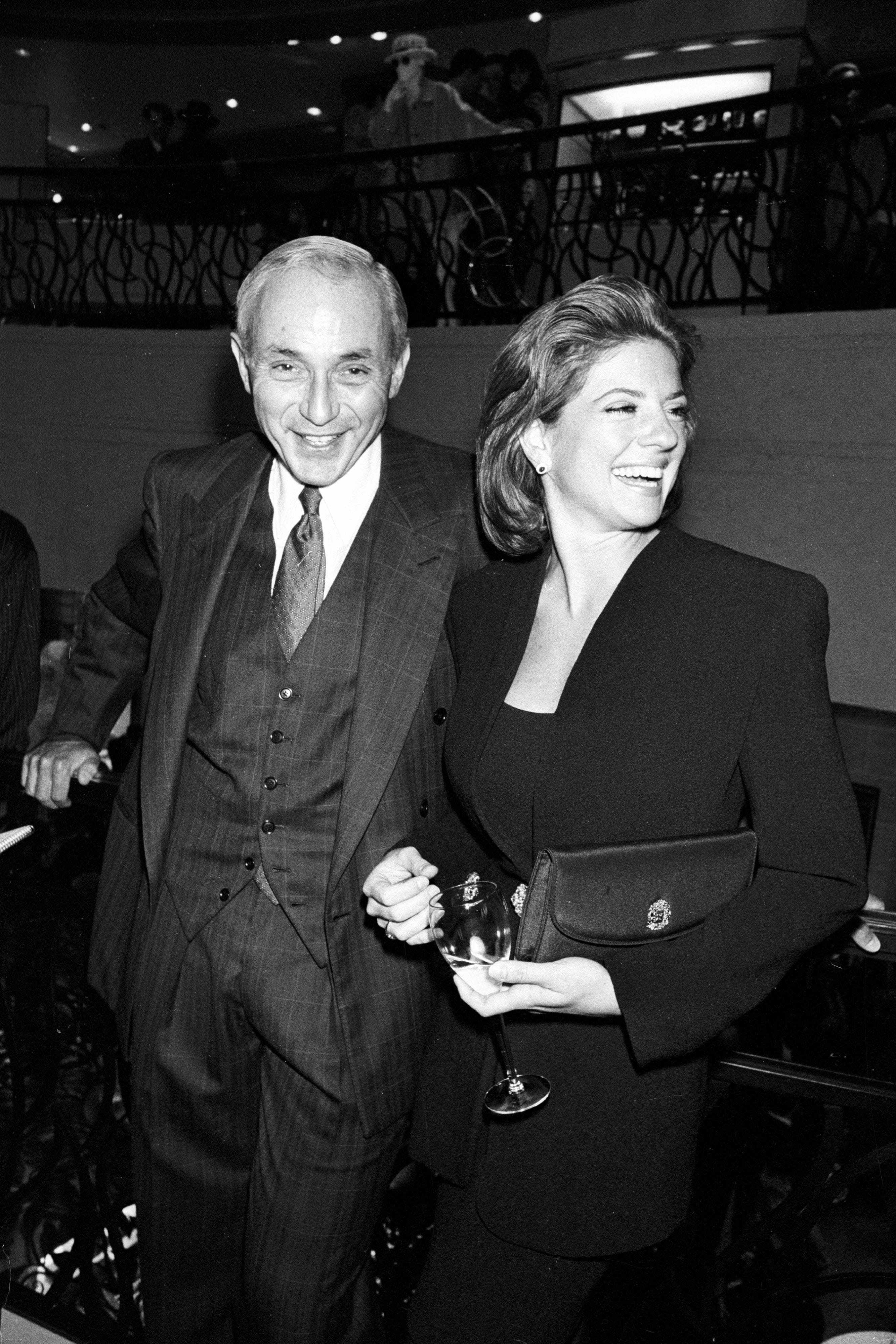
Since 1983, the Wexner Foundation has contributed hundreds of millions of dollars to Israel-linked charitable causes, quietly underwriting flagship pro-Israel institutions in America. Although Leslie is the family’s familiar public face, Epstein’s emails suggest Abigail became far more active than Leslie in the family’s finances after their marriage. As both the trustee of The Wexner Foundation and director of the Wexner Family Charitable Fund, Abigail sits on both sides of the philanthropic funding pipeline: how money enters the family fund, and how much of that money flows to charitable causes.
Epstein and Abigail sometimes emailed directly, but most critical financial issues raised by Wexner’s family office were routed to Epstein through Indyke, who was both Epstein’s personal lawyer, and the secretary of The Wexner Foundation, according to an SEC filing.
In one example from Epstein’s emails, in August 2006, the family office controller Peg Ugland emailed Epstein’s lawyer about a grant to the Jewish Media Fund, which creates and distributes Jewish-heritage media for American schools and television, including a Sesame Street spin-off dedicated to Israel called Shalom Sesame.
The Abba Eban grant, named for a famed Israeli diplomat who also served on the Jewish Media Fund’s advisory council, was pushed as “the highest priority” in an email from Larry Moses, the foundation’s president. “I need to know if it is ok and if it should be paid from LHW Charitable or WF,” Ugland wrote. Indyke, acting in his role as middleman, forwarded Ugland’s request to Epstein, who made the call that payment from the foundation would be appropriate as long as the recipient was a U.S.-based charity.
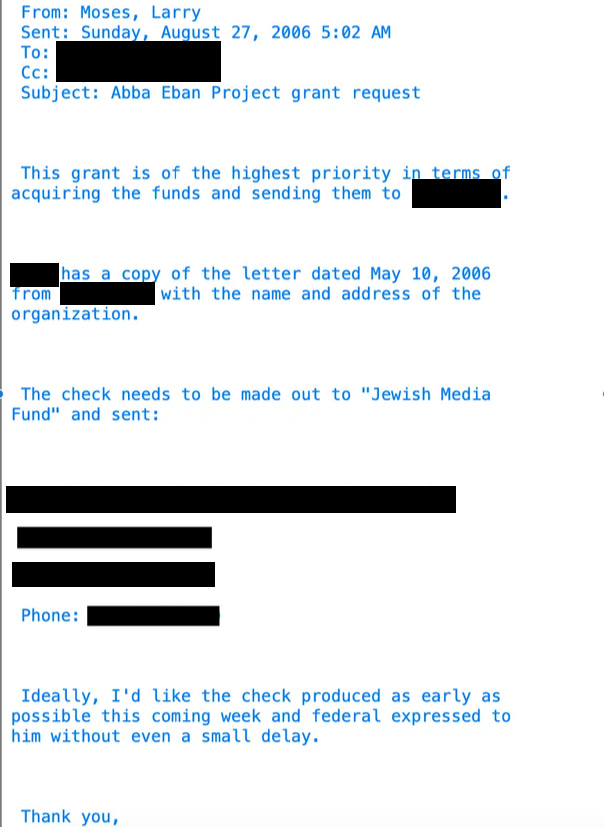
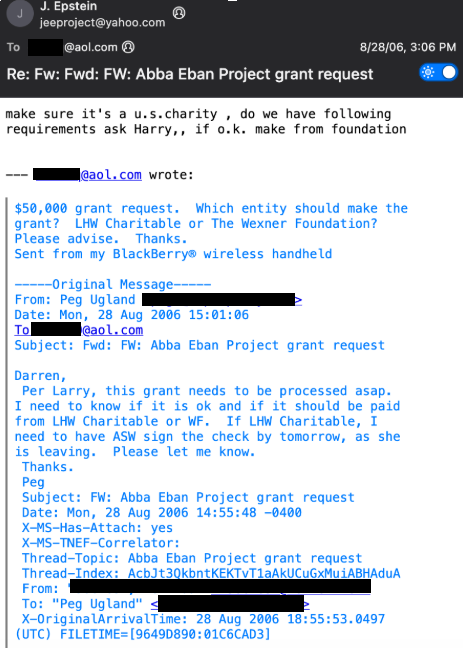

As was often the case, Epstein’s reply was filled with typos and not simple to follow; this time making it impossible for his lawyer to decipher. Indyke apologetically responded by asking for clarification, telling Epstein he had already “confirmed that it is a US public charity.” Epstein’s reply upped the ante on the typos, but was finally clear: “pay for foundctiona.”
(That communication style is something of a power move, familiar to subordinates used to dealing with bosses who take little care to write with grammar or clarity, requiring the underling to divine the meaning of the message.)
“Ask Jeffrey”
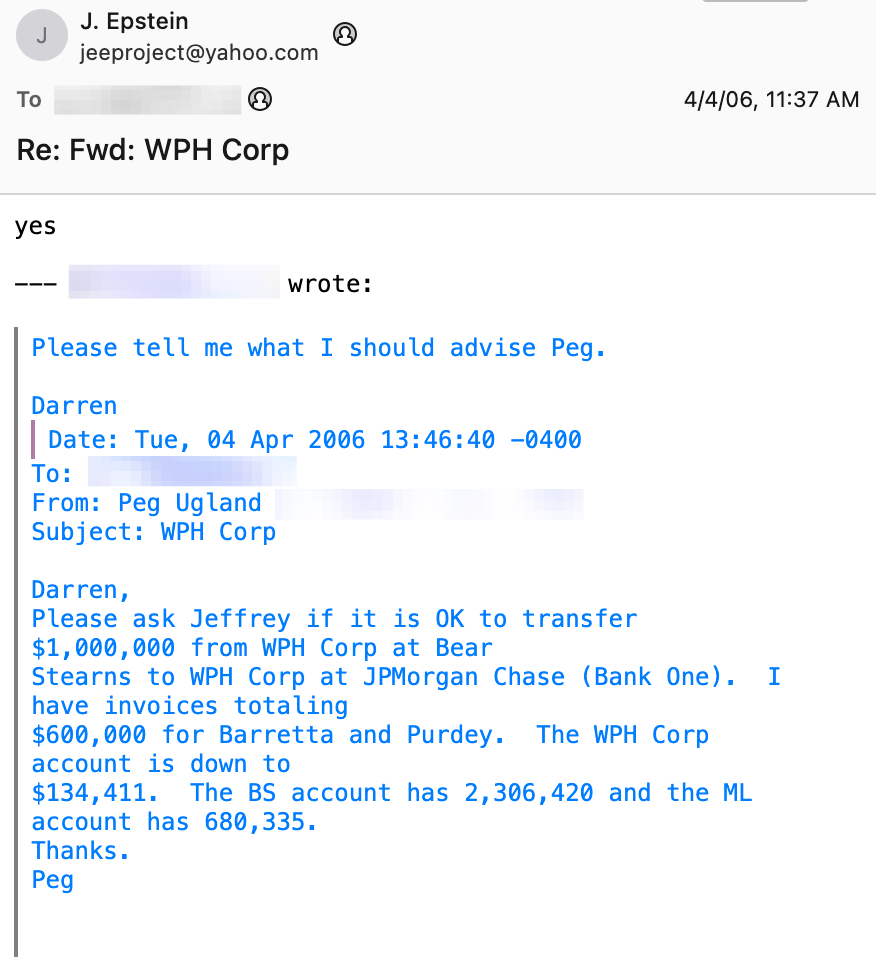
Epstein was often the final say inside the family office control room, where emails suggest there was a blurred line between personal, corporate, and philanthropic money. Epstein was frequently asked to approve funds transfers totally unrelated to philanthropy, including an April 2006 request from Ugland to move $1 million from a Wexner Personal Holdings Corp account at Bear Stearns to a JPMorgan account with the same name. Drop Site found several similar funds transfer requests between 2005 and 2008, totaling tens of millions dollars, with Ugland often explicitly requesting Indyke to “ask Jeffrey” for approval.
In a March 2007 email, Wexner attorney Charles Miller submitted an invoice to Indyke with a note “about 90% of my time was LSJ [Epstein’s private island holding company], 10% Wexners.” Epstein instructed Indyke to split the bill in such a way that was not remotely in line with the declared work performed, charging the Wexners double for a fraction of the work: “200 k , from wexner, 100k from lsj.”
The Wexner family office used layers of entities that kept real ownership of shell entities obscured from outsiders and regulators. In one 2007 email, Wexner’s lawyer Gideon Kaufman reported that the U.S. Forest Service had offered to reimburse the owner of a Wexner ranch property after a ditch collapse, but the agency needed to see the full ownership chain before cutting a check. An entity called Ranch Lake IV was on the deed, but behind it sat two shell entities and then Wexner himself.
Preserving the anonymity of a shell entity’s “ultimate beneficial owner” was a priority and a specialty of Epstein’s. Gideon wrote to Indyke, “At the end of the day we will get about 14 thousand dollars from [the Forest Service] and I wonder if it’s worth all the brain damage and revealing all these documents to them for that amount of money Please advise thanks.” Indyke forwarded the query to Epstein. “At this point do we still have anonymity in the ownership of Ranch Lake IV?” he asked.
While calling the shots for the Wexner financial machine, Epstein also sought to conceal his own role from financial disclosures. In 2006, Indyke sent Epstein a draft amendment to Limited Brands’ Schedule 13D, an SEC filing that discloses who controls big blocks of stock in a public company. Indyke needed Epstein’s sign-off, writing “I just wanted to make sure the disclosures…are acceptable to you before we file.” Epstein wrote back, “do i have to be named personaly. if ftc is trustee.” FTC is shorthand for Epstein’s Financial Trust Company.
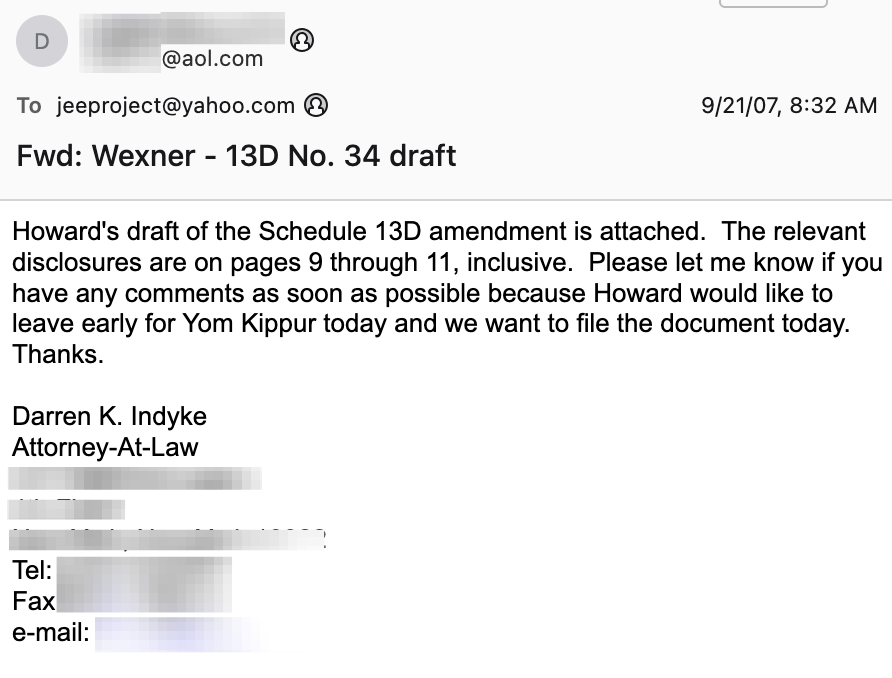
The next year, on September 21, 2007, two weeks after Epstein had supposedly resigned as trustee, Indyke sent another 13D draft for Epstein’s comment and approval. In the 2007 filing, Epstein and FTC were no longer named, replaced by Indyke himself as trustee.
Despite the labyrinthine structure of shell entities, the staff of the Wexner family office were accustomed to treating Epstein as the true fiduciary—causing confusion as Epstein was slowly disentangled from the family’s finances. In a November 2007 email, Ugland asked Indyke to clarify who was the trustee for two of the family’s charitable trusts. Indyke replied that the trusts remained under “FTC.” Ugland was confused whether Epstein was still part of FTC, writing, “Is FTC now you, or still JEE?” Indyke forwarded the message to Epstein with a note, “another example of ASW withdrawing,” a reference to Abigail.
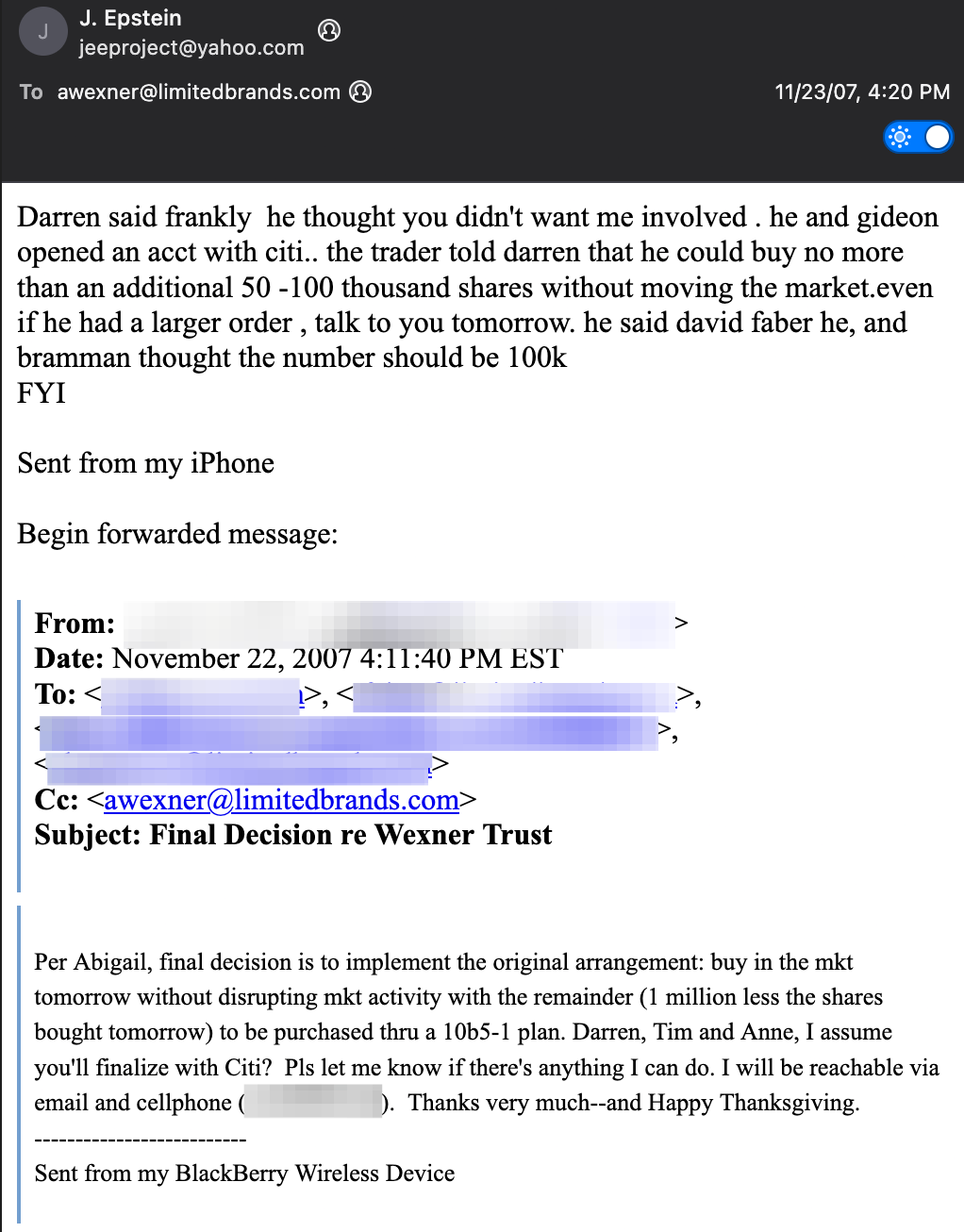
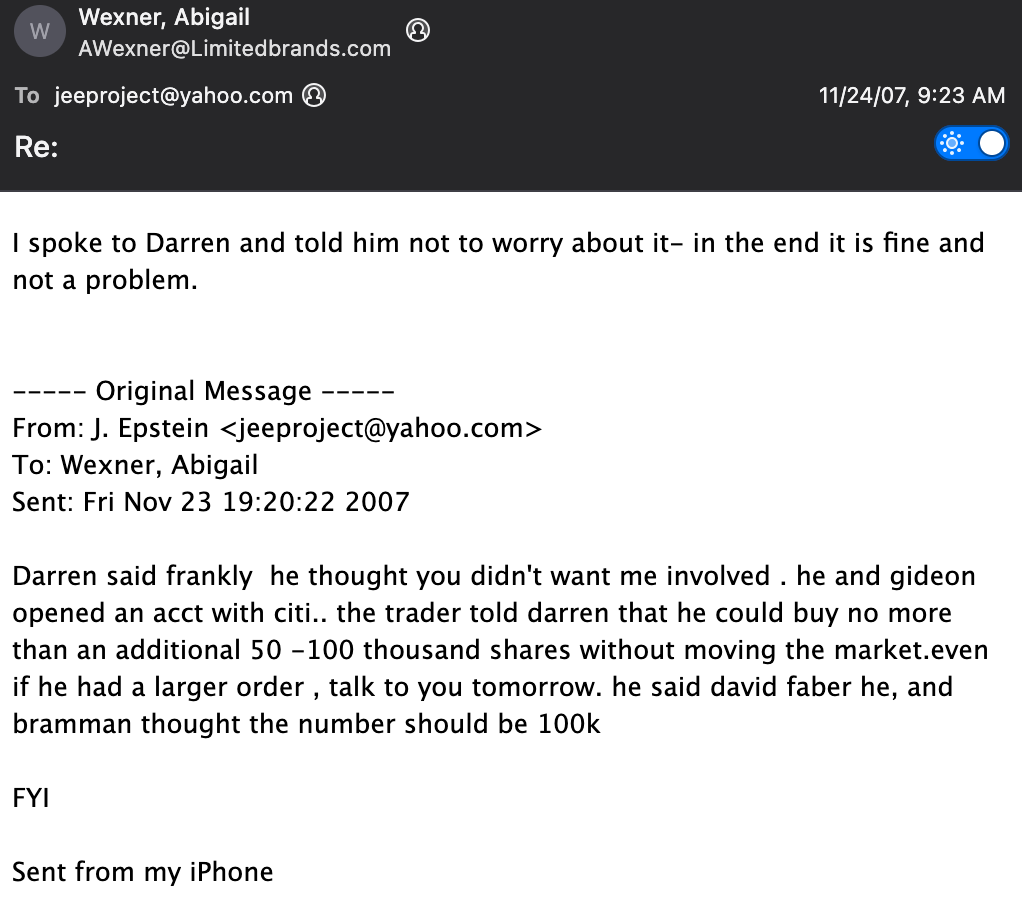
Although the Foundation’s independent reviewer claimed that its staff had “no contact” with Epstein after his resignation in September 2007, and he had “no meaningful role” before then, the emails suggest Abigail Wexner remained at least partly dependent on Epstein for months after that date. On November 23, 2007, at the beginning of the financial crisis, Epstein directly advised Abigail on executing a purchase of one million shares of Limited Brand stock, valued at almost $20 million.
Wexner urgently needed Epstein’s advice—because the market was crashing, and liquidity was thin on the day after Thanksgiving, most of the shares had to be bought outside normal trading hours to avoid moving the stock price. Wexner planned to use a Rule 10b5-1 trading plan, which provides a legal safe harbor for “inside traders” who do not possess secret information about the business.
Epstein sent a detailed plan for executing the stock purchase on Black Friday, and told Abigail, “Darren said frankly he thought you didn’t want me involved.” She replied the next day, “I spoke to Darren and told him not to worry about it- in the end it is not a problem.”
Two weeks later, on December 7, Leslie Wexner found himself in a similar situation requiring Epstein’s counsel. Wexner had been asked during a board meeting at The Ohio State University whether he had any holdings in Mellon Bank, but he couldn’t answer the question; Indyke emailed Epstein for clarification. BNY Mellon is currently facing a civil lawsuit alleging the bank knowingly provided financial services in support of Epstein’s sex trafficking operation.
“Great Opportunities”
As a looming public relations crisis over Epstein’s legal troubles crept closer, Abigail Wexner executed a plan to claw back family funds trapped in C.O.U.Q. Foundation, a large Epstein-controlled entity which had been used to fund Jewish organizations, university research, youth programs, and hospitals.
On December 26, 2007, the Wexners’ attorneys prepared IRS forms to create a new private foundation for Leslie Wexner, called YLK Charitable Fund. Indyke emailed Epstein a draft copy of the IRS submission, asking for Epstein’s approval on a disclosure document that showed Epstein’s C.O.U.Q. trust would transfer more than 25% of its assets into YLK. The new fund had only two officers, Peg Ugland and Abigail Wexner; it was named “YLK” after the initials of Abigail’s father, Yehuda L. Koppel, of Israel’s founding generation.
On January 1, 2008, six days after Indyke emailed the IRS paperwork to Epstein, two Epstein-controlled entities dumped almost their entire balance sheets into Abigail’s new fund. Epstein’s C.O.U.Q. Foundation transferred about $12 million in securities, and his Financial Trust Company contributed Apple stock worth roughly $34 million.
YLK barely functioned as an independent charity. After receiving the $46 million from Epstein, it made two large grants totalling $6.5 million to the Columbus Foundation, a non-profit community fund in Ohio, and a handful of small donations before its portfolio was hammered by the 2008-10 market crash. The foundation took in no new contributions in 2009, then dissolved at the end of 2010, shipping its remaining assets (about $35 million) back into the Wexner Family Charitable Fund.
Leslie Wexner’s 2019 letter claimed Epstein had “misappropriated vast sums of money,” and the C.O.U.Q.-YLK donation was a repayment of those funds. The 2020 independent review reaffirmed this assertion, stating that the donation was a “partial recovery” of misappropriated assets. Publicly claiming to have been wronged by Epstein put the Wexners on the side of the victims, rather than the perpetrator. However, the donation in question was similar in character to many other transactions he had carried out for the Wexners over the years.
The Wexners remained collegial with Epstein, even as they were supposedly recovering “misappropriated” assets: one month before the money flowed back from C.O.U.Q. into YLK, Abigail was working hand-in-glove with Epstein on multimillion-dollar stock trades; a few months after the money was returned, Leslie sent the note scolding Epstein for not being “careful.”
Epstein entered his guilty plea in June 2008—but emails suggest he remained quietly connected to Wexner business, attempting to cultivate a relationship between Wexner and Sultan Ahmed bin Sulayem, the CEO of Emirati conglomerate Dubai Ports. Less than a month after submitting his guilty plea, he wrote to Sulayem on July 18, “where are you my friend.. .. great opportunities,, did anything ever come of your wexner meeting?”
“Pure Zionistic Motivations”
After Epstein’s public departure, the Wexner Foundation remained a major force in pro-Israel philanthropy, funneling millions of dollars into programs aimed at boosting Israel’s influence in the U.S. Between 2003 and 2018, Inside Philanthropy tallied $128.4 million donated by the Wexners to Israeli and Jewish charitable causes, making them the third largest donor to such causes in the U.S. during that period.
Wexner resigned as CEO of Limited Brands in 2020, one year after Epstein’s death. That year, right-wing politicians in Israel campaigned against the Wexner Foundation and its fellowship programs for Israeli officials, claiming the foundation had a “radical left political affiliation.” After Israel’s National Security Minister Itamar Ben Gvir decided to ban government employees from participating in the Wexner Foundation’s leadership programs, another Likud lawmaker praised the decision, writing that the foundation was part of Israel’s “shadow regime” and “a long arm of the deep state.”
The accusations tied into a domestic political brawl in Israel, aimed at undermining former prime minister Ehud Barak—a close associate of Epstein, then attempting to reenter political life and challenge current Prime Minister Benjamin Netanyahu. Barak’s political opponents in Israel have long raised questions about his financial ties to the foundation.
Details about that scandal are also documented in the emails obtained by Drop Site. In late 2005, Larry Moses (president of the foundation) emailed Indyke about an agreement with Barak to write two books about Middle East politics and his experience as head of state, with a fee of $100,000 per chapter to be paid to Barak by the foundation. Indyke needed Epstein to instruct on how to execute the payments, writing, “Please advise what you want Peg to tell Larry Moses.”
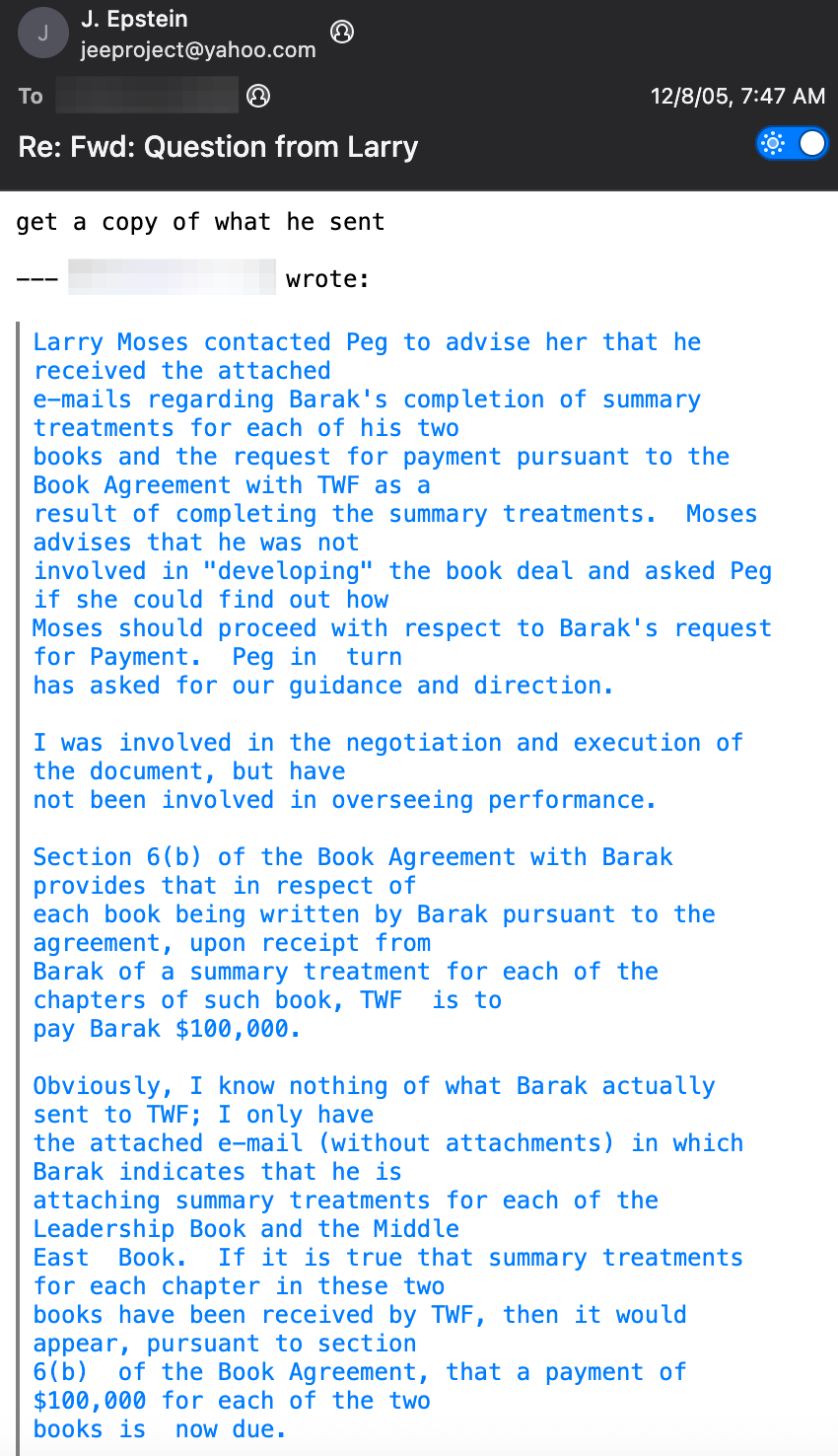
The single manuscript that Barak completed for the foundation eventually earned Barak $2.3 million in consulting fees. The Wexner Foundation has stated Barak’s payment was for two reports (one of which was never completed) and related advisory work.
The enormous payment became a talking point for Barak’s right-wing political opponents for years, who cast aspersions on Barak and Wexner’s relationship with Epstein. In response to attacks from Israeli lawmakers aligned with Netanyahu, the Wexner Foundation defended itself as an institution firmly committed to the interests of the state of Israel, decrying what it called an attack on, “a foundation that from its inception has acted from pure Zionistic motivations.”
Epstein continues to serve as a political football in Israel. Netanyahu shared a Jacobin article on November 21 that included a summary of Drop Site’s coverage on Epstein’s ties to Barak and Israeli intelligence. Barak has dismissed claims of Epstein’s involvement in Israeli politics as “extremely antisemitic.”
On August 8, 2019, after Epstein’s arrest but two days before he died in jail, Wexner wrote a letter to the foundation community portraying himself as another victim of Epstein’s actions, claiming that he was “deceived,” and that his trust in Epstein was “grossly misplaced.”
“I deeply regret having ever crossed his path,” Wexner wrote.
Good report. I knew two decades ago that Epstein was a Mossad asset, but these extensive details are interesting. [No mention of the reprobate Alan Dershowitz.] I will be glad (like most of the world) when Israel is finished and hope to live to see its and the US's simultaneous downfall.
+Update on El Al lawsuit filed by New York Attorney General Letitia James alleges that the owner of Centers Health Care misused over $83 million in government funds, including money intended for nursing home residents, to purchase a controlling stake in El Al.
'When the COVID-19 pandemic struck, the homes failed to control its spread. More than 400 residents across the four homes died in 2020, according to James.'
ynet:
El Al owner reaches $43.75M settlement over nursing home mismanagement allegations
Kenny Rozenberg and partner Daryl Hagler, accused in New York of misusing $83 million in state funds meant for nursing home care, reach settlement agreeing to invest additional $35 million into their facilities to improve resident care
Golan Hazani, Calcalist|11.14.24 | 17:58
https://www.ynetnews.com/business/article/byvryw4mke
Under the settlement reached on Thursday, Rozenberg and Hagler admit no wrongdoing. In addition to the financial settlement, they will invest $35 million into a fund aimed at improving resident care in the four facilities named in the lawsuit. This fund will be allocated toward higher wages, increased staffing, enhanced care standards and strengthened oversight.
Rozenberg’s attorney, Moti Shulman, welcomed the settlement, saying, “We are pleased with this agreement, which rejects all accusations of misconduct by the companies or their managers. For over three decades, these companies have provided quality care for thousands of seniors across more than 35 New York facilities. We are fully committed to implementing the settlement terms, including the $35 million investment to enhance services.”
wiki: 2024 brought a record profit of $545 million to the company, as many competitors cancelled flights to Tel Aviv due to the Gaza war.
I bet they're pleased!