

Leaked Documents Reveal Details of the Secret Saudi Arabia–Pakistan Mutual Defense Pact
The U.S.-Iran talks in Islamabad pushed Pakistan’s relationship with Saudi Arabia into the spotlight.

When we launched Drop Site, we made a promise: expose the crimes of the powerful and hold them accountable, no matter the consequences. We knew we’d be targeted for it. We also knew reader support would be the only thing keeping us alive.
As the attacks intensify, your support is what makes us impossible to silence. Can you make a tax-deductible donation today to show them we’re not backing down?
On Saturday, as Pakistan was in the middle of mediating hard-won ceasefire talks between the U.S. and Iran, Saudi Arabia made a sudden revelation that appeared to undermine Pakistan’s status as a neutral host. In a statement posted on X, the Saudi Ministry of Defense announced “the arrival of a military force from the Islamic Republic of Pakistan at King Abdulaziz Air Base in the Eastern Sector,” adding that the force would include a contingent of military aircraft and would improve “operational readiness between the armed forces of the two countries.”
Those deployments are the result of a defense pact signed last year between Riyadh and Islamabad that has now been activated amid an ongoing regional war and numerous Iranian attacks against military and energy targets in Saudi Arabia.
Ceasefire talks collapsed over the weekend in Pakistan, with the American delegation leaving without an agreement. But Pakistan is far from out of the picture; secret documents obtained by Drop Site News reveal the extent to which Pakistan is committed by treaty to potentially become a participant in the war it was attempting to mediate.
The details of the Pakistan–Saudi Arabia defense agreement have never been made public or even reviewed by Pakistan’s parliament. They are being reported here for the first time based on an archive of classified documents about the pact obtained by Drop Site.
The risk that Pakistan may itself be pushed into the war is also important context for the zeal of Pakistan’s leaders to bring an end to the fighting. Pakistan enjoys good ties with both Iran and the U.S., and relies heavily on financial support from Saudi Arabia. Following news that the United Arab Emirates had recalled a loan from Pakistan last week, Saudi Arabia and Qatar stepped up with $5 billion aimed at propping up Islamabad’s foreign reserves as it deals with fallout from the economic crisis caused by the war.
Talks in Islamabad
After weeks of intense fighting, Pakistan emerged as an unlikely mediator seeking to bring an end to the U.S.-Israeli war with Iran. Pakistan does not have an extensive history of mediating conflicts in the Middle East, and is mired in its own conflict in Afghanistan.
But Pakistan was extremely motivated to end the war. Early on, Pakistan attempted to broker an arrangement under which Iran would refrain from attacking Saudi installations. On March 3, a few days into the war, Pakistani Foreign Minister Ishaq Dar referenced the Saudi-Pakistan defense agreement and stated that he had communicated Pakistan’s position to Tehran. “We have a defense pact with Saudi Arabia, and the whole world knows about it,” Dar said. “I told the Iranian leadership to take care of our pact with Saudi Arabia.”
On April 8, Pakistani Prime Minister Shehbaz Sharif announced that Islamabad had successfully negotiated a two-week pause in fighting between the parties, intended to apply to the entire region and laying the groundwork for talks in Islamabad that could produce a more lasting deal. “With the greatest humility, I am pleased to announce that the Islamic Republic of Iran and the United States of America, along with their allies, have agreed to an immediate ceasefire everywhere including Lebanon and elsewhere, EFFECTIVE IMMEDIATELY,” he wrote in a post on X.
(Later, it turned out that Sharif’s message was likely vetted—if not written by—the Americans. The initial post on X, edit history shows, had a heading that read “*Draft - Pakistan’s PM Message on X*.” The New York Times reported the U.S. had signed off on the statement, though the White House denied actually writing it.)
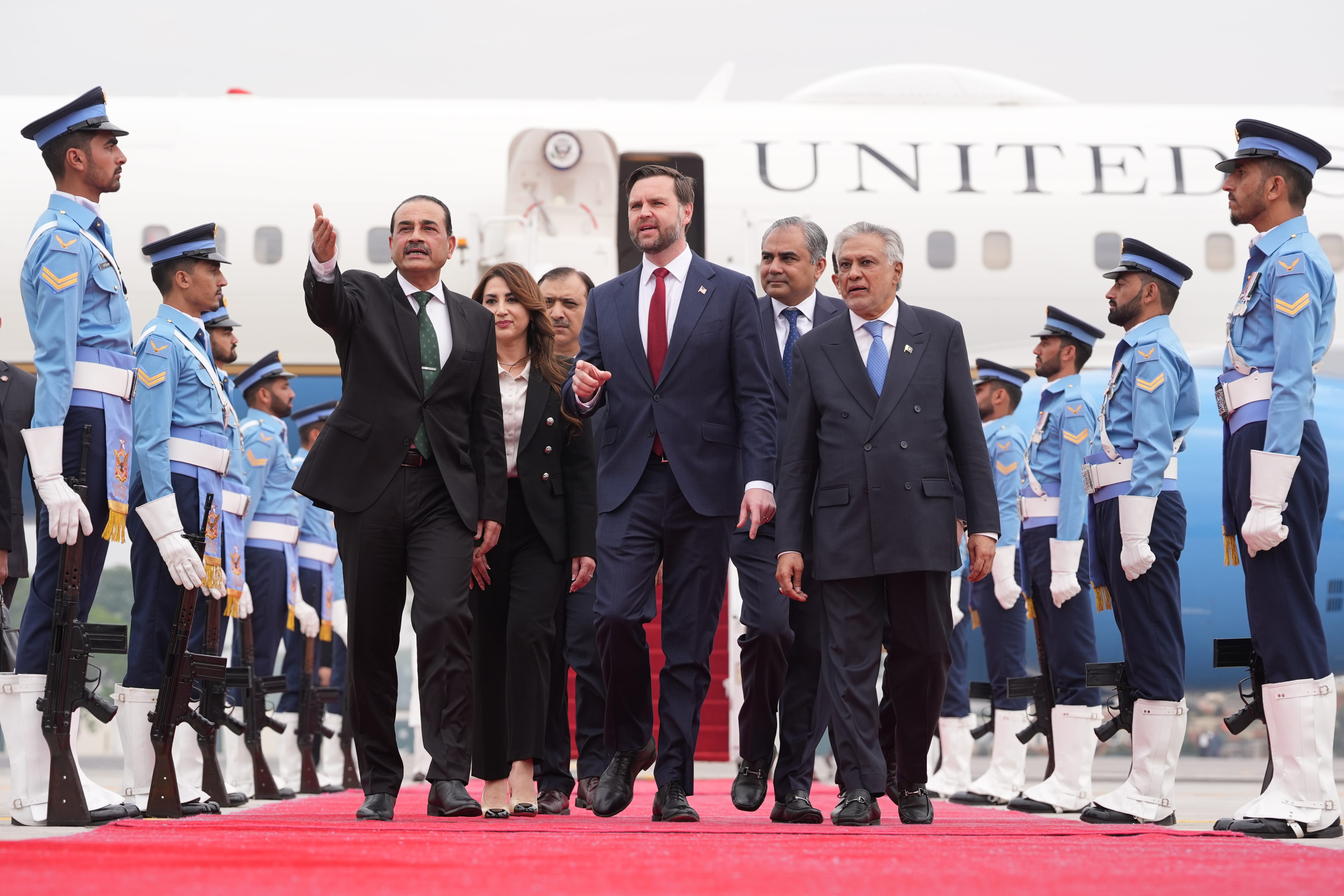
On Friday, Vice President JD Vance, envoys Steve Witkoff and Jared Kushner, and a technical team flew to Islamabad to meet with a large delegation of Iranian diplomats and technical experts. Shortly beforehand, Saudi Arabia, which has been relatively tight-lipped about damage in the country, revealed that attacks on a critical pipeline had wiped out 10% of its export capacity.
On Saturday, April 11, right as Vice President JD Vance was conducting negotiations with the Iranian leadership in Islamabad, the Saudi Ministry of Defence announced that Pakistan has sent its forces, including fighter jets, to Saudi Arabia under their defense pact. Pakistan had actually been quietly conducting airlifts of military equipment throughout December and January, noted by open-source intelligence monitors. The announcement coming on a day of consequential negotiations in Islamabad could be seen as a form of pressure on Iran. Notably, the Pakistani government did not release a corresponding statement about the deployments.
While Pakistani officials have periodically referenced this pact, which has been in place in various forms since the 1980s, its details have largely remained secret. The current iteration, the Strategic Mutual Defense Agreement (SMDA) was signed by Saudi Crown Prince Mohammed bin Salman and Prime Minister Sharif on September 17, 2025—but it was never even presented to the country’s parliament for review.
The documents were provided to Drop Site by a source who requested anonymity in order to share classified documents. They include historical versions of the pact as well as internal Pakistani memos and analysis detailing how the treaty has been updated over time—giving critical insight into Pakistan’s stance on the ongoing war with Iran, as well as the risks that it faces as the conflict continues.
Historical Pacts
The pact began with a confidential agreement signed between the two countries on December 14, 1982. A revised version entitled the Military Cooperation Agreement (MCA) was signed on July 30, 2005.
The classified 2005 agreement—a copy of which was obtained by Drop Site—states that the goal of the MCA is “to develop and strengthen cooperation in the military field between the two countries through expansion in areas such as training, deputation of personnel, defense production and transfer of technology, exchange of experience, purchase of weapons, equipment, spare parts and military medical services.” The document also includes provisions allowing for both parties to amend and expand the pact over time.
While the 2005 agreement was significant, it limited the scope of the bilateral military relationship to cooperation in training and equipment sharing. It did not obligate Pakistan to engage in actual military action or assume responsibility for the defense of Saudi Arabia.
In later years, the scope of Pakistani commitments to Riyadh would grow substantially. In August 2021, a summary of a new amendment to the defense agreement was sent to the government of then-Prime Minister Imran Khan. The amendment added a profoundly important new component to the pact, effectively committing Pakistan for the first time to engage in the physical defense of the Saudi government if requested.
Pakistani foreign policy has long been determined by the country’s powerful military establishment, which serves as kingmaker for Pakistani politicians and has conducted clandestine agreements and diplomacy for decades outside the purview of the country’s weak democratic institutions.
But for almost a year, the amendment to the 2005 pact sat on Imran Khan’s desk. The description of Pakistani obligations also left ambiguous the question of whether the threat to be combatted at Saudi government request was foreign or domestic. According to two former officials who requested anonymity to discuss sensitive information, Khan was apprehensive about signing an agreement that would obligate the Pakistani military to participate in a foreign war.
“The second party [Pakistan] is obligated to send its forces to the Kingdom of Saudi Arabia upon a request of the first party, to support the armed forces of the first party in dealing with any threat that affects its security, safety, sovereignty, territorial integrity and interests,” the amendment stated. “A protocol will be signed between both parties and attached to this agreement to clarify the details of such arrangements.”
While imposing sweeping obligations onto Pakistan, the text of the document did not commit Saudi Arabia to any specific reciprocal support. Instead, Saudi Arabia has provided financial support to Pakistan’s unstable economy over the years. The Kingdom currently holds more than $5 billion in deposits at the State Bank of Pakistan, which are rolled over periodically.
Between August 2021 and April 2022, commentators aligned with the Pakistani military continuously pressured the government over its policy towards Riyadh—alleging that Khan, who had continued to hedge on signing the agreement, was destroying the country’s relationship with Saudi Arabia.
A prominent critic of Khan, Najam Sethi, noted in an op-ed around the time, “General Qamar Javed Bajwa, has paid countless visits to the Kingdom to smooth the crown prince Muhammad bin Salman’s ruffled feathers, over transgressions by Imran Khan.” The alleged transgressions included, “an attempt to set up a rival bloc comprising Pakistan, Turkey and Malaysia” against the Saudi-led Organization of the Islamic Conference (OIC) and to “don the mantle of an interlocutor between Saudi Arabia and Iran without the blessing of MBS.”
In April 2022, Khan was removed from government in a thinly veiled military coup. The summary was ultimately signed in February 2024 by the military-backed caretaker government that came to power after imprisoning Khan and banning his political party.
The amendment was speedily approved by the caretaker federal cabinet appointed by Pakistani Army Chief Asim Munir. However, documents show that the language of the new amendment expanding Pakistani obligations to Riyadh was hotly debated inside the military establishment after it was signed. The amendment was one-sided, some worried, and would obligate Pakistan to defend Saudi Arabia, without imposing a reciprocal obligation on Riyadh.
Assessments also noted the amendment did not clearly differentiate between conventional and nuclear forces. The documents show that the Pakistani military was only interested in committing conventional forces to any deal with Saudi Arabia, and sought to explicitly exclude nuclear capability from the obligation.
Internal debates also noted that threats to Saudi sovereignty and interests might not remain confined within Saudi territory, and could require military action outside Saudi Arabia. The Pakistani side subsequently sought to narrow the scope of its obligations to Saudi territory.
Many of these concerns were eventually addressed in the 2025 SMDA, signed months before the Iran war. Even though the immediate catalyst for the SMDA seemed like the Israeli strike on Qatar last year, it was always clear that the agreement was directed at Iran—as has all Pakistan-Saudi cooperation since the 1980s. The SMDA is not part of the leaked documents. But public disclosures from Pakistan suggest that the new agreement was an update to the old MCA; renaming the agreement while including additional amendments to the security relationship.
Bypassing Parliament
According to the joint Saudi-Pakistan press release announcing the 2025 SMDA, “The agreement states that any aggression against either country shall be considered an aggression against both.”
The conditions in which such reciprocity may be triggered remain unclear, however. Saudi Arabia has limited capacity to provide military assistance to Pakistan in a conflict. The primary strategic rival to Islamabad remains India, which enjoys close political and economic ties with Riyadh. Pakistan is also currently involved in a fierce cross-border war with Afghanistan, for which Saudi Arabia has not provided material assistance.
Despite their numerous private agreements, Pakistan and Saudi Arabia have had a difficult history actually enacting meaningful security cooperation.
In early 2015, Saudi Arabia launched a military coalition to intervene in Yemen’s civil war, targeting the Ansarallah movement, which had swept south from its northern strongholds and forced the internationally recognized government out of the capital, Sanaa. At the time, Riyadh asked Pakistan to contribute warships, aircraft and ground troops to help fight the group. The request was rooted in decades of financial patronage and the assumption that the signing of the 2005 MCA would enable such collaboration.
However, in the absence of a clear bilateral framework, and not wanting to involve the country in an increasingly ugly civil war in Yemen, then-Prime Minister Nawaz Sharif referred the matter to the Pakistani parliament. In April 2015, in a rare display of democratic cross-party consensus, Pakistan’s National Assembly passed a resolution rejecting military participation in the Yemen war and calling for neutrality to allow a mediating role. The vote was embarrassing for Riyadh and a shock to Saudi-Pakistani relations.
The war with Iran has once again raised the question of if and how the agreement can be enforced. The current version of the defense pact signed in 2025 has already been called into question, as Pakistan has been loathe to involve itself in a military confrontation targeting Iran, which currently enjoys widespread support among the Pakistani public.
“The Saudi pact is becoming a problem for us,” a source described as being familiar with Pakistani military decision-making told the Financial Times in an article about Pakistani mediation efforts on March 28. The comments also shed light on what Pakistan expected to get out of the deal: “It was supposed to be cash for deterrence. But we’ve not gotten any new Saudi investments, and deterrence failed.”
Iran has launched numerous attacks on U.S. forces based at Saudi military facilities who have been assisting in attacks against Tehran. On April 6, in retaliation for Israeli attacks on its own energy infrastructure, Iran also bombed Saudi Arabia’s Jubail petrochemical complex—one of the largest industrial complexes in the world and, according to some reports, responsible for 7% of Saudi GDP.
For now, the deployment remains largely symbolic and is not likely to have an immediate effect on the war as a whole. A Pakistani military expert who spoke to Drop Site News on condition of anonymity due to the sensitivity of the matter said the deployment on Saudi territory offers limited utility in the current scenario. Iran is not conducting—and is not expected to conduct—a ground invasion of the Arabian Peninsula. Pakistani support for missile and drone defense would also not add much to the U.S.-provided defensive support that Riyadh presently enjoys.
Under the current terms of the deal, which is entirely defensive, Saudi Arabia could not request that Pakistan counterattack Iran, even from Saudi territory. An attack launched from Pakistani soil also appears unlikely, and would likely fall outside the scope of the SMDA.
Even a limited conflict with Iran would be politically radioactive inside Pakistan. It would place Pakistan on the side of the Israel-led coalition—an allegiance that would be highly unpopular with many Pakistanis. And it would also be a strategic nightmare for a country that is already facing two other hostile countries on its border, and would risk the prospect of total encirclement if ties deteriorated with Tehran.
Pakistan has a large Shia population which acts as a strong bridge between Islamabad and Tehran and the conflict has raised tensions with the government. In a late March meeting with prominent Shia clerics who had expressed concerns about the war, Army Chief Asim Munir reportedly told those assembled, “If you love Iran, go to Iran.” Syed Ahmad Iqbal Rizvi, deputy head of the Muslim Unity Movement, an umbrella body for Shia parties, pushed back in a recorded statement: “We boldly respond to the army chief’s remarks: we love our country, but this war is between right and wrong. We stand with the right, with Iran.”
In that light, Islamabad’s continued commitment to acting as a peacemaker makes sense as an attempt to ward off a strategic disaster that could engulf its own interests. In a statement the day after the collapse of the talks, Pakistan’s Foreign Minister Muhammad Ishaq Dar held out hopes that Pakistan would continue to find a way to bridge the gap between Washington and Tehran.
“It is imperative that the parties continue to uphold their commitment to the ceasefire,” said Dar. “Pakistan has been and will continue to play its role to facilitate engagement and dialogue between Iran and the U.S. in the days to come.”
Murtaza and everyone else at Drop Site are demonstrating - daily - that actual journalism is entirely possible. This particular piece proves that enterprise-class media truly is **legacy** media, which have the resources to source and report similar facts, but lack the will, independence, and credibility of professional character necessary to do so. Drop Site delivers.
Thank you for this information that has been sitting outside the spotlight during this crisis. Pakistan, and others as well, has to continue waking a tightrope across the abyss. I worry there is not much road left, down which the can can be kicked. And then what, for all of us?