

Mass Expulsion in Lebanon as Israel Expands War: “We Don’t Know Where to Go”
Israel issued a sweeping displacement order for the entire region south of Litani River as it escalated its bombing campaign across Lebanon.

Drop Site is a reader-funded, independent news outlet. Without your support, we can’t operate. Please consider becoming a paid subscriber or making a 501(c)(3) tax-deductible donation today.
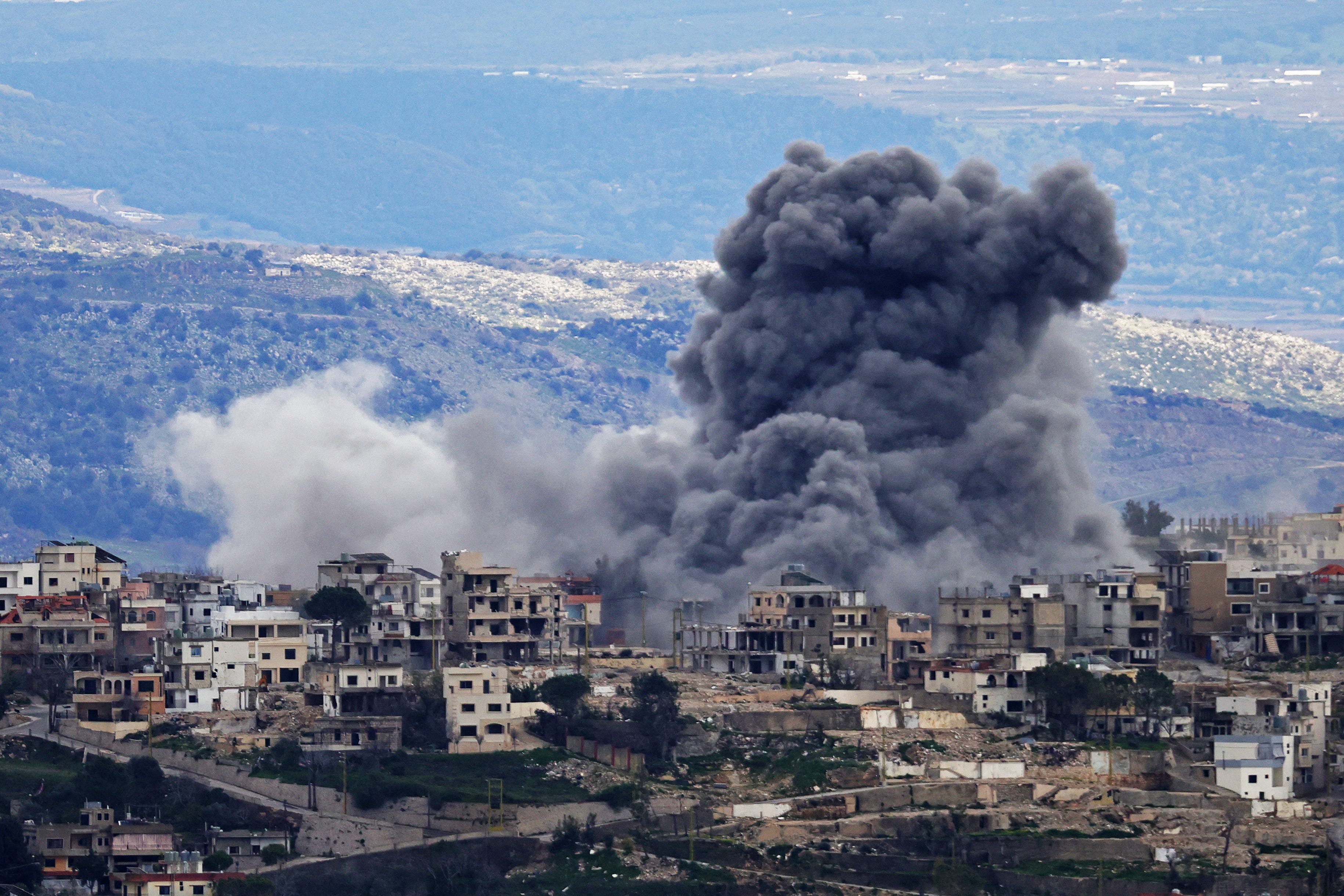
BEIRUT, LEBANON—Mustafa Arout was forced to flee his home in Mais al-Jabal, a town in southern Lebanon, before dawn on Tuesday as the Israeli military issued mass displacement orders to dozens of communities in the area and launched a wave of heavy airstrikes.
The 78-year-old mukhtar—an Arabic term for a local leader—had hoped for the roads to clear before evacuating with his family, but instead they found themselves inching through traffic in the darkness as thousands of others fled the area in a mass exodus. Arout and his family headed north with no clear destination, the sounds of bombing echoing from the hills in the near distance.
“We don’t know where to go,” Arout told Drop Site in a phone interview while still on the road. His voice shook as he spoke. They reached Saida after a grueling 12-hour drive that would normally take two hours.
Friends had offered refuge in Deir al-Zahrani, a town northeast of Saada, but that prospect offered little safety. Like his hometown, Deir al-Zahrani was among the more than 80 villages Israel had ordered to evacuate.
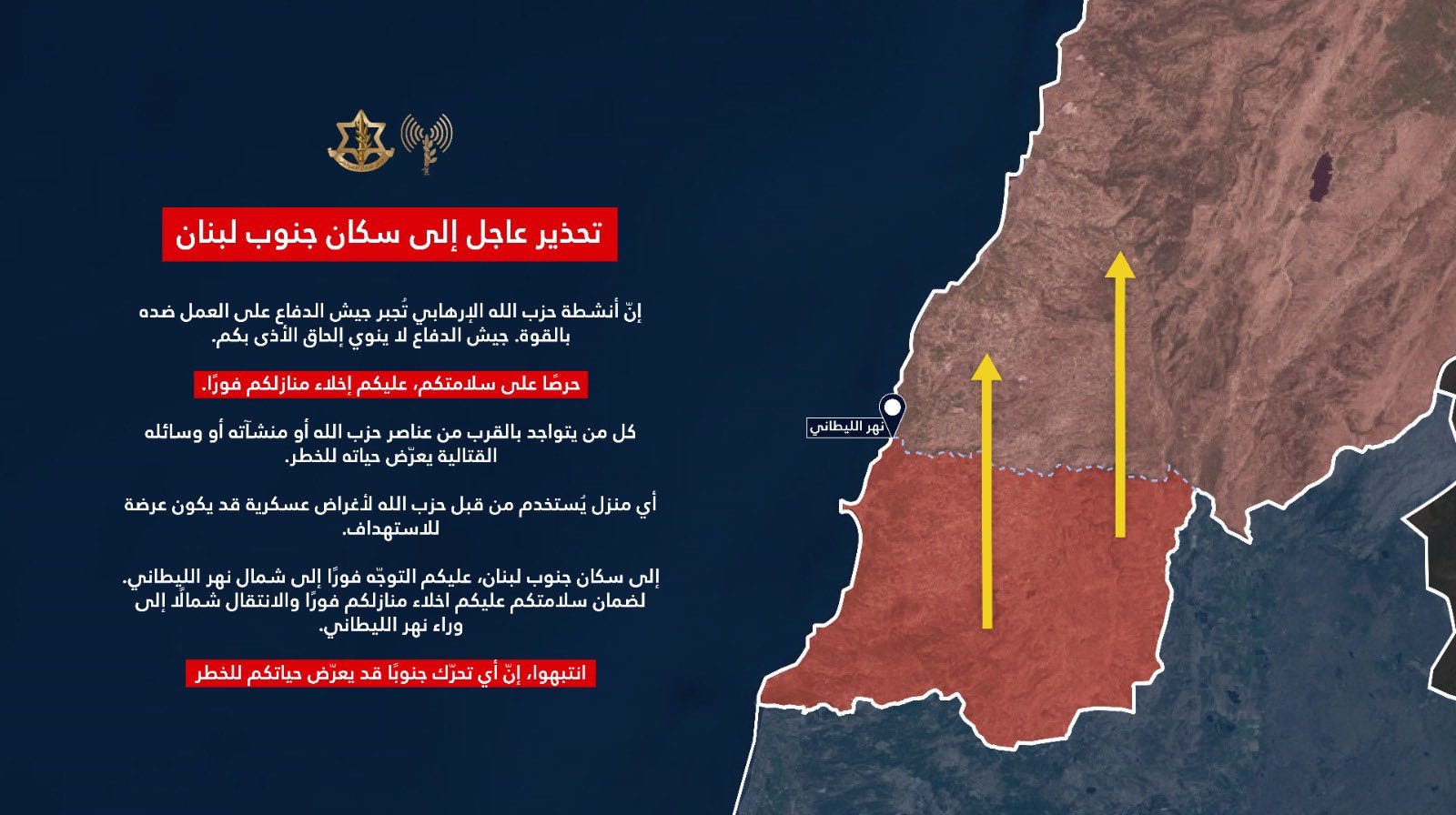
On Wednesday, the Israeli military escalated and issued a sweeping displacement order for all residents in Lebanon south of the Litani River. The order was accompanied by a map showing the entire southern part of Lebanon shaded in red with two large arrows pointing north.
Nearly 60,000 people have been displaced over the previous 24 hours alone, according to Lebanon’s state-run media outlet, the National News Agency, adding to the tens of thousands who have already fled their homes since Monday.
The escalated Israeli military campaign in Lebanon came after Hezbollah fired a barrage of missiles and drones at the Mishmar al-Karmel missile defense site in northern Israel overnight on Sunday, calling the strike retaliation for Israel’s killing of Iran’s Supreme Leader Ayatollah Ali Khamenei and for ongoing Israeli operations in Lebanon.
Israel retaliated with heavy bombardment across southern Lebanon and Beirut. At least 50 people have been killed and 335 wounded in the Israeli attacks, according to Lebanon’s Ministry of Public Health. Among them, two of Arout’s relatives—two-year-old Haidar and four-year-old Ruqaya, children of his cousin Ali Arout. They had been living in the village of Al-Sultanieh, 10 miles west of Mais al-Jabal, after their home was destroyed in an Israeli airstrike in 2024. On Monday evening, just as the family was getting ready to flee the area, Israel bombed the house where they were staying, killing the two children and injuring Ali’s wife and baby daughter. They were among at least seven children killed in Lebanon within the first 24 hours, according to UNICEF.
“It was a home for displaced people. They weren’t building rockets,” Arout told Drop Site. “Where are the European nations with their great morals? Where is the conscience of humanity?”
Hezbollah’s decision to fire rockets across the border at Israel marked the first major violation of the ceasefire by the group since it took effect in November 2024. Over that same period, Israel has bombed Lebanon on a near daily basis, killing over 340 people, and committing over 15,000 ceasefire violations, according to the UN. It also established five military positions and two “buffer zones” inside Lebanon.
Hezbollah began firing rockets and artillery at Israeli forces on October 8, 2023, one day after Israel began its genocidal assault on Gaza. Israel launched airstrikes on southern Lebanon, with cross border attacks continuing for months. In September 2024, Israel escalated, detonating thousands of pagers and walkie-talkies across Lebanon, killing dozens of people and injuring thousands. Israel then launched a wave of heavy airstrikes on Lebanon and a series of assassinations of top Hezbollah commanders, culminating in the killing of the group’s longtime leader Hassan Nasrallah, followed by a ground invasion in October 2024. Large swathes of southern and eastern Lebanon were destroyed in the Israeli attacks, with entire villages being demolished. Over 3,800 people were killed and more than 1.2 million forcibly displaced.
Arout was among roughly 600 families who returned home to Mais al-Jabal after the so-called ceasefire. Before the war, the town was home to about 30,000 people. They returned to find that the Israeli military had booby trapped and obliterated entire neighborhoods, razed farmland, and destroyed two local schools. And while the ceasefire brought an end to Israel’s mass bombing campaign, it only ushered in a new phase of violence, particularly in the south.
In Mais al-Jabal, as with other towns in the area, Israel conducted routine nighttime incursions, assassination operations, and drone surveillance. Israeli troops targeted villagers who tried to rebuild their homes or tended to farmland close to the border. Faced with these conditions, Arout said he came to support Hezbollah’s decision to reenter the war.
“We are lovers of life, we don’t like death,” he said. “But a good, dignified life, not a life of humiliation.”
However, Prime Minister Nawaf Salam, along with numerous members of parliament, reacted angrily to Hezbollah’s decision to fire at Israel. On Monday, Salam declared Hezbollah’s military operations “illegal acts” and imposed a ban on the group’s security and military activities—the government’s harshest stance against Hezbollah yet. He also called on security agencies to prevent the firing of missiles or drones from Lebanon and detain those behind the launch.
“There is a side that wants to drag the country to matters that we have nothing to do with,” the Lebanese information minister quoted President Joseph Aoun as saying, in reference to Hezbollah, during an emergency meeting of the Cabinet that discussed the escalation.
The Lebanese Armed Forces have been tasked with enforcing the decision and asserting a state monopoly over weapons north of the Litani River using “all means necessary.” On Tuesday, the army detained 12 armed Hezbollah members at a military checkpoint, according to local broadcaster LBCI.
In a statement early Tuesday, Hezbollah said “confrontation is a legitimate right,” adding that it had repeatedly warned that Israeli attacks “could not continue without a response.” Senior Hezbollah official Mohamoud Komati went further, saying, “The Zionist enemy wanted an open war, which it has not stopped since the ceasefire agreement,” senior official Mohamoud Komati said. “So let it be an open war.”
Meanwhile, the Israeli military has begun advancing further into Lebanese territory from positions along the border. Israeli ground troops have entered the town of Khiam, according to NNA, and established a military position near the municipality building. Israel’s Defense Minister Israel Katz said the military has been instructed “to advance and seize additional controlling areas in Lebanon to prevent firing on Israeli border settlements.” Katz also declared that Hezbollah Secretary-General Naim Qassem, who succeeded Nasrallah, is a “target for elimination.”
As the Israeli military campaign in Lebanon continues, tens of thousands of displaced families have been uprooted from their homes in the largest mass displacement since the 2024 war. In Beirut, scenes along the seaside boardwalk recalled that period, with families walking beside cars packed with mattresses and suitcases, and sleeping on the pavement in the cold.
Finding housing has become another battle. Dozens of shelters are already at full capacity. Landlords in Beirut suspicious of southerners’ ties to Hezbollah are demanding identification cards and conducting background checks before accepting new tenants. Rents have soared into the thousands of dollars per month in a country where modest apartments typically cost a few hundred.
Lebanon’s border region, now largely evacuated, is an agricultural heartland that is also home to thousands of Syrian refugees who work the land.
Um Mahmoud, who fled Idlib in northern Syria in 2011, has lived in the southern village of Khiam ever since. She and her husband worked a plot owned by a Lebanese family, harvesting crops and caring for the property while raising their three children.
When the war between Hezbollah and Israel first erupted in October 2023, Um Mahmoud and her family were displaced four times before settling near Nabatieh. Unable to find work, they survived on food rations provided by a local Lebanese woman, who was herself displaced. Syrian refugees are barred from certain official displacement shelters, which are reserved for Lebanese citizens.
Her greatest fear is that the ordeal would be repeated. When they learned of the displacement orders late Monday night, Um Mahmoud and her family packed a few bags and headed for Marj al-Khokh, a displacement camp for Syrians.
“You should have seen the exodus in the darkness. It was devastating—some people on motorcycles, others on foot,” she said. “Farmers without trucks herded their sheep on the shoulders of the road.”
They rented an unfurnished tent and slept on the ground. The next day, nearby Israeli strikes prompted some of the roughly 400 Syrian families in the camp to return to Syria. Um Mahmoud refused to do the same, fearing the insecurity that still grips Idlib.
Instead, the family traveled to the Bekaa Valley to stay with her brother-in-law. She said leaving Khiam was painful. “My soul is attached to the south,” she said. “After 15 years there, I got used to the people, the land. If I were to have a homeland, it would be the south.”
 | A guest post by
|
We really do need new Nuremberg trials, and soon!
Is this Israel trying to do the "greater Israel" take over local neighbor's territory thing?