

After Insurgents Battle Military Junta, Mali Pushed Toward War and Economic Collapse
Widespread violence has gripped Mali as militant groups have advanced to pose a significant threat to the ruling regime.

Drop Site is a reader-funded, independent news outlet. Without your support, we can’t operate. Please consider becoming a paid subscriber or making a 501(c)(3) tax-deductible donation today.
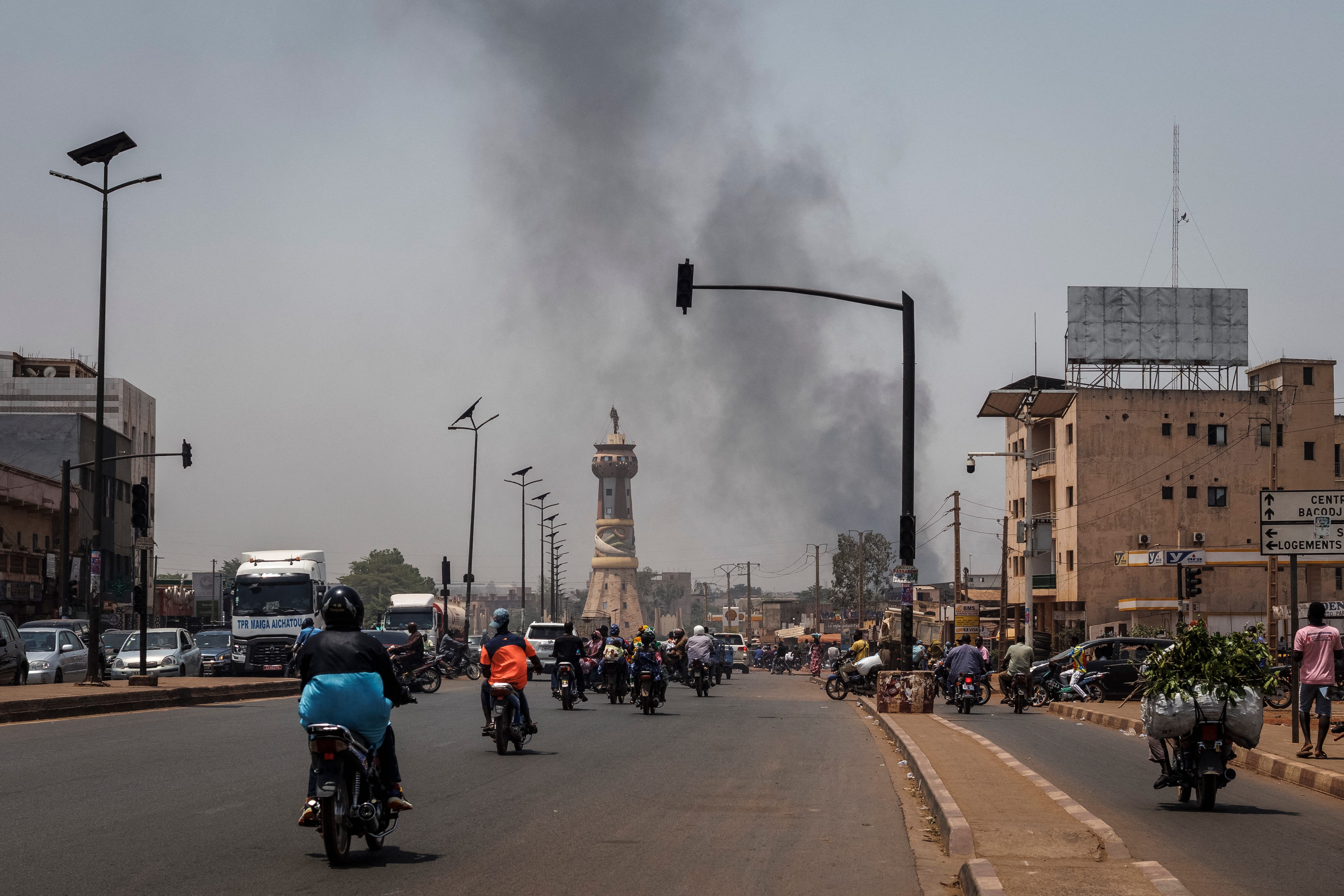
BAMAKO, Mali—Abba, a truck driver who lives on the outskirts of Bamako, recently spent 10 days stranded at a makeshift camp in Kita, a town about 100 miles west of the capital. Like many drivers bringing goods from Dakar, a coastal city in neighboring Senegal, he found himself stranded amid a breakdown in security in Mali that severely escalated last month.
Videos of burning transport vehicles that had attempted to cross the country were being widely circulated on social media, leaving Abaa and other drivers terrified of driving along the route to Bamako.
“No driver will risk heading towards Bamako,” he told Drop Site. “It is extremely risky, you either lose your vehicle or your life.”
Abba said he received little information from the authorities, but appreciated the outpouring of support from residents of Kita who shared food and other necessities. Some movement recently resumed on the route from Kita to Bamako with support from the military, which allowed Abba to cross safely, but many other drivers remain stranded.
A rural insurgency that has challenged the authority of the Malian state for over a decade has transformed over the past several weeks into a significant threat to the power of the ruling military junta. On April 25, an alliance of jihadist groups and Tuareg ethnic separatists carried out a series of coordinated attacks across the country, sparking sustained, widespread violence, a blockade on the capital, and growing fears that Mali is on the brink of unraveling completely.
Jama’at Nusrat al-Islam wal-Muslimin (JNIM), the main militant group in the Sahel with a declared allegiance to al-Qaeda, launched the attacks—including an offensive targeting Bamako and a military garrison in the nearby town of Kati—that killed Mali’s defense minister, Sadio Camara, when a vehicle exploded outside his residence.
Days after the April 25 attacks, JNIM declared a complete blockade on Bamako, escalating a broader campaign of economic warfare they launched against the government in September 2025. The siege on critical infrastructure has targeted trade routes, threatened fuel tankers, and attacked electric grids across the country. The effects are already being felt, with shortages and price spikes, delegitimizing the state. “I struggle to find fuel just to run errands,” a student in Bamako told Drop Site.
“Breaking Point”
The long-running insurgency has pitted a coalition of militants and rebels against Mali’s central government and a rotating cast of foreign allies, chief among them France, the former colonial power in Mali. In 2021, the current regime took power in a coup d’etat— the second coup in the space of a year—with a promise to restore stability to the country. The new military government quickly pushed French forces out, ending a nine-year military operation in Mali, and solidified relations with a state-connected Russian paramilitary organization known as the Africa Corps that is a successor to the notorious mercenary organization Wagner Group.
The JNIM militants were joined in their offensive by fighters from the Azwad Liberation Front (FLA), a separatist group of ethnic Tuareg rebels that has been fighting for independence from Mali, to seize Kidal, a historic city in the north of the country. In Kidal, Russian troops from the Africa Corps who had been deployed in the city alongside the military, were forced to retreat in the face of the offensive, sharing videos on social media of widespread militant attacks on the city.
The surprise joint attack by JNIM and the FLA has led to fears that the Malian military government itself may be on the verge of collapse. In Bamako, supporters of the government have held public rallies in stadiums to boost morale and show support for the ruling junta, but concerns are rising about its ability to hold onto power amid the loss of key officials and an escalating economic siege on the capital.
Outside the city, government authority has always remained more tenuous. A farmer from Diafarabé, a village located in the Mopti region in central Mali, said local residents had been pushed to the brink by the war and resulting economic collapse. “The village has been under siege by jihadists for several months now, with absolutely no response from the authorities,” the farmer, who spoke on condition of anonymity out of security concerns, told Drop Site. “We can no longer go out to our fields, and hunger is beginning to set in. We are at our breaking point.”
The fighting has caused panic within the ranks of Mali’s military. In some of the latest violence, drone strikes by Mali’s army killed at least 10 civilians on Sunday in the central region of San as they were preparing to celebrate a wedding. The strikes targeted “a procession of motorbikes following one another,” a security source told AFP. “That is certainly what drew the attention of the drones.”
On the ground in Kati, a historic stronghold of the Malian military, residents remain in shock after the devastating April 25 attacks. A teacher residing in the city told Drop Site that armed militant groups had managed to infiltrate and maintain a presence within the garrison city from 4 a.m. until 4 p.m. on the day that Camara was killed. For 12 hours, the country’s military center remained in the hands of the attackers, before they finally withdrew. The insurgent coalition’s ability to penetrate so deeply into the country and kill top officials, apparently with ease, has deeply unnerved many residents.
Earlier this month, the allied insurgents attacked two towns in Mopti, killing dozens of people, mostly from the Dogon ethnic group. Locally formed Dogon militias, known as Dana Ambassagou, had previously received informal support from the government, but one member of the militia told Drop Site that they feel they have been “abandoned,” and that the recent killings would not have taken place if they had been able to properly defend themselves. “The authorities couldn’t care less about our problems, because the army fails to intervene during jihadist attacks,” he said. On May 11, a state representative traveled to the area to convey the president’s condolences for those killed in the attack.
Around Mopti, the rallies for the military in the south stood in stark contrast to the muted response to the deaths of the Dogon. “No human life is more valuable than another,” said a Bamako-based woman whose family lives in the Mopti area and asked to remain anonymous for security reasons. Two days of national mourning were declared in honor of the slain defense minister, she noted, but for over a week, the government issued no comment for the estimated 50 people killed around Mopti.
Malian authorities have insisted that security has been restored, yet the situation on the ground remains highly precarious. The state has reinforced strategic locations like the national news station and international airport with swarms of soldiers, pre-emptively protecting areas typically targeted during attempts to overthrow state leadership. The airport holds particular significance. It is adjacent to Base 101, which hosts units from Russia’s Africa Corps.
The Russian mercenaries have been accused of engaging in widespread massacres and rampant human rights abuses in Mali. In a bid to restore their reputation after military losses such as the retreat from Kidal, Africa Corps recently posted a video on Facebook showcasing their operations against the insurgents—the latest in a long-running series of propaganda videos that they have produced during the war.
Meanwhile, the Trump administration in February lifted sanctions on Mali’s defense minister and other senior officials it accused of having ties to Africa Corps. The move was aimed at allowing the U.S. to resume flying surveillance aircraft over Mali to gather intelligence on jihadist groups, according to Reuters.
Shattered Lives
Three days after the April attacks, Mali’s president, Assimi Goïta, released a statement aimed at reassuring the public. He vowed that “no violence, no intimidation—and certainly no desperate attempts at destabilization—will be able to reverse the country’s forward march,” adding that “the national refoundation will continue, and sovereignty will be consolidated.”
Despite striking a tone of unity and confidence in public, the apparent success of the insurgent campaign has fed doubts inside the country about the reliability of the country’s government and armed forces, while contributing to government infighting that has further weakened the state.
An initial investigation into the April 25 attacks led by the Bamako military prosecutor’s office pointed the finger at individuals and factions within the ruling junta as having assisted the insurgents. Early findings accused current and former members of the military, as well as a former member of parliament who participated “in the planning, coordination, and execution of the attacks.”
Meanwhile, the security situation continues to deteriorate, arrests are widespread alongside raids by masked government forces who have reportedly abducted several political opposition figures. “Everything suggests that these events are being used as an opportunity to carry out a purge within the political opposition and the army,” a Malian official told AFP.
The human cost of the growing violence is being felt across the country. Families have been left to mourn loved ones who fell on the front lines. While authorities have not published a death toll, many of the victims are soldiers aged between 22 and 40. For many Malian families, the incalculable grief of losing a son is compounded by the loss of an economic pillar for the household.
In the outlying district of Samé, near Kati, a mother who lost her 33-year-old son to the fighting in Sevaré, in central Mali, described her heart as “torn apart” by the death of her son, who also represented her family’s sole economic hope. Just one week prior to the attack, she saw her son for the last time. Grieving her loss while witnessing the slow-motion collapse of the Malian state, she said that no one in the country will want to allow their child to join the military.
This article was published in collaboration with Egab.
 | A guest post by
|
Mali isn’t unraveling — it’s being gutted by a junta that swapped foreign masters, silenced dissent, and called the wreckage “sovereignty.” This reporting shows a state that can stage rallies but can’t defend a single village or even acknowledge massacred civilians. When your own factions are accused of aiding insurgents, you’re not governing. You’re collapsing. And the only people holding the country together are the ones the regime has already abandoned.
"The ruling regime" is the ruling government. "Militant groups" are terrorist groups. And they are backed by the US which aims to topple the government because it challenged decades-long US and France military occupation of Mali.