

Michigan Dems Came Down Hard On Student Protests Against the Gaza Genocide. It Just Blew Up in Their Face.
Two upset primary at the Michigan Democratic nominating convention are material and symbolic victories for pro-Palestinian activists at the University of Michigan.

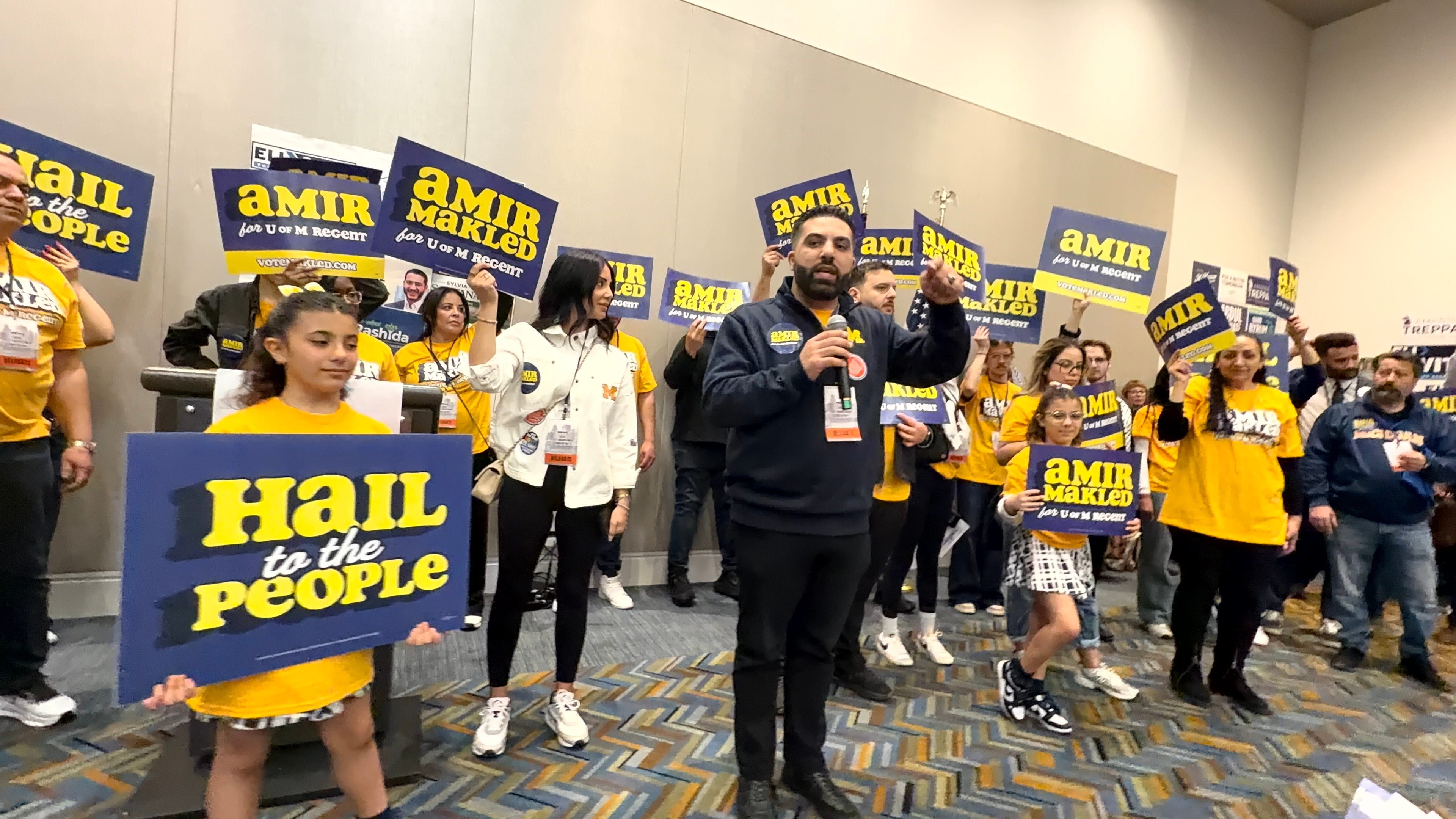
Story by Tom Perkins
For two years, establishment Democrats have led a wide-ranging legal attack on University of Michigan pro-Palestinian student activists, aiming to shut down their protest of Israel. On Sunday, Democratic Party delegates symbolically rebuked the establishment’s draconian campaign. Two pro-Palestinian candidates notched upset wins against pro-Israel-backed opponents in statewide primary races in this critical upper Midwest swing state.
The races, decided by the Michigan Democratic Party’s delegates during a nominating convention, mark material and symbolic victories for pro-Palestinian activists at the University of Michigan (U-M)—some of whom continue to face investigations over their protests of the genocide. And, as more polling shows the extent to which support for Israel has collapsed across the political spectrum, the wins indicate that the pro-Israel playbook is failing even in lower, state-level races.
In the state Attorney General’s race, Ann Arbor’s progressive Jewish prosecutor, Eli Savit, beat Karen McDonald, who was backed by major corporations and pro-Israel donors. And in the race for a seat on the U-M board of regents, the school’s governing body, defense attorney Amir Makled defeated incumbent regent Jordan Acker, who helped lead the school’s legal attack on the pro-Palestinian students. Makled represented some of the students who beat the U-M prosecutions.
Makled, who is Lebanese-American, overcame an onslaught of allegations that he is antisemitic and supports Hezbollah. He told Drop Site the wins show “the electorate is done with AIPAC-aligned candidates and their smear campaigns.”
“People are done with it, and the establishment has to recognize that,” Makled added. “It is the only way this party moves forward because it’s the right way.” His win also came after The Guardian on Friday reported on lewd text messages Acker appeared to have made about a student and Democratic strategist.
Makled was one of three Democratic candidates vying for two open U-M regent seats. He and the other winner, incumbent Paul Brown, will face GOP candidates in the November general election.
Savit and Makled each opposed U-M’s ongoing investigations into pro-Palestinian students. U-M in May 2024 dispatched police to violently break up a campus pro-Palestinian encampment, and officers forwarded dozens of warrant requests to Savit’s office.
Savit, finding the protesters were largely peaceful, declined to charge, a move that incensed U-M’s leadership. In response, it recruited Michigan Attorney General Dana Nessel to prosecute students. Nessel has deep ties to the state pro-Israel establishment and regents, and in September 2024 she filed charges against eleven protesters. But she dropped the cases months later as she faced allegations of pro-Israel bias.
She also partnered with Trump’s FBI to raid students’ homes in April 2025 in response to someone vandalizing U-M regents’ houses with anti-Israel graffiti, including Acker’s. A year later, Nessel has not yet brought charges, and she has been silent about the investigations’ statuses.
Nessel is term-limited, and her tenure ends on Jan. 1, 2027. A Drop Site analysis of campaign donations through October 2025 found McDonald had raised $840,000, more than her three opponents combined, and over twice Savit’s total.
At least $200,000 came from local pro-Israel donors, including Acker, and pro-Israel U-M regents Mark Bernstein and Denise Ilitch. Among her other major contributors were leadership in the local, pro-Israel Jewish Federation chapter, AIPAC donors, and Friends of the IDF donors.
McDonald was also the establishment-backed candidate, with endorsements from major unions, Democratic leaders, EMILY’s List, and donations from top state corporations, like DTE Energy and Blue Cross.
But it was not enough to sway the Democratic Party’s rank and file, and delegates picked Savit by a 58-42 margin.
It is widely believed that Savit will end Nessel’s remaining investigations, though he could not be reached for comment on Monday.
In the election’s wake, pro-Israel Michigan State Rep. Noah Arbit wrote that “the party is abandoning us.” Jewish Insider wrote that Jews in Michigan were “politically homeless.”
Acker’s loss “is a warning to the rest of the regents,” said one campus activist targeted by an investigation. Many of Makled’s campaign organizers were students; the advocate said U-M students in 2026 more clearly than in the past understand the regents’ roles in campus attacks on the pro-Palestinian movement.
“It does sort of seem like we can enshrine a clear message to the board of regents that this is a losing strategy,” they added.
Makled’s win, meanwhile, came despite the smear campaign that accused him of being a Hezbollah supporter and antisemitic. He drew criticism for posts on X in 2025, including a retweet that lamented the death of former Hezbollah leader Hassan Nasrallah. Another retweet, from Candace Owens, referred to Israelis as “demons” over Israel’s attacks on Palestinian Christians.
“The electorate is seeing through the nonsense and smears,” Makled said.
Makled faced an especially vulnerable candidate in Acker, who was hit by the text messaging scandal in the race’s final 48 hours. He was also widely loathed by many on the left over his attacks on unions, opposition to pro-Palestinian groups, and support for the dissolution of U-M’s DEI program. Nevertheless Acker was endorsed by state senator Mallory McMorrow, now running for U.S. Senate, Michigan Gov. Gretchen Whitmer, other major Democratic state leaders, and several major unions. They did not rescind their endorsements.
Acker’s and McDonald’s loss shows that “anyone who thinks Palestine is a fringe or ‘wedge’ issue in Democratic politics is fooling themselves,” said Bilal Baydoun, a Dearborn, Michigan-based writer and political commentator.
“Like Democrats across the country, Michigan Dems are tired of being censored and smeared for wanting leaders who will speak out on a defining moral issue of our time,” Baydoun said.
Some Democrats have downplayed the elections’ significance, arguing that the vote took place at a nominating convention, and the delegates in these formats are far more to the left than voters across the state.
However, the Michigan format includes delegates from across the state, and is designed to cap the influence of those in counties that hold Detroit, Ann Arbor, and other activism centers. The delegates come from across the state, and the party has, until now, leaned conservative.
And some attacked progressives for booing US Rep. Haley Stevens during her convention speech and allegedly cursing.
“Responding to this growing consensus with more contempt for the party’s base of support is obviously going to fail,” Baydoun said.
Tom Perkins is a freelance reporter in Detroit who covers the antiwar movement locally and nationally.
A lead story in the Financial Times today is “Why America is Falling Out of Love With Israel.” The image of Israel as an American ally is fast unraveling—just about everywhere in the US. The corporate Democrats are going to have a hard time ignoring the issue this time around.
Supporting my favorite Lebanese owned restaurant today. My fellow Americans please use your dollars to support axis of resistance businesses in your city. Solidarity.