

Grieving Parents in Iran Spend Every Night at the Graves of Their Children, Killed by U.S. Strike
As Ramadan comes to a close, families in Minab, Iran struggle to come to terms with the scale of death, one of the deadliest single attacks on children in memory.

Drop Site is a reader-funded, independent news outlet. Without your support, we can’t operate. Please consider becoming a paid subscriber or making a 501(c)(3) tax-deductible donation today.
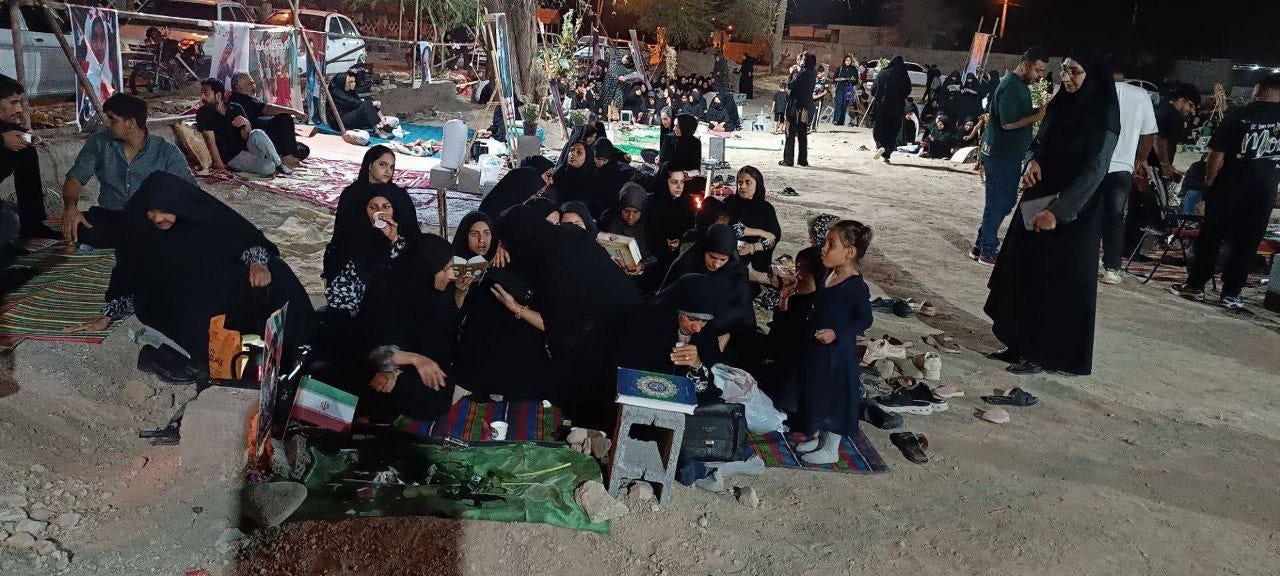
MINAB, IRAN—Families arrive at the cemetery after sunset. They come carrying rugs and cushions, food and water, and candles or lanterns that they place on the small, freshly dug graves. Parents carefully clean the tombstones of their buried children. They arrange the spaces around them and settle in for the night—a quiet vigil that will continue until dawn.
The collective grief in Minab, Iran is unfathomable. At least 168 children, most of them girls aged between seven and 12 years old, were killed in a single strike on the Shajareh Tayyiba elementary school on February 28, in the opening hours of the U.S.-Israeli war on Iran.
As the holy month of Ramadan comes to a close this week—a time when prayers carry special weight—families have continued to gather at the cemetery after iftar, the sunset meal to break the fast, to pray beside their dead children in the dark.
Amina Karimi, 42, lost her seven-year-old daughter, Leila, in the strike. She comes to the cemetery every night.
“Ramadan this year arrived carrying a grief I have never known before,” Karimi told Drop Site News. “I read the Quran in a low voice and recite prayers I dedicated to her, and I speak to her as though she can hear me.” She pauses. “Sometimes I close my eyes and recall her laugh, her voice, how she used to run at school, laugh with her friends, and how we used to dream of her future.” Karimi stays at the graveyard through the night despite the cold that cuts through her clothes. “The night is heavy and the cold bites. But the dim candlelight gives me some warmth.”
Evidence collected by human rights groups and media outlets strongly point to the U.S. conducting the Tomahawk missile strike—one of the deadliest single attacks on children in memory. Preliminary findings of an internal U.S. military investigation determined the U.S. was responsible and the school was likely bombed based on outdated targeting data. The Trump administration has not admitted to anything.


In Minab, parents are struggling to come to terms with the scale of the loss.
Reza Zarei’s seven-year-old son, Ali, was killed in the strike. The 45-year-old comes to the cemetery to be beside Ali’s grave through the night until the predawn call to prayer. “I remember the small details of his life,” Zarei told Drop Site. “How he went to school. His friends. His games in the street.” He added, “The night here is silent except for the sounds of prayer and recitation.”
The atmosphere in the cemetery, where all the victims of the school bombing were laid to rest, is unlike anything in the city around it. Sounds disappear. Voices are muted. Families sit or lie down beside the graves, reciting verses, whispering to one another, or falling into long silences. Those who cannot sleep stare at the headstones. The candles planted at the graves create a scattered, uneven light—dozens of small flames that bend in the wind but do not go out. From a distance, the cemetery glows with dim flickering lights.
Reyhana Akbari Far, 40, who lost her eight-year-old daughter Zahra, told Drop Site that she sometimes lies down beside the grave and closes her eyes. “I try to feel her close to me,” she said. “The lit candles around the graves give me some light in the long night, but they cannot remove the pain that fills my heart.” She said the sound of other families nearby—talking, reciting, sharing memories—makes the nights less unbearable. “We exchange memories. We talk about the games our children loved, and we bring back moments of their laughter,” she said. “All of that makes the night a little less lonely, and eases the feeling of absence a little.”
Parents describe the experience of gathering at the cemetery not as mourning in isolation but as a form of continued presence, a refusal to fully accept the distance between the dead and the living. Small children, most of them presumably brothers, sisters, or cousins of the victims, move carefully between the graves. They watch how the adults hold themselves, how grief is organized into ritual, how it is possible to sit with an unbearable thing for hours without breaking apart. They are learning something they are too young to learn.
For Reza Rezaei Pour, 47, the hours in the cemetery are organized around the act of speaking. “I put my hand on the cold stone, I read prayers, and I recall my son Mohammed’s memories,” he told Drop Site about his dead seven-year-old. “His laughs. His play. The small things of his daily life that used to give us happiness.” He describes meeting other fathers in the dark, trading what they remember. “We tell each other about the moments that no longer exist,” he said. “And we learn that shared pain can lighten some of the weight.”
Suhoor—the pre-dawn meal before fasting resumes—passes quietly at the cemetery. Families bring some food but few seem to eat. The ritual of suhoor is observed more than the meal itself. Mothers pour tea from thermoses. A child falls asleep on a father’s shoulder. Someone straightens a candle tilting over in the soft earth.
Fatima Azadi Pezeshki, 43, lost her seven-year-old daughter Huda. She arrives each evening and stays as long as she can. “Sometimes I close my eyes and try to imagine her voice and her image in front of me,” she told Drop Site, “as though she is still present with me.” She said she reads the prayers she used to recite with her daughter at home, in the same order, as a way of keeping something intact. “I try to make her part of these moments despite her physical absence.”
Just before sunrise, families begin to slowly gather their belongings. They fold the blankets, collect the food they barely touched, extinguish the candles. The cemetery empties gradually, family by family, until the dawn breaks and the graves are silent and alone once again.
This story was published in collaboration with Egab.
 | A guest post by
|
It’s so frustrating, I’m a combat wounded Vietnam Veteran, after coming home I joined Vietnam Veterans Against The War, the Republicans and Democrats don’t work together unless it’s for war, being an American is shameful.
This is a heart-wrenching piece. For Muslims, this month when revelation came is one of detachment from worldly matters and turning to God. One common belief is that innocent people who are killed -- men, women, children -- are considered martyrs and their next abode is heaven.
As for the perpetrators of this mass murders, most likely our own government, the Muslim belief is that they will be held accountable in this life or the next, but justice will be done either way. Same as in the Biblical phrase of "You reap what you sow."
Let's hope and pray for peace. To paraphrase Dylan, "How may deaths will it take till we know too many people have died?"