

Morocco Is Profiling and Imprisoning Young People to Crush Gen Z Protests
Police are targeting Moroccan youth based on their appearance amid mass anti-corruption protests over government underfunding of healthcare and education.

We have a commitment to ensuring that our journalism is not locked behind a paywall. But the only way we can sustain this is through the voluntary support of our community of readers. If you are a free subscriber and you support our work, please consider upgrading to a paid subscription or gifting one to a friend or family member. You can also make a 501(c)(3) tax-deductible donation to support our work. If you do not have the means to support our work financially, you can do your part by sharing our work on social media and by forwarding this email to your network of contacts.
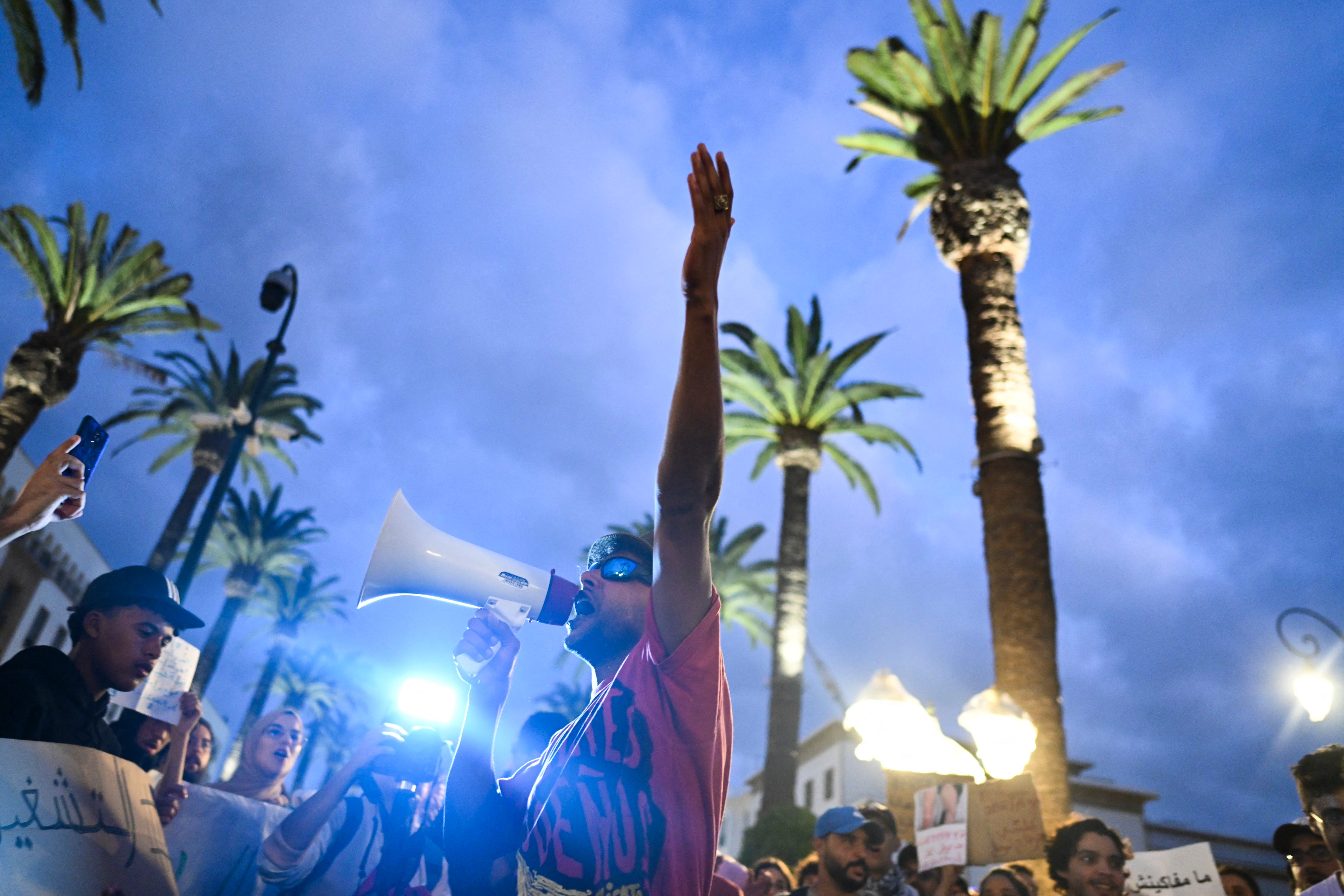
RABAT, MOROCCO—When two young men entered his small print shop in Rabat on October 4 with a 40 dirham (about $4) work order, Ayoub didn’t imagine that the simple job would land him in prison. Barely an hour later, the 34-year-old biology graduate had just finished printing several football shirts with the requested designs featuring the logo of the “Gen Z 212” movement—a reference to Morocco’s international dialing code—and the words “Free Palestine,” when two police officers walked in.
Within 48 hours, Ayoub was behind bars in Arjat Prison, charged with “participating in incitement to commit crimes”—an offense carrying up to five years imprisonment. Over a month later, he remains in prison. Ayoub’s case is emblematic of an unprecedented government crackdown that has swept Morocco since late September, when youth-led, anti-corruption protests demanding improvements in healthcare and education erupted nationwide.
The mass demonstrations that ignited in more than a dozen cities across Morocco in late September have decried the government’s underfunding of schools and hospitals amid plans to spend more than $5 billion on stadiums and infrastructure as the country gears up to co-host the 2030 FIFA World Cup. The protests against government spending priorities have used the gaming chat app Discord and other online platforms to call for mass mobilizations. Police have responded with tear gas, batons, and mass arrests.
Authorities have arrested approximately 2,000 people since September 27, according to the Moroccan Association for Human Rights (AMDH). Morocco’s Public Prosecutor’s Office reported last week that 1,473 defendants remain in pretrial detention, 959 are under conditional release, and 330 are minors. At least three protesters were shot and killed by security forces.
Moroccan authorities are now profiling citizens and arresting people based on their appearance or perceived association in an effort to crush any and all dissent.
Imprisoned for printing T-shirts
Ayoub’s imprisonment is representative of the escalating crackdown. After completing his master’s degree in biology at the University of Sciences in Rabat, he spent years unsuccessfully searching for work in his field. Unemployment for Moroccan youth has climbed to as high as 36% in recent years. In June 2025, he accepted a short-term position at a local print shop. Colleagues describe him as quiet and diligent, more interested in scientific journals than political debates.
“He never went to protests. He wasn’t even aware of the movement,” a family member told Drop Site, requesting anonymity for security concerns.
When the two young men entered the shop requesting football shirts with the “Gen Z 212” logo and “Free Palestine” printed on them, he completed the order without hesitation. Hours later, police detained the two clients in Hassan neighborhood and questioned them at the station about the shirts. Within the hour, officers from the General Directorate of National Security arrived at the print shop.
During interrogation, Ayoub admitted to printing the shirts but denied any connection to the movement. He surrendered his phone. Investigators found no evidence linking him to Discord platforms that have been used by protesters. He was released that evening, only to be summoned again two days later. On October 6, Ayoub appeared before the prosecutor expecting to testify as a witness. Instead, he was arrested and transferred to Arjat Prison. His name was added to the charges against the two young men who requested the shirts, which included incitement and distributing “public posters.” Prosecutors later added a new charge: “insulting a constituted authority.” Requests for their provisional release were denied.
“We learned that two young people were arrested simply for wearing T-shirts with slogans like ‘Free Palestine,’ ‘Dignity,’ ‘Freedom,’” said Sara Soujar, a human rights lawyer documenting the crackdown. “Then there’s Ayoub, who printed the shirts. Slogans that were once freely chanted in the streets are now treated as criminal acts.”
On Sunday, after more than eight hours of hearings, the Rabat Court of First Instance sentenced Ayoub to one month in prison. He is scheduled to be released this week. The two young men who ordered the shirts, Mehdi and Imad, were sentenced to four months and two months respectively.
Profiling Moroccan youth
Human rights defenders say the authorities are now conducting a systematic arrest campaign targeting young people based on appearance rather than actions. “Many of these arrests weren’t based on proven acts or people caught in the act, but on a preventive security approach targeting specific age groups,” Soujar said.
Videos circulating widely online show plainclothes officers detaining young people for what appears to be nothing more than the way they look. “We’ve seen arrests simply because of hairstyles, clothing deemed ‘protest-like,’ or even a backpack carrying a slogan,” Soujar said. “Some weren’t even at protest sites; they were just passing nearby.”
Hajar, a 23-year-old cinema student, was stopped by police on September 27 as she was walking to meet friends before a planned demonstration on Mohammed V Avenue in Rabat. Hajar requested a pseudonym for security reasons to speak to Drop Site.
“I was just walking when they arrested me,” Hajar said. “They asked for my ID, and when I asked them, ‘On what grounds?,’ they tried to take my phone. I refused. They didn’t even let me speak before pushing me into the police vehicle.”
Inside the vehicle, Hajar said she found herself surrounded by other bewildered young people who had been rounded up. “Two girls were crying the whole way,” she said. “They kept saying they were only heading to the [old city]. They had nothing to do with the protest.”
At the Al Joulan police station, Hajar waited for hours before she was taken in for questioning. “They asked about everything: my studies, my family, my social media. They insisted on knowing if I had any connection to ‘Discord groups.’ I was scared, thinking of my parents. I live alone here; I didn’t want them to worry.”
After several hours, Hajar was released, though she remains shaken by the arrest. “We were treated like criminals,” she said. “All we wanted was to demand basic rights. I kept thinking: how can a country preparing to host the World Cup treat its youth this way?” She added, “They told me that if they caught me again, I could go to prison. I don’t want to put my family through that. I don’t want to lose my studies. If I’m jailed, they’ll suffer too.”
From peaceful protest to indefinite detention
Meanwhile, hundreds have been detained for taking part in peaceful demonstrations.
Anass El Moustaid Billah, 23, was arrested in September after taking part in a peaceful demonstration in Casablanca. Orphaned young—his mother died from colon cancer in 2016 after months of delayed public hospital appointments, his father from heart disease and diabetes in 2022—Anass became the sole caretaker for the rest of his family.
Police abruptly detained him after the demonstration was over and transferred him to Oukacha Prison. Footage captured by a Moroccan media outlet clearly shows him protesting peacefully and heading home when he was detained. More than a month later, he remains behind bars. “His only ‘crime’ was expressing his opinion and demanding basic rights—education and healthcare,” said a friend who requested anonymity for security reasons.
Authorities rely on the 1958 Dahir regulating public assemblies to crack down on peaceful demonstrators in violation of Morocco’s 2011 Constitution. “This law no longer fits Morocco’s Constitution, particularly Article 29, which explicitly protects freedom of expression and peaceful assembly,” Soujar said, adding that the legal tactic violates both constitutional guarantees and international obligations. “A T-shirt calling for health reform or showing Palestine solidarity—these have turned into criminal charges,” she said. “We’re criminalizing slogans that were once shouted freely. Guilt is no longer tied to actions, but to assumptions—to appearances, intentions, imagined risks.”
In one well-publicized case, a woman with documented mental health disorders was sentenced last week by the Rabat Primary Court to eight months on charges of “insulting the monarchy” under Article 267-5 of the Penal Code and participating in unauthorized gatherings despite her defense team’s consistent appeals for medical support rather than prosecution.
“These cases force us to ask: where does protection really stand?” Soujar said. “We hear speeches about equality and protection, but when the time comes to apply these principles, they vanish.”
Despite the crackdown, the protests have continued. In response, the government on October 19 announced a 140 billion dirham (about $15 billion) allocation for health and education—a 23% increase—and promised 27,000 new public sector jobs. Meanwhile, protesters last weekend gathered in multiple cities to demand the release of detainees arrested in the crackdown.
“We must restore the right to peaceful protest and respect detainees’ rights. What’s happening now is legally and morally unacceptable,” Soujar said. “The security approach has never been a solution. It only deepens frustration. The price is always high—for society, for the state, for families. It drains our energy and leaves deep psychological scars that take years to heal.”
Ayoub’s family requested his full name not be published while he remains in prison.
This story was published in collaboration with Egab.
 | A guest post by
|
I have been looking for coverage of GenZ 212 generally. Thank you for your reporting.