

Pakistan Plays Peacemaker While Bombing and Blockading Afghan Civilians
While working to mediate an end to the U.S.-Israeli attack on Iran, the Pakistani government is escalating its own war against civilians on the border with Afghanistan.

Our mission is to report on what matters most, beholden only to the truth. In that spirit, we made a commitment to ensure that our journalism is free for everyone, not locked behind a paywall. But that means we rely on the voluntary support of our community of readers. Please consider making a tax-deductible donation to support our work today.
Story by Emran Feroz and Mohammad Zaman Nazari
KHOST, Afghanistan—In Afghanistan’s border provinces, the pace of war with Pakistan is a familiar one: It arrives as coordinated artillery fire in the early mornings, followed soon by the systematic emptying of villages. Then comes the slow, unmonitored collapse of local infrastructure.
This border has once again become the scene of a major armed conflict, as the Pakistani military pushes forward a military campaign against Afghanistan. The campaign has been publicly justified as a response to terrorism following a series of clashes and attacks by the Pakistani Taliban, Tehrik-i-Taliban (TTP), which Islamabad accuses of receiving support from the Taliban government in Kabul.
But the impact of the war is being felt largely by Afghan civilians, many of whom have spent more than 40 years surviving various iterations of occupation and proxy warfare only to find themselves once again in the path of a state-led, military campaign.
At this same moment, Islamabad is attempting a complex diplomatic maneuver on the international stage, trying to position itself as a necessary mediator between Washington and Tehran, offering to facilitate the de-escalation of the U.S.-Israel-Iran conflict and even acting as an interlocutor for the Chinese government.
To the populations under fire in the Afghan highlands, the idea that Pakistan could act as a stabilizer or a bridge is an obscenity, enabled by Afghanistan’s own information vacuum.
There are no international monitoring missions in Kunar or Nooristan. Access for independent journalists is severely restricted by both the geography and the political climate. Aid organizations, already stretched thin by the broader Afghan economic crisis, operate under extreme constraints to reach the isolated communities, mostly members of Afghanistan’s Kohistani and Gujjar minorities.
“There is a lack of reporting because many people, including journalists or human rights activists from Kabul or abroad don’t visit this region,” said Sher Agha, a local activist from Kunar. Before speaking to Drop Site News on Wednesday, he had visited the funeral of one of the recent attacks’ victims, a little girl named Baharat whose picture was also spread on social media. “Attacks are taking place while I am talking to you. Sarkano district, which lies along the border, is being hit intensely. This is the ongoing situation for weeks,” he added.
What emerges from the border are fragments: local testimonies, community statements, and scattered data points. Taken together, however, they reveal a coherent picture of a war fought without internal or international accountability. The hunger, disease, and exposure reported by displaced families are the predictable outcomes of military strategies that treat civilian populations as variables in a larger geopolitical equation.
For the families forced to flee on dirt roads in Kunar, Nooristan, and Khost provinces, the conflict is defined by the absence of witnesses and the presence of a neighbor that defines its security through the destabilization of its periphery.
Deliberate Strikes, Strategic Displacement
The geography of the conflict has moved far beyond disputed mountain passes, as the opening salvos in February 2026 revealed. Following Pakistan’s declaration of “open war” against the Taliban regime for its alleged support of TTP militants, Islamabad’s campaign shifted from rural border skirmishes to multiple targeted strikes on Kabul itself.
By March, these airstrikes intensified, culminating in the destruction of a rehabilitation clinic in the center of the capital, resulting in hundreds of civilian casualties.
According to findings from the United Nations Assistance Mission in Afghanistan (UNAMA), as of April 1, 2026, verified civilian deaths from Pakistani operations have reached a historic high of at least 212 victims, including male clinic patients, women, and children. However, the actual toll is likely significantly higher—owing to UNAMA’s conservative accounting methodology and the reality of armed conflict in a vast, largely inaccessible region.
Recent Pakistani strikes also targeted Asadabad, the capital of Kunar province, a city of roughly 50,000 people and the hub for northeastern Afghanistan. Residents reported that shelling and strikes over the past weekend did not discriminate between military installations and residential blocks. “Many people have been killed. I counted at least twenty. Many more were injured. We had to bring the victims to hospitals in Jalalabad city and elsewhere,” Mohammad Agha, a resident of Asadabad, told Drop Site. In the aftermath, the city’s markets slowed to a halt and the central hospital struggled to manage the dozens of casualties with dwindling supplies.
The targeting of a provincial capital marks a shift in Pakistan’s military doctrine toward Afghanistan. It suggests that the goal is no longer merely ”border management” or the containment of militants, but the application of maximum pressure on the Taliban administration by targeting the civilian centers it is supposed to protect.
Outside the capital, the rural districts of Kunar are emptying as they are systematically attacked. Residents describe a pattern of relentless shelling aimed at traditional villages. The targets appear to be the fabric of rural life rather than specific insurgent hideouts.
“The situation is very bad,” Shahzad, a resident of a village along the border, told Drop Site News. “Many people had to leave their homes. Others were killed. The Pakistani army is hitting all of us deliberately.”
When the smoke clears, the demographic shift is total. “Four villages were hit. All the people, including my own family, were expelled. Nobody is there anymore,” another witness reported. Homes, mosques, and schools have been destroyed or abandoned, residents told Drop Site. Many local observers consider these attacks as a deliberate strategy of the Pakistani army to expel residents and gain more land for creation of a “buffer zone” along the border, something that also happened in the era of the U.S.-backed Islamic Republic of Afghanistan and before the return of the Taliban.
According to the United Nations, the Taliban’s government, local NGOs, the Red Crescent and various media reports, between 30,000 and 40,000 people have been driven from their homes in Kunar alone, with little prospect of receiving aid from international organizations or government authorities.
A Silent Blockade
In Nooristan, the war is not defined by explosions, but by silence. In the remote districts of Kamdesh and Barg-e Matal, the Pakistani military has effectively created a blockade. The main road connecting these districts to the rest of the country—the region’s only lifeline—has been closed for over a month following attacks on roads and bridges by the Pakistani military aimed at severing connection to the area.
In a high-altitude environment where supply chains are already fragile, the consequences of a road closure are immediate. Locals who spoke to Drop Site described markets that have run out of flour, rice, and cooking oil, as well as clinics that are empty of medicine. The blockade creates a vacuum where basic survival becomes a daily struggle for thousands of people, including children and pregnant women.
Alternative routes through the mountains are currently impassable due to seasonal landslides and heavy rain. The region is under siege. While limited air deliveries have taken place, local sources report that the supplies largely benefit state and military personnel, leaving the civilian population to rely on dying livestock and deteriorating water sources.
Residents of Nooristan recently issued a collective appeal to the United Nations, the World Health Organization, and the Red Cross. They are not asking for political intervention, but for the bare minimum: food, medicine, and the reopening of a single road. “This is a test for humanity,” their statement read.
Despite a fragile five-day ceasefire over the Islamic holiday of Eid last month brokered by Saudi Arabia and Qatar, the Pakistani military resumed its campaign on March 19, the second day of the holiday. In both Kunar and Nooristan, the truce ended before it actually began with a new wave of aerial strikes that targeted civilians attempting to cross the mountain passes to visit relatives. Among the dead was a Kabul-based physician who was killed when her vehicle was hit near the border.
The Taliban-led Afghan government has waged its own counteroffensive against Pakistan. Over the last four weeks, Taliban border units have launched coordinated artillery barrages against Pakistani Frontier Corps outposts in the Khyber and Kurram districts. On March 31, Taliban forces successfully overran and destroyed a Pakistani army border installation in the Dangam district of Kunar—the same post residents identified as the source of the indiscriminate shelling that had decimated local villages earlier in the month.
The following day a new round of mediation was announced in China aimed at finding a durable ceasefire and reopening border crossings, though no progress has yet been made.
“We are ready to defend our land”
Further south, in Khost and the broader southeastern zone, the military campaign has produced a dual effect: mass displacement and organized local defiance.
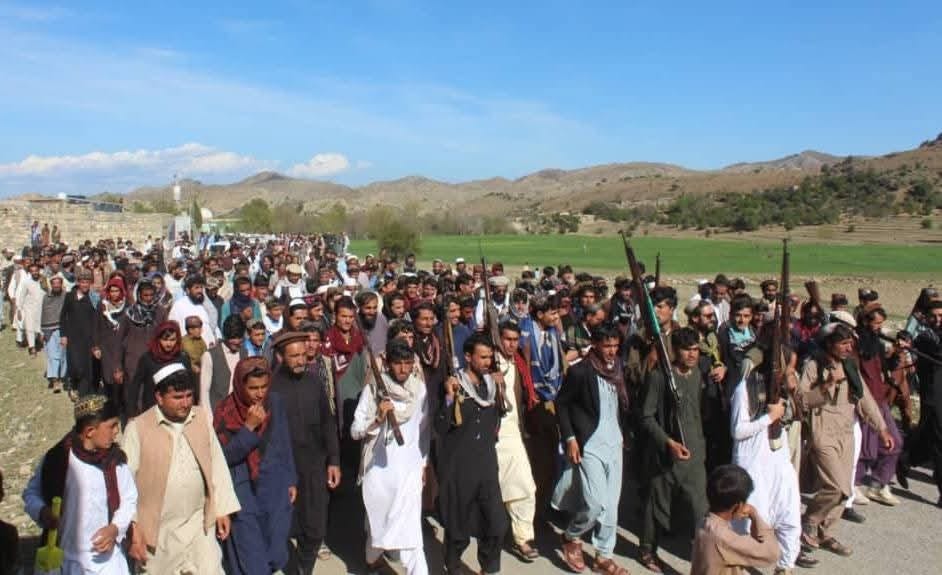
In districts like Ali Sher and Zazi Maidan, the population has begun to organize public gatherings against the Pakistani military. These are not merely symbolic protests; they are expressions of a deep-seated anger regarding the Durand Line—the 1,600-mile border drawn by the British in 1893 that has never been formally recognized by any Afghan government.
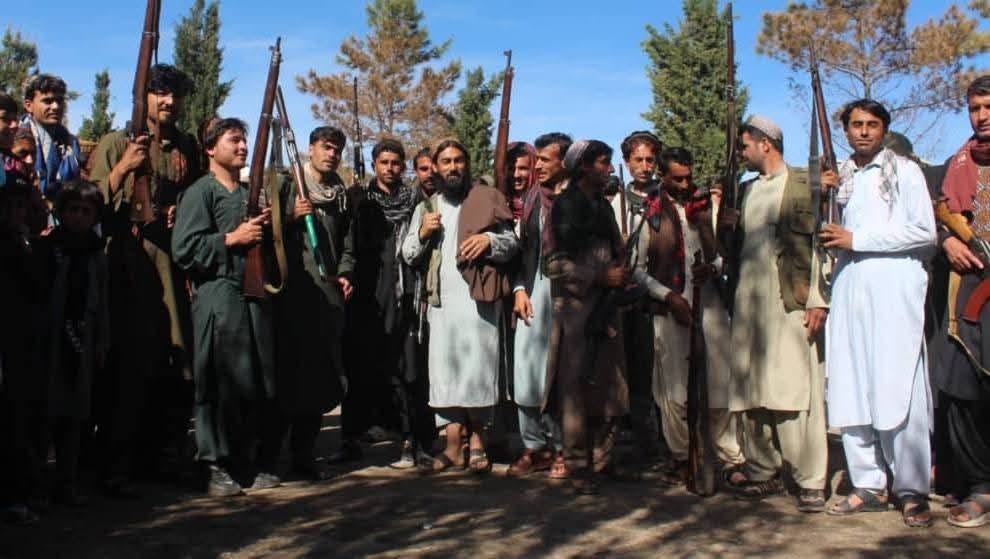
“We are ready to defend our land,” dozens of participants declared in a recent gathering, calling on the Taliban authorities in Kabul to allow them to dismantle Pakistani border installations. Some of the men were armed and most of them didn’t have any history of fighting with the Taliban. They repeatedly claimed that they would fight Pakistan’s soldiers themselves if the Taliban allowed them to participate.
Heavy clashes erupted early Thursday between Afghan forces and the Pakistani military along several points of the Durand Line, including the Ghulam Khan border crossing in Khost and the Dand-e-Patan district in neighbouring Paktia, resulting in at least two civilian injuries from mortar fire. Despite confirmation of the fighting from local officials and the Taliban’s 203 Mansouri Army Corps, specific casualty figures remain unknown, creating a sharp paradox as the hostilities unfold simultaneously with high-level peace negotiations between Taliban and Pakistani delegations currently taking place in China.
The numbers in the south reflect the scale of the crisis. In one week between late February and early March, more than 115,000 people across eastern Afghanistan were forced from their homes, according to aid organizations. Many spent the Eid holidays, traditionally a time of community and celebration, under plastic sheets or in unfinished buildings.
“We left everything behind to save our children,” said Abdullah, a 52-year-old from Zazi Maidan. “On both sides, there are Afghans. We consider them as brothers who were once separated from us. But the Pakistani army shows no mercy.”
 | A guest post by
|
Thank. you so much, Emran Feroz, for this excellent and detailed reporting on what is happening to the people of Kunar, Nooristan and Khost and others on this western fabricated "border" of Afghanistan by the Pakistan military and the terrible violence and conditions they are facing. Their situation is heartbreaking. The western press reports nothing and at the very least those of us whom this report reaches can bear witness and hold them in our prayers.
I remember a time when Washington DC and the American think tank and media establishment were telling everyone Afghanistan and Pakistan, referred to as AfPak, were the most consequential geopolitical entities in the world.
Thousands and thousands of men, women and children died, many more were wounded for life and millions displaced because of such enthusiasm, while the US wasted trillions of dollars on madcap schemes from men like Khalizad, Petraeus, McChrystal and Crockett, and war lords and drug barons got rich.
Now nothing is said in the US about the men, women and children of Afghanistan; although the generals and ambassadors sit on boards and lecture at universities, the war lords and drug barons enjoy their seaside villas, and all those smart people in Washington DC who got AfPak so wrong and did so much harm have senior titles, larger offices and second homes.
Thank you Emran and Drop Site for continuing to remember and report on the Afghans.