

How 51 Seconds at a Pro-Palestine Protest Could Send a Muslim Student to Prison for 34 years
Former University of Pittsburgh student Muhammad Ali faces three felonies for a brief tug-of-war with an officer over a metal barrier.

Reader support is what makes Drop Site possible. Without it, this journalism wouldn’t exist. If you’re able, please consider making a tax-deductible donation or upgrading to a paid subscription today.
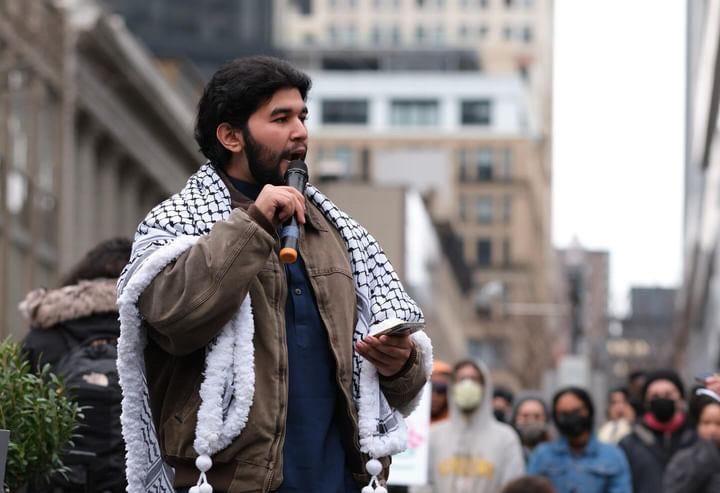
The struggle over a fallen police barrier lasted less than a minute, but it has forever altered the course of student Muhammad Ali’s life.
On June 3, 2024, the 21-year-old University of Pittsburgh senior was protesting in support of a pro-Palestine encampment in the center of campus. University police had set up metal barriers, held together with zip ties, to keep protesters from delivering food, water, and supplies to the encampment. Frustrated, some protesters tried to move the barriers.
Ali bent down to pick up a fallen barrier. An officer grabbed the other side and tried to pull it from his hands. After a brief exchange of words, Ali let go and stepped back, his hands raised. He thought that was the end of it. Weeks later, Ali was charged with multiple crimes, including three felonies. The most serious charges against him carry a maximum sentence of 34 years in prison.
Ali’s attorney and supporters say he is being treated harshly because he is Muslim and brown. They point out that the Allegheny County District Attorney’s office filed criminal charges against other protesters, but nearly all of them were offered plea deals with lesser charges, or a pretrial rehabilitation program that if completed would leave them with no criminal record.
But Ali and another community member, his co-defendant Cole Florkewicz, who is white, were not offered any deal. Both are still facing felony charges.
Assistant District Attorney James Sheets said in court that the decision to prosecute Ali “was not based on where in the world he comes from, the color of his skin or whatever God to whom he prays,” and that he is not “being made an example of.”
The Allegheny County District Attorney’s office and the University of Pittsburgh Police Department did not respond to requests for comment. The University of Pittsburgh did not respond to questions about Ali’s case.
The ACLU of Pennsylvania and other advocacy groups have raised concerns about racial disparities in Allegheny County’s criminal justice system since 2021 and called for accountability in prosecutorial practices.
“I think there’s a very concerted effort, and there has been for decades, to demonize speech about Palestine and speech that is against Israel,” said Solomon Worlds, a staff attorney with the ACLU of Pennsylvania, “speech about Palestine being the exception to free speech.” These colleges and universities, he said, seem to be targeting pro-Palestine activists and speech “as a way to show the federal government that they’re tough on antisemitism, so that they don’t lose funding.”
For Ali, who had no prior criminal record, the possibility of a felony conviction for exercising his First Amendment rights is shocking. “This cannot be real,” he said. “Why am I being charged with felonies?”
The Crackdown on Pro-Palestinian Protest
After the Oct. 7 attacks by Hamas and the launch of Israel’s war in Gaza, protests erupted at more than 525 U.S. campuses, leading to thousands of arrests, doxxing campaigns, and criminal charges against demonstrators. The University of Pittsburgh in particular took a number of harsh actions against students and faculty involved in pro-Palestinian speech and protests.
In December 2024, Students for Justice in Palestine held an overnight “study-in” in the library. Students who participated wore keffiyehs, traditional scarves that symbolize Palestinian identity, and Palestinian flags as they prepared for their finals. The university held a conduct hearing against the student organization and suspended them in March 2025, after an open letter was released condemning this action.
The ACLU of Pennsylvania sued Pitt on behalf of the students. A federal judge ruled last August that the group’s suspension was a violation of protected speech and ordered Pitt to reinstate them.
That month, Elon Dancy II, a Pitt professor in the School of Education, filed a federal lawsuit against the university and one of its deans claiming he was removed from leadership positions after he defended a group of students who criticized the dean’s response to the war in Gaza.
In April 2024, Ali, who had started at Pitt in 2021 and founded an organization called Progressive Students for Change, helped organize the first encampment at the University of Pittsburgh. The encampment lasted about a week and ended peacefully. In June of that year, as the war in Gaza entered its eighth month, students and community members set up a second encampment at Pitt, calling for transparency on endowment investments and divestment from Israel.
Colorful tents dotted the grass outside the Cathedral of Learning, the Gothic skyscraper at the center of campus. Protesters, including Ali, arrived to support those inside, chanting and holding up signs. Ali wasn’t one of the leaders or organizers for this effort, but showing up and supporting the people in the encampment was important to him, he said.
Campus police arrived soon after, setting up metal barriers to put distance between the encampment and their supporters. The next morning, when protesters returned, they saw that Pitt Police had moved the metal barriers farther out from the encampment. The distance set the tone. By late afternoon, the mood among protesters had shifted. Ali could sense the tension in the air. Frustration rippled through the crowd.
On the second day, protesters tried to pull apart the zip-tied barriers to move supplies inside. Campus police and protesters struggled over the fence pieces. Ali could see some protesters were injured from the encounters. Soon, only a few of the barriers remained standing. Those who tried to move through the gaps were met with force.
The charges against Ali stem from a 51-second confrontation recorded on body-camera footage obtained by Drop Site.
Footage from University of Pittsburgh Police Lt. Brooke Riley’s body camera shows a 51-second confrontation during a pro-Palestine protest that led to charges against Muhammad Ali, on June 3, 2024.
Lt. Brooke Riley’s body camera was recording as she repeatedly screamed at other protesters and Ali, demanding to know whether they wanted to hurt her. Ali, wearing a tee shirt with beige shorts and a white face mask, walked over. He checked on another protestor and stepped between them and Riley, standing near fallen barriers. He stared ahead and said “yes.” After Ali tried to pick up one of the barriers, Riley, Ali, and Florkewicz pulled back and forth on the metal fence for a few seconds before Ali let go and stepped back.
“It was an emotional response that what she was saying is incorrect, but looking back it feels like an entrapment thing with regards to the questions she was asking about remembering her and also whether or not I wanted to hurt her,” Ali said.
“I think those things are connected in a way,” he said.
A Pitt police criminal complaint alleges that this brief tug-of-war over the barrier by Riley, Ali, and Florkewicz, caused “numbness and pain” in Riley’s fingers and bruising to her leg.
Riley did not respond to requests for comment.
Charges and Leniency
By January 2025, the DA’s office had filed charges against 20 protesters. Eight were initially charged with felonies, including Ali.
All the protesters but Ali and his co-defendant were offered plea deals or Accelerated Rehabilitative Disposition (ARD), a pretrial program for first-time, nonviolent offenders that involves probation, community service, and rehabilitation. Of the protesters who were charged, 10 were offered plea deals they accepted. Eight were offered ARD. After completion of the program, all charges are dismissed and criminal records are expunged.
Drop Site interviewed nine protesters, including seven who were among those initially charged. They all say they can’t understand why Ali and Florkewicz are still facing felony charges, when most protesters engaged in similar conduct.
Mark Goldstone, a Washington D.C.- based lawyer with more than 35 years of experience with protest-related offenses, said he thought the charges against Ali were excessive. “It just seems to be a classic case of government overcharging,” he said.
“There’s nothing I saw in the video that would indicate that the barricade was being used offensively against an officer, and any injury to the officer probably was a result of accidental conduct,” Goldstone added. “In the heat of a back and forth, people can say certain things that may not really hold up as an actual threat to injure.”
David Rudovsky, a senior fellow who teaches at the University of Pennsylvania Law School also reviewed the footage. Rudovsky, a civil rights and criminal defense lawyer with a career spanning over five decades, also sees this as overcharging. “To me, it’s a close call,” he added, after reviewing the footage. “It’s hard to tell from that at all whether and how she was injured, but let’s assume that she was to some degree,” said Rudovsky. “She didn’t get treatment, didn’t take time off, so it couldn’t have been a very serious injury.”
“We’re just talking about probable cause at this point,” Rudovsky said, “but there are grounds certainly, probably for some of the charges, in my own legal view.”
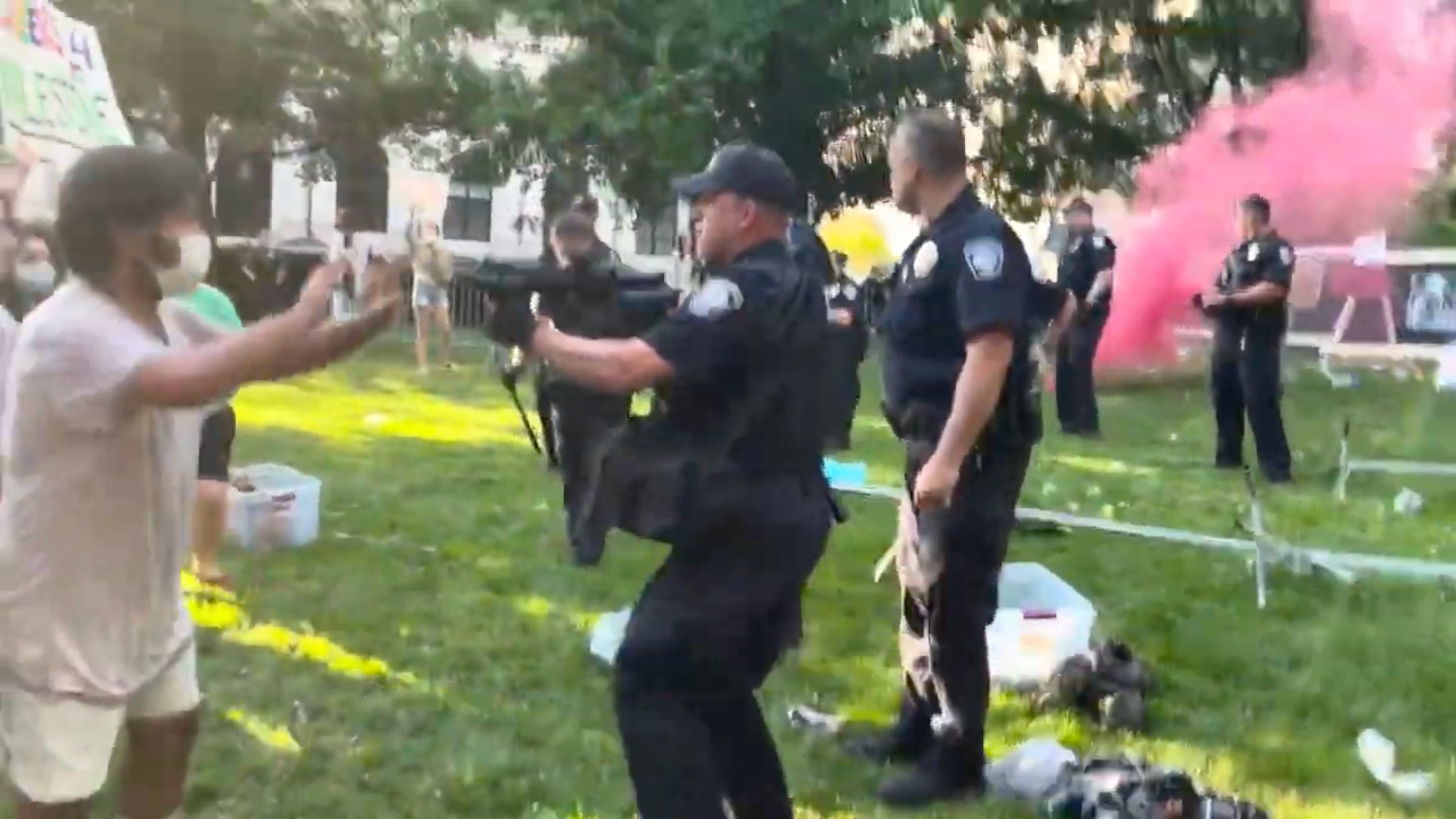
Andrew Collins, a protester and community member, won’t forget Ali stepping between him and an officer who was pointing a non-lethal firearm in his direction. Ali placed himself in the line of fire, Collins said. He raised his hands and said, “Hands up, don’t shoot.”
It was the first time he had ever had a weapon pointed at him, Ali later told Drop Site.
Collins was offered ARD for his third-degree felony charge—a charge Ali is still facing.
For years, the county’s District Attorney Stephen A. Zappala Jr. and his office faced scrutiny over their treatment of people of color.
In 2021, Black defense attorney Milton Raiford accused the Allegheny County District Attorney’s Office of systemic racism, alleging it offered less favorable plea deals to people of color. District Attorney Stephen A. Zappala Jr. responded by emailing deputy prosecutors and directing them not to offer plea deals to Raiford’s clients. The ACLU of Pennsylvania condemned the move as an abuse of power and evidence of potential bias. Zappala later rescinded the directive after widespread criticism.
In 2023, a national public interest law firm and two law professors filed an ethics complaint against Zappala. Civil rights groups and local elected officials called for accountability, but he was reelected to a seventh term that year.
An Aggressive Prosecution
Over 21 months, Ali’s case has been before six judges. The prosecution was marked by a notably aggressive tone. When a preliminary hearing was delayed at the prosecutors’ request because a witness was unavailable, Ali’s defense attorney Aaron Sontz objected. In response, Assistant District Attorney James Sheets, who according to court documents was wearing an Israeli flag lapel pin, threatened to hold Ali without bail if the continuance were denied.
After Sontz protested that such threats were inappropriate, Sheets said, “I don’t make threats, I make promises,” according to Ali, Sontz, and a court watcher whose name was redacted from the court transcript. The judge granted the delay.
In response to allegations of selective prosecution in a July 2025 hearing, Sheets pointed to the charges against Florkewicz, who is white, and said that Ali, who he claimed was the “de facto leader” of the encampment, had prior encounters with police. Sheets also cited the “egregious nature” of Lt. Brooke Riley’s injuries and said that the officer had specifically asked that no offers be made to Ali.
At a prior hearing Riley said that she was “limping” after the incident but continued to work and did not seek medical care.
The issue of bias also emerged in the prosecution’s evidence, a point raised unsuccessfully by Sontz. Video files, shown in a photo obtained by Drop Site, that were presented by the prosecution at a hearing were labeled as “anti-semetic [sic] protests.”
Ali and other protesters all maintain that the encampment did not have a leader, and the prosecution has provided no evidence to the contrary.
In another hearing, Riley recalled telling a Pitt detective she did not want Ali to receive a plea offer and wanted the case to proceed, according to the court transcripts. “I want to be heard because he doesn’t see me as a person,” she testified. Riley also said she was upset that Ali “had an opportunity to apologize” at his student conduct hearing at Pitt, but did not.
Sontz, Ali’s lawyer, pointed out that offering an apology while facing a pending criminal case would essentially be an admission of guilt, and a violation of Ali’s Fifth Amendment right against self-incrimination.
Ali’s trial is scheduled to begin in May, but regardless of the outcome, he has faced significant consequences. He was expelled from school, one semester short of graduating, and doxxed on Canary Mission, a site that purports to be fighting antisemitism. Ali is still grappling with what all this means for him. Since last year, he has been taking online classes at the University of Maryland. When he transferred, he lost 40 credits or nearly a year of classes. He hopes to attend law school and took his LSAT this year, but whether that’s possible depends on the outcome of his trial.
 | A guest post by
|
"Weeks later, Ali was charged with multiple crimes, including three felonies. The most serious charges against him **carry a maximum sentence of 34 years in prison**."
Just like the insurrectionists received after J6... What a sick double standard.
How can we say more clearly that a foreign nation has hijacked the US than our **first** amendment being crushed at Israel's demand?!
Here's an additional term that has lost all meaning:
4) "antisemitism"
And, for the record - not that it matters to anyone who won't listen anyway - I am **NOT** an anti Semite. I physically fought neo Nazis in my younger years, in the streets. I had bones broken for standing up to them. And I still would. But in no way do I regard the nation state of Israel as being special or deserving of all the world's free passes amidst the horror they have ravaged upon their neighbors.
If you want to know who is in charge, look at who you are not allowed to criticize.