

Israel Is Conducting a Campaign to Ethnically Cleanse Southern Lebanon of Shia Residents
Residents of border villages have been abandoned by the Lebanese army as Israeli troops invade.

Drop Site is a reader-funded, independent news outlet. Without your support, we can’t operate. Please consider becoming a paid subscriber or making a 501(c)(3) tax-deductible donation today.
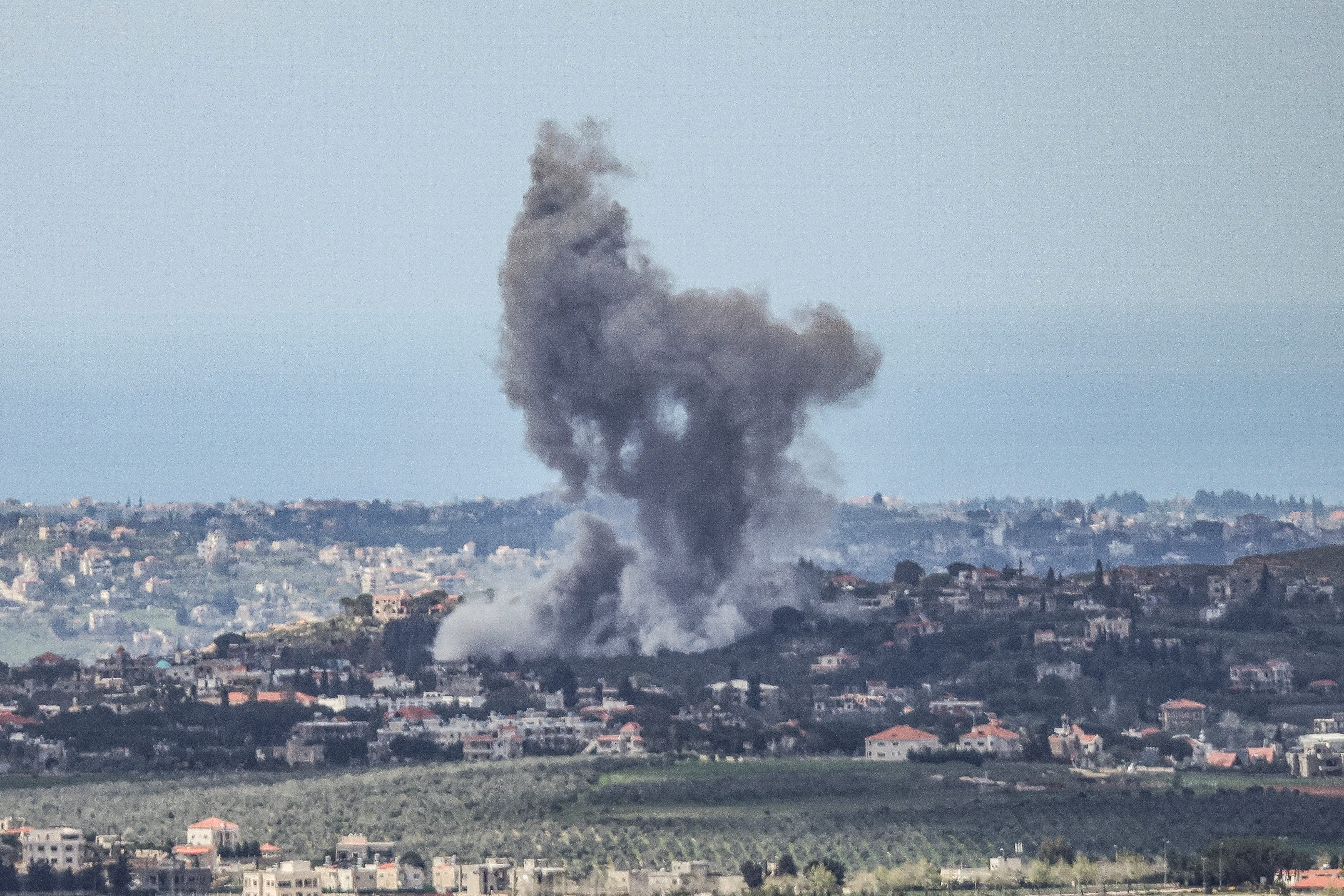
BEIRUT, Lebanon—On March 28, George Saeed, 62, and his 24-year-old son Elie were driving back to their home in Debel, a Christian village in southern Lebanon close to the border with Israel. It was a route Saeed knew well. He ran a small laundromat beneath his house, where he washed uniforms for a Polish unit in the United Nations peacekeeping force stationed in the nearby village of Tiri. The trip from Tiri used to take a few minutes, but after the main road was bombed by the invading Israeli military he had begun taking a longer route through the neighboring village of Rmeich.
That afternoon, villagers saw George’s car pass through Rmeich and enter Debel, disappearing along the village’s steep, winding roads. When they were roughly 60 meters from their house, the crackle of gunfire rang out, followed by the blare of a stuck car horn.
Elie Louqa, Saeed’s nephew and the former mayor of Debel, was in Beirut when he got a call from his brother describing what had happened. He began contacting UN peacekeepers (UNIFIL), the Lebanese Army, and the Red Cross, asking them to reach the car. Both the Red Cross unit in Rmeich and the nearby UNIFIL contingent told Louqa they could not secure permission from their superiors to move.
After about 90 minutes, a group of young men from the village decided to go themselves. Carrying white blankets and mattresses to signal they were civilians, they reached the site of the attack and found the father and son dead inside their bullet-ridden car. They pulled the bodies out and carried them to the village cemetery for burial.
“You won’t find a man with cleaner hands. He was generous to a fault,” Louqa told Drop Site News. “Go and ask the people of our villages who George Saeed was.”
The killings were just one in a series of attacks on residents of several villages along the southern border who have chosen to remain in their homes despite repeated sweeping displacement orders by the Israeli military covering all of southern Lebanon.
Earlier this week, the Lebanese army announced its forces had withdrawn from southern border villages, leaving residents without even the semblance of protection. At least six Lebanese soldiers have been killed by Israel over the past month. The army said its troops had to “reposition” as they were being encircled and cut off from their supply lines but claimed it continued to “stand by residents” by “maintaining a group of military personnel” in the villages. What this meant in practice, according to residents, was that soldiers from the area could stay in their homes provided they did not wear army uniforms or carry arms.
“We don’t know why the army made this decision,” said Boutros al-Rai, a local farmer and civilian administrator. “For us, its presence made us feel protected.”
Lebanon is being ravaged as Israel’s escalated assault enters its second month. More than 1,300 people have been killed, including over 120 children, and over 4,000 injured in a relentless onslaught. Israel has issued displacement orders covering around 15% of Lebanese territory and more than 1.1 million people—about a fifth of the country’s population—have been forced from their homes. Emergency workers have also been increasingly targeted, with over 50 killed over the past four weeks.
Despite a ceasefire agreement in November 2024, Israel continued to carry out near daily attacks and occupied five hilltop positions on Lebanese territory. When Hezbollah fired rockets into Israel on March 2 in solidarity with Iran after the U.S. and Israel launched a war on Tehran, Israel launched a full scale aerial assault and ground invasion on Lebanon.
Israeli Defense Minister Israel Katz announced on Tuesday that the Israeli military plans to occupy the entire area south of the Litani River and will not allow hundreds of thousands of residents to return to their homes, making a reference to areas in Gaza that have been completely razed in the genocide. “The return of over 600,000 residents of the area south of the Litani River will be completely prohibited until the safety and security of residents of the north is ensured, similar to the model of Rafah and Beit Hanoun in the Gaza Strip,” Katz said.
The Israeli military also appears to be engaged in a campaign to ethnically cleanse southern Lebanon of its Shia residents. Around three weeks ago, Israeli military officials called the heads of a cluster of majority Christian villages in southeastern Lebanon and ordered them to force out any “displaced people” that had taken refuge there, according to a municipal official in one of the villages, who spoke to Drop Site on condition of anonymity. “Displaced people” was a thinly-veiled reference to Shia residents who had been forced to flee nearby towns like Khiam.
U.S. Ambassador to Lebanon Michel Issa used explicitly sectarian language two weeks ago in referencing Israel’s military campaign in the south. “We asked the Israelis to leave the Christian villages in southern Lebanon and requested that the army keep a unit stationed there,” Issa said in a meeting with Maronite Patriarch Cardinal Mar Bechara Boutros Rah.
Over the past week, the Israeli military made a new round of phone calls to leaders in majority Sunni villages Chebaa and Kfarchouba, warning them to not accept any non-locals into their village. Mohammad Hammoud, a spokesperson for the town of Chebaa, confirmed the authenticity of a video circulating online showing a call received on Tuesday by local leader Ibrahim Nabaa. Over the phone, an Israeli soldier warned that the village would be targeted if officials failed to keep resistance fighters out. Hammoud said that the municipality had organized a small police force to conduct patrols at night and make sure no outsiders entered—measures that, he hoped, would spare residents their homes and land.
As part of its invasion of southern Lebanon, the Israeli military is in the midst of a scorched earth campaign, systematically destroying homes and civilian infrastructure in border villages. Louqa, the former mayor of Debel, said he fielded frantic calls on Wednesday from village residents who told him that occupation forces had begun to blow up homes on the village periphery. The homes were empty, he explained, because in times of war, residents often move closer to the village center for safety.
“These homes are in Debel—not on the outskirts, not kilometers away,” Boutros al-Rai, a local official told Drop Site, adding that at least 10 houses had been demolished on Wednesday alone. “They’re blowing them up one by one. We don’t know why or how.”
Around 1,700 people remain in Debel, according to al-Rai, down from 2,500 before the war. Once the escalation began on March 2, residents started making trips to the nearby village of Rmeich to buy essential goods. But after the killing of George and Elie Saeed last week, and without any support from UNIFIL or the withdrawn Lebanese army, that route was no longer considered safe.
“People have supplies for a week or two,” al-Rai said. “They rely on each other. But it’s not enough for much longer.”
Access to medical care is also severely limited. In Rmeich, where about 6,000 people remain, there is no hospital. Residents depend on coordinated evacuations, typically requiring approval from the Lebanese Army as well as UNIFIL, which then communicates with Israeli occupation forces.
Elie Shoufani, a local official and Red Cross volunteer, said the process is inconsistent. “Sometimes we get permission quickly, sometimes we don’t.”
Earlier this week, a 48-year-old man, Paul Mu’awwad, went into cardiac arrest and died before he could get treatment. “We didn’t get permission to take him for emergency care,” Shoufani said, adding that Mu’awwad had left behind a wife and six children. “If we had been able to reach a hospital, he might have lived.”
Over the past month, residents in Debel, Rmeich, and nearby Ein Ebl have relied largely on aid convoys from the International Committee of the Red Cross, which in the past have been accompanied by the Lebanese army.
“Now that the army has left, we don’t know what will happen,” Shoufani said.
UNIFIL troops have also limited their movement after Israeli airstrikes killed three Indonesian peacekeepers in southern Lebanon over a 24 hour period last week. Residents say this has further reduced their options.
“All we ask is for a way to move the injured or reach medical care,” Louqa said. “A mechanism to respond when we call. God will take care of the rest.”
Al-Rai described the difficulty and humiliation of displacement in a state with overburdened shelters and skyrocketing rents. More than anything, he worried that if he abandoned his home, it would be destroyed by Israeli occupation forces. He, like the others in his village, was determined to stay put.
“These are our homes, our livelihoods, our villages, the homes of our parents and grandparents,” he said. “These are not places that can be left behind.”
 | A guest post by
|
Southern Lebanon is being emptied in real time.
Villages bombed. Homes demolished. Civilians cut off from food, medicine, and escape. And now—open talk of blocking entire populations from ever returning.
This isn’t “security.” It’s forced removal.
Reporting from Drop Site News shows a pattern: displace, destroy, deny return. That has a name—ethnic cleansing.
Even more disturbing, communities are being pressured along sectarian lines to exclude displaced Shia families, turning survival into division.
Meanwhile, the institutions meant to protect civilians? Gone. The army withdrawn. Peacekeepers restricted. Aid delayed.
People are trapped—and the world is silent.
If this doesn’t trigger outrage, then what does?
Because what’s happening isn’t hidden.
It’s being carried out in the open.
Our country should send support to Lebanon to repel the invasion, but allas, we are on the side of the baddies. 😞