

Report From Sudan: In Besieged City, Massive Numbers of Displaced Find Little Shelter or Food
"The security and living conditions have become unbearable.”

Drop Site is a reader-funded, independent news outlet. Without your support, we can’t operate. Please becoming a paid subscriber or making a 501(c)(3) tax-deductible donation today.
Story by Me’ad al-Khair
EL-OBEID, SUDAN—Abu Bakr Muhammad, 46, used to farm his family’s plot in Dilling, South Kordofan—land that had been passed down through generations. When the brutal war broke out between the Sudanese Armed Forces and the paramilitary Rapid Support Forces (RSF) in 2023, Muhammad was suddenly faced with the prospect of having to abandon his ancestral land.
The decision weighed on him for a long time but after his house was destroyed in a bombing in January 2024, he had no choice but to leave. His family, including his wife and six children, was forced to flee with few belongings, traveling 170 kilometers north to El-Obeid, the provincial capital of North Kordofan.
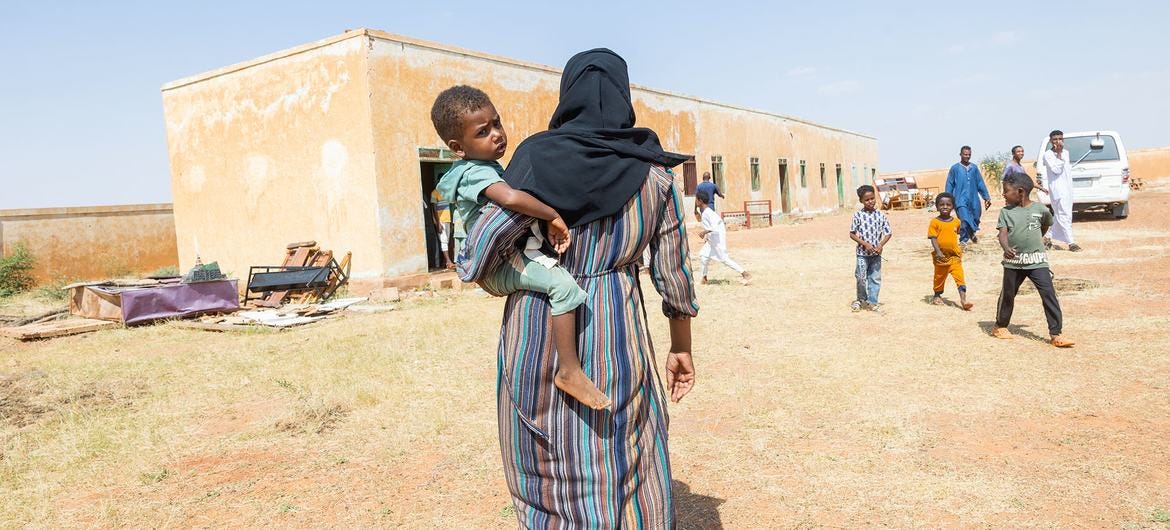
After a week-long journey on foot, they finally reached the outskirts of the city. Since then, he and his family have been living in a makeshift shelter in Al-Mina camp for the displaced, with scant food, sanitation, or medical care. With no toilets at the site where they had set up their tents, his three-year-old son, like many children in the camp, has now fallen ill with diarrhea.
“We live without food, without medicine, without tents, without bathrooms,” Muhammad told Drop Site News, his voice weary with exhaustion. “The diarrhea and malnutrition are hitting children and women the hardest.”
Nearly three years since the onset of the conflict, Sudan has become home to the world’s largest humanitarian crisis, with over 12 million people uprooted from their homes, including over four million people who have fled to neighboring countries. Hunger is endemic, with more people living in famine conditions in Sudan than the rest of the world combined, according to the International Rescue Committee. Estimates of the death toll from the war vary, ranging from 150,000 killed to far higher.
For nearly two years, El-Obeid has been almost entirely encircled by the RSF, enduring relentless drone strikes, the ferocity of which have only intensified following the fall of El Fasher—the capital of North Darfur—to the RSF, and the seizure of the areas of Kazgail and Al-Riyash, south of El-Obeid.
Though El-Obeid remains under army control despite RSF advances elsewhere in the vast North Kordofan state, it has become a key target for the paramilitary group due to its strategic location between the Sudanese capital of Khartoum and the Darfur region, where the RSF has taken over and established a parallel government.
The latest attacks came on January 30 with a barrage of drone strikes lasting for over two hours targeted government buildings, including the regional parliament, a police headquarters, and a telecommunications company. On January 6, a strike on a home killed at least 13 people, including eight children.
With RSF forces deployed to the north, west, and south of the city, backed by local alliances, El-Obeid now relies on a single supply route—the eastern Al-Rahad road—which serves as the only lifeline of food, medicine, and fuel for over a million people.
Mona Mahdy, representative of Plan International Sudan, a humanitarian organization operating in El-Obeid, told Drop Site that newly arrived displaced families face even worse conditions than families like Muhammad’s. They sleep out in the open on bare ground and receive no support from aid organizations, with no shelter and nothing to eat. Organizations operating in the city, including Plan International Sudan, do not have the capacity to accommodate the massive numbers of displaced. The organization has declared a state of emergency across the Kordofan region, according to Mahdy, with 1.5 million people displaced.
Fatima Ahmed’s family is one such case. The 50-year-old fled El-Nahud, a city in West Kordofan, with her children in May, when continued attacks from the RSF and widespread violations against civilians made it impossible to stay.
Her journey eastward over 200 kilometers to El-Obeid took a full month. She stopped in every village along the way, resting for days at a time, and trying to monitor the danger on the roads. Looting, killings, and arbitrary arrests are common and armed clashes in areas around El-Nahud made movement perilous. With no motorized vehicles available, many travelers had to rely on animals for transport, paying between 250,000 and 300,000 Sudanese pounds (between around $400 and $500) for a single cart, an amount far beyond her means.
She arrived in El-Obeid with nothing—no possessions or source of income. She struggles to care for her three daughters and two young sons in a city where the medicine she needs for chronic ailments is unavailable.
“I haven’t received support from organizations throughout my displacement,” Ahmed told Drop Site. “I have diabetes and blood pressure. We registered [with humanitarian organizations] several times to no avail. The situation is difficult with the high prices of medicine and food.”
To survive, she and her son have taken work cleaning homes, scraping together enough to buy food and, when possible, her medication. “It’s never enough,” she said. “We want to leave El-Obeid because the security and living conditions have become unbearable.”
Other local organizations, including the Alsalam organization for Rehabilitation and Development and Kafa, report that displacement continues to accelerate while international support remains limited. Security concerns, they say, represent the single greatest obstacle to delivering aid.
“The humanitarian situation is witnessing great difficulties. Most families cannot afford basic necessities,” said Salah al-Din Fakhry, a community activist who has remained in El-Obeid throughout the conflict.
El-Obeid’s markets—which once drew agricultural products and livestock from across the Kordofan region and served as a key trading hub connecting farmers to buyers throughout western Sudan—have largely collapsed. Many of the areas that once supplied crops and cattle are now under the control of the RSF or are too dangerous to traverse.
“This has led to rising prices and difficulty obtaining basic necessities,” Fakhry said, adding that these circumstances have stripped families of the ability to provide for themselves. “Many people have lost their sources of income, and prices are high. This has made it difficult to provide basic necessities.”
Humanitarian organizations warn that continued fighting could displace hundreds of thousands more. The targeting of infrastructure has led to worsening power outages and fuel shortages, exacerbating an already dire humanitarian situation. The city’s lone general hospital is overwhelmed amid severe medicine shortages and a growing exodus of medical staff.
Muzamil Ahmed Al-Safi, director general of El-Obeid Teaching Hospital, told Drop Site that hospital staff are struggling to provide medical care under conditions that grow more difficult by the week.
The hospital serves as the referral center for all of western Sudan, receiving patients from across West Darfur and the Kordofan states who cannot afford treatment elsewhere. It operates around the clock, with more than 350 beds, and an emergency department and operating rooms available 24 hours a day.
“The hospital faces critical shortages of fuel, electricity, oxygen, and essential medicines,” Al-Safi said. “Medical staff have left, seeking stability in the private sector or fleeing the city entirely.” Even the morgue has become difficult to operate because the refrigeration units have broken down. The hospital also needs development of the dialysis department, alternative energy sources, infrastructure maintenance, and an overhaul of the sewage network, according to Al-Safi.
Fakhry, the community activist, said the problems extend to all health facilities in the city with financial and other support for local clinics coming from multiple, often fragmented sources.
“The city faces persistent challenges, including poverty, restricted access, and corruption in the distribution of aid,” he told Drop Site. “The international community could help by increasing humanitarian support and closely monitoring its distribution to ensure it reaches those who need it most.”
This article is published in collaboration with Egab.
This catastrophe in Sudan is not just the result of internal warlords—it is also the predictable outcome of global neglect and cynical foreign policy. The U.S. and EU routinely claim humanitarian leadership while pouring vast resources into conflicts that serve strategic interests, yet Sudan’s 12 million displaced and famine-level hunger barely register beyond occasional statements of “concern.” The UN continues issuing warnings and emergency appeals that are chronically underfunded, while bureaucratic inertia leaves families like Abu Bakr Muhammad’s and Fatima Ahmed’s to literally starve waiting for assistance that never arrives.
Gulf states also bear serious scrutiny. Regional powers have long been accused by analysts and investigators of fueling Sudan’s instability through financial and political backing of rival factions, treating the country as a battleground for influence while civilians pay the price. Meanwhile, Western governments that maintain close security and economic relationships with those same states rarely apply meaningful pressure.
What is happening in El-Obeid is not simply a tragedy—it is a policy failure across multiple power centers. When hospitals collapse from fuel shortages, when children die from preventable disease in displacement camps, and when supply routes for over a million people hang by a thread, that reflects deliberate global priorities. Sudan is being allowed to implode because it offers little geopolitical return on investment. Reporting like this is crucial because it exposes not only the brutality of the RSF and SAF, but the international system that enables mass suffering through indifference, selective outrage, and chronic underfunding.
Thank you very much. With the shutdown of AID, how can we provide humanitarian support?