

In Tehran, Iranians Struggle to Breathe After Israeli Oil Facility Strikes
"By the time we finally packed our bags and locked the door, our fingernails were caked in chemical grime, and our lungs were burning just from breathing inside our own living room."

Drop Site is a reader-funded, independent news outlet. Without your support, we can’t operate. Please consider becoming a paid subscriber or making a 501(c)(3) tax-deductible donation today.
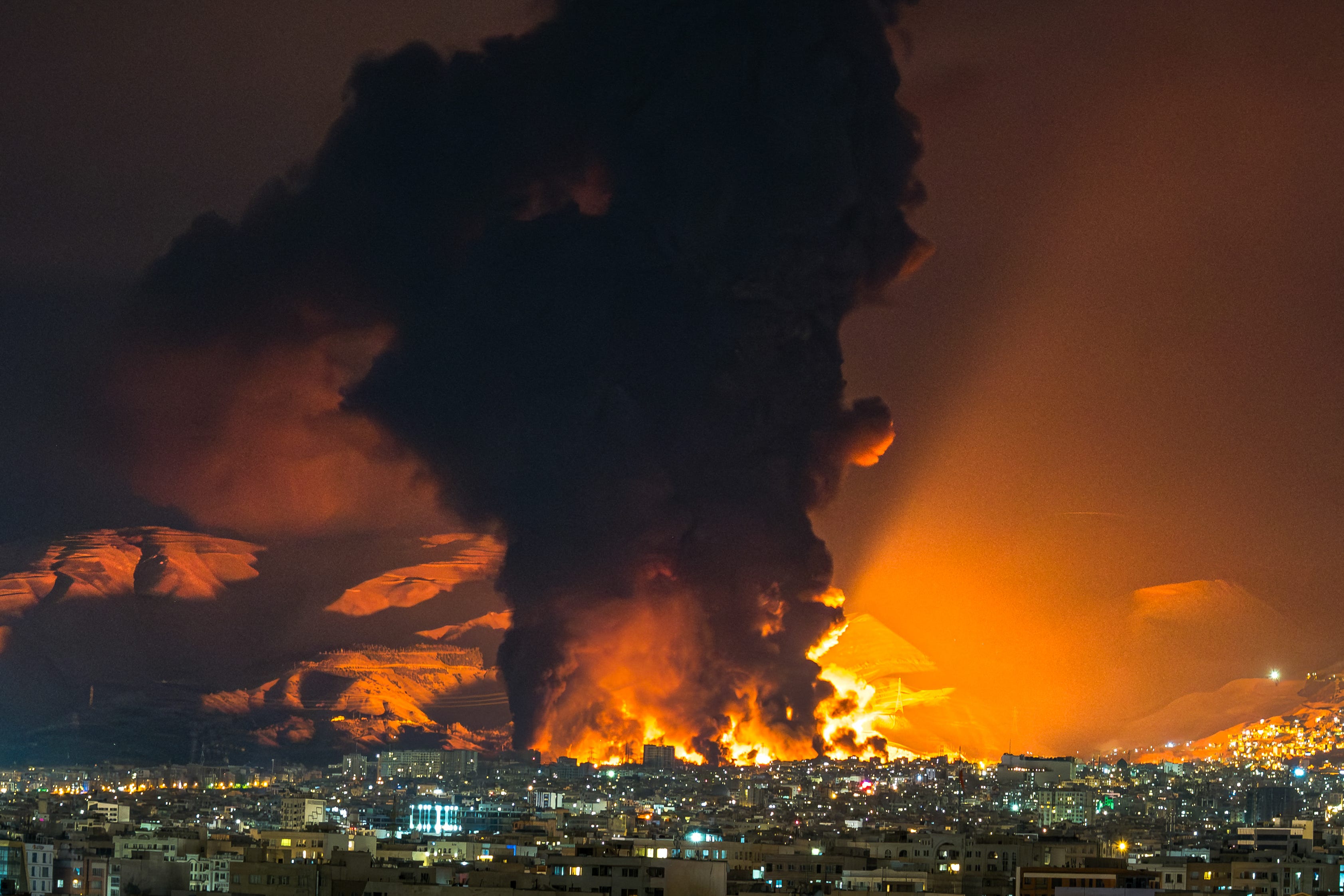
TEHRAN, IRAN—Saghar recalls the airstrikes that targeted oil facilities in and around Tehran on Saturday with a terrifying clarity. It was exactly one week into the U.S.-Israeli war on Iran and the constant roar of fighter jets overhead punctuated by loud explosions that rattled the windows had already become a familiar sound in the capital.
But at around 10:30 p.m. on March 7, three deafening blasts, distinctly larger than the strikes of previous days, shook her home. Saghar, 24, lives with her parents and sister in a residential complex in northeastern Tehran, perilously close to the Aghdasieh oil depot.
“The house shook, it truly shook. Far worse than an earthquake,” Saghar told Drop Site News. (Saghar is a pseudonym; she requested anonymity to speak with Drop Site News given the war.) “I remember the Tehran earthquake of May 2020—this was exponentially worse. The kitchen and living room windows shattered instantly, and the chandelier swung violently like a pendulum. My mother was at the sink washing dinner plates when the blast hit. The shockwave threw her so hard she landed head-first on the floor.”
A colossal orange flash ignited on the horizon. Israeli airstrikes had targeted major oil depots and infrastructure in the Tehran neighborhoods of Shahran, Aghdasieh, and Shahr-e-Ray, as well as in the nearby city of Karaj. The massive reservoirs of combustible fuel triggered apocalyptic-looking fires that raged throughout the night.
“My sister and I were in the living room. My father was lying down nearby. We rushed to my mother first, and my father slowly dragged himself over because his leg prevented him from walking easily,” Saghar said in a trembling voice. Her father, a combat veteran, had suffered a gunshot wound from the Iran-Iraq war in the 1980s that left him severely impaired. “For the first few seconds, my mother was completely dazed. We were paralyzed, not knowing what to do.”
They called emergency services and received triage instructions over the phone. “They told us not to move her, fearing a critical fracture. After about 15 minutes, each second dragging like a year, the paramedics arrived. Following an initial assessment, they loaded her into an ambulance and rushed her to a nearby hospital.”
Medical staff determined the head trauma was not critical, and Saghar’s mother was discharged after roughly 24 hours of observation. “While she was hospitalized, my father hired someone to reinstall the shattered windows,” Saghar said. “My sister and I packed our bags. As soon as my mother was discharged and cleared by the doctors, we planned to flee to Ramsar.”
Ramsar, located some 220 kilometers (136 miles) northwest of Tehran on the Caspian Sea, has become something of a safe haven in the escalating war. Tens of thousands of residents of Tehran and other cities have fled north to Mazandaran seeking shelter from the bombardment.
“Since the war began, we stayed in Tehran under the assumption that a purely residential complex wouldn’t be targeted,” she added. “We figured we were safe, with no military or security installations nearby. We never imagined a fuel depot nestled next to a civilian neighborhood would be bombed.”
When they returned to their apartment to pack, some nine hours after taking their mother to hospital, they found it blackened from the oil fires raging nearby. “Everything was coated in soot,” Saghar said. “Our white refrigerator was entirely black. If you ran your finger across any surface, it came away stained black.”
For two grueling hours, Saghar and her sister scrubbed surfaces and wiped down appliances. Wet rags became instantly soaked with heavy, black sludge as they tried to clean the thick, greasy layer of airborne crude. “We went through rolls of paper towels and bottles of detergent, but the oily film just smeared before it lifted,” she said. “By the time we finally packed our bags and locked the door, our fingernails were caked in chemical grime, and our lungs were burning just from breathing inside our own living room.”
Acid rain and a city gasping for air
When Tehran residents awoke the next day, March 8, they found a city robbed of daylight.
“When I woke up, the house was so dark I assumed it was heavily overcast,” said Sina, a 42-year-old father to a five-year-old, who lives in the Sattarkhan neighborhood in central Tehran, far from the burning depots. “I showered and dressed for work. But the moment I stepped outside, I panicked. A mixture of smoke and clouds, but overwhelmingly thick smoke, had blackened the entire sky.”
Sina, who gave his first name only, continued, “The air smelled horrific, but it wasn’t just the smell. A brief rain shower had turned everything greasy and black. My white car was covered in dark, oily spots.”
The Iranian Red Crescent issued a warning on Sunday for Tehran residents to stay indoors, saying that the explosions had spread “toxic hydrocarbon compounds and sulfur and nitrogen oxides” in the air. The group warned that any precipitation would result in highly dangerous acid rain capable of causing chemical skin burns and lung damage. It also encouraged people to protect exposed food.
“The streets were deserted. It took me about 15 minutes to reach my office, and by the time I arrived, my throat was burning and my head was pounding,” Sina said. “I immediately called my wife. She’s staying home these days to take care of our son. I woke her up, warned her about the toxic smoke, and told her to seal all the windows. She said the baby was still sleeping.” Two days after the attack, Sina said his chest still felt heavy, and he was struggling to breathe normally.
On Monday, the head of the World Health Organization, Tedros Adhanom Ghebreyesus, put out a statement on social media about the dangers posed to the nine million residents of Tehran and its surrounding area: “Damage to petroleum facilities in Iran risks contaminating food, water and air—hazards that can have severe health impacts especially on children, older people, and people with pre existing medical conditions. Rain laden with oil has been reported falling in parts of the country.”
Since the start of the war, Tehran has been the most heavily targeted location of the U.S.-Israeli aerial campaign. As in other cities, residential areas and civilian infrastructure in the capital have not been spared the relentless bombardment. Hospitals, shops, schools, public squares, and residential buildings have all been hit, in addition to government buildings. But the oil facility strikes were impossible to escape. Iran’s Department of Environment formally declared the strikes a violation of human rights, citing the Geneva Conventions.
Sara, 36, had been sheltering for a few days with her husband at their home in the Tehran neighborhood of Ekbatan, far from the targeted oil facilities. “My husband and I had planned to go grocery shopping on Sunday morning—meat, fruit, basic essentials. We’d been cooped up for two or three days,” Sara, who only gave her first name, told Drop Site. “When I saw the air on Sunday morning, I told him it wasn’t safe to go outside. We postponed it. By evening, the soot in our neighborhood seemed to have cleared, and we could see patches of blue sky, even though we could see other parts of the city were still smothered in smoke. We decided to make a run for it.”
Sara and her husband, Mehdi, walked to the grocery store about five six minutes away. “Our breathing became incredibly heavy. We felt like we had been doing grueling manual labor after walking for only five minutes,” she said. “We bought face masks on the spot and wore them the entire way back.”
Sitting in her two-bedroom apartment with her husband, Sara displayed her hands that were inflamed and covered in hives. “I have an old allergy that used to bother me, but it had been dormant for a long time. A few hours after getting back, my hands started itching intensely, turned red, and broke out in these hives,” she said. Her forearms were scratched raw while Mehdi suffered from labored breathing and a severe headache.
“Despite the blue sky, it felt like acid had been poured down our throats,” she said.
This story was published in collaboration with Egab.
 | A guest post by
|
My heart aches for the people of Iran.
As an American, I am perpetually ashamed for the horrors made in my name. These atrocities are the designs of our ruling-class, cheered by our stupid-class and seemingly ordered by Israel.
Most sincere apologies to my fellow human beings in Iran, Lebanon, Gaza and everywhere else this two-headed beast has made death and despair. There are **many** of us here who do not want this to be the world we share.