

Rescue Efforts in Tehran After a Triple Strike Hit Apartment Buildings, Killing 40
“Every time we lifted a stone, we increased our sense that we might succeed in saving a life, or that we might find someone who could not be saved.”

Drop Site is a reader-funded, independent news outlet. Without your support, we can’t operate. Please consider becoming a paid subscriber or making a 501(c)(3) tax-deductible donation today.
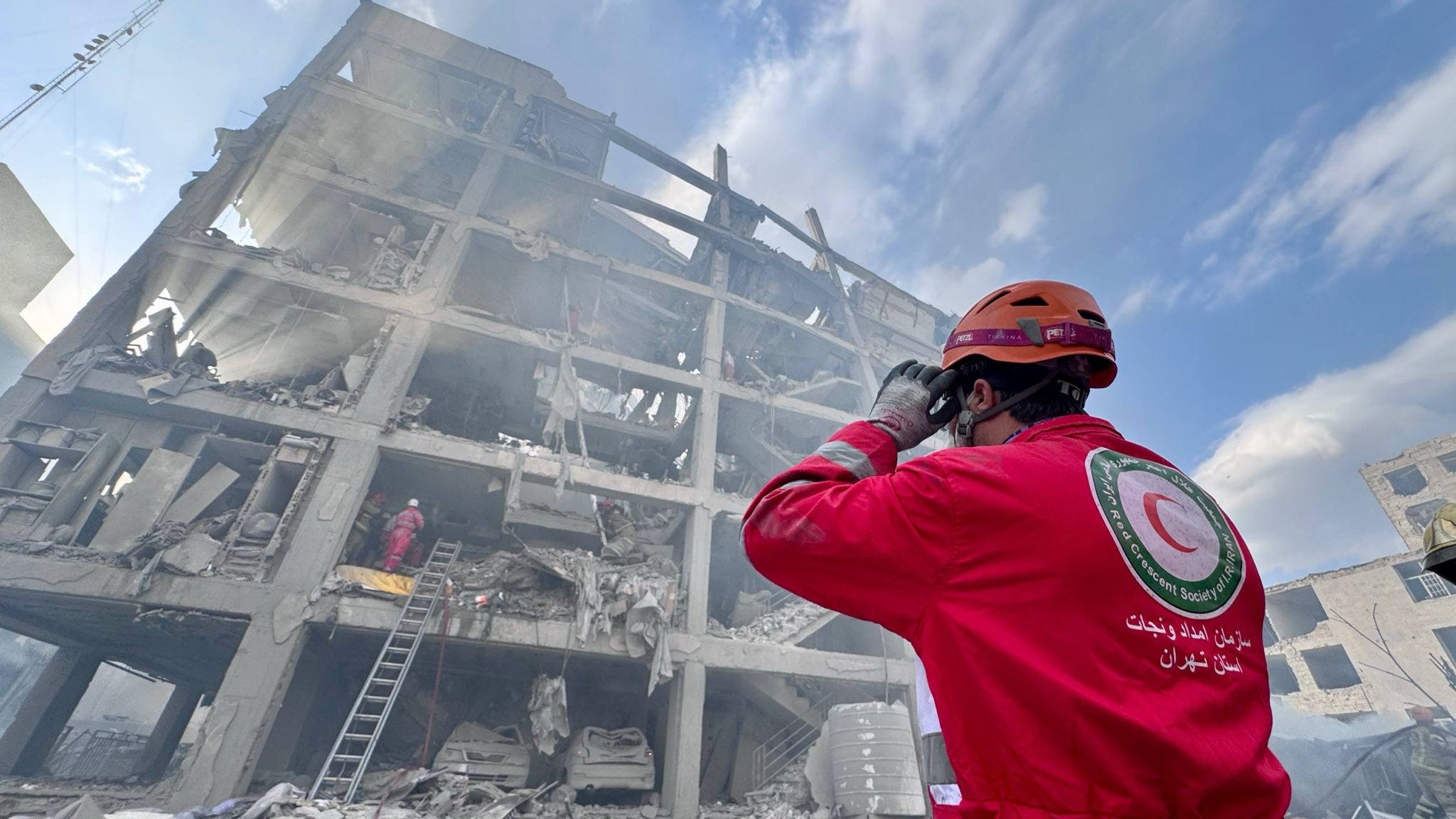
TEHRAN, IRAN—Less than an hour before a deadly airstrike tore through a residential neighborhood in Resalat Square in eastern Tehran late Monday evening, Hassan Sharifi was walking through the area on his way home. He passed by the mid-rise apartment buildings that housed bakeries, shops, cafes, and small grocery stores on their ground floors. When the missile struck, he immediately ran back to the square.
“I didn’t think about myself,” Sharifi, a 40-year-old accountant, told Drop Site News. “I ran toward the collapsed buildings to help whomever I could. I felt that every minute mattered.”
What he found was devastating. The building facades had been blown away. Balconies had collapsed. Windows shattered. Rubble was everywhere. Inside, where families lay buried under the broken concrete, screams began to fill the air.
At least 40 people were killed, according to official reports. Most of the victims were civilians who had been inside their homes when the strike hit, Iranian media reported.
The bombing was a concentrated attack, with several blasts hitting buildings in the area in short succession, according to the spokesperson for the Iranian Red Crescent, Mujtaba Khalidi. “Three residential buildings were bombed simultaneously and on the same street a missile struck a building belonging to the Iranian police,” Khalidi told Drop Site.
At least 460 people have been killed and over 4,300 wounded in Tehran alone since the launch of the war, the deputy head of Tehran Emergency Health Department Mehr Soroush told public broadcaster IRIB News. Monday’s strike was one of the deadliest attacks on Tehran since the beginning of the U.S.-Israeli war on Iran that has killed over 1,300 people across the country.
The strike hit at 1:00 a.m. on March 10, according to Khalidi. But during Ramadan, shops are open late into the night for people to gather and eat. Grocery stores had their lights on, bakeries were serving Ramadan bread and pastries to customers, and men were sitting in the local café, talking and waiting for the late night meal ahead of another day of fasting.
Laila Brahimi was still awake preparing the late night meal for her three children when the missiles struck. “The buildings shook violently. Windows and doors trembled. Objects fell from shelves,” said Brahimi, a 39-year-old high school philosophy teacher who lives across the street from the bombing site. She rushed outside to help walking towards the rising dust and smoke. Neighbors, some in sleepwear and holding their phones, were on the scene before the first ambulance arrived. They pulled at the concrete with their hands.
“The explosion turned our lives upside down,” Brahimi told Drop Site. “I saw buildings collapsing in front of me, I heard the screams of the neighbors. I couldn’t sit still.” She ran toward the nearest damaged building, afraid with every step that more of it would collapse to the ground. “Every minute that passed might mean the loss of a life.”
Emergency workers with the Iranian Red Crescent arrived a short while afterwards. “The rubble spread into every corner, the collapsed walls, the destroyed cars,” one of the rescue workers, Ali Rezaei, 28, told Drop Site. “We immediately began opening paths through the debris to reach the injured.”
They followed the sound of survivors crying out for help. “The continuous noise of screaming and calling for help filled the place,” he said. His team moved from case to case, working to save the injured before additional equipment arrived. “Every movement you make could be the difference between life and death for someone trapped under the concrete. The first minutes were decisive.”

Video posted online by the Iranian Red Crescent of rescue efforts at the site of the Resalat Square bombing in Tehran. March 10, 2026. Source: X.
Fatima Kadhemi, a 25-year-old paramedic, described one apartment where two children were trapped under the ruins of a collapsed wall while their mother screamed outside. “I felt helpless for a moment,” Kadhemi told Drop Site. Her colleagues helped lift the heavy concrete slab and get the children out. “I saw the mother crying bitterly, and I felt that my work is not just treating a body, but psychological support as well.”
Neighbors helped move the injured to ambulances. The wounded were rushed to Gandhi Hospital, which had also been badly damaged in airstrikes last week and partially evacuated. Dr. Ali Moradi, 55, said the injured arrived in waves, many with severe fractures and acute hemorrhaging. Some cases were life-threatening. “We had to make very rapid decisions, and coordinate between surgery, the emergency department, and intensive care,” Moradi told Drop Site.
Rescue operations continued through the night and into the early morning. Heavy machinery was brought in and emergency workers kept calling out for survivors under the rubble. Kazem Najafi, 32, a Red Crescent coordinator, said the cooperation between professional rescue teams and residents of the neighborhood was a decisive factor in how many people survived. “Seeing the local teams and the community working together was very moving,” Najafi said.
Teams also swept surrounding buildings for structural damage and evacuated some as a precaution.
Mohamed Haidari, part of a Red Crescent search and rescue team, described the conditions: dense debris, heat from smoldering fires, and the ever-present risk of structural collapse. “Every time we lifted a stone, we increased our sense that we might succeed in saving a life, or that we might find someone who could not be saved,” he told Drop Site. “This mixture of hope and fear accompanied us constantly.”
The hardest moments, he said, came when they found people motionless beneath the wreckage. “In some cases, we had to make difficult decisions: which person to try to save first, and how to distribute the team to cover as many damaged buildings as possible.”
By dawn, the lights of emergency vehicles still filled the narrow streets around Resalat Square. Pavements were grey with dust. In one apartment whose outer wall had partially collapsed, an entire living room was visible from the street, with an overturned sofa, a small table, and a torn curtain hanging from a broken window.
Hassan Sharifi, the accountant, wandered the streets for hours after the explosion. He moved between the rubble, looking for anyone who might still be trapped. It was psychologically painful,” he said. “But seeing a person come out from under the rubble alive was a reward that cannot be described. I felt that we were all—residents and paramedics—living a moment of real human unity.”
Kadhemi, the paramedic, agreed the community’s efforts were essential. Hours into the rescue operation “we began to feel that we were regaining some control over the situation,” she said. “I felt that we, despite everything that happened, gave everything we could, and that every effort, no matter how small, has value,” Kadhemi added.
“But the psychological pain and fear did not disappear, especially seeing the great destruction in the surrounding buildings, and the blood spread in the streets.”
This story was published in collaboration with Egab.
 | A guest post by
|
Truly horrifying. I suppose the strike could have come from either the US or Israel. The leadership of both countries is stark, raving mad!
US or israel, they are one and the same. US has now become the U.S. O.F. The U.S. Occupation Forces, ruled by a traitor and his oligarchy and, of course, his sycophantic cabinet and administration. May God help us and use us to right these wrongs.