

Winter Cold and Collapsing Buildings Kill Palestinians in Gaza as Israel Blocks Shelter Supplies
A family of three was killed while they slept by a collapsing wall. A one-year-old baby died from the cold. Over 30 Palestinians in Gaza have died from a lack of shelter this winter.


Drop Site is a reader-funded, independent news outlet. Without your support, we can’t operate. Please consider making a 501(c)(3) tax-deductible donation today.
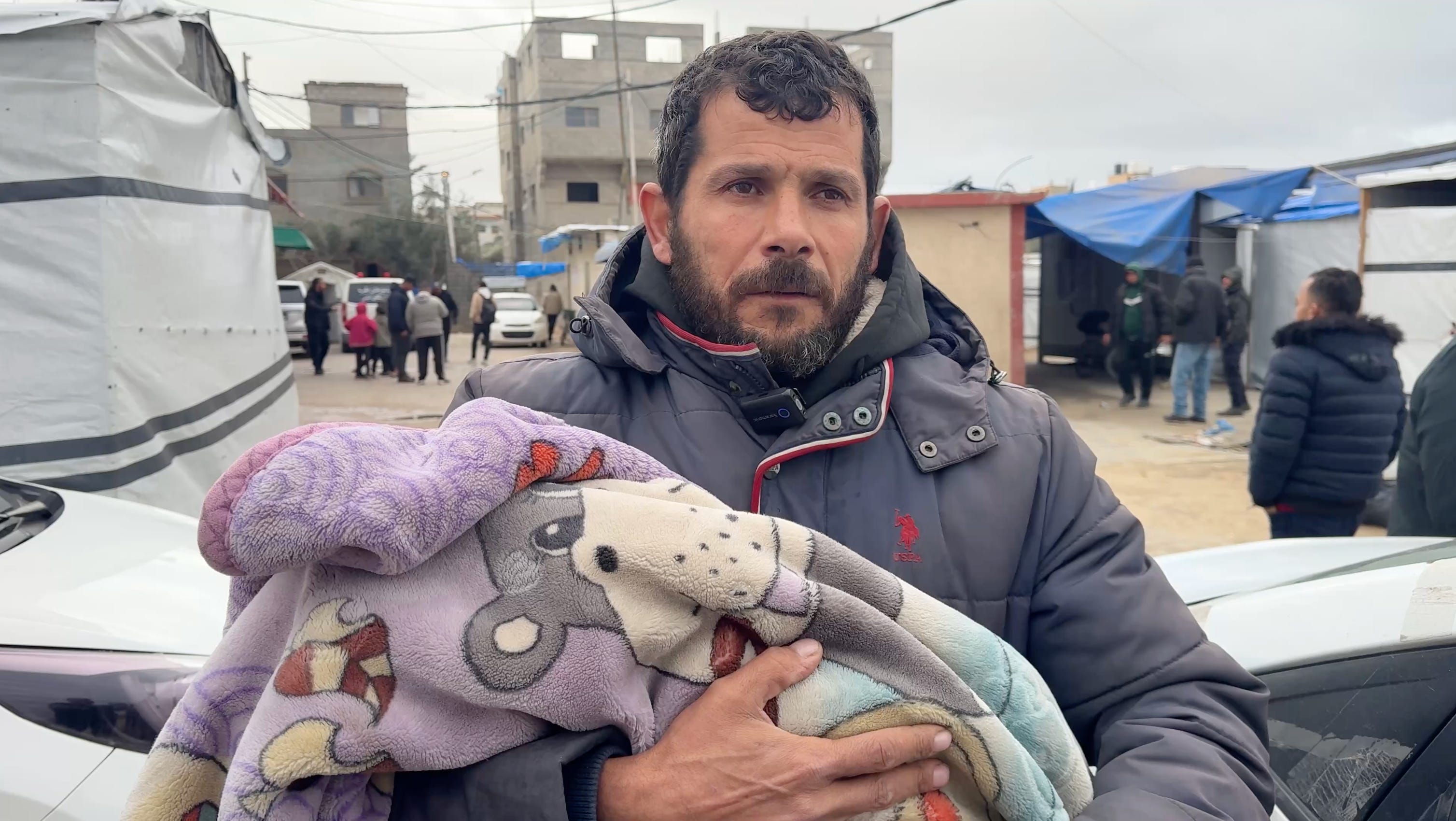
DEIR AL-BALAH & GAZA CITY—One-year-old Mohammed Bassiouni died of exposure to the cold on Tuesday. It was his first birthday.
That night, as winter storms lashed Gaza with cold winds and torrential rain, his family was shivering in a battered tent in Deir al-Balah where they had been displaced after fleeing Beit Lahia in northern Gaza.
“It was a night of rain and wind. We were up all night, his mother and I,” Mohammed’s father, Maher Bassiouni, told Drop Site. “At 4 a.m., the wind and rain calmed a little and me and his mother slept a bit. I woke up at 6 a.m. and I found the boy dead.” He spoke holding his son’s lifeless body wrapped in a purple blanket. “We belong to God and to him we shall return. God is sufficient for us, and He is the best disposer of affairs. I have nothing more to tell you. He is one year old. Today is his birthday. January 13th is his birthday, the day he died.”
The family rushed Mohammed to Al-Aqsa Hospital, but it was too late. His tiny body, still in diapers, was kept in the hospital morgue before he was wrapped in a white shroud for burial. Mohammed is the seventh child to die from hypothermia since the onset of winter, according to Gaza’s Health Ministry, including four since the beginning of the year—among them a baby just seven days old and a four-year-old girl. Another 25 Palestinians have been crushed to death as storms caused damaged buildings and walls to collapse on families seeking shelter inside or in tents nearby.
Israel’s continued strangulation of essential supplies during winter has left hundreds of thousands of Palestinians shivering in the wet and cold and nearly three dozen dead. The genocidal war has displaced nearly the entire population and reduced Gaza to a broken landscape of rubble and collapsed structures. Hundreds of thousands of Palestinians are now living in flimsy tents that provide little shelter from the elements. According to the UN, the heavy rains and flooding have rendered thousands of tents uninhabitable and placed nearly 800,000 people, almost 40 percent of the population, in flood-prone sites at heightened risk—leaving families exposed to the winter cold without blankets, mattresses, or heating. Hundreds of tents have simply blown away and makeshift shelters have been heavily damaged.
Winter storms lashed western Gaza City with cold winds and torrential rain. January 12 and 13, 2026. (Footage provided by Abdel Qader Sabbah).
Despite the so-called ceasefire that went into effect on October 10, Israel has continued to restrict desperately needed humanitarian aid. More than one million people are estimated to be in need of emergency shelter assistance, according to the UN. Among the items Israel restricts are drainage equipment, heaters and solar equipment, and reconstruction items such as cement and timber, many of which are classified as “dual-use” items. According to the Government Media Office in Gaza, only 24,611 aid trucks have entered the enclave during the ceasefire, out of a total of 57,000 trucks under the deal. Israel has also completely prevented the entry of mobile homes, caravans, and heavily restricted shelter materials such as tents and plastic tarpaulins. “The Gaza Strip is facing a slow-motion genocide, as the occupation has continued to evade its obligations stipulated in the agreement and the humanitarian protocol,” the Government Media Office said in a statement on Thursday.
On Monday evening, three members of the same family were killed when a wall of the Organza building collapsed onto a pair of tents sheltering 15 people in a coastal area in western Gaza City. Mohamed Hamouda, 72, his daughter-in-law, Doaa Hassouna, and his 15-year-old granddaughter Rimas Hamouda died and several others were injured.
“This is what happened last night. This is the blood—do you see it?” Mahmoud Hamouda, Mohamed’s grandson, told Drop Site. “When night came, the wall collapsed on them. I first went to my aunt and her daughter. Then this remaining wall toppled onto my grandfather, my uncle, my aunt, and onto that tent. All of them. We came but couldn’t pull them out because of the rain and the strong wind.”
Broken slabs of concrete cover the ground after a wall collapsed on a pair of tents in a coastal area in western Gaza City killing three Palestinians. January 13, 2026. (Footage provided by Abdel Qader Sabbah).
Around him, broken slabs of concrete covered the ground where the tents once were. The heavily damaged building stood close to the shore, its remaining walls pockmarked with large holes and twisted rebar protruding at awkward angles. “We fled Jabaliya because of the danger and came here seeking safety,” Hamouda said. “If I leave here, where am I supposed to go? Sleep in the street so it satisfies them? If I go somewhere else, where will I get a tent? We don’t have money or anything to buy a tent.”
Mustafa Shaaban Nabi was sheltering in a tent nearby when the wall collapsed. “What we went through here last night was extremely difficult. Horrifying scenes—people sleeping in their tents, and you see a wall [many] meters high falling on them. It was very hard,” Nabi said, clearly distraught. “Tents are flying away, everything is flying away. We want relief, we want something better than this,” he continued. “I swear, the whole night I couldn’t sleep because of the building. Just imagine. Everything collapsed, as you can see. By God, it’s a sight that makes your skin crawl.”
Along with blocking critical building supplies from entering Gaza, Israel has killed over 450 since the so-called ceasefire went into effect, including over 100 children. It is also continuing to systematically demolish hundreds of homes and buildings, especially in the nearly 60 percent of Gaza that it still occupies east of the yellow line.
With even tents hard to come by, many displaced Palestinians have been forced to shelter in buildings on the verge of collapse, despite repeated warnings by Civil Defense to avoid them.
A short walk from the Organza building, through alleyways of rubble, Hedaya Al-Kafarna, a 55-year-old woman, lived on the ground floor of a building that appeared to be on the verge of caving in. The heavily cracked roof buckled so deeply there was barely enough room to stand on one edge of the room. Scattered mattresses and thin blankets were strewn on the floor. There were no walls or windows leaving the entire space exposed to the outside weather.
“This is my life here, as you can see, under this ceiling, and I’m afraid it will collapse on us,” Al-Kafarna told Drop Site. “When it rains, water, sand, and gravel start falling on us—it all comes down on us. We’re scared. I want a tent. I want to live like other people. I want to leave this place. I sit there trembling, afraid the ceiling will fall on me.”
Hedaya Al-Kafarna lives on the ground floor of a severely damaged building. January 13, 2026. (Footage provided by Abdel Qader Sabbah).
Al-Kafarna was displaced from Beit Hanoun in the north, first to Rafah and then to Khan Younis before ending up on the coast of Gaza City. “Seven times we’ve been displaced, moving from place to place. Our life is hard, harder than the hardest. My life—what can I tell you? My cousin’s children are orphans and under my care. I have a boy who was killed, and another boy who has been missing for eight months—we don’t know if he’s alive or dead,” she said. “Last night, by God, we didn’t sleep, afraid the building would collapse on us.”
In a statement on Tuesday, Hamas called on the international community to pressure Israel to allow shelter supplies, heating, fuel, medical, and food aid into Gaza. “With the intensification of the weather depression and the fierce winds that are uprooting the tents of the displaced and leaving thousands of families without shelter, more victims are threatened with death in the coming hours and days if urgent aid is not brought in immediately, and if the siege and restrictions imposed by the occupation on relief and shelter are not lifted. The root of the problem is the continuation of the siege and the occupation’s prevention of the entry of aid,” Hamas said. “The mediators and the guarantor states of the ceasefire agreement are called upon to fulfill their legal and moral responsibilities, continue to pressure the occupation, and compel it to bring in urgent aid without conditions or restrictions.”
Near Gaza’s port, in a cluster of ragged tents tightly packed together, 37-year-old Alaa Dhahir recounted a horrific ordeal when heavy winds blew his tent away on Monday evening. “At 11:30 my entire tent was blown away. I started running and grabbed my children, that’s all. I picked up my children and my wife and left everything behind,” Dhahir said. “All our clothes were soaked with water. This tent, as you can see, is torn. It’s all makeshift sheets, just as you see…What’s happening to us is unjust—they need to take care of us. We want a tent, we’re not even asking for a caravan.”
In the same area, Diab Al-Mubayyidh, 42, who was displaced from his home in the Al-Shujaiya neighborhood of eastern Gaza City near the yellow line, described a similar harrowing Monday night. “If I hadn’t woken up around 12 at night and fixed the tent, honestly, we could have died…My daughter inside is sick. They’re all sick—with the rain, winter, wind, and storms. The tent was about to collapse on us, I tied all the ropes,” he said. “All the tents are ruined, flooded with water, and we were humiliated—an unbearable level of humiliation.”
He continued as a cold wind whipped through the makeshift displacement camp. “I’m suffocating, I can’t do anything. What can I do? I just keep tightening the tent, and then it flies away—all for nothing…bring us caravans at the very least. These tents, I swear to God, are useless,” he said. “We are extremely exhausted. Every weather depression that comes brings the same problem, the same story, the same suffering. We fix things, they break again, and we redo them once more. Honestly, we are tired of this situation. What we build gets destroyed, we rebuild it, and it’s destroyed again. The situation is unbearable.”
Drop Site News Middle East Research Fellow Jawa Ahmad contributed to this report. Sami Vanderlip edited the video.
Editor’s note: An earlier version said Israel has “completely prevented the entry of mobile homes, caravans, and shelter materials such as tents and plastic tarpaulins.” This has been amended to: “completely prevented the entry of mobile homes, caravans, and heavily restricted shelter materials such as tents and plastic tarpaulins.”
 | A guest post by
|
our cowardly Western governments are so like those tents, USELESS in this hideous storm....they offer naught but death.
Calling this a ceasefire while Israel blocks tents, tarps, heaters, and building materials is an insult to language. People are being killed by rain, wind, and collapsing walls because survival itself is being denied. A ceasefire that allows children to freeze and families to be buried alive under rubble is not peace—it’s managed cruelty.