

How the UAE’s Decade-Long Project in Yemen Ended in 48 Hours
Saudi Arabia has swiftly consolidated power in southern Yemen over the UAE-backed Southern Transitional Council.

Drop Site is a reader-funded, independent news outlet. Without your support, we can’t operate. Please consider making a 501(c)(3) tax-deductible donation today.
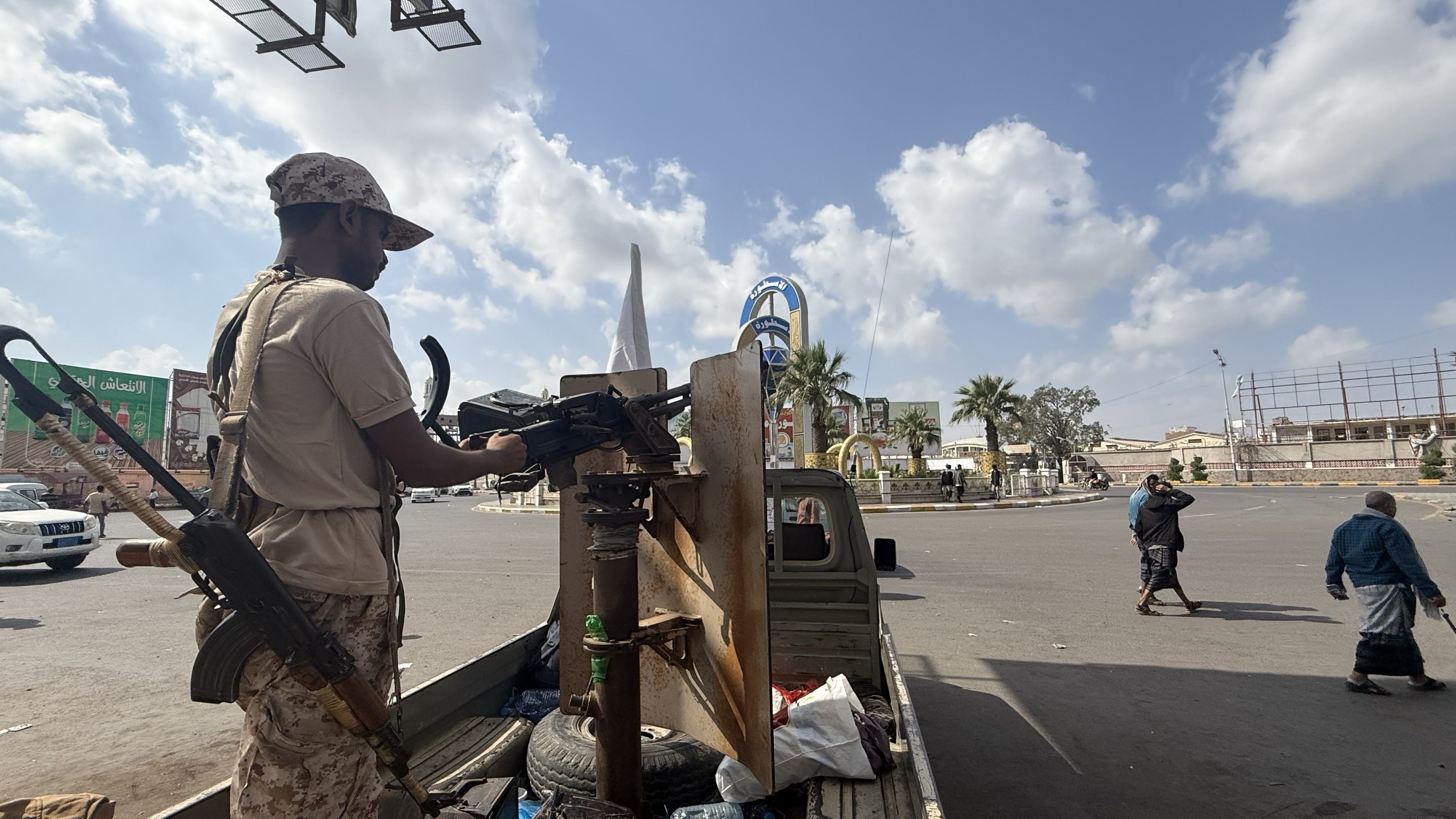
Saudi Arabia continued its consolidation of power in southern Yemen over the weekend as days of rapidly evolving Saudi military action against UAE-backed forces shifted into dramatic political change in the anti-Houthi side of the country’s unresolved civil war.
Thousands of demonstrators took to the streets of Yemen’s southern port-city of Aden on Saturday in support of the recently routed UAE-backed Southern Transitional Council (STC) and in response to a statement read from Riyadh by STC Secretary-General Abdulrahman al-Sebaihi that was broadcast on Saudi state TV on Friday, announcing the dissolution of the group.
Saudi Arabia and the UAE joined together in a coalition in 2015 to battle the Houthis who had taken control of Sana’a and much of the north. But divisions between forces on the ground in the south backed by Riyadh and Abu Dhabi reached a dramatic climax last month when the STC took control of much of southern and eastern Yemen, severely deepening a growing geopolitical rift between the UAE and Saudi Arabia. Since then, Saudi-backed forces have largely retaken the areas the STC had seized.
Any prolonged political crisis will severely impact Yemeni civilians already struggling to recover from a devastating humanitarian crisis, which peaked in 2017 during the Saudi-led war against the Houthis. Price hikes, extreme floods, and aid cuts have all contributed to worsening conditions in 2025. Half of the population in anti-Houthi territory is food insecure, with 15% classified as one step from the international classification of famine.
Controversy surrounds the supposed disbanding and the fate of the STC leadership. A delegation of more than 50 STC leaders flew from Aden to the Saudi capital on January 7 to take part in a conference Saudi Arabia said was being held to discuss Yemen’s southern issue and the separatist STC’s demand for renewed independence from Yemen’s north.
Instead of joining the group, STC leader al-Zubaydi instead secretly left by boat to Somaliland and then boarded a plane to the UAE. Saudi Arabia released the details of the smuggling operation, including the UAE’s involvement in the escape, hours after declaring al-Zubaydi was “wanted for treason” when he failed to board the plane to Saudi.
Meanwhile, the delegation in Riyadh is believed to be being held incommunicado. STC officials in Aden say they have been unable to contact any of the group since they travelled. Drop Site News called several of the STC leaders held in Saudi Arabia but could not reach any of them. Family members of the delegates have similarly been unable to speak to the party since they left Yemen on January 7. An STC official still in Yemen told Drop Site that communication with the leadership in Riyadh had been cut off and there are strong indications they are under immense pressure. The official spoke on condition of anonymity for security reasons.
The group now appears divided between those under apparent Saudi control and those outside the kingdom. STC officials in Aden remain defiant and denounced the announcement to disband as “null and void” during an emergency meeting of its political committees held in the city on Saturday. “The Southern Transitional Council is not a company to be dissolved by a statement,” one of the STC officials who attended the meeting in Aden told Drop Site. “Any statement issued under pressure or in closed rooms in Riyadh represents only those who wrote it,” he added, implying the Saudis had authored the statement.
Saudi Arabia has a history of coercing political figures and Al-Zubaydi’s decision to flee was likely influenced by previous experience. In 2019 he was held against his will for several months in Saudi during negotiations with Yemen’s internationally recognised government.
In similar but more prominent incidents, in 2017, Saad Hariri, Lebanon’s then Prime Minister, travelled to Riyadh at the invitation of Crown Prince Mohammed bin Salman where he made a surprise resignation speech on Saudi television. On his return to Lebanon, Hariri backtracked, withdrawing the resignation that was made under duress while he was held incommunicado. That same year, some of Saudi’s wealthiest individuals and princes were held in the Ritz-Carlton hotel in Riyadh and coerced into signing over billions of dollars worth of assets to the Saudi state, headed by bin Salman.
Al-Zubaydi’s descent to a wanted fugitive and the apparent forced split in the STC came after a spectacular collapse of the organization, unimaginable just a month ago.
In early December, UAE-backed STC forces swept east from their long-standing stronghold in Aden, taking Yemen’s largest governorate of Hadhramaut with its 400-mile-long border with Saudi Arabia and the governorate of Al-Mahrah which stretches along Oman’s western edge. Largely uncontested, the separatists’ gains redrew Yemen’s map, marking the biggest political shakeup in the country since the Houthis seized the capital Sana’a in 2014. The STC’s move raised the prospect of a full-scale proxy conflict igniting between the UAE and Saudi Arabia on the kingdom’s southern border.
On December 30, the increasingly dangerous rift between the two major Gulf nations saw Saudi Arabia launch airstrikes on the port of Mukalla, targeting a large shipment of Emirati military equipment being offloaded at the Yemeni dock. The kingdom followed up with an ultimatum, giving the UAE 24 hours to leave and end its “military or financial support to any party within Yemen.” The UAE heeded the warnings.
The few Emirati troops still in Yemen scrambled to leave their bases dotted along Yemen’s southern coast and at the liquefied natural gas terminal in Shabwa. UAE military cargo planes flew their troops home as heavy fighting broke out on the ground between Saudi-backed Yemeni government military units and STC fighters. Their decade-long project in Yemen officially ended in 48 hours.
Without the UAE’s command structure and without air cover from their patrons in the flat desert landscape of eastern Yemen, the STC’s collapse in the first week of January was as precipitous as its gains had been a month before. Further waves of Saudi airstrikes quickly routed STC forces. As one STC fighter put it in a video posted on social media: “we went to Hadhramaut and Al-Mahrah with a large force and high-end equipment…and returned on buses.”
Amid the STC’s swift collapse, on January 2 in a television address, Al-Zubaydi announced a two-year transition period ahead of a referendum for southern independence and laid out a “constitution” for the creation of “the State of South Arabia.” The Saudi-backed advance continued while the Kingdom’s foreign ministry provided an apparent off ramp for the secessionists in the form of talks in Riyadh to address the call for independence.
The kingdom’s new dominance in Yemen was underscored by an announcement on Saturday by Saudi-backed President Rashad al-Alimi that the military and associated fighting groups will be united under a new supreme military committee. The new united military will fall under the ultimate command of Saudi Arabia.
The UAE’s Expansion of Control in Southern Yemen
The UAE had spent the last decade establishing and funding a network of militias across southern Yemen, its Red Sea coast, and the central city of Taiz. The project began alongside its role as a partner in the Saudi-created military coalition that intervened in Yemen in 2015 to counter the advances of the Houthis, also known as Ansar Allah, who hail from Yemen’s north and receive backing from Iran.
But the interests and objectives of Riyadh and Abu Dhabi quickly deviated. The UAE’s priorities switched to sabotaging Yemeni’s political Islamist party, Islah, whose leaders are part of Yemen’s internationally recognized government, along with expanding its strategic interests in ports and maritime routes across the Gulf of Aden, Indian Ocean, and Red Sea.
Emirati troops, training, and weaponry were central to breaking the Houthi siege of Aden in the early months of the war. Many of the senior local fighters in that battle were veterans of Yemen’s previous civil war between north and south in 1994. The 2015 battle in southern Yemen reinforced long held ambitions for the revival of a separate southern state that existed for 23 years between Britain’s departure from Aden in 1967 and unification with the north in 1990. The UAE leveraged the secessionists, underwriting the establishment of the Southern Transition Council, led by Al-Zubaydi, in 2017.
Many of the UAE’s forces withdrew from Yemen in 2019 along with hundreds of mercenary Sudanese Rapid Support Forces (RSF), deployed on the country’s western coast under Emirati command. Despite the significant drawdown, their footprint and influence remained. UAE airbases sprung up on Yemen’s small islands and their military influence remained through an array of fighting groups they continued to bankroll that operated outside the Yemeni government’s chain-of-command.
The UAE’s backing of secessionist groups is not limited to Yemen. Abu Dhabi’s patronage extends to groups in Libya, Syria and Sudan. Although it continues to deny running weapons to the RSF’s genocidal campaign in Sudan against government forces which Riyadh supports, it was the standoff over Sudan’s conflict that precipitated the battle for Hadhramaut.
Saudi Crown Prince bin Salman raised the Sudanese civil war with President Trump during his visit to Washington in November, an impingement that appears to have antagonized his former mentor, the ruler of the UAE, Mohammed bin Zayed Al Nahyan. Two weeks after bin Salman’s trip to the U.S., the STC launched its eastward campaign.
By the end of last week, the Saudi-backed reclaim of territory from the STC had reached all the way to Aden. Yemeni government forces took control of the city’s airport, presidential palace compound, and military bases for the first time since 2014. But the Saudi backlash against the STC has not wiped the group out entirely, or crushed demands for southern independence. The distinctive flag of the former socialist southern state, adopted by the STC, still flies across Aden. The Yemeni national flag is noticeable by its absence despite the presence of government troops.
“The next phase is one of establishing a new reality,” an STC figure in Aden told Drop Site. That new reality includes salaries of STC officials that have gone unpaid since September, highlighting an absence of sponsorship as well as leadership while the group’s top-brass remain in Saudi Arabia.
Andreas Krieg, associate professor of security studies at King’s College London, is skeptical that UAE involvement in Yemen is over. “An Emirati ‘exit’ in uniform does not necessarily mean an exit in influence,” he said. “If Abu Dhabi judges Yemen remains central to its broader maritime and geo-economic posture, it will retain levers through partners, finance, logistics, and political sponsorship.”
The consequences of events in Yemen over the past month will ripple across the region as the Saudi-UAE rivalry looks set to continue well beyond the country’s borders including in Sudan’s ongoing war. “It is increasingly about the rules of regional order, not just a disagreement over a local partner,” noted Kreig. “The competition will become more explicit and more coercive.”
 | A guest post by
|
What’s most chilling is how casually this geopolitical reshuffle unfolds atop mass hunger and aid cuts. A decade of Emirati militarization ends in 48 hours, but Yemeni civilians are left with the same instability, higher prices, and even fewer avenues for accountability.
Riots in Iran, Saudi in Yemen it must make Netanyahu and his Israeli stooges smile.