

Zohran Mamdani Has More Jewish Support Than You Think
While attention is on the new mayor’s revocation of pro-Israel executive orders, analysis reveals age and income shaped the Jewish vote more than ethnicity, religion, or support for Israel

We have a commitment to ensuring that our journalism is not locked behind a paywall. But the only way we can sustain this is through the voluntary support of our community of readers. If you are a free subscriber and you support our work, please consider upgrading to a paid subscription or gifting one to a friend or family member. You can also make a 501(c)(3) tax-deductible donation to support our work.

Ask anybody about the Jewish vote for New York City Mayor Zohran Mamdani in the election, and they’ll tell you he lost it badly. If they saw the news coverage, the headlines put a number on it: One-third went to Mamdani, and two-thirds went to his opponent Andrew Cuomo. To backers of Israel, the support for Mamdani was too high. To others, it was read as a sign that Mamdani was too divisive for the Democratic Party coalition—alienating large segments of New York City’s Jewish electorate.
On his first day as Mayor, Mamdani rescinded all executive orders issued by Eric Adams following his federal criminal indictment. This included revoking the Adams administration’s adoption of the International Holocaust Remembrance Alliance’s (IHRA) definition of antisemitism, which equates criticism of the state of Israel and Zionism with antisemitism, even as Mamdani maintained the newly-created Mayor’s Office to Combat Antisemitism.
Unsurprisingly, Mamdani, the first Muslim mayor in the city’s history, has routinely been accused of antisemitism from segments of the Democratic and Republican Party establishments, given his advocacy for the Palestinian cause. Regardless, the election results have been used to promote the narrative that Mamdani has little more than marginal support within the Jewish community. But an exit poll of Jewish voters that tells us nothing about their denomination or the wealth of their neighborhood might be missing crucial variables.
A closer block-by-block analysis, in fact, reveals an entirely different story. Whether a voter was Jewish or not turns out to have little to do with their preference for Mamdani or his opponent. Jewish voters, like New York City as a whole, were split between New York City Mayor Zohran Mamdani and his erstwhile opponent Andrew Cuomo based on culture, denomination, age, and income. Block-level results show that Jewish voters routinely voted in line with their neighbors.
In the United States, there is no way to know how a specific voter casted their ballot short of asking them, but political scientists have found reliable proxies by looking at the demographics of districts. One method, developed by the City University of New York’s Graduate Center, led by Steven Romalewski and John Mollenkopf, categorizes districts based on the percentage of voters who have what they call “Jewish-identifiable surnames.” A neighborhood where more than 10 percent of such surnames has been found to be a reliable barometer for demographic support.
When the mainstream press talks about the Jewish vote, they are generally not talking about Trump-voting Hasidic Jews, who are assumed to vote for the most conservative candidate no matter who is on the ballot. Orthodox and Sephardic voters also went overwhelmingly for Trump and can not have been expected to have voted for a progressive candidate, regardless of their views on Israel-Palestine. It’s important to understand how well Mamdani fared among non-Hasidic Jewish voters, who don’t automatically vote for conservative candidates.
Pulling Trump voters out of the analysis, it turns out that among Jewish Democrats, Mamdani performed far better than the exit-poll headlines suggested. Among Jewish voters who were genuinely up for grabs, Mamdani and Cuomo split them roughly 50-50. Among voters in Jewish surname (10%+) precincts that voted for Kamala Harris (60%+)—i.e. Jewish Democrats—Zohran Mamdani ran less than three points behind Andrew Cuomo: 47% to 49.5%.
Cuomo performed best in the so-called Oligarch Alley—the city’s wealthiest and oldest blocks, between Park Avenue and Fifth Avenue—and among wealthier and older Jewish voters, while Mamdani performed best among younger Jewish voters and those less well off. In other words, Jewish voting habits in New York City mirrored the voting habits of non-Jewish voters, and the vote was split along the lines of age and wealth.
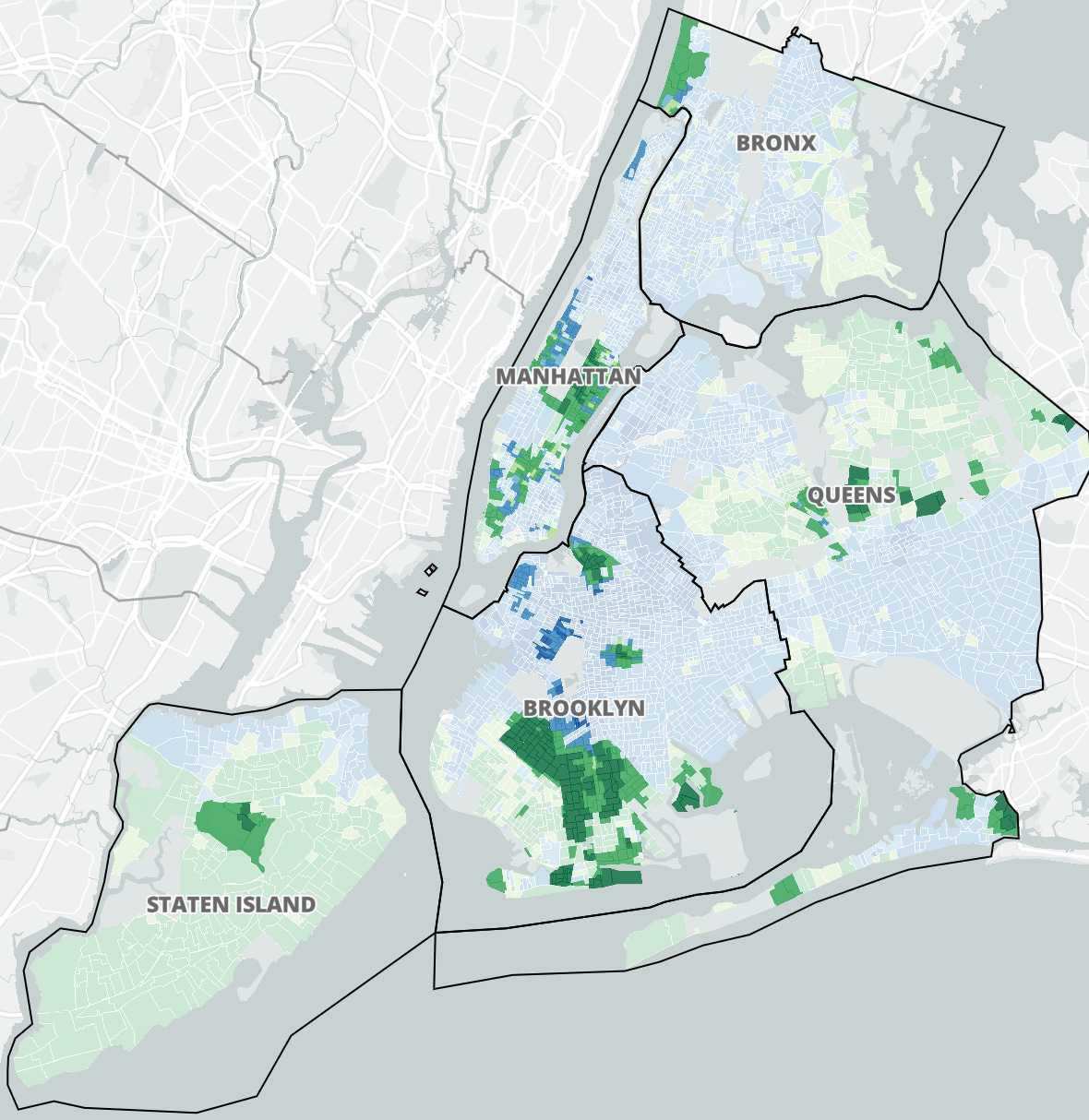
The Post-Election Political Landscape: Wealth and Age
What confounds any analysis of the Jewish vote in New York City is the presence of the Orthodox, Sephardic, and Hasidic voting block. The New York City Hasidic population, primarily residing in homogenous Brooklyn enclaves, totals one hundred thousand, with around 45,000 Satmar in Williamsburg, around 15,000 Lubavitch in Crown Heights, and around 45,000 in Borough Park—home of the Gerer, Bobover, and Belzer Hasidic dynasties. They vote in a greater proportion than the average New Yorker, and often vote as a bloc at the behest of local rabbinical power brokers to maximize their electoral influence. Hasidic voters make up 25-33% percent of the overall Jewish vote in general elections.
Among voters in Jewish surname (10%+) precincts that voted for Donald Trump (40%+) , Cuomo thrashed Mamdani: 77% to 16%, dominating in Orthodox, Sephardic, and Hasidic enclaves in Borough Park, Midwood, Ocean Parkway, South Williamsburg, and Kew Gardens Hills: 120,548 to 24,465. In some precincts, bloc voting delivered Cuomo 30:1 margins.
Across these neighborhoods, where the former governor won support from local rabbis and power brokers, voter turnout rose precipitously, tantamount to an anti-Mamdani groundswell. While Mamdani registered tens of thousands of new voters in advance of the Democratic Primary, Borough Park, a multi-sect Hasidic neighborhood in Brooklyn, experienced a surge in new voter registration after the primary. According to The Forward, “one Borough Park election district jumped from 280 voters in 2021 to 1,046 this year—a fourfold increase.”
In Park Slope, a progressive professional class neighborhood bordering Prospect Park, Mamdani routinely won precincts with a preponderance of Jewish surnames with more than 77% of the vote. In tony Brooklyn Heights—one of the city’s wealthiest ZIP codes with multi-million dollar views of the Manhattan skyline—Mamdani’s support was more muted, but still routinely eclipsed 65% of the vote. The Jewish vote in Lower Manhattan was far more split, as Cuomo dominated the penthouses of TriBeca and Flatiron, while Mamdani carried parts of Greenwich Village and Chelsea—a re-run of the Democratic primary.
These trends continued uptown, as Cuomo convincingly carried Sutton Place. The Upper East Side, home to a large number of Jewish voters, was Cuomo’s best neighborhood in Manhattan. In “Oligarch Alley,” Mamdani was (predictably) crushed, barely receiving fifteen percent of the vote. Across the rest of the Upper East Side, Mamdani struggled compared to his more modest deficit in the Democratic primary, blunted by an uptick in turnout (from nominal Democrats, Independents, and ancestral Republicans). Still, the precincts Mamdani did win were primarily clustered in the Yorkville section—a combination of early career renters, young families, and seniors on fixed income.
Across Central Park, on the Upper West Side, historically the center of the city’s liberal Jewish Democratic community, the story was similar. Cuomo clung to the precincts with a preponderance of Jewish surnames along Central Park West, an impressive row of doorman buildings, and Riverside Drive, a mix of classy apartments and townhouses. Mamdani performed better along the neighborhood’s spine, between Broadway and Columbus Avenue, comparably less wealthy and oftentimes younger. Once Mamdani became the Democratic nominee, he improved here compared to the primary, although the distribution of the vote barely changed. With each block north, Mamdani’s percentage among Jewish voters also improved. Above 96th Street, the democratic socialist won every block along Riverside Drive, oftentimes by more than thirty percent. Mamdani won both the Park West co-ops by double-digits and Morningside Gardens by fifty five percent.
Most notably, the less-Jewish precincts voted almost identically to the more-Jewish precincts, suggesting neighborhood culture (class, age, renter/owner) was more indicative of voter preference. Such was also the case in Hudson Heights, an enclave atop Washington Heights that is home to many middle-class cooperators (teachers, civil servants), where Mamdani thrashed Cuomo by more than forty points. However, Jewish voters in the Bronx and Queens were less kind to Mamdani.
While the (non-Haredi) Jewish middle-class once anchored large swaths of the outer boroughs, their presence has been reduced to a handful of neighborhoods. In the Bronx, Jewish voters in Spuyten Duyvil, another community of thirty-story cooperatives along the Hudson River, Cuomo and Mamdani split most of the vote. Nonetheless, Cuomo performed far better than Mamdani in Riverdale, home to many Orthodox Jews, and Fieldston, an affluent enclave with a blend of secular and Orthodox voters. While parts of the Bronx, these leafy communities of single-family homes share a cultural character with neighboring Westchester County. Such was also the case in other outer borough, middle-class Jewish neighborhoods won by Cuomo, like Forest Hills in Queens. Historically, these blocks have oscillated between the city’s progressive-left coalition (Lindsay, Dinkins, De Blasio) and the more centrist backlash (Koch, Guiliani, Bloomberg).
Mamdani, similar to his progressive predecessors, enters office with powerful opposition. Jewish Democrats, split between Mamdani and Cuomo in both the Democratic primary and general election, will remain a crucial bellwether for the mayor, as he embarks on the left’s most ambitious executive project in generations. Once upon a time, the coalition that came together against Mamdani—the ultra-wealthy, pro-Israel forces, ideological moderates, older working-class Democrats, and Republicans—would have easily carried the political day in New York City. Now, as a new day dawns, they have been reduced to a loud minority.
Michael Lange is a writer, researcher, and strategist born and raised in New York City. His Substack newsletter, The Narrative Wars, covers all things New York City politics.
 | A guest post by
|
What stands out here is how closely Jewish voting patterns mirrored the city as a whole. Mamdani didn’t “lose the Jewish vote”; he won younger, renter, and lower-income voters—Jewish and non-Jewish alike—and lost older, wealthier homeowners. That’s not a failure of coalition politics; it’s the emergence of a different one. If anything, the data suggests that future fights won’t be about identity, but about whether New York remains governed by oligarch enclaves or by the people who actually live and work in the city.
The enterprise press wouldn't last a day if they had to do this level of actual reporting. Truth has never been kind to their bottom line.