

As Airstrikes Loom, Hundreds of Afghan Refugees Still Stranded at U.S. Base in Qatar
After U.S. travel freeze and with the looming threat of an Iran war, hundreds of Afghan evacuees remain trapped and fearful near Doha.

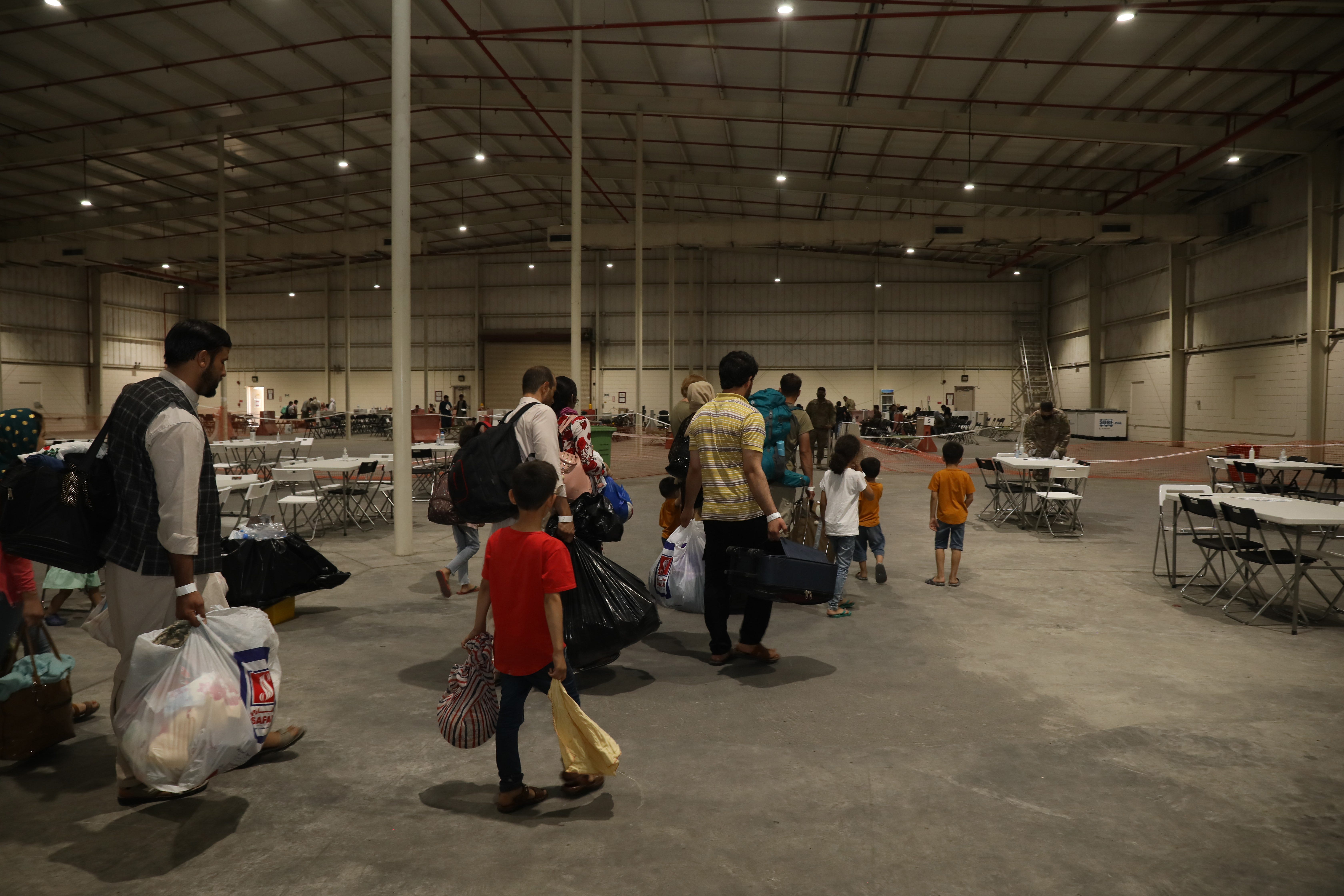
As the U.S. and Iran gear up for another potential confrontation in the Persian Gulf, a community of Afghan refugees left stranded for years at a U.S. military facility in Qatar fear that they might wind up in the crossfire. After the fall of the U.S.-backed Afghan government in 2021, a chaotic evacuation process for Afghans who had ties to the government wound up stranding hundreds of refugees at a U.S. military base near Doha. They remain there to this day, trapped in legal limbo and residing in makeshift conditions.
The same base that houses these refugees was struck by missile debris during the war between Iran, Israel, and the United States in June of last year, and many fear the consequences of a repeat of that conflict. The story of these refugees, forgotten and abandoned after the collapse of the U.S. occupation of their country, represents just one more tragic postscript of a two-decade long intervention in Afghanistan, and the ongoing indifference of U.S. authorities to the human consequences of that conflict.
We rely on the support of our readers. Make a tax-deductible gift or upgrade your free subscription to support stories like this:
As Region Braces for Iran War, Afghan Refugees Stranded at U.S. Base Fear Attack
Story by Sayed Jalal Shajjan and Emran Feroz
More than four years after the chaotic evacuation of Kabul in August 2021, hundreds of evacuees remain stranded in a U.S.-run military facility in Doha, Qatar – caught in a legal, political, and humanitarian limbo that shows no clear end. Brought to Qatar by the United States and its allies as part of emergency evacuation operations following the Taliban’s return to power, many of these evacuees were initially told they would soon be resettled in the United States. Instead, their cases have stalled, their futures frozen by policy reversals, suspended visa programs, and a growing sense of abandonment.
The number of evacuees currently in the Camp As Sayliya (CAS) is around 800. Some have remained in the camp since the initial days of the evacuation, while others were brought after undergoing initial vetting in Afghanistan or neighboring countries in the past four years. Once in CAS all were required to undergo an additional round of security vetting before resettlement in the United States, and for some this process stretched on for years.
For many of the evacuees still living in U.S.-run facilities CAS, daily life has become a grinding routine defined by uncertainty, deteriorating living conditions, and deep psychological strain. Those who had previously received clearance to come to the United States during the Biden administration have had their cases thrown into limbo by the Trump administration.
“Right now, everyone is worried,” said one Afghan evacuee, who asked not to be named. “Some families have been waiting for four years. Others for three or two. The cases vary, but the P1 and P2 programs have been suspended for a year. Their fate is still unknown.”
The Priority 1 (P1) and Priority 2 (P2) refugee referral programs were designed to offer protection to Afghans who worked with or were at risk because of their association with Western governments, organizations, or advocacy of values opposed to the new government. Their suspension has left hundreds in procedural limbo, including families already removed from Afghanistan and placed under U.S. oversight abroad.
Living conditions inside the camps, evacuees say, are worsening. “Raising children is very difficult,” the same source explained. “It’s like living in an alley. The rooms have no roofs. The toilets are far from the rooms. There is always noise at night.”
According to evacuees, sleep deprivation has become widespread. Anxiety, depression, and irregular eating patterns affect entire families. “Everyone stays up until one or two o’clock,” they said. “We can’t sleep because of anxiety and depression. Some people sleep until one in the afternoon. If one or two people in the family eat breakfast, the whole family doesn’t eat. Some families don’t eat at all.”
Education for children has also suffered. Informal classes exist, but evacuees describe them as inadequate. “There is no formal school,” the source said. “The classes have no roofs. There is a lot of noise. They don’t study together. Everyone’s anxiety and stress have increased.”
The prolonged uncertainty has taken a severe psychological toll, particularly on children. “They can’t eat,” they added. “The whole family is in fear.”
Neither the State Department nor CENTCOM responded to a request for comment.
Beyond living conditions, evacuees now face a new and unexpected layer of insecurity: regional conflict. Camp As Sayliyah, where many evacuees are housed, is a U.S. military installation that has become increasingly exposed amid rising tensions in the Middle East.
Mamdouh, a former contractor with the U.S.-backed Afghan government who has lived inside Camp As Sayliyah since 2022, described a recent incident that underscored the vulnerability of those inside the camp. “The Iranian attack last summer was close to the camp,” he said. “When the anti-missile system intercepted the missiles, debris fell inside the camp. Parts of the missiles fell near the living areas.”
According to Mamdouh, the debris landed close to residential blocks. “No one was injured, but it was very close,” he said. “That time, they couldn’t do anything. They say it could happen again. I think it’s not going to be a joke anymore.”
Whether Iran is aware that Afghan evacuees are housed at the base remains unclear. Thomas Ruttig, co-director of the Afghanistan Analysts Network, said he doubts Tehran knows who exactly is living inside Camp As Sayliyah. He also questioned reports suggesting the base had been fully evacuated. “Isn’t this one of the largest U.S. bases in the Middle East?”, Ruttig asked. While some U.S. and British troops may have been withdrawn, he said, the facility remains strategically significant, particularly amid ongoing tensions and the risk of escalation between Washington and Tehran.
For evacuees, the implications are unsettling. They were brought to Qatar as civilians under U.S. protection, yet now find themselves housed on a potential military target.
At the same time, political developments in Washington have further dimmed hopes of resettlement. According to multiple Afghan sources and advocacy groups, the Trump administration has not only halted onward travel to the United States for many evacuees but has also offered financial incentives for voluntary return to Afghanistan.
Ruttig noted that similar offers had previously been made by Germany, though with limited success. “Only a few accepted,” he said. “People did not flee because of money. Their greatest fear is having to return under the Taliban regime, whose treatment of former Western employees is unpredictable.”
That fear remains widespread. Despite Taliban claims of general amnesties, reports of intimidation, detention, and reprisals against former government employees, journalists, civil society activists, and those associated with Western institutions continue to surface. For evacuees in Doha, the idea of returning—even with financial compensation—is not seen as a viable option.
More broadly, Ruttig sees the current situation as emblematic of a deeper political failure. “Overall, one can say that the United States – like all former Western interveners in Afghanistan – treat Afghans as less than pawns on their political chessboard,” he said.
He described the treatment of former Afghan allies under the Trump administration as “a moral bankruptcy.” In his view, Afghans in the diaspora who still hope for decisive U.S. intervention on their behalf should draw sober conclusions from what is happening now.
For the evacuees themselves, the sense of abandonment is acute. Many followed U.S. instructions during the evacuation, boarded planes under American control, and were assured that Qatar was only a temporary stop. Years later, they remain in makeshift conditions, dependent on shifting political calculations in Washington over which they have no influence.
The suspension of visa pathways, the lack of transparent timelines, and the emergence of return incentives have left many questioning whether the promises made in 2021 were ever meant to be kept. With regional tensions rising and no clear resettlement plan in sight, evacuees say their lives are once again being shaped by forces far beyond their control.
What was initially framed as a humanitarian operation now risks becoming a prolonged containment strategy—one that keeps Afghan evacuees out of Afghanistan but also out of the United States. As one evacuee put it, “Our bodies are here, but our lives are nowhere.”
I am beyond ashamed of being an American right now. On one hand, I'm GLAD to see the imperialist foundations of this country being completely exposed for all the world to see. On the other hand, I'm stunned by the lack of any moral compass in this administration and so MANY Americans, as well.
This is what “forever war” looks like after the shooting stops: people warehoused in limbo, stripped of timelines, rights, or safety, while Washington moves on. The U.S. evacuated these families, made explicit promises, then suspended the very pathways meant to protect them—leaving civilians housed on a military target as regional war looms. Calling this a humanitarian failure understates it. It’s a breach of duty, and a reminder that U.S. intervention doesn’t end when the cameras leave—it just becomes quieter, slower, and crueler.