

AIPAC Coordinates Donors in Illinois House Primaries
Three Democratic candidates are benefiting from dark-money super PACs, and they share hundreds of donors who have previously given to AIPAC and its subsidiaries.


This is a collaboration with The American Prospect. Subscribe or show them some love here.
With Israel’s reputation reaching record lows among Democrats, the American Israel Public Affairs Committee (AIPAC) is resorting to ever more sophisticated methods to support its preferred candidates while cloaking its own involvement.
The amount of money that the premier pro-Israel organization is able to spend in elections is extraordinarily valuable to candidates who would otherwise have little chance of winning. But it now comes with a catch: If voters know the money comes from an organization advocating on behalf of Israel, it can do more harm than good.
AIPAC road-tested its stealth approach in a 2024 House primary in Oregon that pitted Susheela Jayapal, the sister of Rep. Pramila Jayapal (D-Wash.), against physician Maxine Dexter. Dexter raised relatively little money throughout much of her campaign, then saw a last-minute deluge organized by AIPAC coupled with outside spending through super PACs, which themselves turned out to be funded by AIPAC. The timing of the donations meant that there was no meaningful transparency before voters went to the polls, and Dexter expressed a mixture of ignorance and umbrage when her opponents suggested the money actually came from AIPAC.
The main super PAC in question (named 314 Action) explicitly denied that any funding came from AIPAC—a claim revealed as a flagrant lie once disclosure records finally became public. But by then, Dexter had triumphed and was on her way to Congress.
Campaign staffers expect AIPAC to continue using the tactic in this year’s primaries. “In these districts where we have a progressive primary fight, you’re going to see AIPAC put out a network of shell PACs, putting money into races without putting their name on it,” said Usamah Andrabi of the progressive campaign group Justice Democrats.
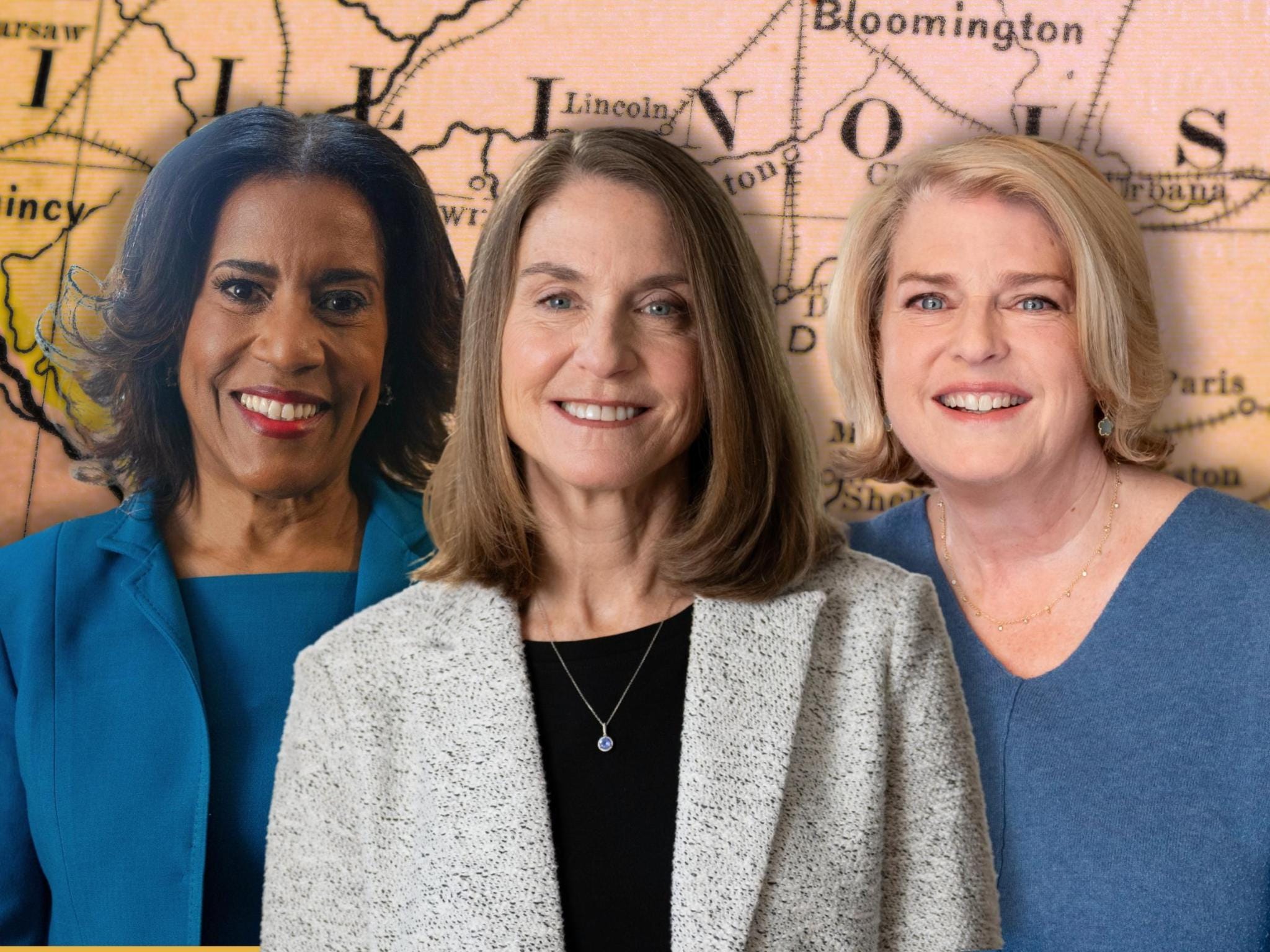
And indeed, the same pattern is emerging in three competitive House primaries in Illinois. The pieces of the puzzle can be found in the campaign disclosures of House candidates Laura Fine, a state legislator running in Illinois’s Ninth Congressional District for the open seat vacated by Rep. Jan Schakowsky on the North Side of Chicago and its northern suburbs; Donna Miller, a Cook County commissioner running in Illinois’s Second District to replace Rep. Robin Kelly on Chicago’s South Side and southern suburbs; and Melissa Bean, a banker and former member of Congress making a comeback in Illinois’s Eighth District in the western suburbs of Chicago. Bean is also running for an open seat to replace Rep. Raja Krishnamoorthi, who like Kelly is running for Senate.
Putting the pieces together, it is clear that AIPAC is again funding super PACs in order to secretly funnel money to its preferred candidates, while also coordinating donors to give to those candidates directly.
Miller is running in a race that features an attempted political comeback by Jesse Jackson Jr., and Fine is squaring off against progressive Daniel Biss and Kat Abughazaleh, who became a national figure after she was indicted by the Trump Justice Department for her role in anti-ICE protests. Bean is facing Junaid Ahmed, who supports ending all military aid to Israel.
A look at Miller, Fine, and Bean’s filings betrays an impressively coordinated operation at work. Sixty-five donors who previously gave to AIPAC or its affiliated super PAC United Democracy Project (UDP) have given to both Miller and Fine. These donors delivered $88,066.66 to the Fine campaign. They also contributed $119,746.33 to Miller. A whopping 237 former AIPAC/UDP donors have given to both Miller and Bean, contributing $396,288.01 to Bean and $429,083.00 to Miller. Forty-four of these donors have given to all three candidates, sending a total of $208,753.33 to them.
Several of the donations were given to the candidates on the same day, by the same donors, for the same amounts.
“This coordinated effort by Trump and AIPAC donors to buy multiple congressional seats in Illinois should be alarming to anyone who cares about the integrity of our democracy,” said Matthew Fisch, campaign manager for Robert Peters, who is running against Miller in IL-02.
ALL THREE OF AIPAC DONORS’ Illinois candidates are benefiting from new pop-up super PACs with anodyne-sounding names. Affordable Chicago Now! is supporting Miller, and Elect Chicago Women is supporting Fine and Bean.
The super PACs, whose donors are currently secret, were both organized in January and began rolling out television ads in the last week. The spots (here’s Fine’s, here’s Miller’s, and here’s Bean’s) are generic positive biographical ads. The total ad buys appear to be in the millions of dollars. Illinois primaries will be held March 17, and the names of the funders of the super PACs will not have to be released until near or even after that date.
The ads do not mention support for Israel. Neither AIPAC, UDP, nor indirectly associated PAC Democratic Majority for Israel (DMFI), which often supports the same candidates, have endorsed or spent money in these three races. But Jewish Insider and several others have reported that AIPAC appears to be behind the pop-up super PACs. AIPAC, United Democracy Project, and the two shell PACs did not return requests for comment.
The need to hide the super PAC ball was made more apparent on Thursday night, after the results of a special congressional primary election in New Jersey to replace Mikie Sherrill, who was elected governor last November. Former Rep. Tom Malinowski faced a direct onslaught of $2 million in UDP ads, and DMFI quietly endorsed former Lt. Gov. Tahesha Way. But with most votes in, Malinowski was a close second to Analilia Mejia, the least-friendly candidate to AIPAC in the race, who benefited from the attack ads on her top opponent. Way finished a distant third.
The same ad buyer handling the Illinois super PAC ads bought ads for AIPAC in that Thursday election in New Jersey.
In Donna Miller’s case, the support, both direct and indirect, came not a moment too soon. In the 11-candidate field in IL-02, she was something of an afterthought, having raised only around $242,000 for her campaign prior to the fourth quarter of 2025, not enough to be taken seriously. Suddenly, she took in over $1 million last quarter, according to her Federal Election Commission report filed on January 31, much of it coming in toward the end of the quarter. The haul immediately made Miller a leading contender in the race.
As with the case of Dexter, Miller’s opponents quickly suspected something unusual was going on. Her opponent Peters’s campaign found that 83 percent of her total haul in the fourth quarter, about $875,000, came from people who gave to AIPAC or UDP within the last four years, a fact that’s confirmed by the raw data at the FEC website.
Miller’s donors were feeling particularly generous on New Year’s Eve: 198 of those donations came on December 31, 2025.
Miller has not made any statements about Israel on her website, and the “red box” on her site that identifies preferred messages for outside campaigns to use does not include foreign policy or Israeli foreign aid, either. But something is obviously attracting longtime AIPAC donors to her campaign.
“The fact that the people who want Donald Trump to be president also want Donna Miller in Congress says a whole lot about Donna Miller,” said Matthew Fisch, the campaign manager for Peters.
Those donors come not just from Illinois but from across the country, including Arizona, California, Texas, Florida, New York, Ohio, Massachusetts, Connecticut, Virginia, Washington, Kansas, Delaware, Minnesota, New Jersey, Maryland, Pennsylvania, New Mexico, Tennessee, Missouri, Nevada, and Michigan. Nearly $39,000 came from donors who also contributed to Donald Trump in his elections.
By cross-referencing this data with data from Laura Fine’s FEC disclosures, you can see that many of Miller’s donors have also given to Fine’s campaign. Fine has also lagged her primary opponents in fundraising; her campaign touted an internal poll this week showing her in a tie at the top of the race, though other campaigns’ polls and independent polling show her behind.
A substantial number of Fine’s donations also come from AIPAC donors, and AIPAC has done a bit less to obscure its support for her, even if the super PAC backing her is called “Elect Chicago Women.” In December, AIPAC board president Michael Tuchin held a fundraiser for Fine and multiple emails from AIPAC asking donors to give money to Fine have been leaked.
Five AIPAC donors—Timothy Wuliger, Gadi Maier, Susan Hammer, William Silverstein, and Mark Gerstein—gave maximum donations of $3,500 to both Miller and Fine. Two other donors—the husband-and-wife team of Jerry and Alexis Bednyak—“double-maxed” to Miller and Fine, meaning that they gave a maximum $3,500 donation for both the primary and the general election. The Bednyaks are major donors to AIPAC, according to the website Track AIPAC, with $100,000 in lifetime donations to the organization. Jerry Bednyak co-founded ticket reseller Vivid Seats and is a managing partner with Skybox Capital.
Other crossover donors gave varying amounts ranging from $250 to $3,500 to each candidate. In all, 65 donors contributed to AIPAC, Laura Fine, and Donna Miller. Some, like Moises Woldenberg of San Antonio, Texas, Rachel Albert of Middlebury, Connecticut, and Jeffrey Drake of Evanston, Illinois, gave the same amounts to Fine and Miller on the same day (December 31, 2025).
“This is the same right-wing dark-money machine that has spent years attacking our democracy and propping up January 6 insurrectionists for office,” said Kat Abughazaleh, one of Fine’s leading opponents.
There are even more significant crossovers between Miller’s donors and donors to Melissa Bean, who was once called Wall Street’s favorite Democrat when she served in Congress from 2005 to 2011. Her name recognition and massive fundraising ability as a former banker have vaulted her to the top of the pack in the crowded race. She has the support of the centrist New Democrats, along with a substantial number of AIPAC donors.
An incredible 45 AIPAC donors maxed out to both Miller and Bean, while Bednyak and his wife double-maxed out to both of them, as they did for Fine. Aside from the Bednyaks, only Gadi Maier of Paradise Valley, Arizona, maxed out to Bean, Miller, and Fine.
The vast majority of Bean and Miller donors gave the same amounts to both candidates, even with weird numbers like $613 (the number of mitzvot in the Torah, from Martin Lurie of Newton, Massachusetts) or $1166.67 (Rada Burdeen of Winnetka, Illinois). That suggests that these donors were encouraged to split their donations to Bean and Miller through some sort of email communication. To have 237 donors shared by both campaigns, with hundreds of thousands of dollars contributed, is hard to write off as a coincidence.
“This is the AIPAC playbook on how to control Congress,” said Bean opponent Junaid Ahmed in a statement. “They’ll spend big money now and then expect my opponent to send billions in aid and weapons to Israel when she’s in Congress. This is exactly what’s wrong with our politics.”
The Fine, Miller, and Bean campaigns have not yet responded to a request for comment. But Daniel Biss confronted Fine about her AIPAC support at a candidate forum on Wednesday. Biss has claimed that nearly $60,000 in Fine donations come from Trump donors, more money than she raised last quarter from constituents inside the district. Fine responded, “I don’t know who a Trump donor is who’s donating.” After the forum, Fine told reporters that she would “love to know who’s funding” the ads.
DONATIONS TO INDIVIDUAL CANDIDATES can be more powerful than super PAC donations. Though candidate donations have limits ($3,500 for both the primary and general elections) relative to unlimited and secret super PACs, candidates get much more favorable ad placement rates, sometimes by a factor of ten, thanks to a 1972 law.
Therefore it makes sense for organizations that want to influence elections to use all channels—including super PACs, outside spending, and funneling donors directly to candidates—to give their preferred candidates resources.
AIPAC has coordinated donor support for its candidates in the past, beyond Maxine Dexter. In 2024, it was the largest source of Republican donors for Democratic candidates in primary races, according to Politico. In addition to Miller and Fine, AIPAC donors are supporting another candidate for an open seat in Illinois, Jason Friedman in the Seventh Congressional District, who is trying to replace retiring Rep. Danny Davis.
There’s nothing illegal about organizations encouraging donors to support certain candidates. The Progressive Change Campaign Committee this week endorsed Peters in the Second District race and Biss in the Ninth District, and is “mobilizing its national grassroots network” to support those candidates by asking its supporters to donate to them directly.
The PCCC is doing this publicly, however, whereas AIPAC has not even endorsed these particular candidates publicly as of yet. And the potential amount of money AIPAC can funnel from big donors with the ability to max out to campaigns is much bigger than a grassroots mobilization.
Combined with the suspected shell super PACs, it represents an all-out effort by AIPAC to get their candidates who presumably agree with their desires for unconditional support for Israel into Congress.
Hannah Riddle, director of candidate services for the PCCC, said in a statement, “These early primaries are indicative of the exact fight we’re seeing for the future of the Democratic Party. Are we going to nominate candidates who are paid for by corporations and special interests, or are we going to invest in candidates who will inspire voters, name those special interests, and fight against them?”
Riddle added, “If Miller and Fine have any integrity, they should return the money and denounce these dark money Super PACs.”
 | A guest post by
|
Democratic primaries are being hijacked by a right-wing dark-money network that also funds Trump—full stop. The goal isn’t representation, it’s obedience: vote for endless weapons, endless aid, and zero accountability. Voters are being deliberately misled, and that’s the point.
Excellent report, so thanks to Drop sIte and American Prospect.
The good news is that pro-Israel advocates are hiding in the bushes and can no longer publicly speak in favor of American support for Israel.
The bad news is that we all now have to play the whac-a-mole game when they pop-up as wolves in sheep's clothing with innocuous names for super PACs. For that, we need independent journalists to remove those masks and show the wolves behind them.
Stay on this, please, and expand the research to elections around the country, and expose all candidates taking pro-Israel money, publish the names of all pro-Israel super PACs, and name all individual pro-Israel donors.