

Al-Shabaab Fighters Break Out of Underground Prison in Somalia
A militant raid on a heavily fortified prison and intelligence headquarters in Mogadishu deals major blow to U.S.-backed Somali government.

As a 100% reader-funded independent news outlet, we operate free from the influence of governments, advertisers, and corporate backers. This is essential to our mission: to report on what matters most, beholden only to the truth. In that spirit, we made a commitment to ensure that our journalism is free for everyone, not locked behind a paywall. But that means we rely on the voluntary support of our community of readers. Please consider making a 501(c)(3) tax-deductible donation to support our work today. Thank you for being a part of the Drop Site community.
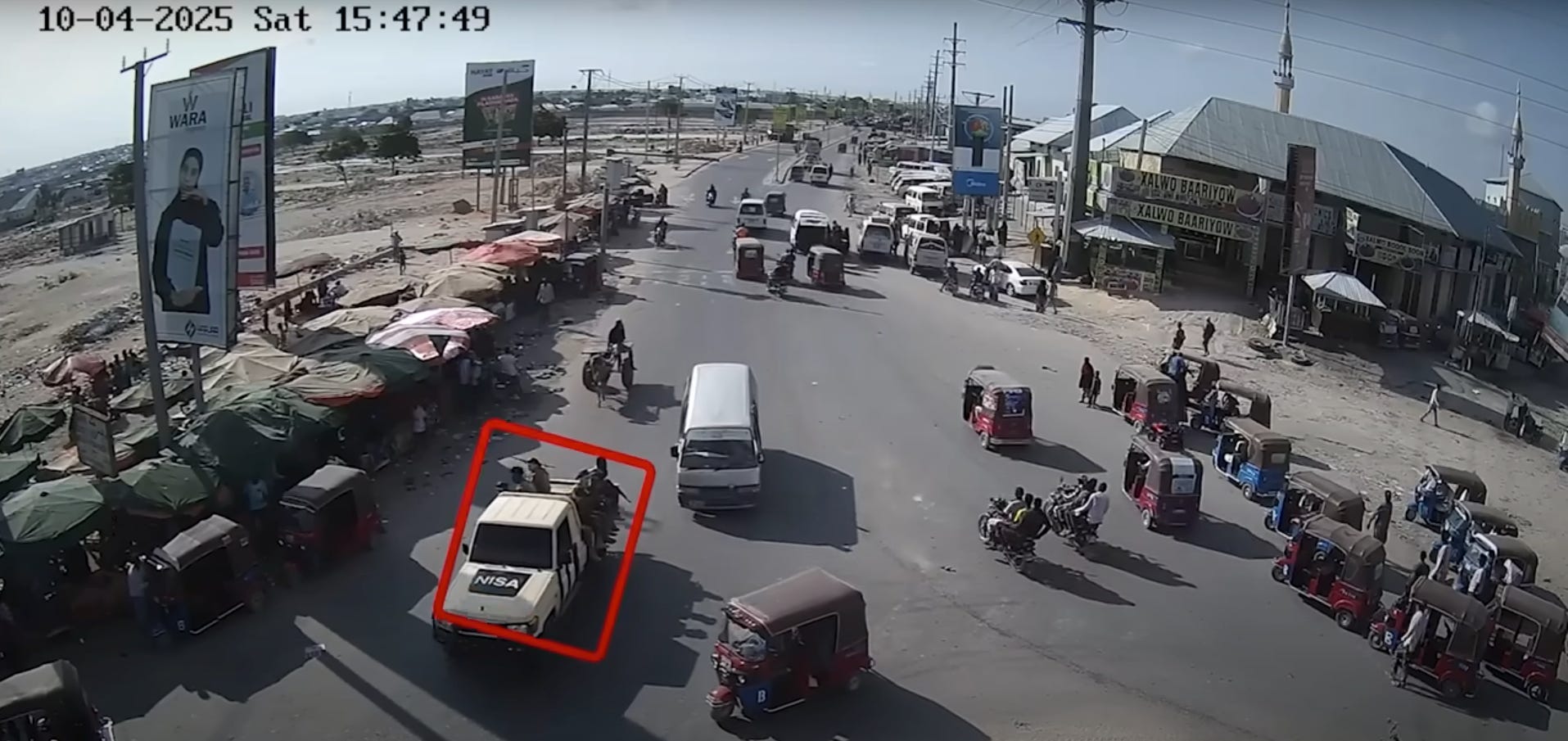
MOGADISHU, SOMALIA – Shortly before 5 p.m. on Saturday, a group of armed fighters from the Somali militant group Al-Shabaab drove to the control gate outside a major intelligence headquarters and underground prison in the capital of Mogadishu. Just hours earlier, the government had removed security checkpoints across the city that had been in place for years. Their removal was celebrated by the government as a signal that security in the war-torn capital had decisively improved after years of conflict between the government, rival clan militias, and extremist groups.
The Al-Shabaab fighters disguised themselves as government security forces, wearing official uniforms and driving a truck labelled with the markings of the country’s National Intelligence and Security Agency (NISA), which runs the facility. The facility they were approaching, known as Godka Jilow, or simply, “the hole,” held senior members of the group captured during their years-long insurgency against the government.
The truck was laden with explosives. As the disguised Al-Shabaab fighters pulled up to the gate, residents nearby reported hearing a thundering explosion, followed by gunfire.
“I was surprised because I haven’t heard of bombings in this area in a while. Things have gotten better, I thought. But the attack on Godka reminded me that the war is still prevalent all around us,” Malyun Omar Sharif, a local resident who lives near the attack, told Drop Site. “I had trouble putting my son to sleep because there were gunshots being fired throughout the night. I was frightened for him and just wanted the gunfire to end, but it only kept intensifying. All we can do is pray that God shields us from any harm.”
Godka Jilow is located in a fortified location less than a kilometer from the Somali presidential palace, known as Villa Somalia, making it one of the most heavily protected sites in the country.
For roughly seven hours, a gun battle raged inside the facility, as a group of roughly seven infiltrators fought security forces, while helping Al-Shabaab prisoners escape from their underground cells. Radio Anadulus, the official radio station of Al-Shabaab, released four separate audio recordings of gunmen from the group who claimed to be speaking from inside the prison, where they said they had taken control and freed several detainees.
A Somali intelligence official who spoke with Drop Site News on condition of anonymity described the attack as a catastrophic security failure.
“They had (NISA) ID cards and wore uniforms akin to those worn by the intelligence service,” the NISA official said. “When the attack happened there was a meeting taking place of senior intelligence officials in Godka Jilow.”
Godka Jilow is also the intelligence headquarters for the Banaadir region that encompasses Mogadishu. NISA officials who spoke with Drop Site said that the timing—occurring at the precise moment when the weekly meeting of senior NISA officers was being held—suggested that Al Shabaab had precise intelligence about operations at the facility.
“While the meeting was taking place is when they (Al-Shabaab) struck,” the official added. “They had to have inside information.”
At roughly 2 a.m. local time, the government announced that the siege on Godka Jilow had ended, claiming that they had killed seven attackers. The toll of government fighters and civilians is not yet officially known, nor are the number of detained Al-Shabaab members who may have escaped during the prison assault. The security official who spoke to Drop Site did not confirm whether any senior intelligence officials had been killed.
Footage that later surfaced online showed several alleged Al-Shabaab members re-captured by the government after initially escaping the prison. A second Somali intelligence official confirmed to Drop Site that “some” Al-Shabaab suspects did completely escape during the siege, but was unwilling to go into further detail.
“A Self-Inflicted Wound”
Shortly following the assault on the underground prison, Al-Shabaab released an official statement taking credit for the attack, stating that they had targeted a “place where Muslim Somalis are punished,” and highlighting that the attack had taken place during a “meeting between senior Mogadishu intelligence officials.”
In 2006, Al Shabaab emerged from the maelstrom of the Somali civil war to fight foreign troops in the country, as well as the Somali central government which it accuses of acting as a proxy for foreign powers. The group has carried out extreme acts of violence against Somali civilians, including suicide bombings and shooting attacks targeting popular beaches in Mogadishu. It has also drawn the attention of foreign governments due to its links to Al Qaeda, as well as catastrophic terrorist attacks including a 2013 massacre at a popular mall in Kenya.
After the Al-Shabaab attack on Godka Jilow, Somalia’s official state-run news agency reported that the Gaashaan unit, an elite commando unit of the NISA had “neutralized all seven attackers” and “secured the entire area” ending the underground prison siege.
Gaashaan, which translates to “shield,” is a CIA-led and trained special force tasked with combatting Al-Shabaab, particularly in Mogadishu. They are known to accompany CIA paramilitary units in joint operations, according to a 2021 report.
The attack was a massive blow to the Somali government, which had made improving security in the capital city one of its priorities. CCTV camera footage later released by the government showed the gunmen traveling in an NISA-marked truck entering Mogadishu through a junction linking the capital city to the volatile neighboring Shabelle Valley. The Shabelle Valley has been an Al-Shabaab stronghold for years, and was the site of a recent U.S. airstrike by AFRICOM.
Upon entering the city limits, the attackers traveled past the headquarters of the Ministry of Foreign Affairs and the Ministry of Education. They also drove past numerous checkpoints, and even a key entry point to the presidential palace, before eventually reaching their target.
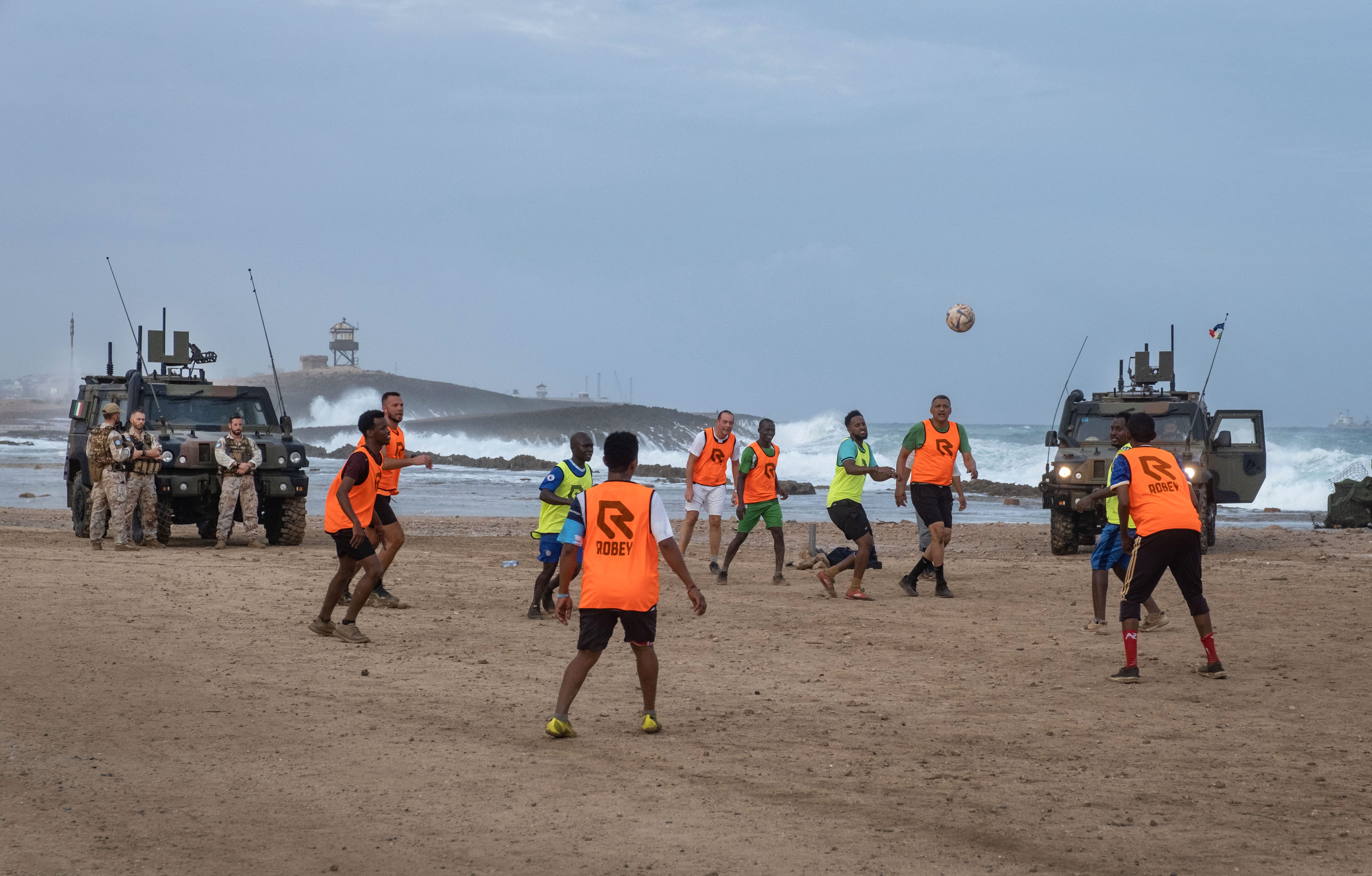
Since 2023, the security situation in Mogadishu has shown signs of limited improvement, leading to a resumption of some foreign visitors, investment, and economic activity in the coastal metropolis of 4 million that was largely destroyed by a civil war in the 1990s.
But attacks have continued in Mogadishu despite the increased presence of plainclothes security agents and a sprawling CCTV network. In March, there was a failed Al-Shabaab assassination attempt on President Hassan Sheikh Mohamud; his convoy was targeted by a roadside bomb as he exited the presidential palace grounds. Between February and August of this year, the group seized control of dozens of towns and districts across southern and central Somalia, raising fears that Mogadishu itself could soon fall. Despite this, the government removed concrete road barricades in the city—just hours before the militants launched one of their most serious assaults on the government in years.
Abukar Arman, a security analyst, as well as Somalia’s former special envoy to the United States, described the assault on Godka Jilow as a catastrophic failure of the government’s security policy, stating that the attack had “hit the nerve center of the government’s war against Al -habaab.”
“A place where Al-Shabaab suspects are interrogated and imprisoned was overrun during broad daylight. No doubt that the current government’s war efforts not only are failing but are turning into a facade as more time passes,” Arman told Drop Site. “Opening roadways and removing barriers to display improved security in Mogadishu only for Al-Shabaab to strike will hurt the government’s legitimacy. It is a self-inflicted wound and the authorities have no one to blame but themselves.”
History of Abuse
The Godka Jilow facility, named in homage to former Somali Col. Ahmed Jilicow, was created under Somalia’s former Marxist ruler Mohamed Siad Barre. During his rule, the prison developed a fearsome reputation as a torture site, where prisoners, many of them political dissidents against Barre, were subjected to excruciating treatment, or often simply murdered by government forces.
After the country descended into a civil war that terminated Barre’s rule in the early 1990s, the prison went into disuse. But it was revived in 2006 during the U.S. Global War on Terror, when a U.S.-backed Ethiopian invasion of Somalia overthrew an indigenous political movement called the Islamic Courts Union that had attempted to put an end to the clan violence that had ravaged Somalia, and impose a new government on the country.
By 2011, as Drop Site’s Jeremy Scahill reported that year in The Nation, the CIA itself was overseeing the detention and torture of alleged terror suspects at Godka Jilow. In the years since, the prison has continued to be used as a site for horrific abuses, not just against alleged Al-Shabaab members, but against political dissidents as well as journalists, and other civilians, allegedly including children.
The U.S. and other countries have continued to carry out military operations to defend the central government in Mogadishu out of fear of the consequences of an Al-Shabaab takeover. Over the past year, the Trump administration heavily ramped up drone strikes in Somalia, targeting not just Al-Shabaab but members of ISIS, who have also gained a foothold in parts of Somalia. In addition to U.S. support, the Turkish government recently surged hundreds of troops and drone operators to the country to help the government in its attempt to beat back the Al-Shabaab offensive that has encroached on the capital.
Regional bodies such as the African Union, which has thousands of foreign troops deployed in Somalia, condemned the Al-Shabaab attack on Godka Jilow late Sunday, calling on the international community to intensify support for Somalia and the AU military coalition known as AUSSOM in order to “eliminate Al-Shabaab.”
The Somali government and its allies in AUSSOM now face the challenge of recovering after one of the biggest setbacks to their security efforts in years. In the meantime, Al-Shabaab continues to grow in influence in Somalia, despite an international coalition fighting for years to stop it.
As one NISA official told Drop Site, “They (Al-Shabaab) have resources and capabilities like the government.”
 | A guest post by
|
Thank you for discussing things I have no real knowledge about!!!
Is Al Ashabad Popular with the people? If so, why?