

Fighting Breaks Out in Aleppo, Pushing Syria Back to the Brink
Over a hundred thousand people were displaced this week by the violent clashes between the Syrian army and the Kurdish Syrian Democratic Forces.

Drop Site exists because readers like you make a different kind of journalism possible. We made a commitment from day one: no paywalls. Our journalism isn’t just for people who can afford it—it’s for everyone who needs it. That commitment is what allows us to amplify the voices of journalists risking their lives on the ground in Gaza, Venezuela, Sudan, Pakistan, and Syria.
But here’s the reality: we can only do this with your support.
Story by C.P. Ward. Photos by Anagha Subhash Nair.
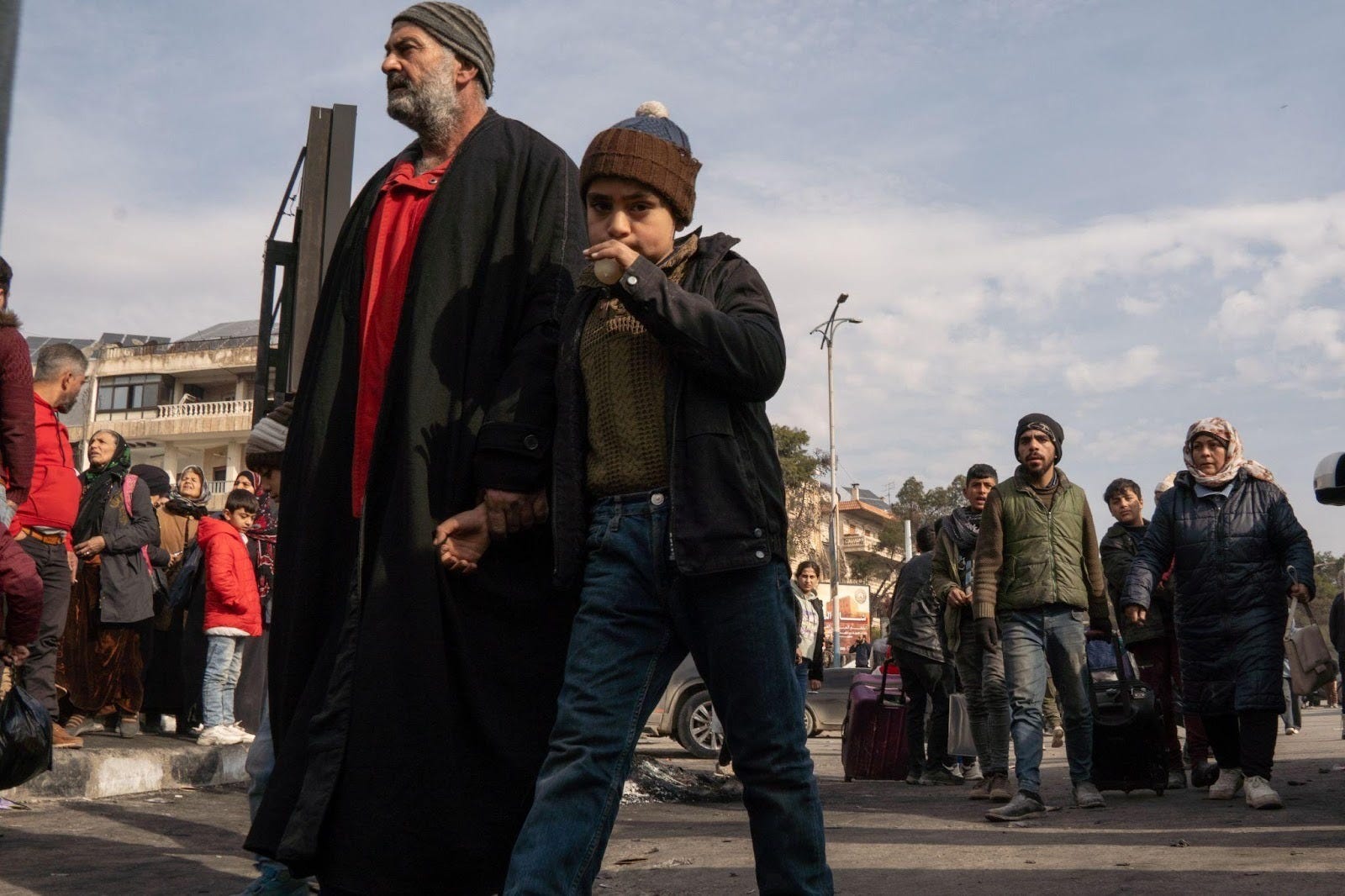
ALEPPO, SYRIA—Amid the rattle of gunfire and the thuds of artillery, crowds of people fled from Aleppo’s Kurdish neighbourhoods through the Zahoor crossing on Thursday, seeking safety from escalating fighting between government forces and the Kurdish-majority Syrian Democratic Forces (SDF). They came carrying suitcases and shopping bags; many brought with them their beloved pets. No one knows when they will be able to return home, and many fear that the conflict could plunge Syria back into civil war.
On Tuesday, clashes erupted between Syria’s provisional government and SDF amid stalled negotiations over how to integrate the autonomous SDF into the Syrian army. The SDF’s units still control Aleppo’s Kurdish neighborhoods of Sheikh Maqsoud and Ashrafieh, as well as large areas of territory in the country’s north-east.
The government declared on Wednesday the two Kurdish-controlled neighborhoods a “closed military zone,” giving residents until 1:30 p.m. on Thursday to evacuate. More than 140,000 people have been displaced from their homes according to Aleppo’s Directorate of Social Affairs and Labour. On Thursday, those emerging from the area seemed to be in shock and most did not know where they were going. “God knows [where we will go], the situation inside is really bad now,” said Radwan, who was fleeing the neighbourhood with his three daughters. “There’s no food or water. There’s nothing.”
The situation on the ground is fluid as of Friday. The fighting continued into the night on Thursday before a tentative ceasefire was agreed to at 3 a.m. By the morning, fighting had largely halted and another humanitarian corridor was open, but reports of fighting quickly emerged again.
While other spates of violence in Aleppo over the past year have died down quickly, fighting continued to worsen over several days this week. Since March 2024, negotiations to integrate the SDF into the Syrian military have largely stalled, failing to meet an end-of-year deadline to agree on terms. The SDF is reluctant to integrate into the Syrian military without retaining some degree of autonomy or agreement for a federalized system of government, as well as concrete constitutional guarantees of Kurdish rights.
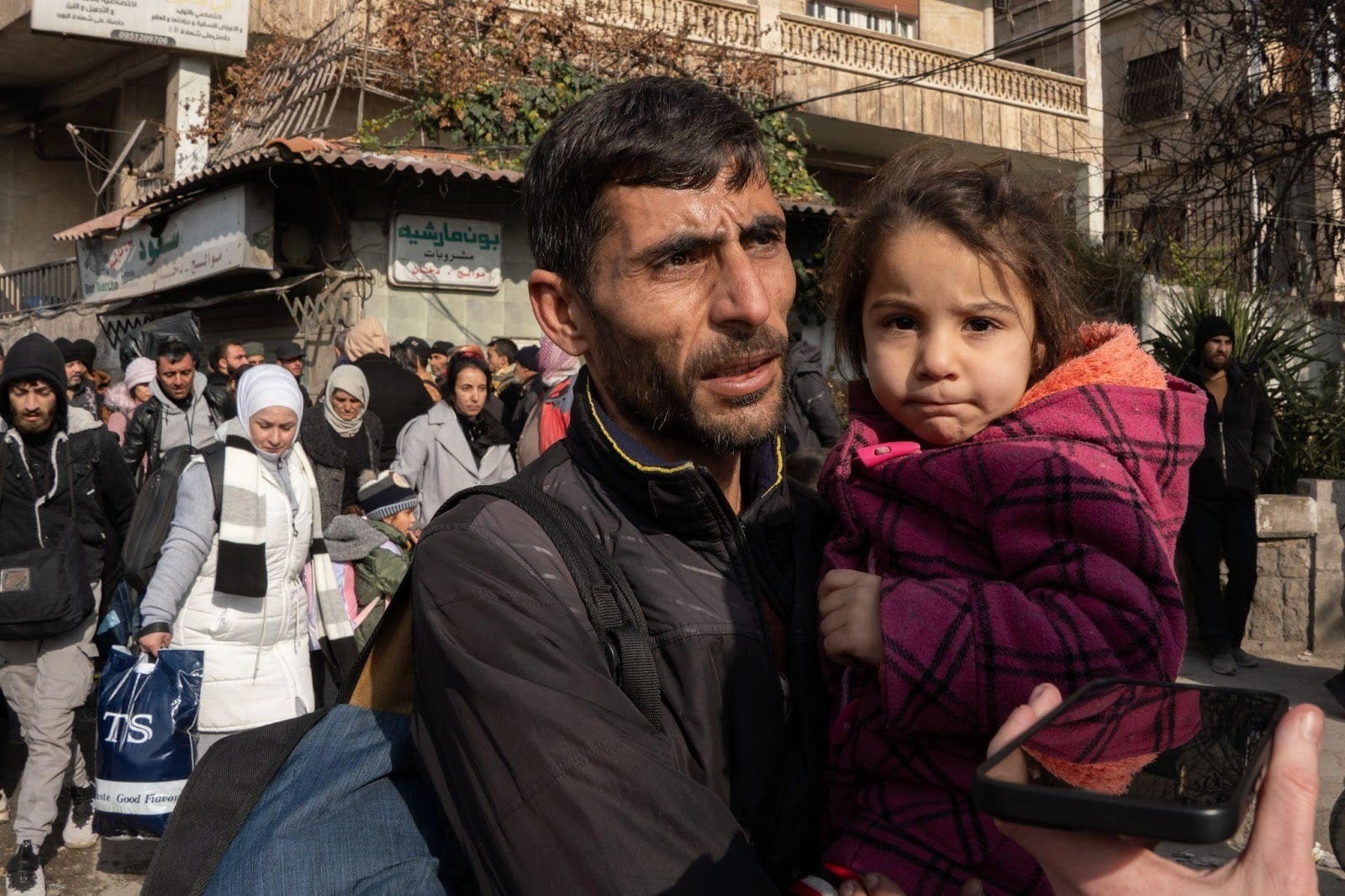
A scant few, like Mohammed Ajel Al-Ali, were heading into Kurdish territory. “I have to get bread for my family. I am out now because I have to be,” he explained. “I am just leaving my fate to God.”
A network of ad hoc displacement shelters have opened across Aleppo to provide shelter and aid for the thousands of displaced. Zein Al-Abideen mosque in the neighborhood of New Aleppo has become a refuge for 337 people. Late into Wednesday evening, it was a hub of activity. Volunteers like Asaad rushed to support the displaced families. “I returned to Syria just two months ago from Lebanon,” he laments. “I thought the war was over so I came back to restart my studies but now it’s all beginning again.”
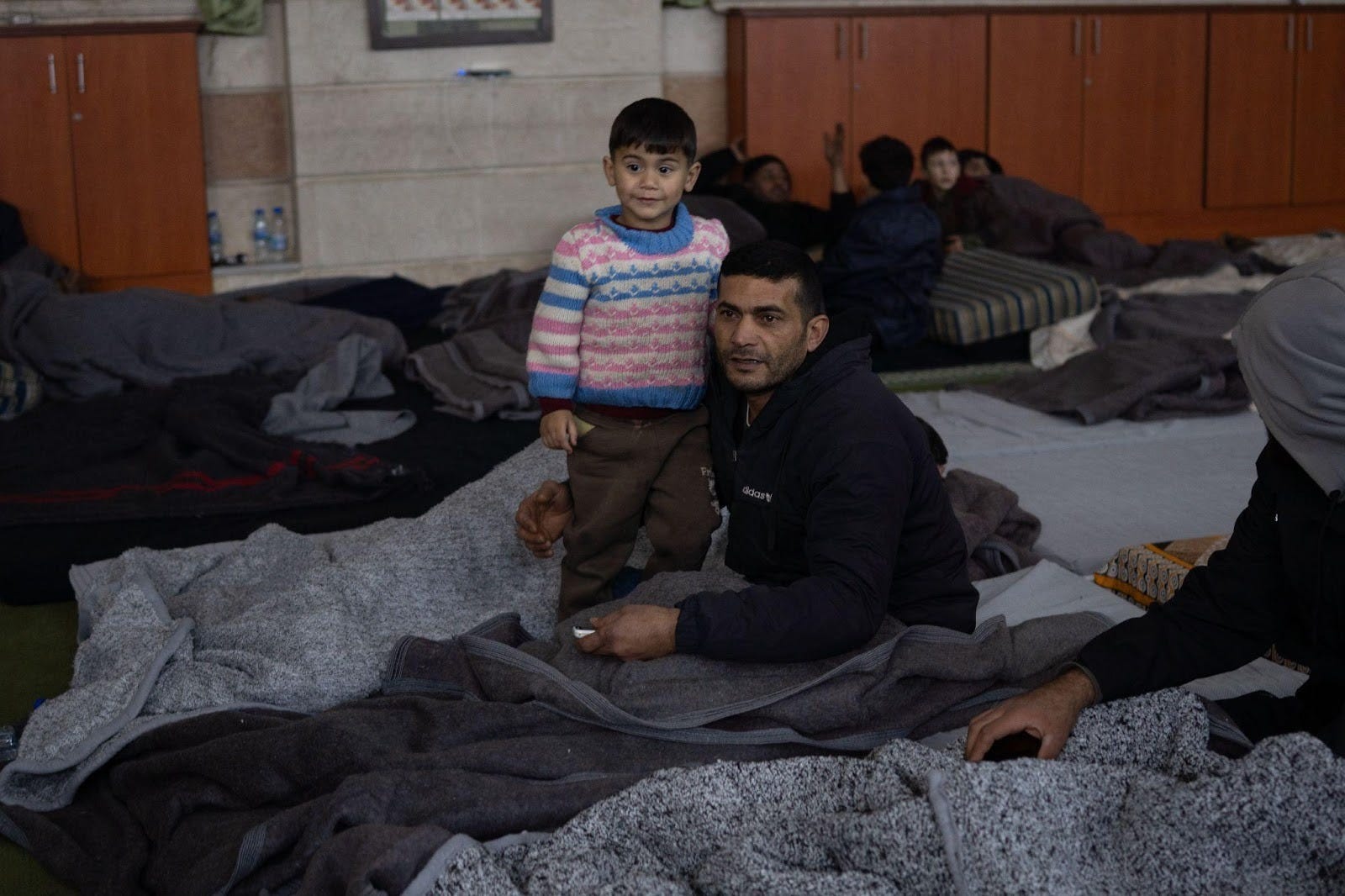
Shahed Baki Zada, an employee of Aleppo governorate, has been tasked with running the center at Zein Al-Abideen. “The situation is very difficult, but our priority is making sure that people are okay and safe, that they are warm, comfortable and fed,” she explained.
“We fear that, God forbid, this situation might drag on, but we hope it will be resolved.”
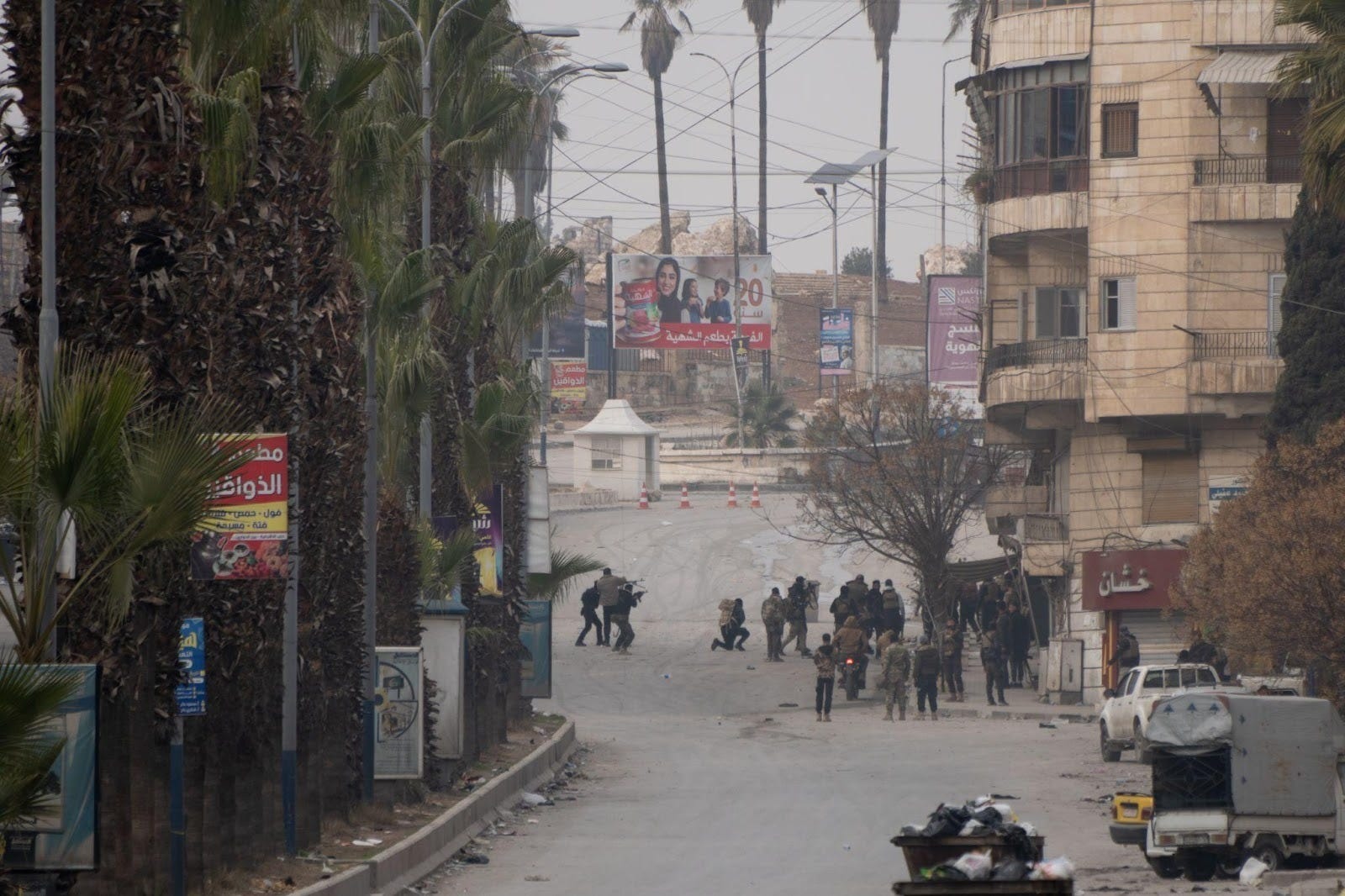
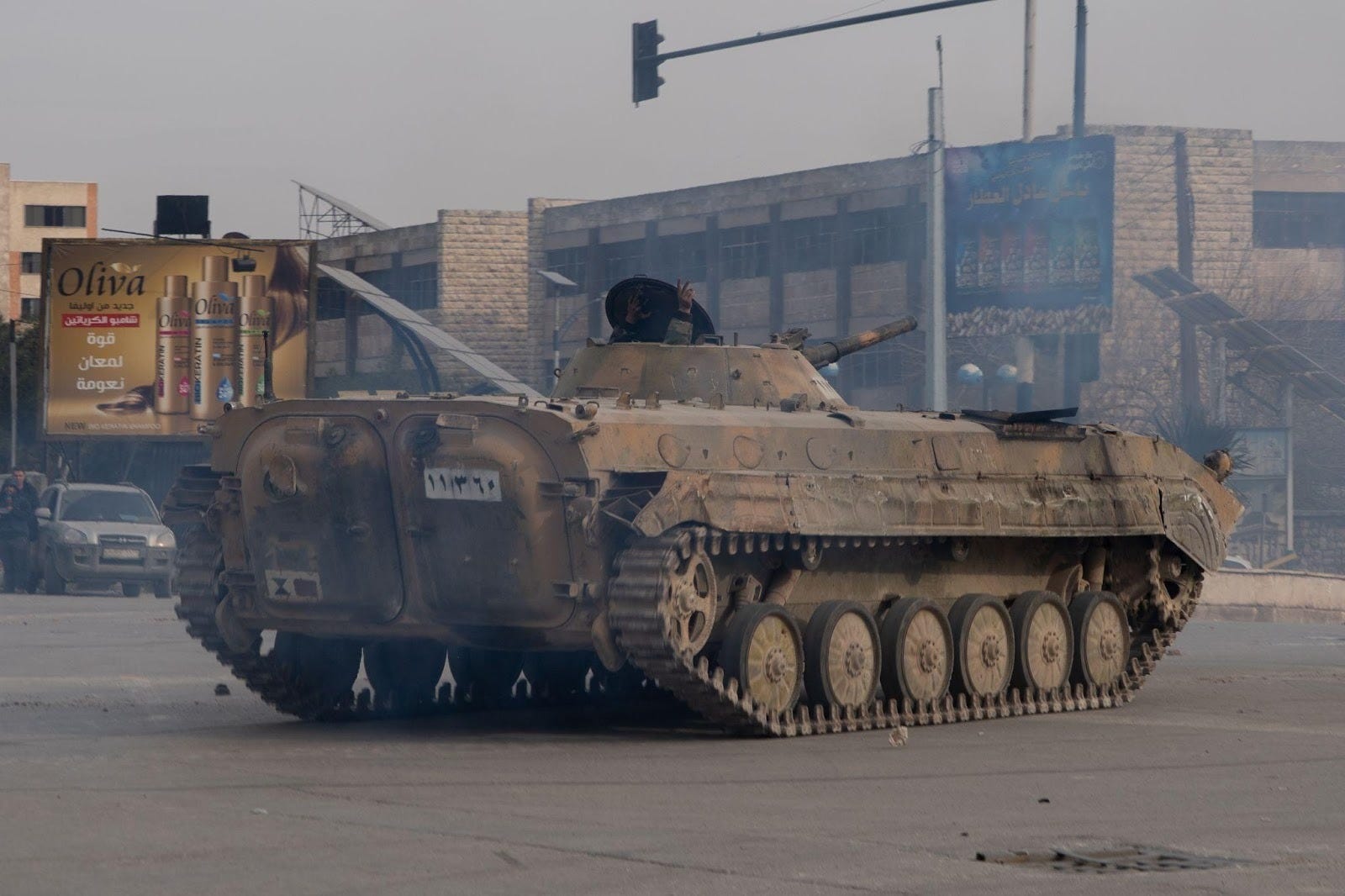
Shortly after the 1:30 p.m. deadline expired at the Zahoor crossing on Thursday, an intense bombardment of SDF-controlled neighborhoods commenced. Drop Site News witnessed heavy street fighting involving the use of tanks, drones, and rockets, as well as three wounded members of the Syrian military being evacuated from the frontlines.
The SDF has reported that eight civilians have been killed in the Kurdish neighborhoods, and dozens injured. The Syrian government says that at least nine civilians have been killed and 55 wounded in the surrounding government-controlled areas.
Al-Razi Hospital has become the main triage point for those wounded coming from the government-controlled areas. Drop Site was able to visit the hospital on Wednesday, where they had taken in 35 wounded cases, including 12 children.
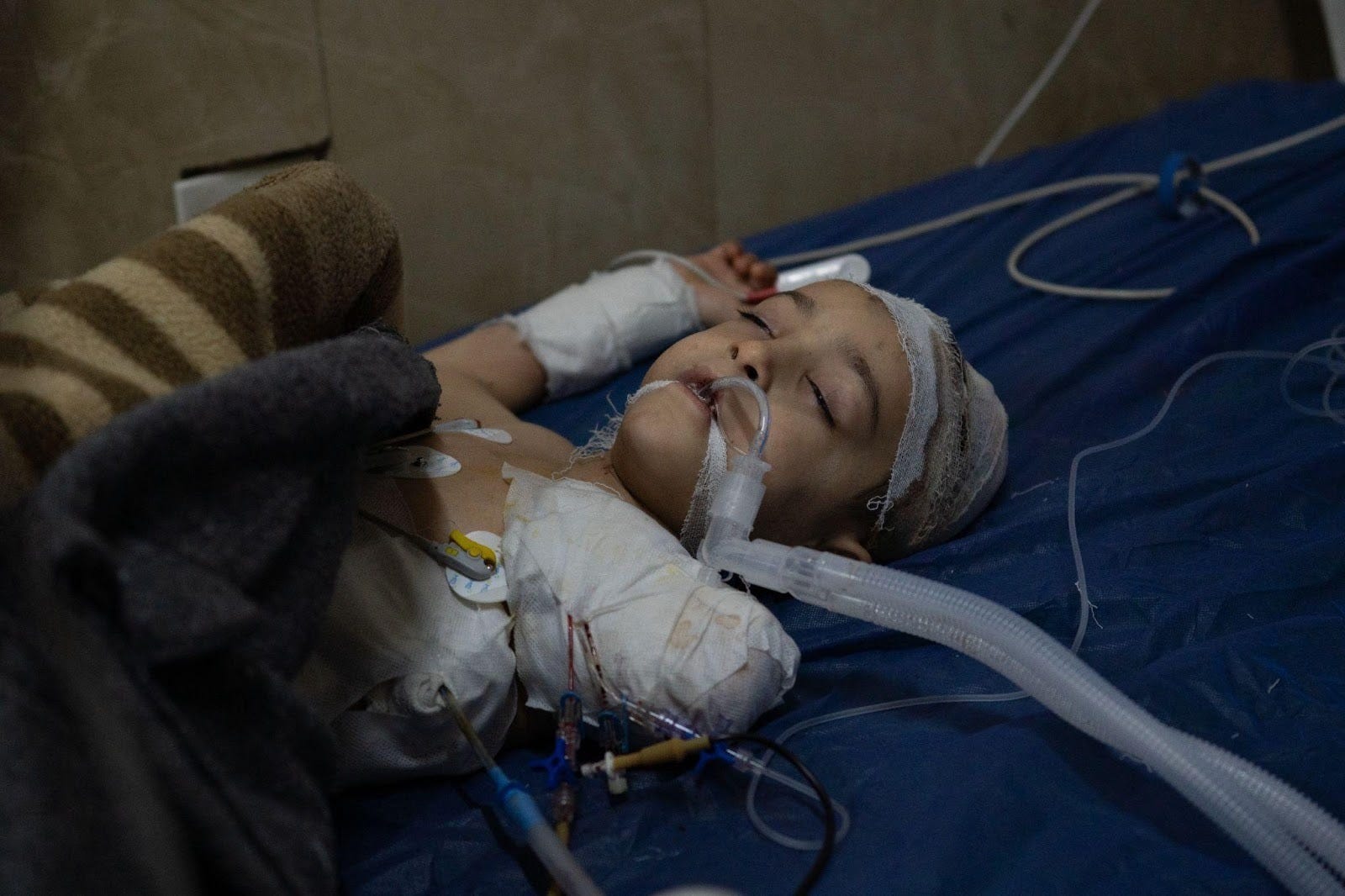
In a dimly lit room tucked away on the hospital’s ground floor, a six-year-old, Ibrahim, was laboring for breath. He was at home in the government controlled Al-Midan neighborhood when a shell hit his home. A large piece of shrapnel severed Ibrahim’s left arm and the shockwave damaged his ribcage. Ibrahim’s four-year-old brother, Ghaith, was killed instantly in the strike.
His father, Mustafa Hajem, was in shock and struggled to find the words to describe what happened to his children.
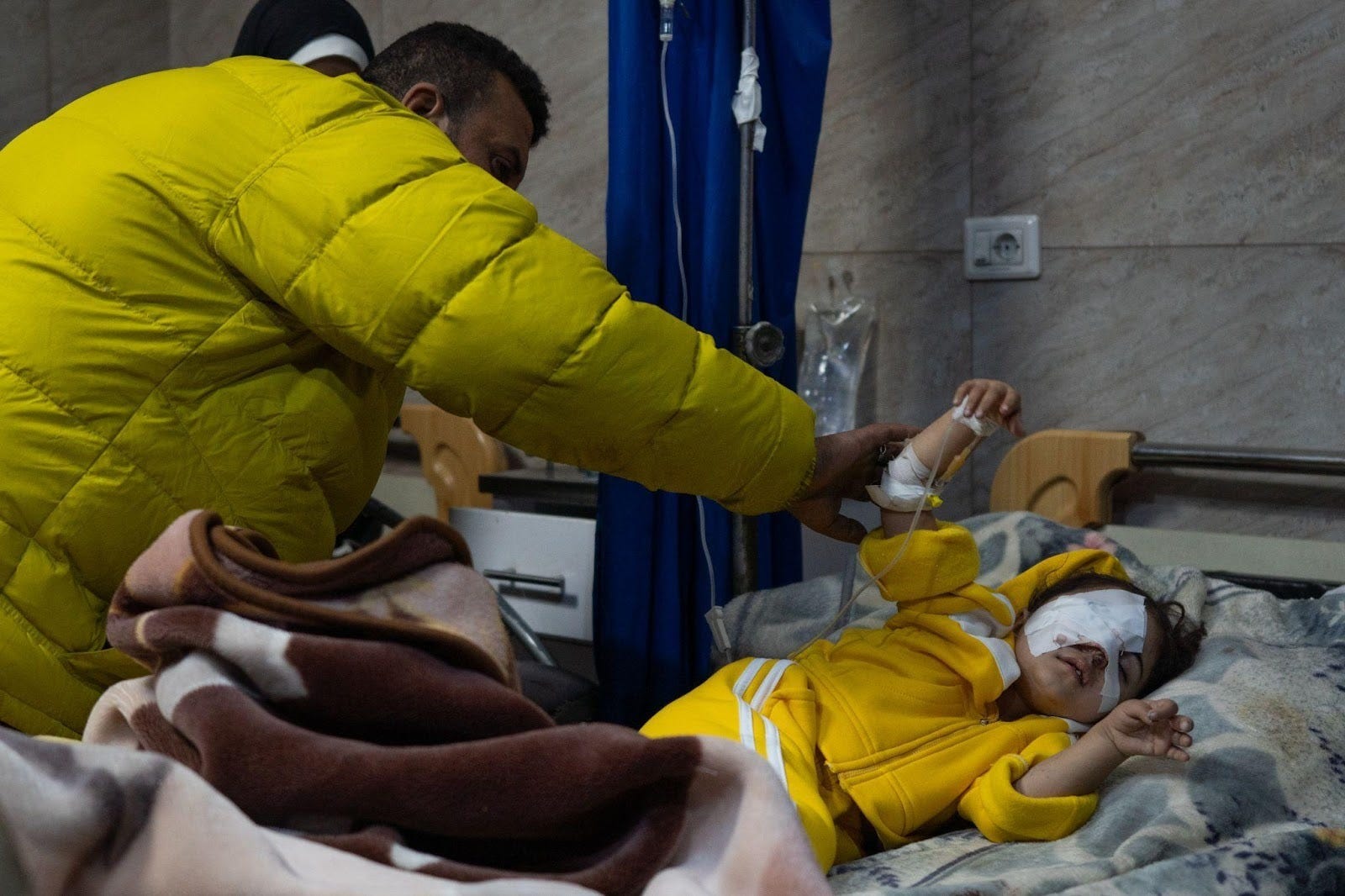
A floor above, four-year-old Fatima Al-Zahira moved restlessly in her bed, a large bandage covering one eye. She had been returning home from kindergarten when she was caught in a strike, which killed two bystanders. She was struck by an eight centimeter piece of metal, which has left her permanently blinded in one eye.
“The doctor told us she will be left with 40% vision,” explained her teary-eyed father, “she will have to have an artificial eye for the rest of her life.”
Dr. Abdelkader Farah had performed a complex four-hour surgery on Fatima to stabilize her condition. “She had major fractures in her facial bones that needed urgent surgery,” he explained. Dr. Abdelkader explained that the hospital has activated its crisis response, meaning the “full on-call staff is present, plus the ‘reserve’ staff who weren’t scheduled to be on duty.”
“The Ministry has circulated a backup plan—God forbid—if the capacity of Aleppo’s hospitals is exceeded, to move patients to the countryside.”
As he spoke, the sounds of artillery could be heard thundering in the background. Al-Razi Hospital is just two kilometers away from the frontline. “We have a basement where we could move our patients if the hospital is endangered,” he said. On Thursday evening, the hospital was reportedly struck, injuring one according to the Syrian state-news agency, SANA.
Khalid Al-Fajr Hospital in the SDF-controlled territory was also reportedly targeted during the bombardment—although Drop Site News hasn’t been able to independently confirm this.
These clashes now likely represent the most intense fighting that the war-ravaged country has witnessed in just over a year since Bashar Al-Assad’s regime fell in December 2024, and present a scale of conflict that Syria’s new government has not yet had to face.
Whilst the country has seen both the massacre of the minority Alawite community on the coast and violence against the Druze community in the southern province of Sweida by forces aligned with the new government, “the SDF is a much more formidable opponent than Syria’s other armed groups,” explained Alexander McKeever, an analyst on Syria and author of the newsletter, This Week in Northern Syria. “It is very well organized, disciplined and motivated - and much better armed.”
The SDF claims to have tens of thousands of fighters, many of whom are hardened veterans of the group’s long campaign against the so-called Islamic State in Syria’s eastern deserts.
“They have also dug an extensive network of tunnels and fortifications in Aleppo and the north-east that will definitely help them hold the territory,” he added.
The SDF warned on Wednesday that the government’s actions “will lead to serious repercussions that will not be limited to the city of Aleppo alone, but will risk plunging all of Syria back into an open battlefield.”
The most acute danger at this point is that fighting spreads beyond Aleppo to the stretch of the Euphrates river dividing government-controlled territory and the SDF’s domain in the north-east. “There is certainly a real chance that this could now break out into full-scale war,” McKeever said.
Reuters has reported that the U.S., which has forged a working relationship with Syria’s President Ahmed al-Sharaa, was leading the push for a ceasefire, amid negotiations for an SDF withdrawal. The U.S. special envoy for Syria, Tom Barrack, confirmed the deal in a post on X, stating the US “warmly welcomes the temporary ceasefire”, and thanking both sides for their “restraint and goodwill that made this vital pause possible”.
A full-scale war also risks pulling in external actors. Turkey—which considers the SDF an offshoot of the Kurdistan Workers’ Party (PKK), an armed group that has fought an insurgency against Ankara for decades—announced on Thursday that it was ready to “provide the necessary support” in any operation to capture Aleppo’s Kurdish neighborhoods.
In a statement on Thursday, Turkish Foreign Minister Hakan Fidan accused the SDF of serving as “a tool for Israel’s ‘divide and rule’ policy,” in the region through its insistence on maintaining autonomy within Syria, claiming that the group was acting in coordination with Israel. Israeli Foreign Minister Gideon Sa’ar decried the fighting in Aleppo, blaming the government for carrying out “systematic and murderous repression of Syria’s various minorities.”
On Friday morning, at the site through which the SDF had supposedly agreed to evacuate its forces, local security officials told Drop Site the deal had already fallen apart.
The Syrian military announced that a humanitarian corridor will remain open until 6:00 p.m. on Friday local time, urging residents to leave and calling on SDF fighters to lay down their weapons. After that it is likely that the bombardment will begin again and some reports of more fighting have already emerged.
 | A guest post by
|
Since Turkey has accused the SDF of being aligned with or a tool of Israel it would be helpful to try and describe what is known of any relationship between Israel and SDF. They seem unlikely partners. Also it's stated that talks to integrate SDF into the national army are stalled because SDF is afraid it will undermine an autonomous region for Kurds. But, even if that is the main reason no agreement has been reached, it doesn't explain why or how open warfare broke out. Which side has chosen to try to impose a solution by force at this point? And what external actors have encouraged that?
Thanks for the update. War up close raises our consciousness of the horror, and social media now distributes it more widely than ever before. Only soldiers knew about this and they did't talk about it because it made them so ugly.