

Illegal Siege, Brutal Abuse: Our Detention and Assault at the Hands of Israeli Prison Guards
In the extended version of their account, two Gaza flotilla members describe their abduction and abuse by Israel last fall.


Last week, a new flotilla set off for Gaza, once again attempting to break the Israeli siege. Late Thursday, Israeli forces intercepted 22 vessels of the Global Sumud Flotilla. More than 170 participants were detained before being taken to the Greek island of Crete. Two participants were taken to Israel for questioning.
Journalist Noa Avishag Schnall covered last year’s flotilla for Drop Site, before it was illegally boarded in international waters, all participants were abducted by Israeli forces, and Noa was abused in Israeli detention. On board the Conscience, she met German journalist Anna Liedtke. Liedtke, too, was abducted by Israeli forces and raped by female guards during her time in Israeli custody, abuse she first made public in December 2025 via the women’s organization ZORA.
The brutal treatment came despite—or, perhaps, because of—the fact that Liedtke is from Germany, a country unapologetically supportive of Israel no matter what it does to Palestinians or even to Germans, and Schnall is American and Jewish, a fluent Hebrew speaker of Yemeni descent who had renounced her Israeli citizenship. The detention of those aboard the Conscience straddled negotiations over the so-called ceasefire, likely also contributing to the increasingly violent mood of the Israeli guards.
As another flotilla embarks, we asked Noa and Anna for a first-person reported account of their time on the water and in detention. They both wanted to be clear that the abuse they endured pales in comparison to that meted out on a daily basis to the some 10,000 Palestinians in custody, many of them held indefinitely without charge. Thirty-two Palestinian prisoners died in detention in 2025, and at least one has already died this year.
A first-person account with two authors creates unusual narrative challenges, but we wanted to explore the format, and Noa and Anna agreed to collaborate on the piece you’re reading below. The article is based on their observations as well as their additional reporting based on documents linked to their detention. When they were separated, the piece makes clear whose perspective is being shared.
What follows is the story of how the Israeli government treated two journalists from the two nations most supportive of its genocide. The Israeli government did not respond to a request for comment.
Noa, meanwhile, is covering this year’s flotilla for Drop Site News. Follow her updates on Instagram or our Drop Site social channels.
—Ryan Grim
We are publishing two versions of this story. You can read the shorter version here.
Remembering the Dead
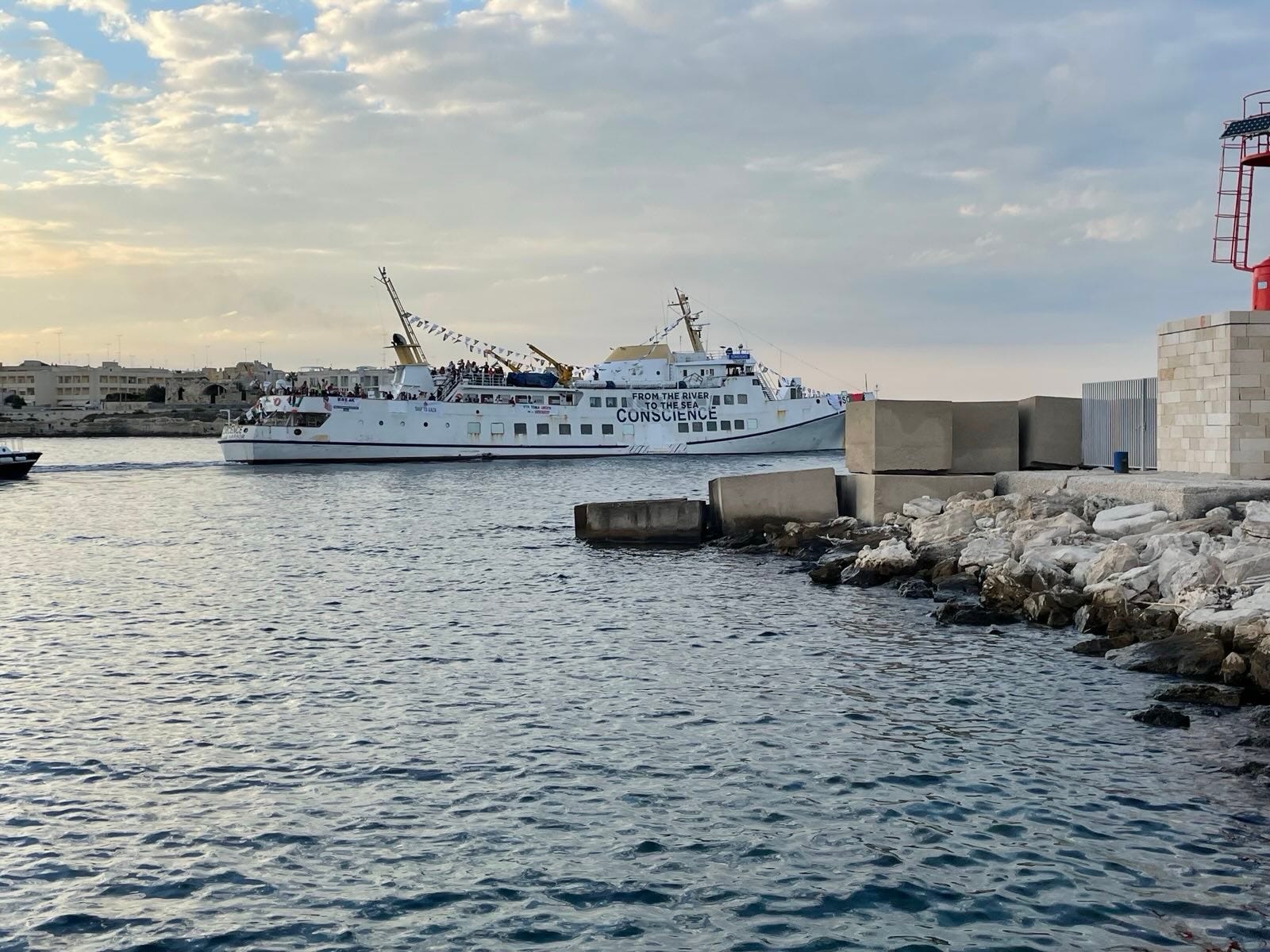
It took us nearly half an hour to read all the names on the branches of the large tree we had all drawn on the ship’s masthead. There were 92 of us aboard the Conscience, headed for Gaza to support medical workers and journalists under fire there. On the tree’s branches, we had memorialized the names of those who had been killed by Israel since October 7, 2023. As we floated on the Mediterranean with our engines cut, Mutaz Jadaan and Dhia Daoud, both Palestinian doctors who had worked in Gaza since October 2023, took turns reading names into the warm evening wind.
Sofia Willer, a young German journalist, had begun the commemoration paraphrasing the last will of journalist Anas Al-Sharif, killed along with four Al Jazeera colleagues in August 2025: “We are the free people of the world…and we are sailing towards our heartbeat.” In her own words she added, “we will not be deterred, we will not be intimidated, and if it’s not our ships, it will be the next.”
Mutaz began his own commemoration with a call and response: “they tried to bury us, but they did not know that we were seeds.” The evening ended with stories from those who knew the slain workers personally.
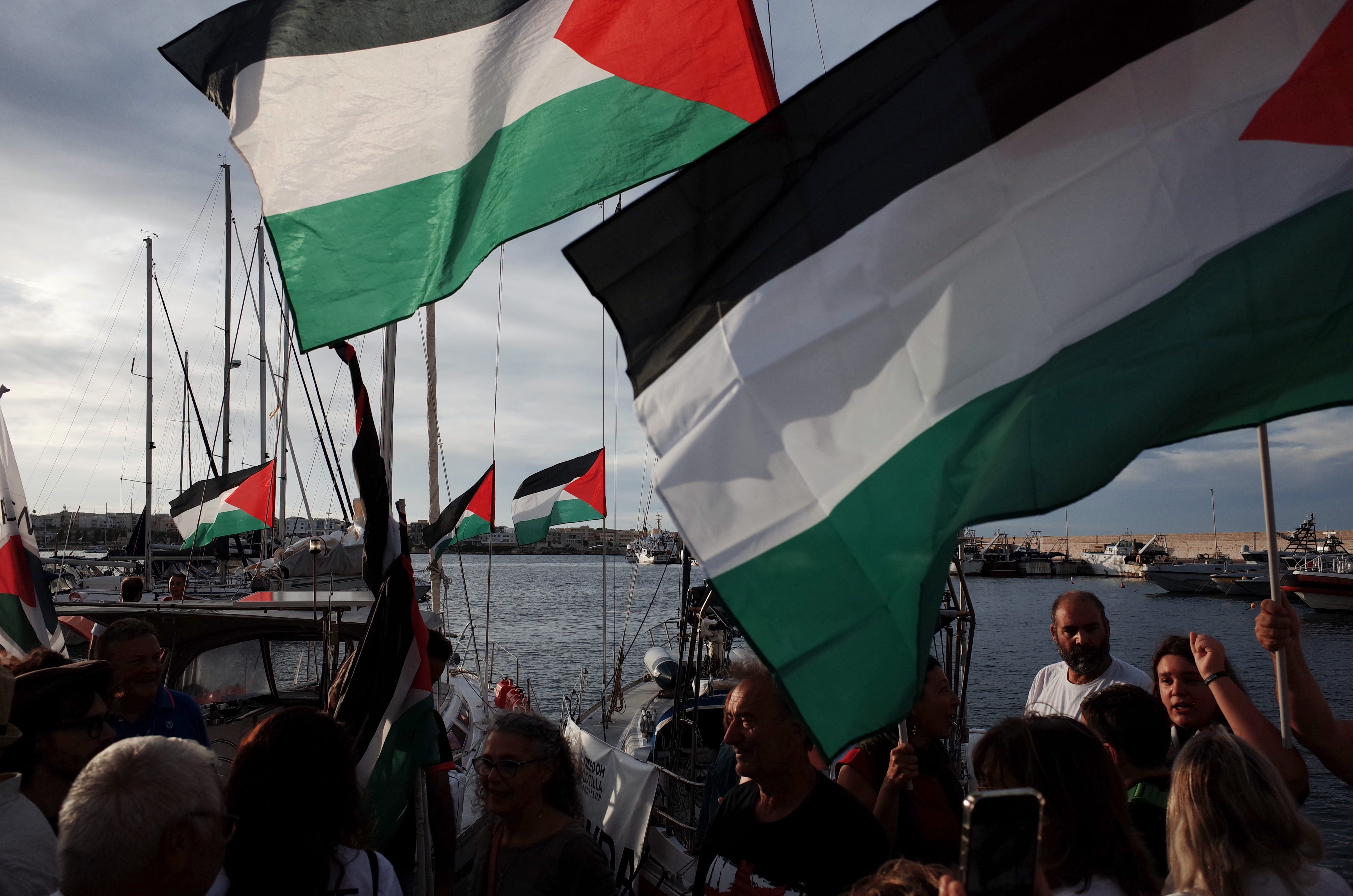
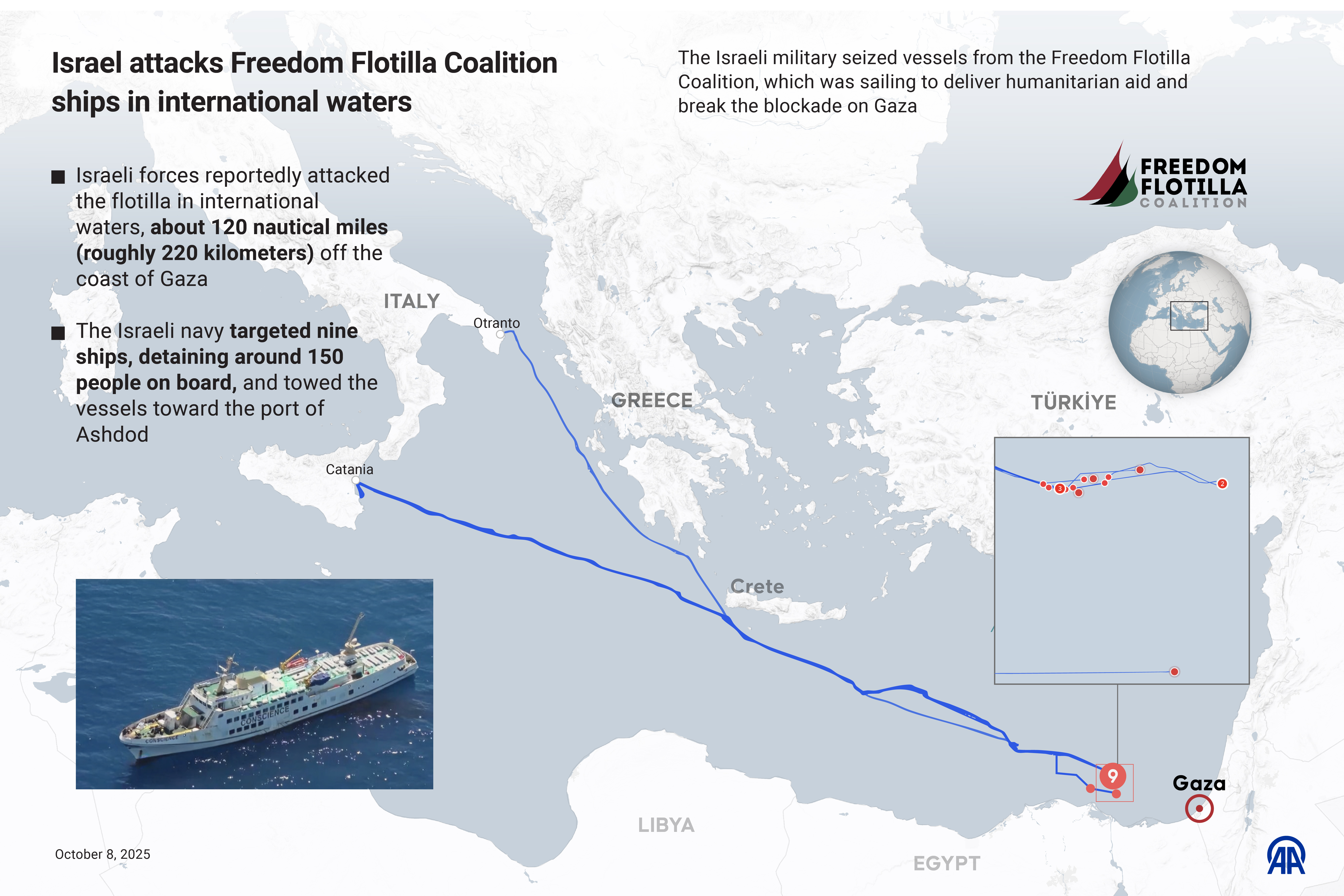
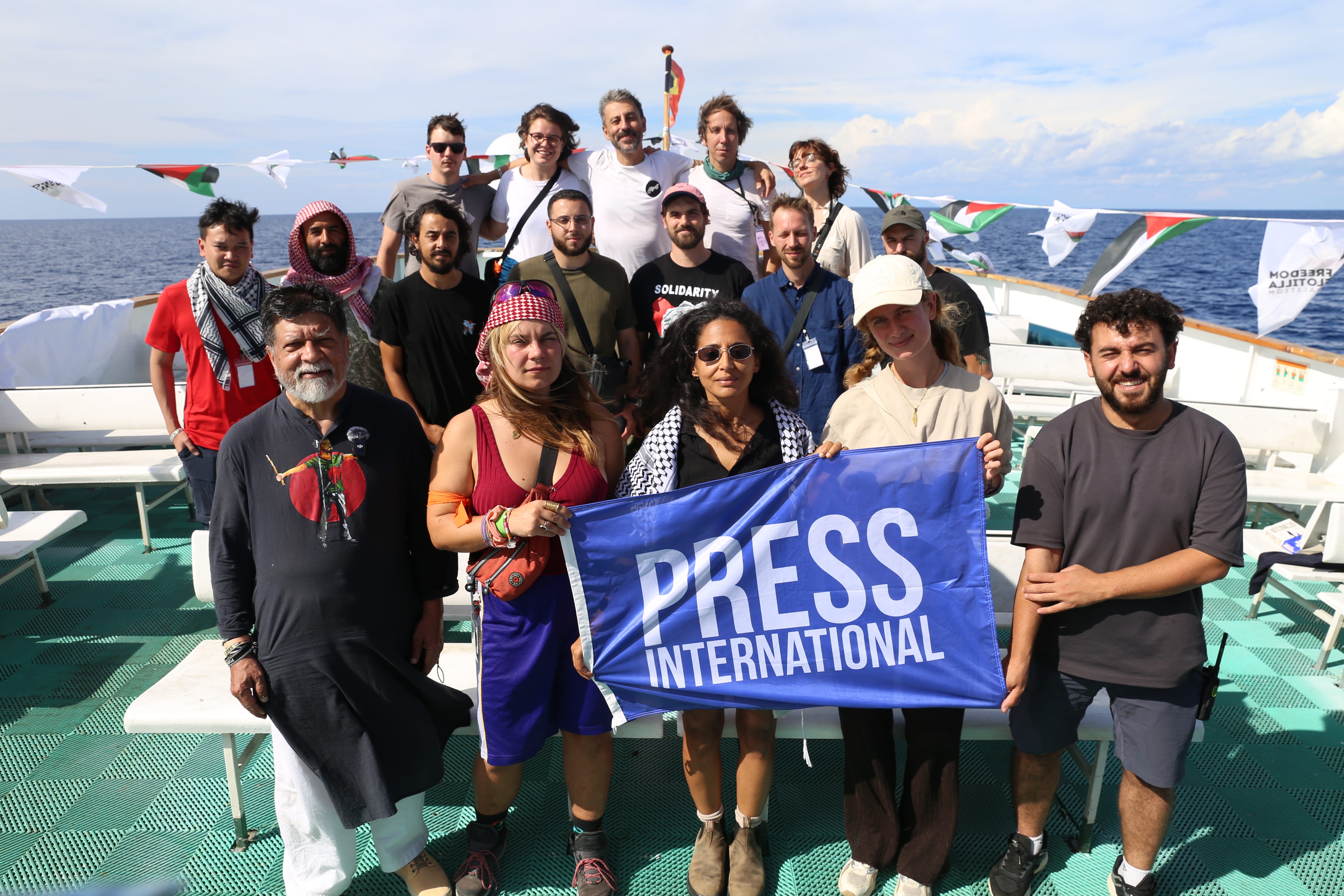
We had boarded the Conscience, an old passenger ferry and a member of the Freedom Flotilla Coalition (FFC), in Otranto, in southern Italy, on September 30 and set sail for Gaza that evening. We were all civilians, from 22 different countries—doctors, nurses, journalists, conflict zone medical specialists, a fireman, search and rescue professionals, social workers, ship crew, lawmakers, and more. The day before, President Donald Trump, with Israeli Prime Minister Benjamin Netanyahu at his side in the Oval Office, announced what he said was a 20-point ceasefire proposal that would end the fighting in Gaza.
Our comrades from the Global Sumud Flotilla, which carried more than 450 people from at least 44 countries, had come with more than 40 boats. They set sail from Barcelona on August 31. In total there were about 600 people from different countries on a human rights mission to Gaza—including some 100 journalists and medical workers on board the Conscience and about 50 people on the eight sailing boats of Thousand Madleens to Gaza. Along the way, one of the Sumud boats was bombed twice by a drone while docked in Tunisia. They were seized in international waters—a blatant violation of law—on October 1, meaning we overlapped with them in the water for two days.
On October 3, Hamas delivered its response to Trump, accepting some terms and pushing others for later negotiations. Trump accepted the proposal and began to pressure Israel to agree. The agreement was officially announced on October 8. We had been abducted that morning.
The fact that we spent five days in illegal Israeli detention isn’t meant to be impressive. It’s meant to be a simple reflection of the brutality of a system that is built to break down and humiliate, so that all things human are torn away.
“Prepare Yourselves”
Before going to bed around midnight on October 7, something felt off. We assumed the lights we saw on the horizon were part of an oil station. We later realized that Israeli war ships and zodiacs were hiding behind it, waiting for us.
It was roughly 5 a.m. on October 8 when the Israeli forces radioed their intent to board and seize our ship and its passengers. The Conscience was 19 nautical miles from Egypt, not far from the Suez Canal and 120 nautical miles from Gaza—nowhere near Israeli jurisdiction. We subsequently received a radio call from the Israeli military ordering us to offload our medicine in the Israeli port of Ashdod, and turn back.
Of course, if we had any faith that the Israelis would distribute the medicine from there to Gaza, the trip would never have been organized in the first place. The problem was not a lack of food or medicine. Hundreds of trucks filled with life essentials sat outside the Gaza fence at any moment. The problem was getting through the blockade. Huwaida Arraf, one of the founders of the flotilla movement who had previously sailed to Gaza and succeeded in early attempts, responded via radio:
“Israeli navy, your blockade is unlawful. You have been deliberately starving the people of Gaza before the eyes of the world. Claiming that you will deliver humanitarian aid for Gaza is a propaganda ploy and we reject it…This is not just about delivering aid. You have no legal authority to control Gaza, and therefore anything going in and out of Gaza is not up to you, it is up to the people of Gaza.”
She reasserted our basic rights to safe passage and laid out the legal rationale of our mission.
“Prepare yourselves,” they responded. “Tell everyone to come on deck. We are coming.”
Soon our boat was boarded and seized in international waters. The eight Thousand Madleens to Gaza boats were taken at about the same time.
We were woken by an alarm. “This is not a drill,” we heard in the captain’s calm voice. “They’re coming.”
We filmed the scene, but because the internet communications were soon jammed we couldn’t transmit everything. Over marine radio, Captain Madeleine Habib told the Israeli forces that we were changing our destination to nearby Port Said in Egypt. Shifting our destination stripped the Israelis of whatever thin rationale they had to board our ship. It didn’t matter, they came anyway.
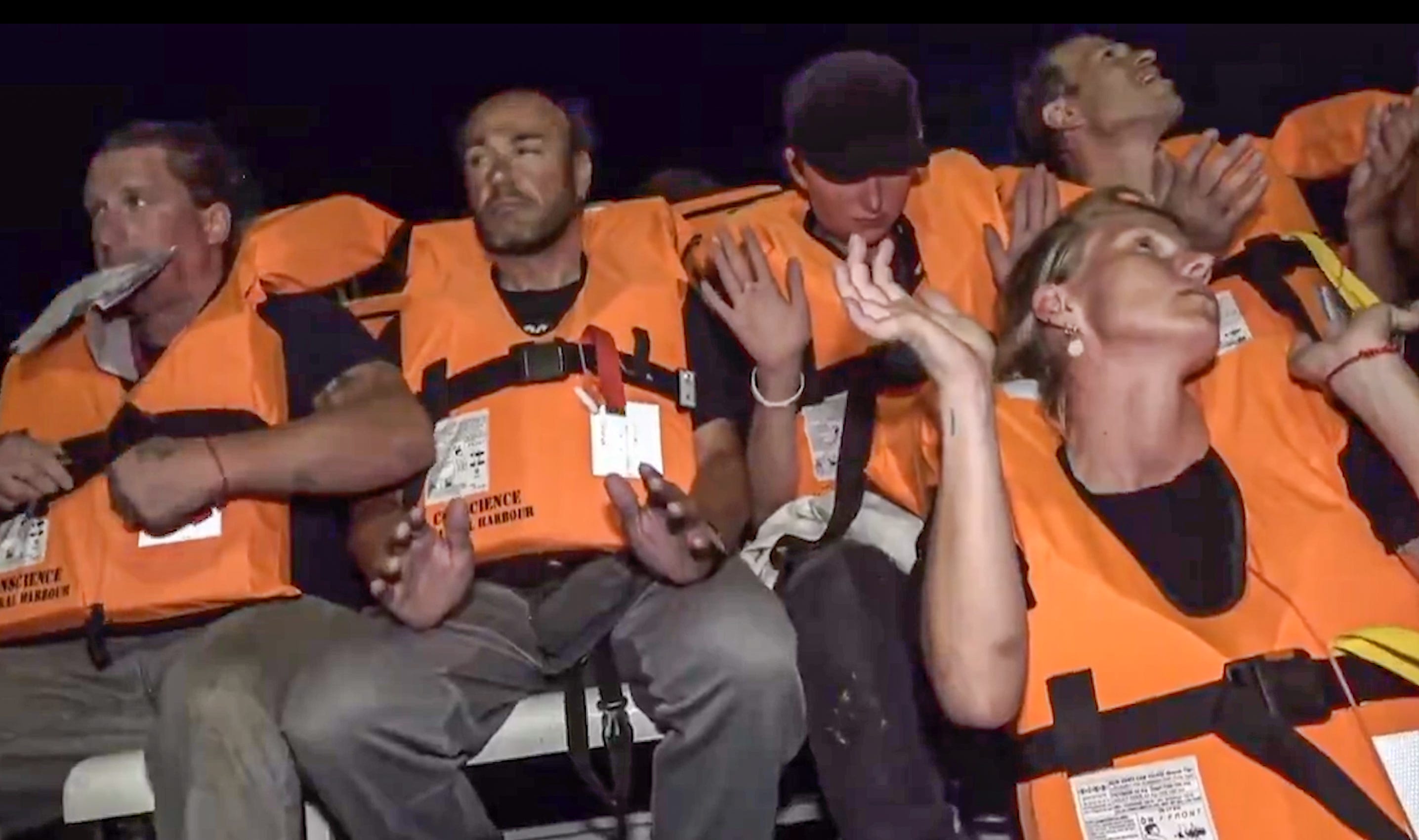
Everyone on board congregated at the muster station, where we had trained for this contingency many times. Gathered in our preassigned affinity groups, we put on our life jackets while trying to limit the chaos. Some journalists were still filming; others focused on breathing calmly as the helicopters approached. Two helicopters, two naval ships, and many zodiacs quickly surrounded us. The zodiacs emerged from the dark with their lights off.
Israeli soldiers rappelled from helicopters as we repeatedly chanted, “We are journalists! We are medics! We are journalists! We are medics!” It was difficult to be heard through the din, but we continued.
Moments before, as we had all agreed in advance, we threw our devices (except cameras) and any items that could be interpreted as weapons into the sea. We possessed no weapons and posed no threat. As we sat in bright orange life vests, hands out in front of us, the air displacement from chopper blades nearly lifting us from our seats, we could see green laser target marks jump rapidly from our comrades’ bodies to spots on the ship. When the soldiers came closer we could see the lasers’ source, their assault rifles. Faster than we could count them, soldiers streamed on to the boat.
They took control of the ship and brought the captain to the muster station. Simultaneously, some soldiers went down below to secure the rest of the ship while others broke down our surveillance system.
Then they moved us individually. Some were separated right from the start and marked as “troublemakers” with purple bands on their wrists and ziptied. Others remained on the deck, waiting to be searched by the soldiers. They took away some of our belongings: lighters, phones, notebooks, and other personal objects.
Then they locked us in the dining area of the boat, where we would sit until we reached the Israeli port city of Ashdod. We sat in the cramped space for many hours. The Israelis had brought photographers with them, clearly aimed at snatching images to be used as propaganda—as when they photographed Greta Thunberg being offered a sandwich, never mind that she refused it.
One photographer wore a press vest and a small scarf to cover his chin and mouth—a stark contrast from the special forces operators kitted out in masks and commando gear. While most of them were men, there was one woman wearing jeans and a white t-shirt with a very big gun slung across her shoulder.
It got warm very quickly. In Otranto, we had practiced non-violent responses to expected Israeli military brutality and received training on how to protect our vital organs during a beating.
The other eight boats in our flotilla were also boarded; our comrades said they were all taken from their sailboats onto a single Israeli vessel and kept in caged compartments in the ship’s hold.
During the day-long sail under Israeli control, several of us were separated from the rest of the group that was being held in the cafeteria. The cafeteria was filled with roughly 80 people; they closed the doors to isolate us from the “troublemakers.”
Noa, meanwhile, was selected for separation, lumped in with fewer than ten people deemed problematic. She disregarded the taunting of the soldiers, who repeatedly asked questions and threatened to destroy her family’s home in occupied Palestine—which seemed counterintuitive considering her family there is made up of committed Zionists.
Identifying the Troublemakers: Noa
The soldiers engaged in several rounds of the good cop/bad cop routine, and removed my zip ties only to put them back on five or six times. Twice, I managed to slip them off myself, which marked me as a troublemaker. My tiny wrists allowed for such maneuvering, but flaunting the advantage only made for tighter ties the next go-around. During one brief interval when my hands were free, I checked the zippered pocket of my jacket to make sure the nose ring I had removed in advance hadn’t fallen out in the jostling.
Tan Safi, who sailed in July 2025 on the Handala, an FFC vessel, recounted that soldiers attempted to remove their septum ring with two types of bolt cutters. When Tan told the soldiers that the jewelry had to be professionally removed, they continued in their unsuccessful attempts, causing the comrade immense pain. Tan still bears the same heavily scuffed ring.
When the soldiers saw me searching for my nose ring they turned my jacket inside out. I never saw my nose ring, or the tiny hoop earrings also in the pocket, again.
Later in the day, a soldier asked me in Hebrew, “Do you know what they’d do to you in Gaza?”
“Probably welcome me,” I responded. My goal in joining this boat was to answer the call of my colleagues abandoned by the international journalism community. I added that there would be a higher likelihood that I’d get bombed by Israel and die than meet some imaginary fate the soldier was projecting.
The three or four soldiers designated to guard those deemed unruly talked about finding me on Tinder. Without more than alliteration for creativity, they nicknamed me Nasrallah after the late Hezbollah leader who was assassinated by Israel. They decided I should be further separated from the group, and put me on the other side of the room, moving my zip ties from in front to behind my back. I found a sleeping mat and made myself as comfortable as possible.
The Israeli soldiers spent part of the day spray painting yellow over much of our boat art. The smell of their paint was pungent, more so because of the association. Eventually, an Israeli flag was hoisted atop the ship.
Huwaida, having been through this process many times before, handled it best. She put her head on her knees and tried to get as much rest as she could, preserving her strength.
We were unable to see the others being held in the dining area, though we later heard reports of the stifling heat. Hours in, we were drinking from water bottles we had strategically placed around the boat in advance. I did my best to turn away from the soldiers while drinking, as we wanted to avoid being filmed consuming anything that could later be used for Israeli propaganda. One of the guards even pointed out, “Look! She’s turning away from us so we won’t see her.”
The soldiers attempted to count the larger group in order to report the number of detainees being brought to port. The initial attempt involved telling us to sit down and then stand when counted. When that proved unsuccessful they reversed their system, but were again unable to complete an accurate count. A third attempt involved instructing us to raise our hands up and then lower them after being counted. With each failed attempt their stress levels rose, egged on by our snickering. The young soldiers’ attempts to look dangerous and professional collapsed on their inability to count to around 90.
By evening, we caught our first sight of the coast. We braced for what felt like the Israeli line of scrimmage, knowing only the outlines of what was in store for us. Our colleagues on the Global Sumud Flotilla had yet to be released and all we had seen were viral images of them being forced to kneel for hours on asphalt at the port. We could already feel it in our knees.
The Palestine Hook
Arriving at the port of Ashdod at 7:45 p.m on October 8, we were pushed off the gangway and swarmed. They ripped our keffiyehs off our bodies, pulled our hair, and threw many of us onto the ground. Noa was among the first to disembark, Anna among the last. Masked soldiers with Israeli flags on their jackets waited on both sides of the plank holding IDF flags, with one yelling “passport!”
Those deemed most difficult were processed first, a designation that continued to include Noa. The rest were forced to kneel for hours on the concrete, prohibited from adjusting their positions and lessening the pain. The ground smelled like urine, and we guessed that it had been “prepared” in advance.
The guards had more interest in inflicting pain than documenting our arrival. As we were shoved toward Ashdod’s interior and through their administrative processing, all of us had our heads violently pushed toward the ground and our arms pulled behind us—many in zip ties—sometimes lifted up to maximize the discomfort of the stress position. Those still managing to wear items with Palestinian allegiance were punished with heightened brutality, their tight plastic handcuffs twisted to inflict more pain.
Noa was targeted for abuse from the start, as were several others including our Tunisian comrade, Ali Kniss, and Adnan Alisan, who is a German citizen of Turkish ancestry. The most obvious motivations for Noa’s abuse: brown skin, Yemeni Arab ancestry, and language abilities to decode Hebrew comments, which immediately set the Israelis on edge. We had been informed by Sumud’s media reps that Jewish comrades were also being singled out for harsher treatment.
Lower-ranking officers were baffled by Noa’s ability to speak their language, regularly repeating to each other that she had an American passport and no Israeli citizenship visible in their system. She offered no further information that was not already available in her American passport, as the participants were trained to do, though it seemed that the higher-ranking officers had been informed of her renunciation.
This action of restraining detainees’ hands behind their back, either with zip ties or handcuffs, and then lifting them up so that both their wrists and shoulders are in severe pain has a name. Adnan described this move to a Turkish officer at the Istanbul airport responsible for taking down the account of his treatment in Israeli custody. The officer, familiar with Palestinians who had left or been deported from the territory, responded, “Oh yeah, the Palestine hook.” Adnan recounted this encounter to both me and a Palestinian journalist from Haifa. She confirmed the usage and commented, “They should call it the Israel hook.”
Two soldiers escorted Anna to her place on the asphalt, where she was bent forward, arms twisted and held tightly behind her back. They pulled her hair and pushed her head down. She was put through a strip search, the first of many.
Contrary to the purported image of Israel as a safe haven for the queer community, trans and gender-nonconforming participants were singled out for humiliation by Israeli guards.
Ruin, a trans woman who sailed with the Thousand Madleens, wrote the following: “I experienced humiliation and verbal harassment during the strip search. I don’t have super sharp memories of the specifics. I was really just trying to keep it together. I remember one of the guards doing the searches, calling me a man and announcing something to the other guards outside. And I remember being laughed and yelled at by guards outside the little building, who were shining flashlights at my crotch. I was really scared they were going to separate me from everyone else, but some of the other Madleens stood up for me and made sure I stayed with the rest of the women.”
Nominally, the strip searches were a security measure, but they were clearly meant to degrade and subordinate us from the very start. We were shoved against walls, pushed and pulled. We were made to get completely naked, with multiple women watching each of us. Three women conducted Noa’s strip search. We were then instructed to put our clothes back on.
Many flotilla members reported seeing their valuables being looted by guards during Ashdod bag searches. Noa’s bag was scanned and then searched by hand. All hygiene products were systematically disposed of, as were any clothing items showing allegiance to Palestine. A comrade from a previous flotilla said that all their underwear was seized. All cameras and remaining electronics were stolen rather than thrown away.
We were constantly photographed in addition to the overhead surveillance, the official mugshot, and other administrative documentation. This included photographs and videos taken by guards on their phones.
At one of the administrative stations, we were seated in front of a man we were told was an administrative immigration judge. Some of us were lucky enough to meet with a lawyer for maybe three minutes. Legal representatives from Adalah, a human rights organization primarily focused on defending the rights of Palestinians, were trying to represent us. Noa whispered to her lawyer, Muhammed, in Hebrew. All of us were presented with three documents. We had been shown samples of these documents during FFC legal training on the Conscience and during similar trainings in Otranto.
Adalah, in response to a request for any information they had regarding that intake, provided the following comment: “Muhammed gave you the consultation at the port and these are the notes we have in our form: ‘She is constantly being told off and subjected to abusive remarks’.”
Noa had indeed given a summary of the abuse thus far to Muhammed, who conveyed it to the judge. She refused to sign the deportation order.
“Israel’s Finest Prison”: Anna
They lined us up after what might have been two hours. I noticed a Turkish crewman was standing next to me. I knew that he didn’t speak any English and I hadn’t seen him a lot on the boat, but I could tell he was in a bad way, seeming to shrink both spiritually and physically. He could barely stand up. So that the soldiers wouldn’t see the effect they were having on us, I started talking to him in Turkish: “We will go home. Everything will pass.” He smiled, but as soon as we started speaking, the soldiers, perhaps thinking we were speaking in Arabic, shouted at us to stop. “Most importantly: Palestine will be free,” I said in Turkish. “The Palestinian people will win.” He smiled again. The soldiers grabbed my arm very harshly and pulled me inside a room.
They took off my backpack and pulled me into another corner. We passed a scanner where they were amusing themselves by humiliating our friend Zohar about her artificial leg. I was told to strip down, and the soldier who had been with me the whole time started a little speech. He was very young and clearly inexperienced. His attempt to earn some respect went something like, “Listen, young lady. You did not listen to the things I told you to do and not to do. Usually I would have to treat you the same as the others, but you are German and that means that your government supports what we do here and is very kind to us. That is why I will also be nice to you,” he said. He made this speech while I was in the process of putting my clothes back on. The strip search had been conducted by the female guards—they hadn’t touched me this time—but the male soldier had been watching the whole time. Adnan recounted that men with dogs hovered during his strip search.
I was brought back into the big hall and to a table where my stuff was. After identifying my bag, they took out my keffiyeh and spit on it before throwing it away, along with my Palestine shirt. Then they took me to the next station, where I was told to “smile pretty” after they welcomed me to Israel. “Smile pretty for the camera, young lady,” said another. “You’ve had lots of time to practice to look pretty on camera on the boat,” observed another.
At the next station there was a man with a big beard. I was made to sit in front of the table as he started singing a Nazi song that I didn’t know before but whose melody I recall. He was singing it in accent-free German and then smiled at me, winked and said, “Verstehst du, oder?” (You understand, right?). And then he called me “Nazi-Schlampe”—a Nazi slut.
A handful of defense lawyers were roving around. “What’s your name? Do you need a lawyer?” asked one.
“Yes!” I said.
“No one needs a lawyer here!” shouted a soldier.
I was again brought to another station with a woman behind it who asked me if I was Spanish. The last man had spoken fluent German to me, but the bureaucracy was deeply confused. I soon realized, as their agitation grew, that they were looking for the Spanish member of parliament who had been on one of the boats. Some seemed convinced I was her, others weren’t sure, as they frantically rushed about the room. I did nothing to help them, but I later got a look at the MP: The woman in the passport photo had no glasses, blond hair, and generally looked nothing at all like me. Two minutes ago, they had been calling me a Nazi slut, now they were worried I was a Spanish lawmaker.
I later learned that the Turkish MPs on the flotilla were spared prison.
The Israelis wanted us to sign papers but I refused. Another lawyer approached me and asked, “What’s your name? Do you need a lawyer?”
I replied “Yes!” while the soldiers next to me aggressively screamed. After arguing with them, they finally let me confer with the lawyer. I told the lawyer everything that I had seen and experienced, and said that I did not want to sign the early deportation paper or anything else. The people working there asked me about my name, the information on my passport, and why I was there.
I was brought into a small corridor with a few more stations and saw Noa sitting on one of the chairs, fully shackled. We exchanged a few words as they yelled at us to be quiet. Down the corridor were more prisoners in handcuffs, shackles, and blindfolds. The blindfolds were jarring, because they appeared to be cut from the kind of pajamas infamously associated with Nazi concentration camps. They smelled stale and musty.
I told the intake officer that I was illegally kidnapped and that I did not wish to be here. “Have a pleasant stay in Israel’s finest prison,” he said.
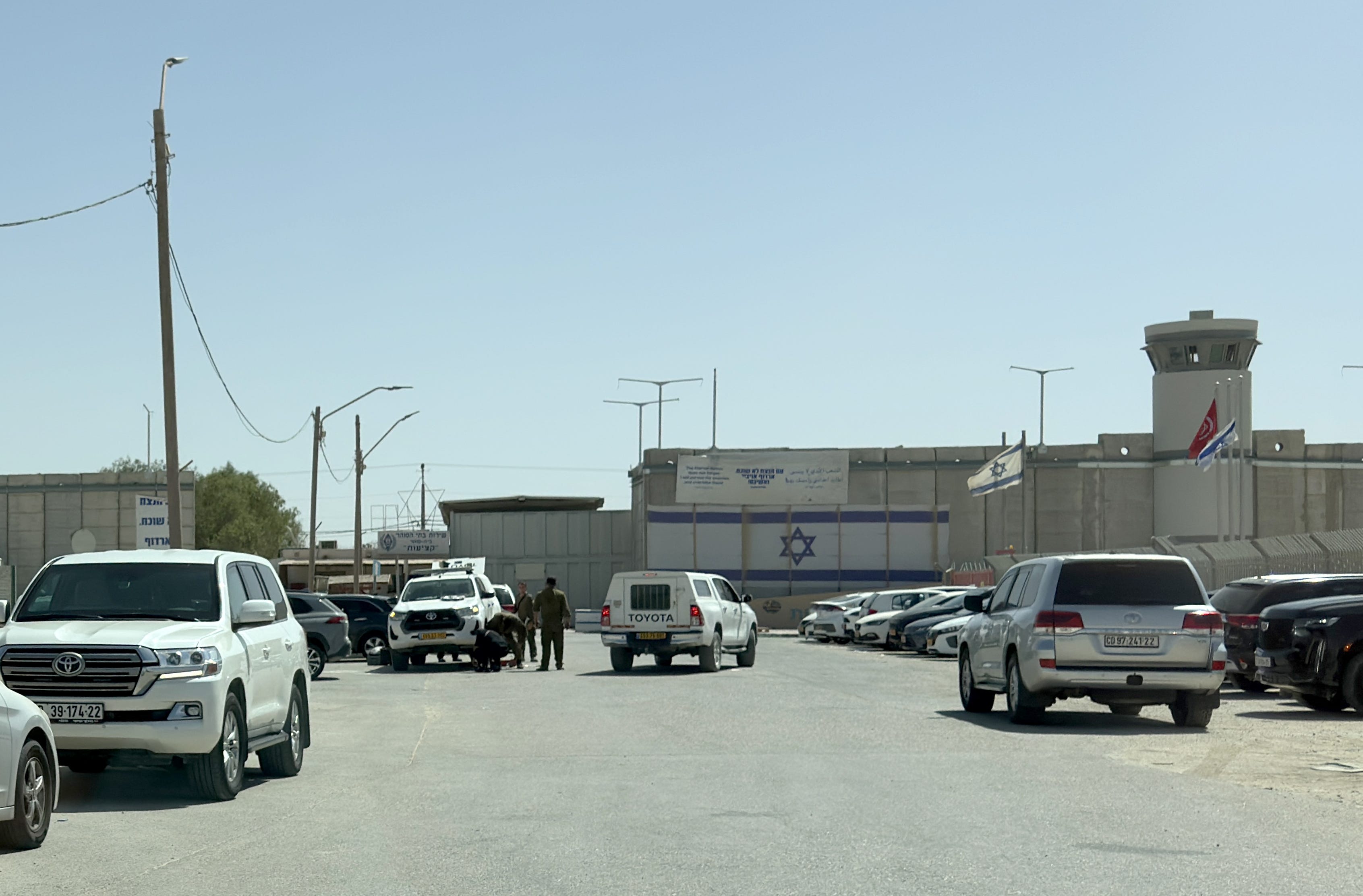
Ketziot Prison
October 8: We were separated into groups of men and women, then blindfolded and put on buses, which we assumed were taking us to Ketziot Prison, where the Sumud flotilla had been taken days before, and where Palestinians accused of terrorism are sent. Prior to boarding the bus transporting us from Ashdod to prison, those wearing shoes with laces had the front of their shoes cut through as well as any clothes with drawstrings. On the bus, we adjusted each others’ blindfolds to see. We could hear another woman from our flotilla screaming that she had no menstrual products and was bleeding all over herself.
The bus was frigid, divided into cages. Being unsure of our destination was deeply unsettling. Worse still were the zip ties that one guard had been progressively tightening behind Noa’s back as we passed through the Ashdod stations. The guard showed a visceral disdain for her and by the time we reached the bus the zip ties had finally managed to cut off the circulation to Noa’s hands. The early stages of shock set in. She mumbled to her bus cellmates that she was feeling sick and about to faint. And for the only time in captivity she began to cry, then screamed in pain so loudly that the other bus cells could hear. The rest of the bus began screaming along with her, and the attention demanded saved her from devolving into the next stages of shock. When guards finally came, they realized that the zip ties had been over-tightened to such an extreme degree that they couldn’t be removed with scissors; there was no space between the plastic and skin. A blade had to be found and deployed. A new pair of zip ties was put on, but in front of her this time, and not as tight.
Ketziot Prison is in the Naqab region, close to the Sinai border. A special section was cleared for the flotilla participants. We arrived sometime between 2 a.m. and 3 a.m. Men with dogs and guns roved the site.
Upon arrival, we were processed once again—brought out one by one for what was called a “medical check” but amounted to more nudity where we were made to get on a scale and our weight was noted down by a nurse. This was when we were given our prison clothes: plastic sandals that had the image of a cow head and the words “high and mighty”—a caricature beyond parody—as well as a white t-shirt, gray sweat pants and a gray sweatshirt. These are the same four items that can be found in news photos worn by Palestinian prisoners. The Muslim women who had their hair coverings confiscated, in denial of their religious beliefs, wrapped the white t-shirts around their heads as makeshift replacements. That left them with only sweatpants and a sweatshirt.
We were marched to another section within the massive Ketziot complex. Some of the flotilla members immediately began a hunger strike, and from that group, some decided to forego water. We were now about 20 hours into our own hunger strike.
In the cell we found filthy brown blankets and thin mattresses of matching color on a floor painted gray. There were bunk beds made of rusted, crumbling metal, but no one in our cells made use of them. There was a toilet in a small room within the narrow rectangle of the cell. Inside the room was a roll of toilet paper and a sink that spit out dirty water. The rusted metal door to the bathroom swung open and would not close. Chunks of sharp metal fell off in bits with each swing. The once-white walls were covered in Arabic, Hebrew, and English writing, mostly in pencil.
We identified Hebrew and English words side-by-side, or other combinations of the three with equivalent meanings on either side, some misspelled—signs of prisoners teaching one another. There was one window next to the door facing the courtyard, and a tiny window at the back of the cell. All were barred, of course.
If we slept that first night it was out of pure exhaustion. Our male comrades reported being tormented by men with guns and attack dogs during the night. We could hear the dogs, but also blaring music in Hebrew, screaming from other detainees, the sound of boots on the high walk, laughter from the prison guards, and shouts of “Free Palestine.”
“The New Gaza”
On the morning of October 9, we were brought outside at intervals. In the yard, beneath the large Israeli flag, hung a banner depicting a landscape of rubble. Across it in Arabic was printed “Gaza al-jadeeda” or “the new Gaza.” In that same open-air yard, Israeli footage of October 7 played on a loop on two large screens. The guards tried to force us to watch it, but they hadn’t thought through their presentation: the screens were positioned so that the glare of the sun made them difficult to see even if we had wanted to watch.
We were then brought to a man we were told was a judge. The Germans—Anna, Sofia and another woman—were the first to see him, and he asked them a rather absurd question: Do you want to go home? The women told him that they were victims of a forced kidnapping in international waters. They both asked for an attorney and were told their lawyers hadn’t shown up.
The day was marked by administrative chaos, supposedly organized by nationality. Some were allowed to see their consular representatives, some representatives didn’t show up. Noa and the other two American women, Mara Morgan and Eogan Moore, were eventually summoned to appear before a judge. They were asked to accept voluntary deportation in exchange for acknowledging “illegal entry into Israeli territory,” a claim they had no interest in confirming, since the statement was factually inaccurate. Noa translated the exchanges between the guards and the judge from Hebrew into English for her fellow Americans, and was expelled for doing so.
Anna and the other Germans, meanwhile, got a brief meeting with two employees from their embassy in Israel, who offered them Dubai chocolate. They all turned it down, citing the hunger strike.
They told Anna that her family, along with many members of the public, had contacted the Ministry of Foreign Affairs, asking if the embassy could intervene on her behalf to expedite her release. Both Anna and Noa recounted instances of abuse to their consular officials but later learned that those officials had told their emergency contacts that they were fine.
The U.S. finally sent three embassy staffers to the prison. It was the last country to do so. They made clear they were doing the bare minimum required. The Americans were presented with documents authorizing consular officials permission to speak to designated individuals about our condition. Only the American flotilla members were presented with this document and it was the first time any flotilla participants were asked to sign it. There was barely enough space to describe the ongoing abuse, which was evident in the bruises on Noa’s wrists. She asked for a second sheet of paper to provide more detail, trying to record everything she could remember so that it might later be used in a court case, this article, or by other inmates who might need it. “We don’t have all day,” said one consulate employee, annoyed at the delay.
Noa asked for the employees’ surnames. They asked why. She explained that she was a journalist and wanted to make sure the document got back to her and stressed that she had a right to a copy. They were hesitant to identify themselves. Two of them ended up agreeing and gave their full names. The third flipped her badge over her shoulder to hide her name. Noa had already committed her first name, Nili, to memory and wrote it down on the document.
“Nili,” Noa said, “That’s so interesting. Are you Israeli?” recognizing the common Israeli first name.
“Why do you ask me that question?” Nili responded.
“I wanted to know if maybe we had something in common at some point,” said Noa.
Nili disagreed. “That’s not relevant.”
Noa switched to Hebrew. “Oh, your Hebrew’s very good,” said Wilbur Zehr, chief of American citizens services at the Jerusalem embassy.
“Yeah. I’m a renounced citizen. You guys should know that,” Noa responded. The other woman, the youngest staff member of the three, was named later by embassy staff as Daphne Flores. Noa had originally recorded both officials’ names but the information was redacted by the embassy when the document was eventually forwarded to her. Only after further pressure were the names disclosed again.
There were only three American women in custody at Ketziot, and it was clear the embassy hadn’t bothered to look into who they were.
Zehr stood up and left the room, visibly bothered by Noa’s comment, leaving a bottle of water behind on the desk. Parched, Noa drank it, after her own consulate had offered nothing. The two women both remarked that the water belonged to someone else.
Noa set the empty bottle on the table between them. “You didn’t bring anything for us,” she said. The two women offered excuses, claiming they were not allowed to bring items. Aside from the Germans and their Dubai chocolates, our South Korean comrade received a chocolate cookie and water from her embassy; Isabelle Hibou snuck a granola bar into our cell after her French consular visit. The Belgian consul brought water. Veronica O’Keane returned with a liter from the Irish team. Everyone shared. So when the American consular officers said, “Oh, we’re not allowed,” we knew it was a lie.
A prison employee popped their head into the room to say, “Let’s go. Let’s go.”
“I’m almost done,” Noa snapped. This was the only moment she had to write anything down, and it was clear the consular employees were doing nothing despite the obvious signs of violence.
We were later told by Adalah that, for every day we were imprisoned, their lawyers had waited to be let in to meet with us but were denied entry. This prison was hours from their offices, and they made the trek each time. The American officials did nothing to help facilitate access to our lawyers.
The next night, guards came to collect some of us. We later learned that those who signed the deportation papers were being sent to Turkey. The rest of us remained.
Postures of Defiance: Noa
October 10: The next morning we were moved to a second cell, slightly larger and without any door carvings.
The guards asked me to translate directions for the other women, using my language skills when it suited them and yelling at me when it didn’t. I heard one of them say, “I wish you would give me a reason,” meaning they knew they couldn’t openly strike one of us first in front of the cameras. But if any of us got violent, they would have had an excuse. And they seemed eager for one. So far, the punches and jabs I received, the cinching of my cuffs, had not yet escalated to a full on thrashing. That was about to change.
Every time they took us out of the cells, I raised my arms with both hands in peace signs, a lion’s mane of messy hair and a stubborn grin. I was trying to keep comrade morale high and defiant—to show that we could not be beaten down no matter what was said or done to us, no matter how badly they twisted our handcuffs or how often they threatened us.
My arms got tired but the joy in resistance kept me going, as did becoming the thorn in the side of the occupation. I knew that the more attention I drew away from my comrades the safer they would be. I could only imagine how terrifying it must have been for my comrades to be threatened without understanding the coded language of the guards and their laughter at our imprisonment. I tried to lessen as much of the fear of that unknown as I could. I was painfully familiar with the menace in their voices. Even while imprisoned, I had that advantage.
They yelled at me to put my arms down, and I resisted their physical attempts to force them. Only when shackled, with a chain connecting our wrists to our ankles, was it impossible to lift my arms. They couldn’t do much about my obstinate grin. Improbable as it may sound, I kept smiling even during the beatings, and it seemed to infuriate them.
We knew everything was being filmed. This posture of defiance denied them the imagery of humiliated prisoners they sought for their propaganda. The Israeli hasbara apparatus is constantly at work, and we knew they would use any footage that served their narrative, either immediately or by saving it in their archives for later use. I wasn’t going to help them. A prisoner smiling with arms raised with peace signs, like the iconic image of Palestinian political leader Marwan Barghouti, who has been imprisoned for over 24 years, would not fit their rhetoric. There wasn’t a moment in the yard where I relented. Eventually, they grew tired of my persistence. The lower-ranking guards dismissed it, calling me “meshuga’at,” Hebrew for “crazy,” and “majnoona,” the Arabic word for the same.
Transfer to Givon Prison: Anna
October 10: After another night with the same routine—coming to the cells to count us, to point at us with their guns’ laser sights, blast music at us—we woke up. It felt weird, like my body did not have any needs. Sometimes my stomach would growl, but I would jokingly tell it, “Don’t you get it, there is nothing to come.” Usually, I live with chronic pain, but this was completely gone, probably caused by the adrenaline in my body.
I was walking quite a lot in the cell to fight the land sickness and to stimulate my circulation.
The guards came to move us to a different cell that had more beds. When we arrived there, just a couple of cells down the hall, there were already four comrades from the cell next to us there. The guards told us we were going home, and that we would have new cells until then.
This new cell did not have a closed door to the bathroom, just a swinging door with no door frame. It did not reach all the way to the floor, so you could see and smell everything. The water there was way worse and it was very crowded.
In this cell, there was a pen that we used to write on the walls, adding our sketches to what was already there. We wanted Palestinian prisoners to see that. We wrote the lyrics to Bella Ciao on the walls, and told whoever would see it that we were from the Flotillas, hoping that it would give other prisoners some hope and a sign of life.
We were all taken out of the cells and had to stand in line again under the Israeli flag in front of the “new Gaza” sign. They put us in handcuffs and shackles and then into the prison bus again. My handcuffs were so tight that my hand started to tingle and become numb. My feet were so cold. People started sharing sweaters to stay warm and we were all talking with each other. Whenever humanity collided like this with such inhumanity it gave off a true sense of the absurd. Here we were being shuttled back and forth through a torture prison complex, with foot rubs, borrowed sweaters, and small talk for comfort.
We drove for what could have been 3 hours or could have been 20 minutes. I hadn’t believed their claim that we were going home, but I also had no other explanation for where we would go. There were rumors about very poor and violent treatment in the airport prison and I remember being a little afraid of going there.
Once we stopped, they took us violently out of the bus. You could tell immediately that the guards were more aggressive in this place. When they pushed my upper body forward and my face toward the floor, while holding my hands behind my back, I thought, “yes, this must be the airport prison. “But then there were no airplane noises, nothing that looked in any way like an airport.
They took us into a hallway with many different cells. They put some of us in one cell, some in the others. There was a walk-through metal detector here and they checked everyone. Some of us were tied together with handcuffs so they had to separate us. They called our names, let us identify our bags, put them away, and then put us in another cell.
The attempts at humiliation were ratcheted to the extreme at this new place: the very loud noises of the doors, the handcuffs, the shackles, and the constant laughter from the male prison guards who were very tall and muscular. When we saw our bags, we thought for a moment that we truly would be going home, but then we were just transferred from one cell to the next one, over and over.
They called us in for a doctor’s visit again, measured our blood pressure, and weighed us. The doctor again asked for allergies or any chronic diseases. So we were definitely not going home. There was no need to ask about allergies just to put us on a plane.
One after another, we were called into a small area that was separated by a curtain from the rest of the hallway. In this hallway there were cells on every side—standing in the middle of the hallway you were able to see who was dragged in which cells. In one corner, there was a small curtain and one after another we were called and then pushed into that small “room” behind the curtain. We could tell strip searches were being performed as we waited to be called in. When my turn came, they tried to touch me. I resisted and told them I didn’t want to be touched. They covered my mouth. During the strip search, I was raped by female guards, while male guards were watching and laughing.
After they were done, they pushed me into one of the nearby cells with the others. It was a tiny cell, packed with 20 women, one metal bench for us all.
“I’m Being Brutalized”: Noa
On October 10 we were moved to Givon prison, the same detention center where previous flotilla members from the Madleen and the Handala, which sailed in 2024 and earlier in 2025, were unlawfully held.
During the bus ride, one of our comrades noticed that some handcuffs were stamped with “Made in England.” To us, this stamped message was a physical manifestation of the Balfour Declaration, settler colonialism, and England’s complicity in the genocide, all inextricably linked and descended from that original crime. Unlike most of the other women who were cuffed in front, mine were secured behind my back. A comrade told me that my cuffs were stamped in Hebrew.
To descend the bus, the guards barked their usual orders at me: “Noa, tell the girls to get in a single-file line.”


I believe what happened next was punishment for my active defiance in the face of their perceived menace and superiority. The Ketziot guards who had accompanied us for the long journey to Givon had one last chance for retaliation before they handed us off. Transit between cells or prisons is the most dangerous time, with the least amount of oversight or surveillance infrastructure. I was the first to step off the bus and was immediately lifted off my feet by the ankle and wrist shackles. Hanging in the air like a stuck pig, the guards swung my body into the first room in the nearest building. As I did every time I was abused, I narrated the violence loudly, for journalistic documentation, legal purposes, but also to remind the guards of their own brutality and to unnerve them. I would call out exactly what was happening, for instance, “My hair is being pulled. I’m being punched in the stomach,” and repeating as I had at Ashdod, “I’m being brutalized.” I wanted my comrades to know I wasn’t far away. Should any surveillance video of our imprisonment ever come to light, there would be proof of these screams.
I could hear all the girls on the bus screaming, “Noa, Noa, Noa!”
In that room was a metal bench onto which I was thrown. A group of three to five guards, men and women, beat me in the stomach, back, face, ears, and skull. I did not fight back. Then, the largest of the women guards sat on my neck and face, blocking my airways. I believe they stopped only because, in an effort to regain breath, I tried to kick free—the only physical resistance I posed during the entirety of our detention—and struck one of the women in the face. I had spent two months mentally prepping for the mission, but when I could no longer breathe, instincts took over. The reaction was primal.
The only punishments available to them were denial of food and sometimes water, psychological torment, and inflicting physical pain. I preempted the first and refused to perform fear in the latter, denying them the reaction that gives punishment its power.
I was then dragged by my armpits before what I gathered was a high-ranking guard who had clearly overseen the beating carried out by his underlings. His name tag read David Bor-something, an Ashkenazi name. I couldn’t make out the ending. He was referred to as “Dudu,” a common nickname for David, and appeared to be in his late forties or fifties. I immediately said “lawyer” in Hebrew. He asked me a question I don’t remember. I answered, “lawyer” again. He repeated the question. I said “lawyer” a third time. He then lifted his large walkie-talkie to my face as if to strike me and taunted in Hebrew, “Say it again.” And I thought to myself, almost comically, “Well, okay then...” and decided to say nothing.
Givon Prison: Anna
October 10: We did not know what time it was and the prison was more like a real “closed prison,” so not a torture camp like Ketziot was. There was only a small window through which we could see whether it was day or night outside, nothing more. The cells were way smaller than in Ketziot, but it was definitely cleaner here. It did not look like a torture prison—but that didn’t mean that the guards were not torturing us there.
As in Ketziot, we found a way to communicate with the other cells. For that, we used the small air vents in the door. We kneeled down on the floor to speak through the small slot and held our ears next to them to hear messages from the others. This way we knew how many we were and that meant we knew that some women were missing. We knew that some of them were isolated, so we made a pact: No one leaves to go home if the missing comrades are not released with us. I remember that feeling being very powerful, because I knew if I were isolated, they would do the same for me and that no one would be left alone in there.
Still figuring out where exactly we were, we saw in our cell the name of one participant of the flotilla that sailed before us.
At night, they came into our cells again, waking us up, making us stand. I told the cell mates to not get up every time, so perhaps that’s why the guards targeted me. I was the one in the cell to initiate the resistance against their orders to get up in the middle of the night. I spent a lot of time lying on my folding bed, not being tired and being exhausted at the same time.
They took us out again for our “outside time,” but as we were walking and running in a circle, we started chanting “Free Palestine,” so the guards immediately brought us back inside.
In the evening of the second day, a woman suddenly came to our cell and screamed at us that we were animals and terrorists. About 20 minutes later, at least 15 male guards came into our cells and told us to sit down on the ground. They took our hands and held them over our heads together (felt like being handcuffed, but more intense), while others held our necks and whenever we looked up, they would smack us in the head—while a third guard watched to make sure we wouldn’t move. A woman stood in the middle of the cell and gave the most disgusting speech: This is my prison. You are here under my rule. We did not ask you to come here, you came here to violate, and got into trouble. We do not want you to be here, tomorrow you will be sent home. Until then, we ask you for respect. We have not treated you in any way without respect, my guards respect you and they do not treat you badly. All that I ask from you is to treat my guards with respect. We never called you animals or terrorists, you know what you did and why you are here and we never treated you badly. This is my prison, my rule. If they ever did anything bad to you, you can always come to me, I will be there. Because after all, we are all women and we need to be united as women.
I felt so disgusted, and I remember not being able to think about anything but this annoying speech.
“You Must Hate Working in This Place”: Noa
October 10: Only certain flotilla members were permitted to see their lawyers after arriving at Ashdod port. Even then, access was inconsistent. Many were denied outright, and those who were allowed had only a handful of minutes, or were prevented from interacting with them in any meaningful way.
The brutality continued. I was separated from my comrades and taken into the Neve Tirtza (NT) section of the Givon prison complex—the only facility Israel designates as a women’s prison. Palestinian women deemed “security prisoners” are typically held in other detention centers with that designation, like Damon and Hasharon prisons.
There, I was assured by the women guards, led by a man named Anan, that they were much kinder than the guards at Ketziot. I told them they were “the smile of the genocide.”
I was taken for a medical intake and brought to—of all people—a Yemeni nurse. She was small, mousy, frail-looking, and had lost her voice. She had a warmth to her and instantly recognized me as Yemeni. I could tell she didn’t want to be there. When I asked her directly, she confirmed. She also acknowledged what I already assumed, and is common history in the Yemeni Jewish community, that children in her family had been stolen by Zionists. This happened in my family as well, and twice on my grandfather’s side. But there were limits to my empathy. She, too, was a part of the Zionist prison infrastructure.
I tried to build a rapport with her, hoping she could contact Adalah and, at the very least, inform them of my whereabouts. I had been completely separated from my comrades and was afraid of getting lost in the system.
The nurse asked if I was all right, and I stared back as if to mock the very question, my face beginning to purple. She asked if I needed any medication, and I told her that I refused to take any from them. She asked if I wanted to explain what happened. I asked whether she would write it down. When she confirmed that she would, I began to recount the abuse in as much detail as I could, telling her everything I remembered. None of it appeared in the medical report I received, months later.
As I was speaking with her, I asked if the officers could step out. She said no. I then asked if they could at least stand by the door so I could feel more comfortable talking about intimate things. She agreed, and asked them to move to the doorway. I began speaking more softly and in greater detail, and she wrote down everything I said. She showed sympathy and listened with close attention.
At the end I commented, “You must hate working in this place.” She replied, “I really do.” I knew she would remember me. I looked at her as if to say, “Thank you for writing all this down,” and in a whisper so the guards couldn’t hear, pleaded “Please, please, if you can, contact my lawyer. Look them up, they’re called Adalah. They will know who I am. Please, just contact them.” I don’t know if she ever did. No such call was reported to me by Adalah.
My tiny single cell had a concrete rectangular block protruding from the wall as a bed, a divider for the bathroom, a surveillance camera, and a thick metal door with a food slot. The guards attempted to bring me food and water several times, but I was exhausted, sore, and committed to the strike as so many Palestinian prisoners had been before me.
In May 1970, Palestinian women held at NT prison carried out a nine-day hunger strike protesting the violent and humiliating conditions of detention and the use of solitary confinement as punishment.
Drawing on the long history of Palestinian prisoner resistance, I banished the guards, saying, “I will accept nothing from this genocidal country,” and told them not to try again.
I felt guilty as I gently tipped over the white bread and Shachar (Israeli Nutella) sandwich that was left on the cell door slot, as I was morally against wasting food, especially when mere kilometers away Palestinians were being deliberately starved by the Israeli regime. I hoped someone else could eat it. A woman guard yelled from down the corridor, “But why on the floor?!” which, for some reason, sounded funny in Hebrew. I repeated, “I’m not taking anything. Don’t give it to me, I’m not going to eat it and I don’t want to waste.”
Before I fell asleep that night, I listened to the conversations of the other women prisoners. Some were likely sex workers talking among themselves, one casually disclosed she was pregnant, which was met with little reaction from the other inmates. Their exchanges formed a sort of soap opera and, for a brief moment, I had a window into the prisoners’ lives. The women asked for coffee from their commissary, spoke about clothing, their lovers, and their children.
“Take Her Back”: Noa
October 11: When the guards came for a prisoner count, they yelled at me to get up. I leaned against the wall for support and they grew frustrated that I wasn’t moving fast enough. Exhausted from the lack of food and water, and sore all over, I could barely support my own weight. “I am trying,” I said. This exchange would recur every few hours. It was calculated; not simply a headcount but a deliberate technique, a form of psychological warfare meant to destabilize prisoners, disrupt any sense of time, and prevent sleep or any sense of mental calm.
The guards repeatedly tried to get me to accept food. The last time I drank anything was two days earlier when Veronica brought water from the Irish team, which was shared among five women. That wasn’t smart, but I’d already dug my heels in about refusing water, and I was ashamed to acquiesce.
During the day, I was yelled at for throwing a clump of hair through the slot in the cell door into the corridor, remnants that had been pulled out of my head. “What do you think this is, a hair salon?” the guard shouted back with the most typical of Israeli attitudes. I laughed, I must admit, my stomach retracting in pain. The arbitrary nature of the comment juxtaposed with what we were collectively experiencing, why we were enduring it, for whom, and to uphold what principles. I heard her rhetorical question again in my head. I had grown up around this tone exactly.
Weak from the worst beating and with a black eye beginning to swell, I was informed that I would be taken for a medical consultation with a doctor. I had been consistently and loudly demanding access to my lawyer. I stated that I had not asked for a doctor and that I would not leave my cell until I saw my lawyer. They attempted to placate me with false promises but I was steadfast. They countered with, “Okay. If that’s how you’re going to be,” continuing to press for compliance. Guards entered the cell. I did not physically resist, but engaged in the non-violent protest technique of going limp, dead weight for the guards to manage and shackle. I would not help them.
One of the woman guards proceeded to drag me by my wrists into the corridor. My knees scraped through the sweatpants. Dirty water had pooled in the center of the corridor, soaking and soiling my sweatpants as I was dragged through it. Midway, the guard began yanking me by the hair. She now had a grip on both my hair and wrist shackles, as she pulled me through the prison hallway toward a doctor I did not want to see. I lost a rubber slipper somewhere in that corridor. Once she got me to the outer door, I was lifted by a male guard into a wheelchair. I slumped over as she pushed the chair on its back wheels down a few stairs into the courtyard. I was nearly vegetative, extremely dehydrated with dry and cracked skin and lips from lack of water, exhausted, beaten and bruised, unkempt hair now immense in volume, bra-less in a dirty white t-shirt, with a busted lip, and missing a shoe. In a state of protective disassociation, I refused to move a single muscle to assist their displacement of my body. I can remember a toe dragging across the black asphalt as they wheeled me across the yard and into the infirmary.
Even today, my most vivid memory is of being dragged through the prison hallway by my hair and wrist cuffs as dead weight.
An Ashkenazi doctor sat behind the desk, visibly unsettled by my appearance. He couldn’t ignore the black eye or the bruising across my arms. He asked the staff what I needed and to inform him of the situation. Though weak, I met his gaze and interrupted him. In Hebrew, I said “You’ve wasted your Shabbat in coming here.” I had, in a new way, made it clear that I wanted nothing from them, and would not accept this gesture of false benevolence. I repeated, “I’m not taking anything from you. I’m not doing anything until I see my lawyer.”
He responded, “OK, I guess there’s nothing to do. Take her back.”
The Yemeni nurse was present, and we exchanged a look. I said nothing, but gave her a pleading look as if to say, “Please tell me you’ve called the lawyer.”
The guard Anan asked where my shoe was as he wheeled me back across the courtyard. At the stairs, he ordered me to get up and walk back to my cell. I refused again. Mentally, I steeled myself for the coming pain, and reiterated to myself, “I am going to make this as hard for you as fucking possible.”
He lifted me, extremely frustrated with my lack of compliance, then put me down at the top of the steps. He dragged me through the corridor—again, by the hair and wrists—but with greater force. Once inside my cell I used the wall to steady myself so he could remove the shackles, which were pulling at my Achilles tendon. I collapsed from exertion.
I was then ordered to get up again. I couldn’t be dragged anymore and I didn’t sense that we were going outside. Instead, they walked me two or three cells over.
This was solitary confinement, very different from the single cell. Using my own foot as a measure, the cell was approximately 7 by 13. Though I was being punished for non-compliance, I was being granted a mattress, but nothing else. No blankets, no toilet paper, 24-hour lights, and direct camera surveillance. The door was reinforced with thick sound-proofing, muffling any screams. The intercom was broken and looked like it hadn’t functioned in decades. The food slot was closed with a latch from the outside. Anyone prone to claustrophobia would easily succumb. A small rectangle opening faced the interior of the prison, from which I could only guess the time of day. The toilet was just a metal basin set into the floor. My mattress and hair tipped into it because the cell was so small. I pounded on the insulated door to demand blankets, both for warmth and to ball up for neck support. My voice joined the cacophony of prisoners yelling for attention. After a very long interlude, a guard told me that I wasn’t entitled to any. The deprivation was deliberate, designed to make you focus on what was being withheld.
I had no sweatshirt to bundle into a pillow; I’d lost it during one of the beatings. So I removed my shirt and sweatpants, leaving only underwear, apathetic to the surveillance camera recording my nudity. I tried to fashion the clothing into padding to cushion the bruises, but I quickly grew cold. I couldn’t decide whether I wanted warmth or comfort, and kept shifting between the two, taking clothes on and off. And at one point, a guard said she would turn on the heat. The cell soon became stifling. I had to calm my mind, take deep breaths, and reassure myself that I was getting enough air flow even if I couldn’t see any ventilation grates. I began stretching, meditating, drawing on all the tactics I had practiced to cope with the loss of control, including the destabilizing swings in temperature.
I was in solitary from Saturday until Sunday morning. Late Saturday evening my level of dehydration had reached an extreme. I took all of the strength I had left and began pounding the door with my feet. My hands were unable. Finally, a guard came.
“OK,” I said, embarrassed to have relented. “Can I have some water?” I think the guards were more relieved than I was. I asked for a one-liter bottle so I could drink slowly, at my own pace, but they refused, saying I was not allowed to have one in the cell. Instead, a guard passed me a small paper cup. I returned it through the door slot for refills, asking to keep the last one in the cell. She refused. I was not allowed to keep anything in the cell. I continued to refuse food and relied on meditation to get through the night, balancing in a meditative pose to allay the pain and doing headstands to stimulate blood flow. But I slept little, maybe thirty minutes at a time.
I remember laughing at a tumbleweed of my own hair that had shaken loose during the dragging as it moved across the cold, filthy floor. I talked to myself often, self-soothing by rocking back and forth with my knees tucked into the oversized white t-shirt for warmth, completely aware of how the behavior made me look under surveillance. Every once in a while I gave the finger to the camera, just to remind them that I was indeed alert. In that tiny cell, they could see everything—the camera was pointed directly at the toilet basin.
A Palestinian music teacher in Gaza, Ahmed Muin Abu Amsha, taught his students to tune out the sound of Israeli drones by singing. One of his songs played in my mind throughout, and still does sometimes. This technique, along with finger tapping—a method for quieting the mind taught by psychologists as well as special operations trainers—helped me to keep it together. One day in solitary is, objectively, not a lot. However, the inability to track time or see daylight made one feel untethered.
“I’m Getting Out of Here”: Noa
October 12: Sunday morning I was ordered to get up for yet another count. Extremely weak and using the wall again for support, I was shackled—two pairs of handcuffs on my wrists and two pairs on my ankles, linked by a chain—and told to get out of the cell. Anan had mentioned our pending deportation, so I did not resist. The pain on my Achilles tendon as I shuffled forward was excruciating. Once in the entrance hall of NT, I caught a glimpse of the deep purple developing around my right eye and asked Anan if he wanted to “kiss” the other side. The quip landed better in Hebrew. He was unamused and handed me an extra sandal so I wouldn’t exit the facility with one bare foot.
Before leaving, I remember telling Anan and the guards around him in Hebrew, “I’m getting out of here, you’re stuck in this genocidal country.” I’d said the same to the guards at Ketziot. I reminded them all that I was a journalist and would recount every instance of violence perpetrated by their hands. They just laughed, confident it wouldn’t matter.
In the prison transport, Julie Petonnet-Vincent and I were directed into the first cell, onto a metal bench facing the front windshield. There was very little space between our knees and the metal door holding us in, which was perforated with small holes through which we could just make out the road. The door served as an immediate separation between us, the driver, and the guard in the passenger seat.
Trying to focus on each other rather than the pain, we allowed ourselves to believe the talk of our release. Still, it remained possible that the Israelis were playing a psychological game, teasing us only to take us to yet another prison.
The bus stopped. The grated door opened, and Nikita Stapleton and Mara joined us on the cramped bench. Nikita, usually a steady presence, was on the edge of tears from overwhelming concern, and melted at the first sign of our care and affection.
We could hear comrades being loaded into the other cells of the bus. Some cried at the reunion, deeply worried about our well being, informing us of their loud protests, chants and screams demanding information about our condition. We assured them that we were fine. The mere sight of them gave me a jolt of adrenaline. We knew we were headed home.
While we were imprisoned, the so-called ceasefire had gone into effect.nd upon our release we were informed of the news, its uncertain durability, and the small number of aid trucks being allowed into Gaza. In the days that followed, nearly 2,000 Palestinian prisoners would be released from Israeli prisons.
Released: Anna
October 12: We went to bed and the same routine came during the second night: Every hour, I am guessing, we had to get up and say our names and our number—each time in a different way.
In the morning of October 12, they came into the cells very early and told us to get ready to go home. We got ready and then waited for a long time. They checked our cells three times before they took us out. I sat on the bus with three others, next to one another, looking out at the U.S. flags and “Thank you, Trump!” posters. We did not know it was the day of the prisoner release.
We also did not know where they would take us. We did not expect to be taken to Jordan, so we were looking for the airport, but we drove straight through the West Bank.
When we arrived in Jordan, they pulled us out of the prison bus violently, one after another. They opened our handcuffs and shackles and then asked for our identification as we stood between the bus and the armed soldiers, prison guards, and police. After having registered our passports, they pushed us up the two steps into a tour bus, and I remember that moment as one of the best feelings ever.. All the men from the flotilla were standing in the back of the bus and in the front there were all the women. Everyone was applauding and smiling, hugging each other. We greeted everyone as they were pushed into the bus. As soon as everyone was inside, the two Jordanian bus drivers closed the doors and we started to hit the windows, screaming “Free Palestine.” The bus drivers said we needed to leave there quickly because it could get dangerous. At this moment I knew we were free.
Someone from the back asked the bus drivers for cigarettes. The driver had only one pack, but he was willing to share. We took the cigarettes and all the smokers came to the front and we smoked inside the bus—the first cigarette after prison felt so good.
So there we were—newly released after five days in Israeli detention—still trying to process what had just happened, yet aware that we were free. Back at the hotel, we were welcomed by numerous organizers from the Flotilla, whose support and relief were palpable. For the first time since we were captured, we were able to follow the news.
Banned for 100 years: Noa
Some guards had alluded to our imminent departure but we did not yet know where we were being taken. Through the metal barriers and obscured windows of the prison bus, we caught glimpses of increasingly arid terrain. In retrospect, it was clear that we were being driven through the occupied West Bank toward Jordan and the Allenby-King Hussein crossing.
Once we arrived in Jordan, we were freed from the Israel Prison Service (IPS) buses and our shackles were removed for good. We cheered “Free Palestine!” in the faces of the IPS guards before boarding the Jordanian bus.
We hugged each other, sang, and shared cigarettes of relief donated by the bus driver as he drove us to what looked like a small, abandoned airport. Our belongings were laid out on the ground and we scavenged through the bags bearing the Hebrew acronym for prison, searching for our assigned prison numbers. Separate plastic bags containing our passports were also marked with prison numbers. No one knew what the Israelis would choose to keep or return, and the majority of us had brought no credit cards, cash, or valuables we hadn’t made peace with potentially losing. On past FFC missions, some members returned home with nothing while others recovered nearly all. One person received nothing but his passport. The whims of the Israelis were unpredictable.
Inside the vacant terminal, were consulate officials who had arranged transportation for their respective citizens into Amman and onward to the hotel where flotilla organizers were waiting. No American officials showed up. The Canadians were kind enough to help those of us with American passports arrange transport.
A kind Jordanian driver from the Palestinian diaspora drove three of us—Mara, Egan and me—into the city. He was thrilled, “honored” he said, to offer us a tour of Amman and stopped to get us any food or drinks we wanted. We accepted coffee and tea.
Representatives from Thousand Madleens and the Freedom Flotilla Coalition, along with a Jordanian delegation, were waiting for us at the Landmark Hotel. We were met with fresh clothes, comfortable rooms, a buffet, and arrangements to get home. The contrast of this soft landing at this five-star hotel was jarring, a far cry from how we’d spent the previous night.
Ismail Beheşti, son of Cengiz Songür—one of ten participants killed by Israeli soldiers in 2010 aboard the Mavi Marmara as part of a flotilla mission—was there to welcome us. He spoke of his gratitude for our work, and we all cried.
We were told that Israel had banned us for 100 years, though we never received any documentation confirming whether this was a legal determination or simply the preference of the Israeli government.
We were informed that the last three of our colleagues, those holding Israeli passports, were still in detention. They ended up being released within hours of us.
At the hotel in Amman, I took my first shower and saw my reflection for the first time since leaving Otranto. The showers on the boat were in disuse, and we used the bathroom mirrors only when washing our faces in the morning. I’d barely broken 105 pounds before we sailed, and was likely in double digits now. The bruises made sense only if I really thought to trace their origin: This potato-sized purple mark in the middle of my spine must have come from one strike, this one from another blow. My calves were mottled, my eye had purpled profoundly over two days, with bruising extending up to my ear, into my skull, and around my neck. Dried blood sitting in my right ear like salt crystals had evaded the first shower.
It was on the flight to Istanbul that I realized I had lost sensation in my outer fingers. I began scraping the seat belt tab across my right thumb. Nothing. No sensation. My pinkies had limited sensation as well. My hands were covered in small slashes from the metal restraints. Some of the swelling had gone down. My forearms and upper arms were covered in bruises of varying sizes. I would later learn that this loss of sensation, caused by prolonged pressure on the radial nerve, is extremely common among Palestinian prisoners and is known as handcuff neuropathy, or Wartenberg’s syndrome.
I was aware going into the flotilla that there was a high likelihood we would be banned from the territory, as previous flotilla participants had been. I would not be with my Yemen-born grandfather, now 93, in his final days, nor perform our shared ritual of mourning upon his passing. Though I hadn’t visited occupied Palestine in years out of solidarity, this was still a consideration, a sacrifice to be made, like the sacrifices we were all making.
Prisons like Ketziot that are designed to torture Palestinians continue to exist. We knew that this ceasefire would not end systematic oppression and occupation. Though the flotillas were not successful in reaching our Palestinian siblings this time, we remain undeterred.
Upon our release, one development dominated the headlines: the new ceasefire. Yet the situation on the ground remained deeply unstable. The need for international solidarity is more urgent than ever. Since October 11, the first day of the so-called ceasefire, Israel has killed more than 800 Palestinians, wounding more than 2,300, according to the Gaza Ministry of Health. A report shared with Palestinian negotiators and obtained by Drop Site documents more than 2,300 ceasefire violations by Israel.
In recent weeks, the focus on the U.S.-Israeli war on Iran has blotted out concern for ongoing crises, including the passage of an Israeli law authorizing execution by hanging of Palestinian prisoners; the spread of genocidal violence in the occupied West Bank and the continued expansion of illegal settlements there; as well as Israel’s invasion and occupation of Lebanese territory.
In April, a new flotilla set sail. Boats from multiple coalitions departed Mediterranean ports in France, Spain, and Italy, committed to breaking the illegal Israeli siege of Gaza. The repeated kidnapping, abuse, and assassination of journalists, medical workers, human rights advocates, and others aboard the flotillas has been met with near silence from the international press, diplomats, and the very organizations meant to stand up for these professions. And if the abuses we faced have been disregarded, the Palestinians continuing to endure a genocide have been actively normalized. The coalitions set sail with the determination to take action alongside Palestinians fighting for their very survival.
 | A guest post by
|
 | A guest post by
|