

Gaza’s Schools Reopen in Defiance of Continued Israeli Attacks on Everyday Life
Palestinian students flocked to Islamic University in Gaza after it resumed in-person classes in the midst of the rubble.


Drop Site is a reader-funded, independent news outlet. Without your support, we can’t operate. Please consider making a 501(c)(3) tax-deductible donation today.
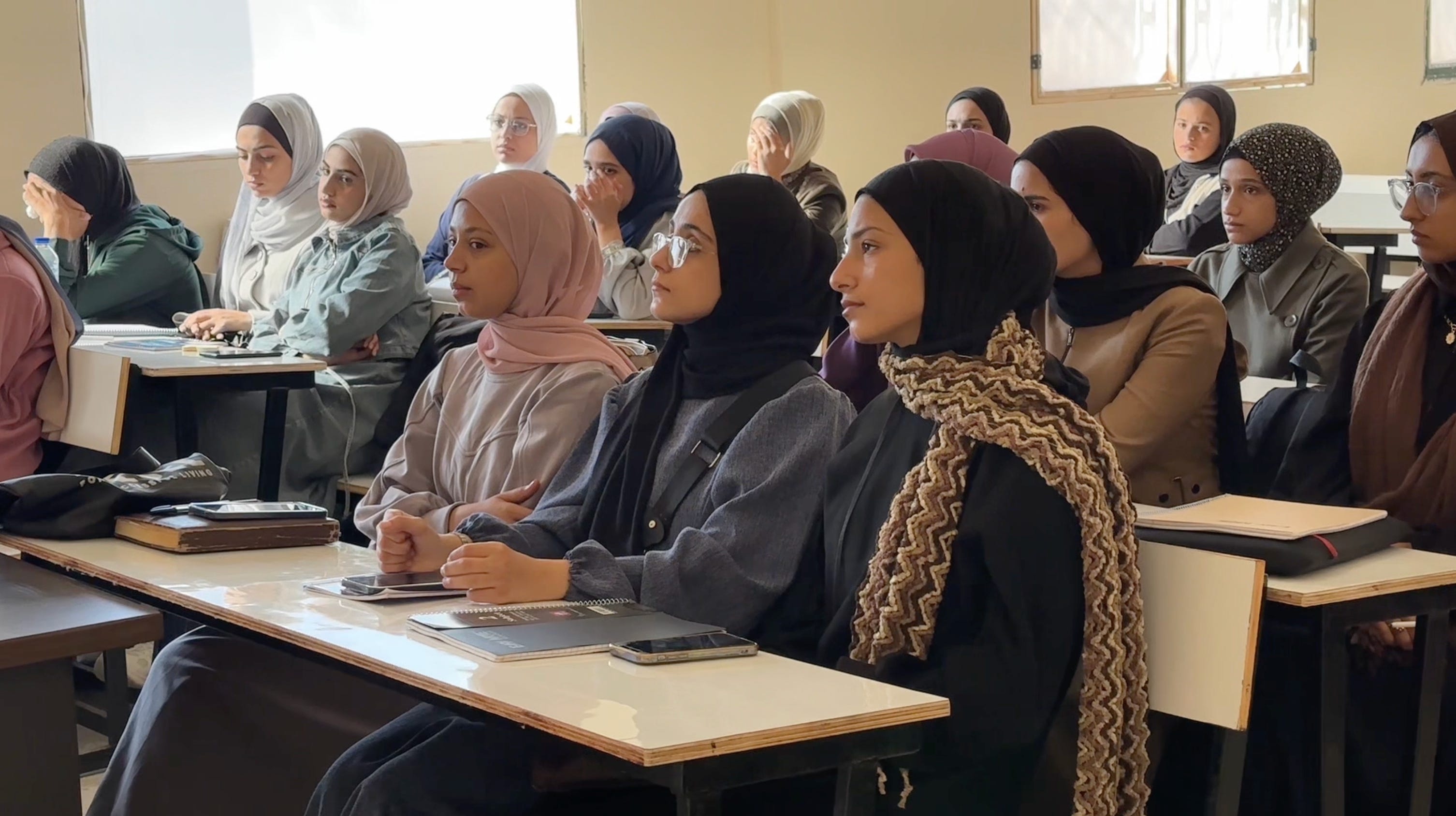
GAZA CITY—On December 1, Mohammed Hossam Ashour stood inside one of the two remaining buildings of Islamic University in Gaza City. A 19-year-old information technology major, he was attending in-person lectures for the first time in two years after the university resumed classes in late-November.
“We are happy to be beginning our return to something of a normal life, even if in a small way, to be returning to in-person learning after having been absent for more than two years because of the war the Israeli occupation waged against us,” Ashour told Drop Site News. “Despite the challenges, and despite the fact that more than 90 percent of the buildings at the Islamic University have been destroyed, the university still repaired and restored the buildings that could be used for teaching and made them available for the students so they could attend their lectures and come regularly to Islamic University.”
Like every other university in Gaza, Islamic University was targeted by the Israeli military during its genocidal assault. Once one of the largest universities in Gaza, with about 17,000 students before the war—60 percent of them women—nearly every building on the campus is now a bombed-out, hollow shell. Many of the roofs are pancaked in and the auditoriums have been gutted and burned. Hundreds of displaced families have set up tents in the rubble-filled courtyard and sought shelter in lecture halls and classrooms.
Much of Islamic University in Gaza City was destroyed in Israeli attacks. December 1, 2025. (Video by Abdel Qader Sabbah.)
Since October 2023, 745,000 students in Gaza have been out of school, including 88,000 in college and beyond. According to the Gaza’s Government Media Office, some 165 schools, universities, and other educational institutions were completely destroyed by Israeli bombardment over the past two years, while another 392 sustained partial damage. Thousands of students, teachers, and staff were killed in the Israeli assault. There is scant electricity and internet. The systematic elimination of the Palestinian educational system in Gaza prompted UN experts last year to accuse Israel of “scholasticide.”
Despite the scale of the attacks, efforts to sustain education in Gaza have continued. Thousands of university students graduated over the past two years through remote learning. And since the so-called “ceasefire,” on October 10, administrators have worked to resume in-person classes.
“We’ve lost many things, and most of the resources we need are still difficult to secure. In IT, you need internet access, you need to have a laptop, and you need to have the necessary mental fortitude,” Ashour said. “The university buildings, though it’s true we repaired some of them, there are still technologies, laboratories, different spaces that we don’t have because of the war, the occupation, and the siege we are living through.
“But here we send a message of defiance and steadfastness in the face of the occupation: that through education, God willing, and through persistence, seriousness, and hard work, we will reach our goals and put an end to the policy of enforced ignorance that the occupation has practiced, and continues to practice, against us,” he continued. “They deprived us of education for more than two years.”
Despite Israel’s brutal occupation, Palestinians in Gaza and the West Bank had one of the highest literacy rates in the world, reaching over 97 percent in 2020, with high rates of enrollment in secondary and higher education. Officials say the efforts to continue education in Gaza in the midst of a genocide and to resume in-person classes at places like Islamic University is a testament to that legacy.
“The university has been able to resume in-person education, gradually and partially, and despite the destruction that befell it,” Professor Bassam al-Saqqa, vice president of academic affairs at Islamic University, told Drop Site.
“More than the buildings, the academic infrastructure of the university was completely destroyed, including the internet infrastructure, which was among the strongest and most renowned in all of Palestine. The university’s laboratories as well, the computer and science labs, for the College of Science, the College of Medicine, and the College of Engineering.
“The Islamic University had the largest number of computers in all of Palestine, as well as highly advanced laboratories. We are speaking now about these resources not to romanticize what has been lost, but to tell our people that, God willing, we will restore these resources and these laboratories to what they once were. We draw our strength from our people and from our students’ passion for learning, for in-person learning. Frankly, we were surprised by our students’ enthusiasm and their widespread attendance, their presence in the university at the earliest hours, seated at their desks and ready to receive knowledge directly from their instructors. We hope this will be the beginning of a complete return to life.”
University students attend in-person classes at Islamic University in Gaza City. December 1, 2025. (Video by Abdel Qader Sabbah.)
Efforts to restore education to Gaza’s school-age children are similarly underway. More than 97 percent of elementary schools in Gaza have been damaged or destroyed. Most of them had been converted into shelters for the displaced when they were bombed.
“Most of the 658,000 school age children have had limited access to face to face learning for over two academic years,” UNICEF said in a statement last month. Since the ceasefire, Israel has also continued to ban or heavily restrict school supplies from getting into Gaza. “So far it has been impossible to get in educational supplies. Teachers are writing on tent walls. UNICEF has stationery, back packs for children and resources for teachers waiting at the borders, but it is not considered as lifesaving humanitarian aid so we have not been given permission to enter the materials into Gaza yet.” The UN Palestinian refugee agency, UNRWA—which ran the majority of the schools in Gaza—echoed the same recently, saying its work has been severely hindered by Israeli import restrictions that prevent even pens and notebooks from entering the enclave.
Palestinian officials and UN agencies have worked to set up hundreds of temporary schools in an effort to continue classes. “The genocide destroyed 90 percent of the institutions of the Ministry of Education, including the headquarters of the Ministry itself,” the Director of Education in Western Gaza, Dr. Jawad al-Sheikh Khalil, told Drop Site. “Now, the educational community, as it always does, is rising again in partnership with international and local organizations, and is opening local schools to receive the students…. In coordination with the corresponding authorities, parts of the courtyards are now being cleared so that students can be received in educational tents. We have no furniture. The students sit on the ground as they learn. The situation is extremely difficult for the teachers, the students, and all the educational staff.”
Some 390 temporary classrooms have been set up with over 5,000 teachers serving nearly 221,000 students—about 567 children per learning space. Even so, only a little over one-third of Gaza’s school-age children are enrolled for the 2025–2026 school year. Now, with cold winter rains ravaging much of Gaza, dozens of temporary classrooms have been affected by flash floods, with more expected to shut down.
Since the ceasefire, Israel has maintained its siege and continued its attacks, killing Palestinians on a daily basis, prompting Amnesty International to declare that “despite a reduction in scale of attacks, and some limited improvements, there has been no meaningful change in the conditions Israel is inflicting on Palestinians in Gaza and no evidence to indicate that Israel’s intent has changed.”
“Israeli authorities are still committing genocide against Palestinians in the occupied Gaza Strip, by continuing to deliberately inflict conditions of life calculated to bring about their physical destruction.”
Nevertheless, when Islamic University resumed in person classes, hundreds of students immediately enrolled. “I’ve finally enrolled at the College of Sharia and Law, after two years of being deprived of study for the tawijhi (high school matriculation) exam and of in-person learning, and after all the struggle we endured, today, I’ve begun my classes in-person,” Misk al-Daour, 18, told Drop Site as she stood inside a partially restored Islamic University campus building.
“This is one of the most beautiful days I’ve lived through the war, but the hardship still persists,” she said. “But we, as Palestinian people, will continue and will persevere in this work, for the sake of God and for the sake of education.”
Rayan El Amine contributed to this report. Sami Vanderlip edited the video.
 | A guest post by
|
These students, these educators - this is what true strength looks like. I doubt there are many people in this world right now that have as unbreakable a human spirit as these Palestinian survivors.
Such a stark contrast to the cowards of our time who hide behind unfathomable wealth, weaponry, technological asset and an unprecedentedly obedient press.
An excellent and a hopeful report!
What better response to the evil and the brutality of Israel than to show that you can bomb and break buildings but you can't break the human spirit and the desire to learn and create normalcy in an abnormal place.
Good bless the students, the teachers, and all those helping to provide learning -- and hope.