

Hungry Palestinians in Gaza Protest World Central Kitchen Scaling Back Amid Rising Food Costs and Israeli Blockade
“If the World Central Kitchen stops, there will be no breakfast, no lunch, and no dinner.”


Drop Site is a reader-funded, independent news outlet. Without your support, we can’t operate. Please consider becoming a paid subscriber or making a 501(c)(3) tax-deductible donation today.
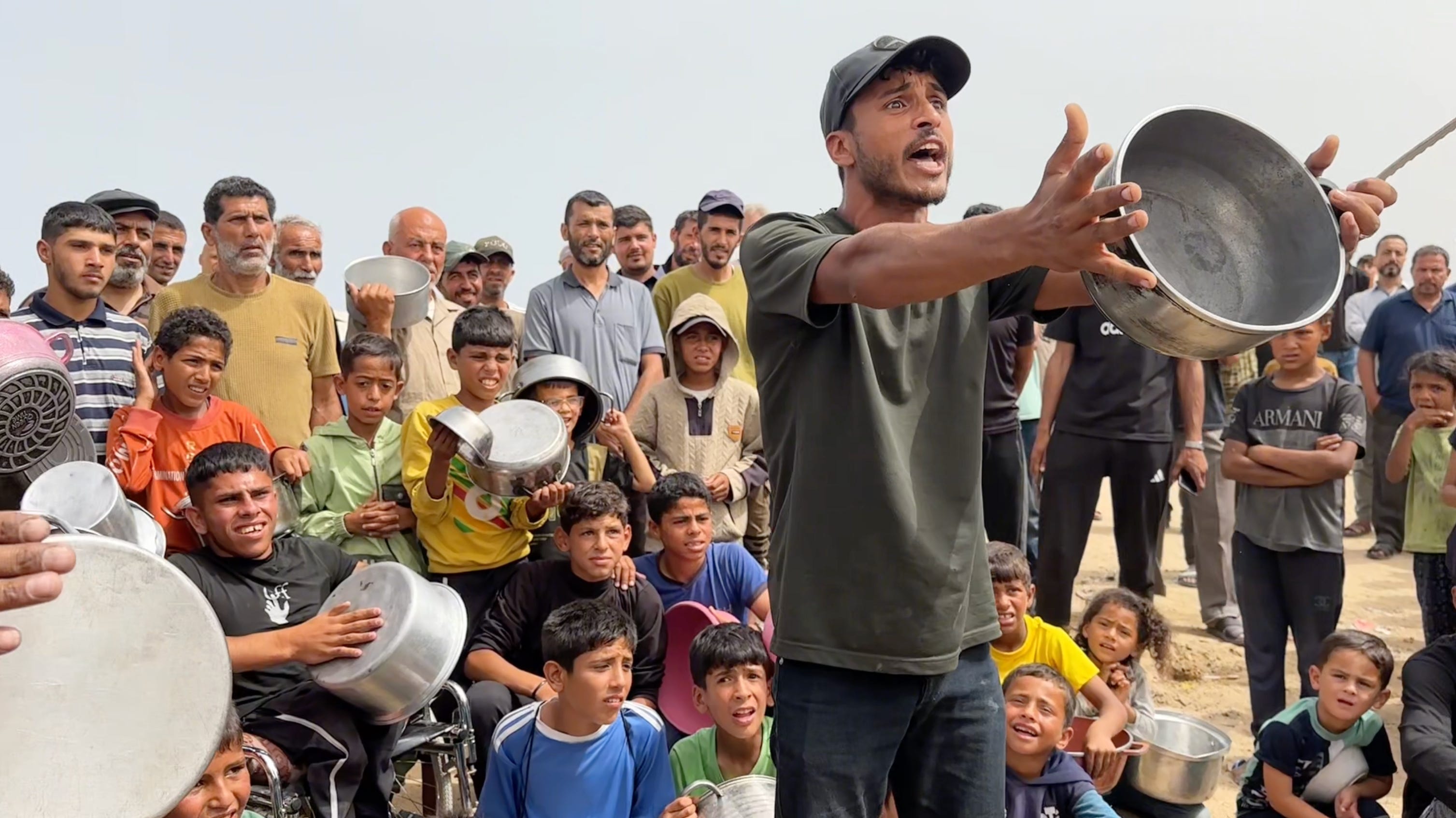
KHAN YOUNIS, Gaza Strip—Last week, Ahmed Abu Ras, 55, stood in the center of dozens of men and children, many holding empty cooking pots, on a sandy, sun-washed plot of land near the edge of the Jinan displacement camp in the Khan Younis area of southern Gaza.
“We call on international organizations to extend a hand of relief and aid to the displaced, not to cut them off from it,” Abu Ras said to the crowd, which had gathered to protest the lack of food. “The suffering is still ongoing. The siege is still ongoing. The displacement is still ongoing. The pain, hunger, and famine are still ongoing.”
Earlier this month, World Central Kitchen (WCK), the biggest provider of hot meals in Gaza, made the decision to cut its distribution in half, from around one million meals a day to 500,000. Abu Ras, a director of the Jinan camp, helped to organize the demonstration in response.
“World Central Kitchen added more pain to this suffering with its decision to stop the community kitchens serving the displacement camps stretching across northern Hamad City, consisting of 12 camps with a population of more than 13,000 displaced people,” Abu Ras said.
Scenes from Jinan displacement camp in Khan Younis, including a protest against a decision by World Central Kitchen to cut its meal distribution in Gaza by half. May 18, 2026. Video by Abdel Qader Sabbah.
In a statement earlier this month, WCK said its decision was “driven entirely by financial pressure” and did not “reflect any reduction in need on the ground.” The founder of WCK, José Andrés, said the cost of supplying food had become unsustainable, citing the U.S.-Israeli war with Iran and the closure of the Strait of Hormuz. “The war in Iran has pushed up our costs significantly. The price of rice has risen by 30 percent, while the costs of chicken and meat have spiked between 10 and 20 percent,” Andrés wrote in an essay in Semafor. “We rely on gasoline to deliver supplies into Gaza and transport meals across the strip, and higher gas prices have affected our operations too.”
This week, Israel’s supreme court upheld draconian government registration rules for international aid groups operating in Gaza and the occupied West Bank, making it near impossible for anyone to fill the vacuum left by WCK. The court upheld a government ban on 37 foreign NGOs, giving them 30 days to comply with new screening procedures “or cease operations.” Those procedures include submitting detailed employee lists, a measure that aid groups have resisted because it would put their Palestinian staff members at risk. Israeli authorities revoked the licenses of the agencies in January, including some of the world’s largest humanitarian groups—such as Oxfam, Save the Children, Médecins Sans Frontières, and the International Rescue Committee—after they refused to comply with the intrusive registration requirements.
Aid groups have warned of devastating effects if Israel moves ahead with the bans. WCK is not part of the ban, making its reduction that much more consequential.
WCK has employed thousands of Palestinians at its community kitchens, providing a crucial source of income for families in Gaza where the unemployment rate has increased to over 80%, according to the Palestinian Central Bureau of Statistics. In the wake of WCK’s decision to drastically scale back food distribution, hundreds of Palestinians suddenly found themselves out of work.
Last week, in a separate demonstration, a group of employees gathered, in WCK uniform, to protest the decision and call for the reinstatement of the fired workers. “On behalf of the employees of World Central Kitchen, and the families affected in the Gaza Strip, we are announcing at this solidarity protest our condemnation of the unjust and unfair decision to arbitrarily dismiss employees from World Central Kitchen, depriving many affected families who depend entirely and exclusively on its meals in light of the ongoing financial crisis as a result of the genocide in Gaza,” one of the WCK workers said, surrounded by his colleagues, in an video circulated on social media.
“Previously, the World Central Kitchen used to provide meals, and people were barely getting by,” Fatima Abdullah Al-Basyouni, a displaced Palestinian mother in Khan Younis, told Drop Site. “Lunch would arrive. Breakfast and dinner were not available except through aid, and the aid was extremely limited. Now, if the World Central Kitchen stops, there will be no breakfast, no lunch, and no dinner. It will create a huge shortage, a shortage of food supplies at homes.”
“It is a decision that is very harmful to the Palestinian people,” she continued. “They must reverse it and look at it from a broader and more developed perspective, not in a way that prevents food from reaching us. The idea should be to improve the quality and quantity of food for people, not to reduce it.”
WCK did not respond to inquiries from Drop Site News.
Beyond WCK scaling back and the Iran war sending global food prices soaring, Gaza’s Government Media Office has repeatedly warned the number of aid trucks Israel allows into Gaza has routinely fallen far below the levels agreed upon in the October “ceasefire” deal.
“The agreement stipulates the entry of 600 trucks daily, including 50 fuel trucks. However, the occupation has not adhered to this,” the office said in a statement on Monday. “Only 37% of the agreed-upon number of trucks have actually entered Gaza. The fuel situation is particularly critical, with only 14% of the agreed-upon quantities having been delivered. Furthermore, only 1,196 trucks entered the Gaza Strip last week, out of the 4,200 that were supposed to enter during the same period.” They called the level of food and supplies “entirely insufficient.”
The United Nations, too, has documented the steadily worsening food crisis, noting a drop of 37% in aid between the first and second three-month periods following the October 10 agreement. The UN’s World Food Program also noted that Palestinians in Gaza were eating less in the first half of April than in March, with most families eating vegetables, fruit, or protein only once a week or less.
The UN placed the blame squarely on Tel Aviv. “Israel’s intermittent closure of crossings, restrictions on the flow of humanitarian aid, and continued ban on the entry of essential supplies have produced chronic shortages of food, medicine, and basic goods across Gaza,” the UN reported last week.
President Donald Trump’s Board of Peace, recently acknowledged in its May 15 report to the UN Security Council ongoing daily violations and “impediments to humanitarian access” but did not identify Israel as the responsible party. Israel has killed over 900 Palestinians since the agreement went into effect in October.
On Wednesday, as families were gathering to celebrate Eid Al-Adha, an Israeli airstrike slammed into a residential home in central Gaza City, killing at least 10, including four children, and wounding more than 20, according to the Palestinian Red Crescent. Harrowing images emerged of residents carrying bloodied children from the rubble through flames and smoke.
On Tuesday, 14 Palestinians were killed in a series of Israeli attacks across the enclave, including one that killed the head of Hamas’s armed wing, Mohammed Odeh—also in violation of the ceasefire—along with his wife and children.
Israel has also continued to target aid workers in Gaza, with two killed in late April in separate incidents, triggering the suspension of health and water services. Israel also fired on a World Health Organization vehicle in early April, killing a contractor and wounding several others, prompting WHO to suspend medical evacuations via the Rafah crossing for six days. At least eight aid workers have been killed since the “ceasefire” was announced in October, according to OCHA. Nearly 600 humanitarian workers have been killed since the beginning of the genocide in October 2023, including seven WCK aid workers when their convoy was targeted by Israeli airstrikes as it left one of the group’s warehouses in Deir al-Balah in April 2024, prompting the group to temporarily pause its operations.
According to local authorities, Israel has committed more than 3,000 violations of the “ceasefire” since it went into effect in October, without any condemnation from Trump’s Board of Peace.
“The plan was supposed to bring relief. Instead, Palestinians in Gaza are still hungry, still cannot reach medical care, and civilians are still being killed,” Adam Coogle, Middle East deputy director at Human Rights Watch, said in a statement last week ahead of a Board of Peace briefing at the UN Security Council on its newly-issued six-month progress report. “No spin can hide the fact that aid is not entering at the needed scale,” Coogle added. The group also noted that four UN agencies had warned back in December that famine, pushed back only weeks earlier through the ceasefire, could rapidly return without sustained access and supplies.
Standing at the demonstration last week against the WCK decision to scale back meal deliveries, one man burst angrily through the crowd. “We truly have nothing. Where are we supposed to work? How are we supposed to feed our children? I sit waiting at the community kitchens from 8 in the morning. This is the result,” he cried, holding up an empty cooking pot. “I have two daughters—from where are we supposed to get food? Or is that it? Have you all conspired against us? I ask for what any Arab country or European country lives with: dignity and peace of mind.”
Drop Site News Middle East Research Fellow Jawa Ahmad contributed to this report. Sami Vanderlip edited the video.
 | A guest post by
|
Gaza isn’t starving because WCK scaled back — it’s starving because Israel blocks the food, bans the NGOs, and kills the workers. WCK’s retreat just exposes the truth: famine here isn’t a tragedy. It’s a policy.
This is APPALLING. Why is our President's Board of Peace allowed to lie to the UN?
Open the border; allow the trucks to enter with aid, food, medicines, and building supplies.
This is horrifying. Thanks so much to the World Central Kitchen for what they have been
doing so far. And I agree with George Leone's comment, famine here is the Israeli policy.