

The Untold Story of Dario Amodei’s Antiwar Past, as His AI Tech is Used for a New Middle East War

I’m a bit older than Anthropic CEO Dario Amodei, but not enough for it to matter, and I learned recently we have something significant in common. When he was in college at Caltech, and I was a student at the University of Maryland, we both threw ourselves into organizing protests against the looming invasion of Iraq. It was, for me, a formative experience. Our Maryland group, called UMCP Peace Forum, organized at least two small but successful rallies and marches on campus, and also coordinated with national groups to help put together a huge march in Washington, D.C. in October 2002.
I learned then how much went into it—the permits, making all the signs, finding enough port-a-johns, getting the word out, the bus coordination—and it turned into the largest antiwar demonstration the city had seen since Vietnam. The next morning I raced for the Washington Post—the print version was still all that mattered—and was stunned to see it buried on something like page A17. (It’s still online, you can read it here.)
The media’s refusal to cover antiwar sentiments with the seriousness I thought they deserved, combined with their credulous coverage of weapons of mass destruction, drove me to consider becoming a journalist myself for the first time. Somebody needed to do it honestly, I remember thinking. (I also did not think Saddam Hussein had WMDs, and all I had to go on was what I read in The Nation or heard on Democracy Now. So anybody who tells you it was impossible to know is just wrong.)
Reporting honestly on war is, of course, essential to what we’ve built here at Drop Site, and the last month we’ve seen the largest growth in subscribers since the month we launched in 2024. If you’re one of those new subscribers, thank you, and welcome, we hope you appreciate what you’ll be reading, though it certainly won’t be enjoyable.
If you haven’t yet made the leap from unpaid to paid, consider doing that today as a signal of support for the work we’re doing. You can also, as always, make a one-time or recurring contribution that is tax deductible (to the fullest extent of the law).
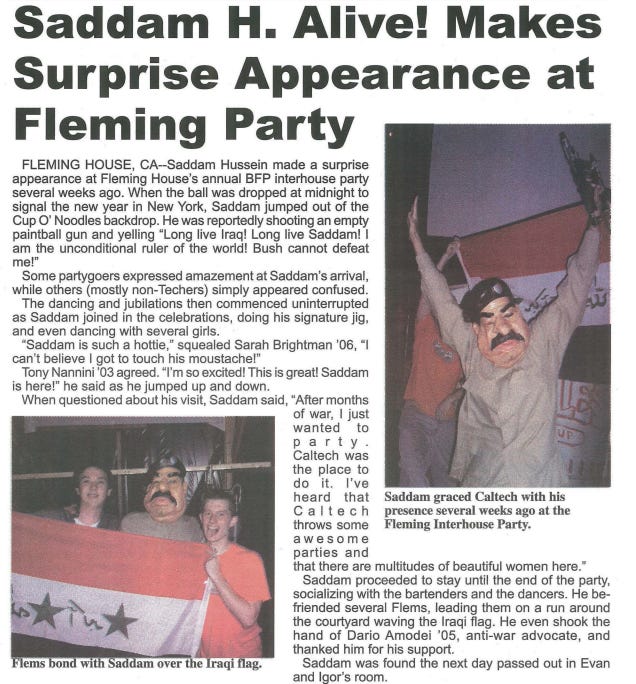
Amodei, meanwhile, took a different path after the war. The student newspaper reported that someone dressed as Saddam Hussein at a spring 2003 frat party mocked Amodei by thanking him for his support. He transferred to Stanford, and his antiwar activity seems to have heavily tapered off. Instead, he threw himself into developing what he has promised will be an ethical AI. (The jury is still out on whether that’s possible.) That commitment clashed headlong with the Pentagon recently; after Amodei inquired as to whether his tech was used to kidnap Venezuelan President Nicolás Maduro, our “War Secretary” lashed out at him. Anthropic and the Pentagon then battled over whether the company’s product could be used for autonomous armed drones or for mass surveillance.
Amodei refused, and the Pentagon severed its links with Anthropic—with a six-month period of conscious uncoupling. In the meantime, the former antiwar organizer’s tech is playing a critical role in another U.S. war in the Middle East. Owen Lavine’s story on this odd chapter of Amodei’s life is below.
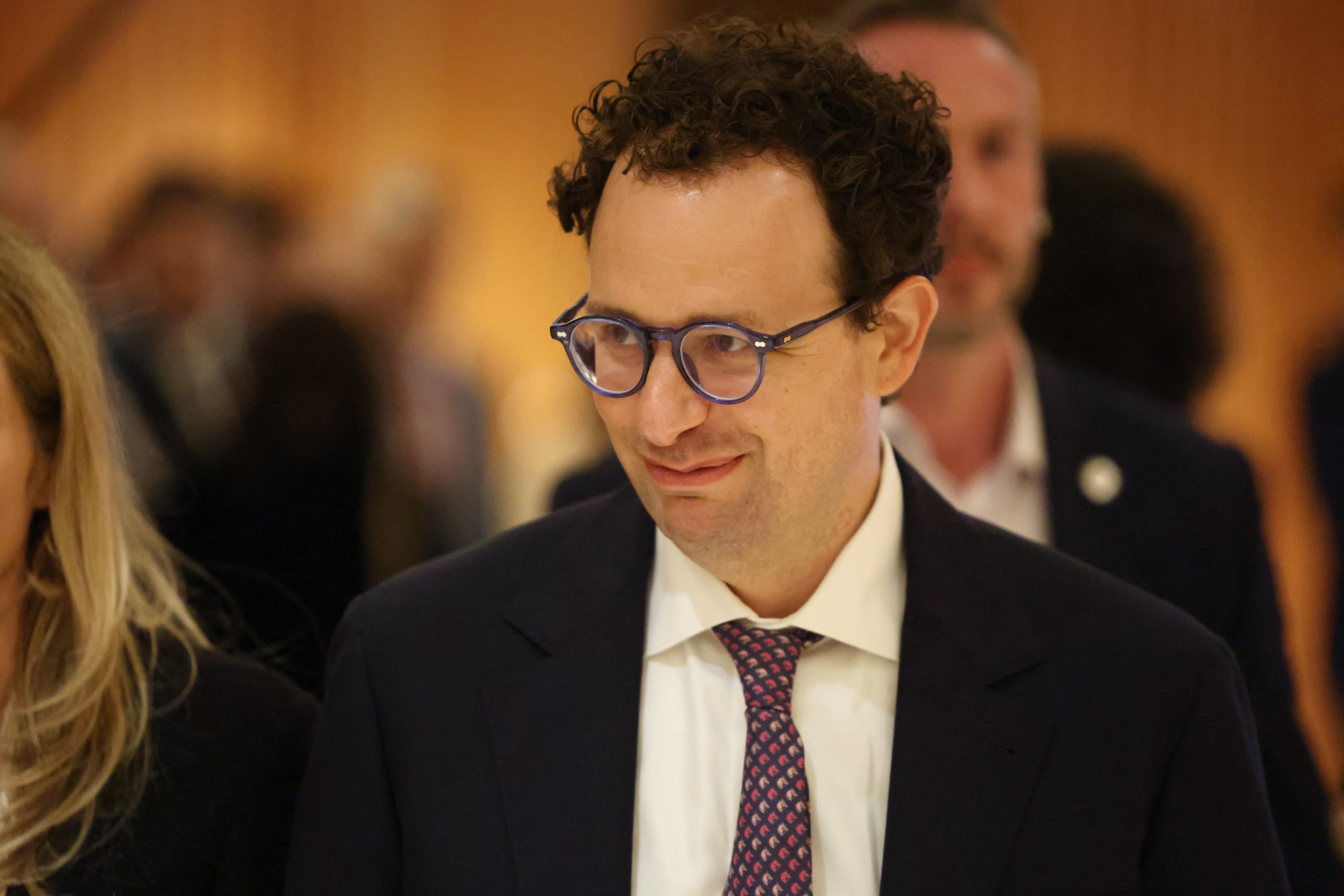
Anthropic CEO Dario Amodei at the AI Impact Summit in New Delhi on February 19, 2026. Photo by Ludovic MARIN / AFP via Getty Images.
The Untold Story of Dario Amodei’s Antiwar Past, as His AI Tech is Used for a New Middle East War
Story by Owen Lavine
It was March 3, 2003. The Bush administration was beating the drums of war. An invasion of Iraq was certain. Dario Amodei was in his second year at Caltech where he was studying physics. After penning a column pushing back on an “unfair” student flier claiming Martin Luther King Jr. was supportive of Zionism, Amodei came out swinging against the looming invasion of Iraq, and his “apathetic” fellow students.
“Anti-War Protest: Most Students Apathetic Towards World Politics by Dario Amodei” read the top of page 5 of The California Tech.
Amodei opens the column referencing social critic Neil Postman’s theory that “the greatest danger American democracy faces is not an Orwellian dictatorship but a culture that makes politics and public discourse irrelevant.”
“Living at Caltech is a forceful reminder that Postman was right,” Amodei went on.
Amodei lamented that, as the Bush administration saber-rattled over Saddam’s regime, he “rarely heard the subject mentioned in casual conversation.”
Driving deeper, Amodei pointed out that “several hundred” people are on the “interest list” for an anti-war campus organization named the Peaceful Justice Coalition, yet, a leader of the group told him “only a handful of them are consistently active.”
“The problem isn’t that everyone is just peachy with the idea of bombing Iraq; it’s that most people are opposed in principle but refuse to give one millisecond of their time to the issue,” Amodei added.
Amodei gives a crystal clear forecast of how the invasion of Iraq will be a complete failure too, quoting then-NATO Supreme Commander Wesley Clark who told a CNN interviewer in 2002 that a war in Iraq could “supercharge recruiting for Al Qaeda.”
“We should never let ourselves be reduced to amoral technicians who run the machines of war as casually as we do our computations,” Amodei went on.
Amodei ends the article by asking proponents of the war to “challenge us” at an anti-war action the following Wednesday.
The March 10 paper described the action as a “small group” with counter-protestors, according to Amodei, who was identified as an “organizer” of the Peaceful Justice Coalition. Across from the Peaceful Justice Coalition, proponents of the war held signs reading “Give War a Chance,” and, “Go back to work, hippies.”
“As scientists, we’re not in some ivory tower,” Amodei was quoted in the paper saying at the protest.
Ten days later, coalition forces invaded Iraq. Amodei and the Peaceful Justice Coalition vented their frustration at a “peace forum” on March 30, hosted by then Congressman Adam Schiff. The article states Schiff, who voted in favor of the Iraq war, gave a “controversial speech.”
“He further noted that while war can be cruel, peace can be terrible as well,” it added. “In addition, he asserted that ‘never has diplomacy deterred a tyrant.’”
Schiff was reportedly interrupted by “outbursts.” Amodei maintained the need for “civility” but “understood ‘how frustrating it is to have your heartfelt pleas fall on deaf ears.’” Amodei qualified that protests were “especially important,” though, noting the “connection of science with the military.”
As the school year drew to an end, Amodei didn’t pen another column nor did The California Tech note him at any other actions against the Iraq war.
In late spring, at a Caltech frat party, a character dressed as Saddam Hussein shook “anti-war advocate” Amodei’s hand and “thanked” him for his “support” as student paper’s 2003 commencement issue retells.
The next semester, Amodei would transfer to Stanford. As legendary Caltech Physics Professor Tom Trombello recalled when asked about Amodei leaving Caltech, “With Dario, it was very important that he not stick it out. This is a national treasure.”
In March, Anthropic was labelled a “supply chain risk” by the Pentagon after the company missed a deadline to meet the Pentagon’s demands to allow them to use Anthropic’s Claude large language model for autonomous weapons systems and mass surveillance.
Anthropic CEO Dario Amodei said in a statement that Anthropic could not, “in good conscience,” accede to the Pentagon’s demands that his company drop safeguards embedded in its large language models. Amodei also drew redlines around Anthropic’s products being used for mass domestic surveillance technology and fully autonomous weapons systems by the Pentagon.
Anthropic was already a prime target for White House AI Czar David Sacks who claimed “Anthropic’s agenda” was to “backdoor Woke AI and other AI regulations through Blue states like California,” in an October X post.
“This is not surprising since Anthropic hired the Biden AI team, which gave us Biden’s Woke AI executive order and the Biden Diffusion Rule,” Sacks added, referring to a Biden-era rule issued by the Commerce Department which restricted some advanced computer chip sales to China.
Amodei pushed back on Sacks’ characterization of Anthropic, indirectly calling out the “recent uptick in inaccurate claims about Anthropic’s policy stances.” Amodei added that the Trump administration and Anthropic were aligned on “key areas of AI policy.”
Amodei has also been critical of “authoritarian” governments in the Middle East, and the Trump administration’s decision to sell some advanced computer chips to China.
In a leaked memo from last year, Amodei reportedly said the company had “vociferously pushed for not allowing big data centers in the Middle East.” Amodei added that “without a central authority blocking them, there’s a race to the bottom where companies gain a lot of advantage by getting deeper and deeper in bed with the Middle East.”
“The basis of our opposition to large training clusters in the Middle East, or to shipping [NVIDIA] H20’s to China, is that the ‘supply chain’ of Al is dangerous to hand to authoritarian governments,” Amodei went on. “These governments can use it to gain military dominance or to gain leverage over democratic countries.”
Amodei’s criticism has been echoed by Democratic lawmakers, such as Democratic Senator from Virginia, Tim Kaine.
“We do not sell our most advanced security critical technology to adversaries,” Kaine told the Senate floor in a December speech, referencing President Trump’s greenlight on NVIDIA H200 chip sales to China.
However, Anthropic’s relationship with the Trump administration really soured after the January raid to kidnap Venezuelan President Nicolas Maduro.
Following the raid, Anthropic reportedly had consternations about their products being used during the raid—Claude, the company’s flagship model was used. Anthropic had previously signed a $200 million contract with the Department of Defense.
“Anthropic asked whether their software was used for the raid to capture Maduro, which caused real concerns across the Department of War indicating that they might not approve if it was,” an official with knowledge of the situation told Axios in February.
The Pentagon then initiated a “review” of Anthropic, which culminated in the frontier AI lab being
labelled a “supply chain risk” on March 4. Anthropic has now sued the Pentagon, claiming the relevant statute, 10 USC 3252: Requirements for information relating to supply chain risk, “exists to protect the government rather than to punish a supplier.”
In another leaked memo from the same day the Pentagon labelled Anthropic a supply chain risk, Amodei reportedly stated, “The real reasons DoW and the Trump admin do not like us is that we haven’t donated to Trump (while OpenAI/Greg [Brockman] have donated a lot), we haven’t given dictator-style praise to Trump (while Sam [Altman] has).”
Anthropic recently gave $20 million to Public First Action, an AI-safety focused group led by former Congressmen Brad Carson and Chris Stewart. One of their key issues is blocking a Republican-led push—that was nearly snuck into the One Big Beautiful Bill Act—to block state level AI regulations. Public First Action hasn’t endorsed a slate of candidates, but they are dumping $450,000 into former Palantir employee and New York State assemblyman Alex Bores’s bid for New York’s 11th congressional district. Bores is facing $1.1 million in attack ads from pro-AI PAC, Leading Our Future, which is backed by Marc Andreessen, an unofficial adviser of the President, and OpenAI President Greg Brockman, who donated $25 million to pro-Trump super PAC MAGA Inc., among others.
A spokesperson for the Bores campaign declined to comment when asked for Bores’ position on the Biden administration’s diffusion rule, another issue Public First Action and Anthropic are aligned on.
It’s noteworthy, too, that Public First Action’s platform—and a key Amodei criticism of the White House—is Trump’s decision to allow China to buy some NVIDIA chips that could be used to run artificial intelligence models.
“There are some elements of the government, some government officials who are not aware, who don’t seem to get it, who still think this is an economic race to diffuse our technology to different parts of the world,” Amodei said at the Anthropic Futures Forum last year, referring to export controls on chips. “Some of the elements in government don’t get it, and are doing exactly the wrong things.”
Anthropic did not respond to a request for comment.
The company scored an early victory in federal court on Tuesday as they sue the Pentagon.
“It looks like an attempt to cripple Anthropic,” District Court for the Northern District Of California Judge Rita F. Lin said of the Pentagon’s labeling of Anthropic as a supply chain risk. Lin appeared to concur with Amodei’s reading that the Pentagon’s labeling of Anthropic as a supply chain risk wasn’t motivated by a concern the company posed a genuine “risk” to the supply chain.
Lin said the Pentagon’s actions “don’t seem to be really tailored to a stated national security concern.”
Democrats fiddle while the world burns. How can we sleep while our beds are burning?
Ryan - the Knight-Ridder Washington bureau (sadly long gone) also did honest reporting on the buildup to the Iraq war.
NJH