

“Small Children Who Knew Nothing of Politics or Wars”
A scene of devastation in Minab, Iran, as parents waited to know the fate of their young daughters after the bombing of a girls' elementary school killed over 100.

Drop Site is a reader-funded, independent news outlet. Without your support, we can’t operate. Please consider becoming a paid subscriber or making a 501(c)(3) tax-deductible donation today.
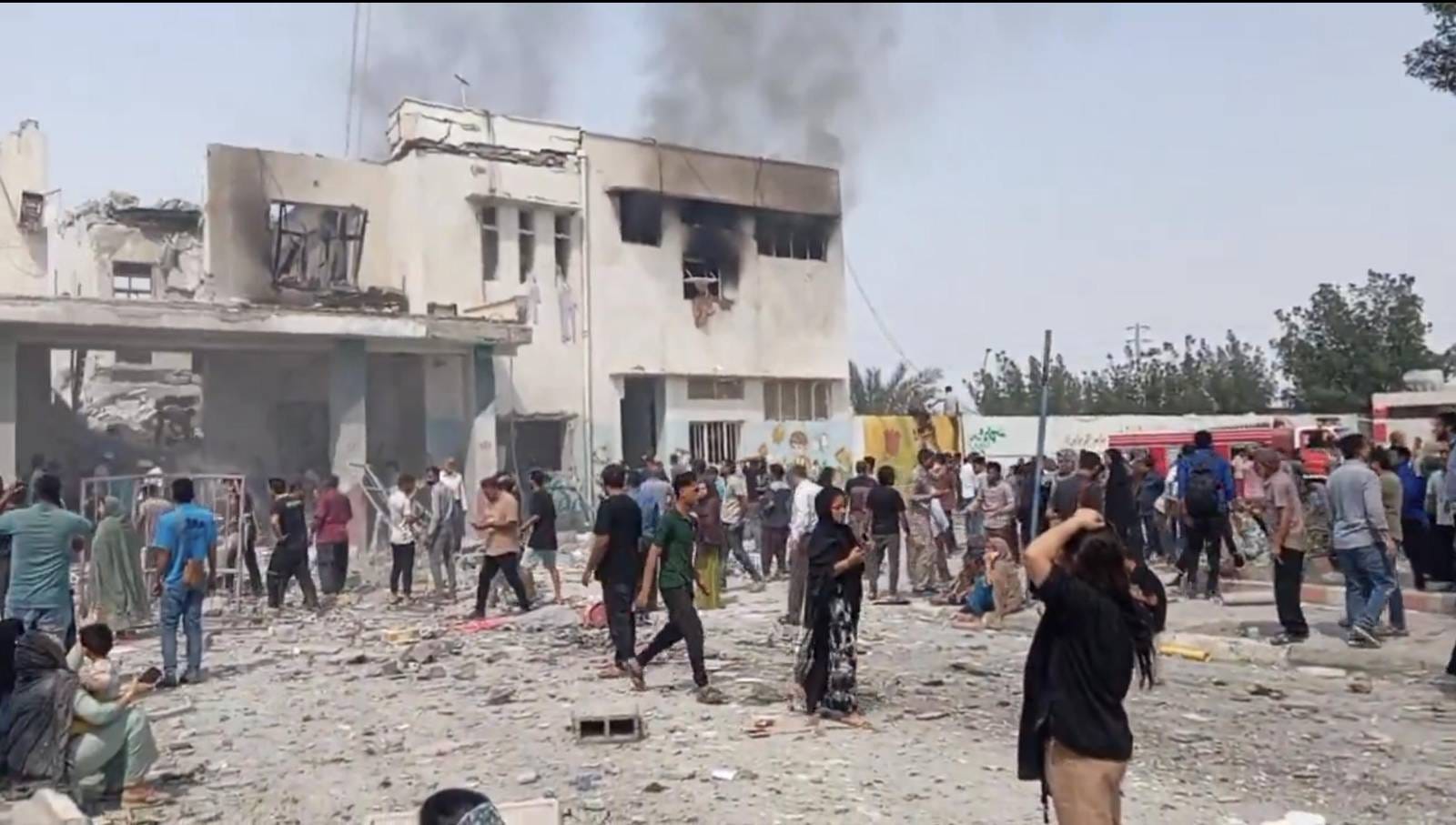
MINAB and TEHRAN, IRAN—Mohammed Shariatmadar stood outside the wreckage of the Shajareh Tayyiba girls’ elementary school in Minab, in southern Iran on Saturday morning, unable to process what he was seeing. His six year-old daughter, Sara, a second grade student, was among dozens of girls killed when the school was bombed in the first few hours of the war launched by the U.S. and Israel on Iran.
In the immediate aftermath of the strike he remained standing in the shade of a cracked wall, staring at the ground and ignoring the commotion around him. He didn’t approach the building, which had been sealed off, but he didn’t move away either. His hands knotted together, then separated, then knotted again, in a repeated motion. Every time a paramedic emerged or an ambulance moved, he quickly raised his head, then returned to staring at the ground. He asked no one a direct question. He was only waiting for his daughter’s name to be called.
When families were finally directed to a gathering point to receive the bodies of their children, he slowly moved forward. When asked if he needed help, he shook his head silently and waited for his daughter’s body to be brought out.
“I cannot understand how a place where innocent children learn can be bombed like this,” Shariatmadar told Drop Site. “We are talking about small children who knew nothing of politics or wars. And yet they are the ones paying the highest price.”
Some 170 students were inside the building attending morning classes when the missile struck. At least 108 people were killed, according to the public prosecutor’s office in Minab, many of them schoolgirls between seven and 12 years old.
It was unclear if it was a U.S. or Israeli strike. On Saturday, CENTCOM’s spokesperson said they were “looking into” the reports.
“My heart is broken,” Shariatmadar said. “For Sara and for all the children we lost today. I want the world to know that the children are the real victims. Every day that passes without a solution increases the pain and the suffering for the families and for the children alike.”
Minab sits far from Tehran, but the school was adjacent to a naval base belonging to the Iranian Revolutionary Guard Corps. Hormozgan province, where the small city of Minab is located, borders the Strait of Hormuz, one of the world’s most strategically sensitive waterways.
A resident of Minab, who spoke to Drop Site on the condition of anonymity, said explosions shook the city Saturday morning, sending residents into an immediate panic. Then reports started emerging that the school had been hit.
“Everyone rushed to the school the moment they heard the blasts,” the resident, who spoke to Drop Site on the condition of anonymity, said. “Chaos took over completely. Security forces were trying to push families back, fearing the area would be targeted again.”
The school building was reduced to a massive pile of rubble and dozens of schoolgirls were trapped under the concrete. People began trying to frantically dig them out with their bare hands. Families wandered around in shock, searching for their children amid the wreckage. “The final number of dead reached around half the students in the school,” the resident said.
Fatima al-Zahra Mohammad Ali, a nine-year-old student, was among those killed. “When we arrived at the school, the place was in chaos,” her mother, Amina Ansari, told Drop Site. The girl’s father, Mohammad Ali, who lost his right leg during the Iran-Iraq war, did not want to speak.
“The school itself didn’t know how to handle the situation,” Ansari said. “There was no accurate information about what was happening. Every time we asked someone they said, ‘Be patient until we get the girls out from under the rubble.’” The family did not learn that Fatima had been killed until around 4 p.m., when her body was discovered.
In a statement, President Masoud Pezeshkian condemned the “brutal attack by American and Zionist aggressors,” calling it a “barbaric act [that] is another black page in the record of countless crimes committed by the invaders of this land.”
Foreign Minister Abbas Araghchi posted an image of the destroyed school on social media. “It was bombed in broad daylight, when packed with young pupils,” Araghchi wrote. “Dozens of innocent children have been murdered at this site alone. These crimes against the Iranian people will not go unanswered.”
“We do not understand the reasons for the U.S. attack on Iran,” he continued in a subsequent post. “Perhaps the U.S. administration was dragged into it. Here is what I do know: Iran will punish those who kill our children.”
Seyyed Ibrahim Mirkhayali, a municipal employee from Bandar Abbas, was also at the school gate. His nine-year-old daughter, Zeinab, a fourth-grade student, was killed in the bombing.
“I was at work when my wife called and told me that the girls’ primary school in Minab had been bombed. I could not process what I was hearing at first. Then I left immediately and drove to the school,” Mirkhayali told Drop Site. When he arrived he found a large crowd of parents standing outside. Some were crying. Others stood in heavy silence.
“The atmosphere was terrifying and catastrophic. The parents were in a deadly silence, filled with fear and dread for their daughters. We did not know who had gotten out and who was still under the rubble,” he said.
He said news seeped out gradually from inside the school as search and rescue operations continued. Every name announced changed the fate of an entire family.
“How long are we going to live like this? Why can’t the United States and Israel reach an agreement with Iran and end this war? What happened is a crime,” he said. “Since the last war we have not lived a stable life in our country because of the United States and Israel.”
The family waited through the afternoon. Near sunset, they were informed that Zeinab was among the dead. “We stayed until her body was brought out from under the rubble,” he said. Her body was largely intact. “But her head was crushed by falling stones from the building. That is what killed her.”
An ambulance took the body to the hospital. The family began the legal process of obtaining a burial permit. “We are waiting for the permits. The burial is expected tomorrow,” he said.
Mirkhayali recounted how Zeinab had memorized the Quran and was preparing to compete in a recitation competition in Tehran in two months. “I had a great dream for my daughter. She was hardworking and outstanding, and she had memorized the book of God. Her participation in the competition was a source of pride for all of us. My dream died with her.”
Iranian state media, citing the Red Crescent, on Saturday evening said at least 201 people had been killed across the country and more than 700 injured.
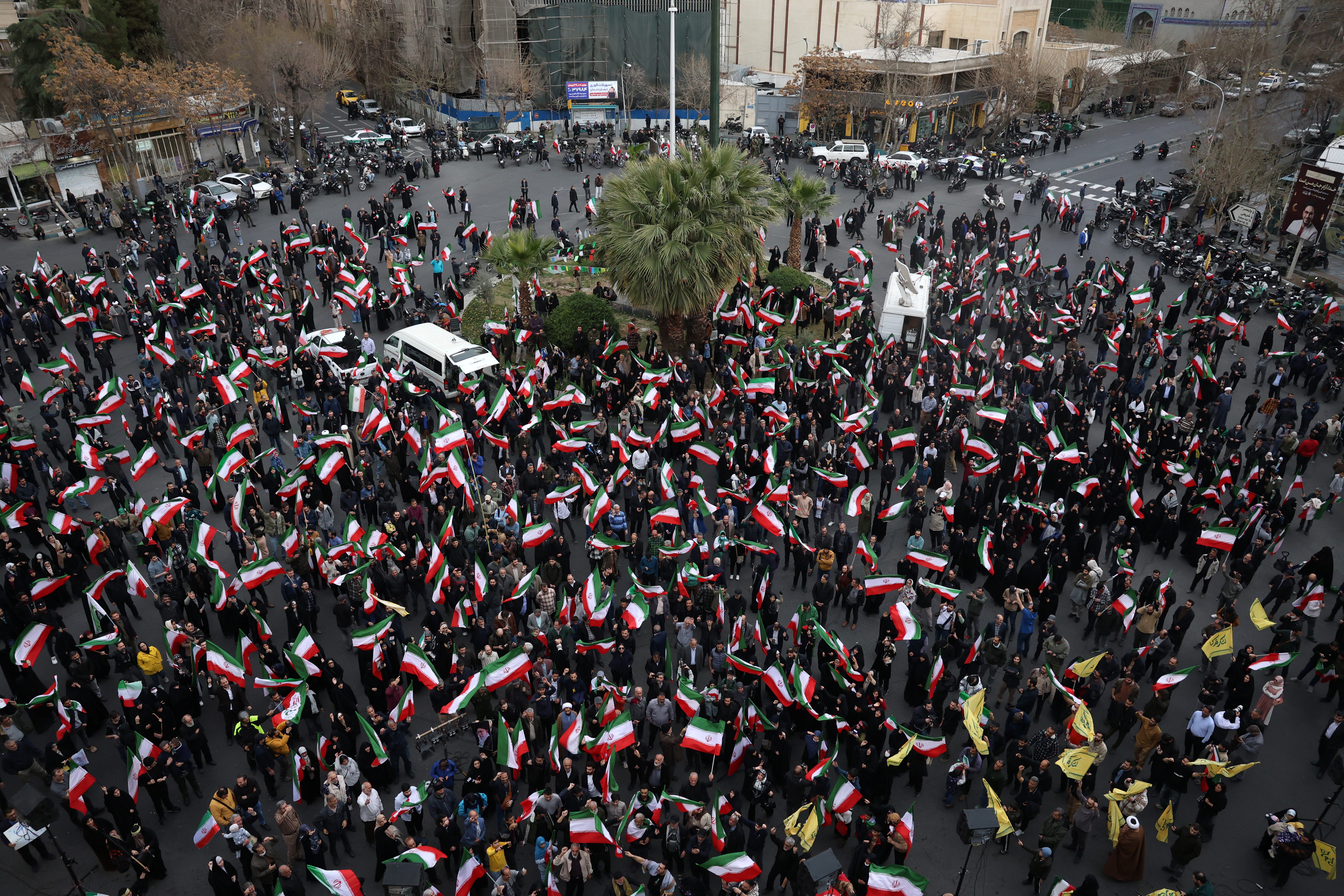
The scene in Tehran
Several hours after President Donald Trump announced the launch of the war in a taped statement, Iran’s National Security Council issued a statement, assuring residents of Tehran that food supplies were stable but advising those who wished to leave the capital to do so, while urging them to avoid traffic congestion. The council’s reasoning, according to the statement, was to prevent a repeat of the mass flight that occurred during the U.S. and Israeli attack on Iran in June, when hundreds of thousands fled the capital to Turkey and to other Iranian cities including Gilan, Qom, and Isfahan, and Israeli strikes on those convoys killed dozens.
By the time the statement was issued, the exodus had already begun. Tehran’s main roads and highways filled with cars. Families loaded luggage onto rooftops or piled it between seats. Horns blared continuously. Passengers shouted into phones trying to reach relatives. Children cried. Women wept openly. Gas stations descended into chaos with growing queues of cars as fuel ran out within minutes at some locations. Nearby shops and small markets were emptied of food, water, and medicine as residents bought whatever they could carry, fearing supply disruptions or further strikes in the hours ahead.
University students from outside Tehran, those studying in the capital but from other provinces joined the flight. Some ran to catch buses. Others drove themselves, laptops and notebooks thrown into bags alongside whatever personal items they could grab.
Not everyone fled. At Palestine Square, one of Tehran’s most politically charged public spaces, scores of Iranians gathered to protest the strikes. They raised Iranian flags and portraits of Supreme Leader Khamenei and former commander Qassem Soleimani. They burned photographs of Donald Trump and Israeli Prime Minister Benjamin Netanyahu.
This story was published in collaboration with Egab.
Read Drop Site’s latest on Trump’s regime change war in Iran here.
And our livestream conversation with Ali Abunimah and Hamood Majd:
 | A guest post by
|
May all of them rest in peace 🕊. Bombed by democracy before they even had the chance to collect memories
There is no justification — military, strategic, or political — that can explain away the image of a bombed elementary school filled with seven-year-olds. When over 100 girls are killed in their classroom, we are no longer talking about “precision strikes” or “deterrence.” We are talking about children buried under concrete.
If this strike was carried out by the United States or by Israel — whether ordered by Donald Trump or by Benjamin Netanyahu — then the world deserves transparency and accountability. Being adjacent to an IRGC facility does not erase the laws of war. International humanitarian law is clear: civilian objects, especially schools, are protected. When half the students in a school are killed, something has gone catastrophically wrong.
What stands out most in this reporting is not geopolitics, but the fathers waiting silently for their daughters’ names to be called. A crushed backpack. A memorized Quran never recited in competition. A six-year-old who “knew nothing of politics or wars.”
Wars are launched by leaders. The dead are almost always children, civilians, ordinary families.
If the United States claims to stand for human rights, it must support an independent international investigation and publicly release targeting information. Anything less sends the message that some children’s lives matter less than others.
No parent — in Minab, Gaza, Tel Aviv, or anywhere — should have to wait outside rubble for their child’s body.
If we cannot say that clearly and without hesitation, we have lost more than a building.