

Iran Weighs Tactical Shift in Persian Gulf Strikes While Intensifying Attacks on Israel
A senior Iranian official told Drop Site that Iran has achieved most of its tactical aims against U.S. military infrastructure, but warned it will still respond to attacks launched from Arab states.

Drop Site’s journalism is free to read because thousands of readers choose to fund it. If our work matters to you, please consider making a tax-deductible donation today.
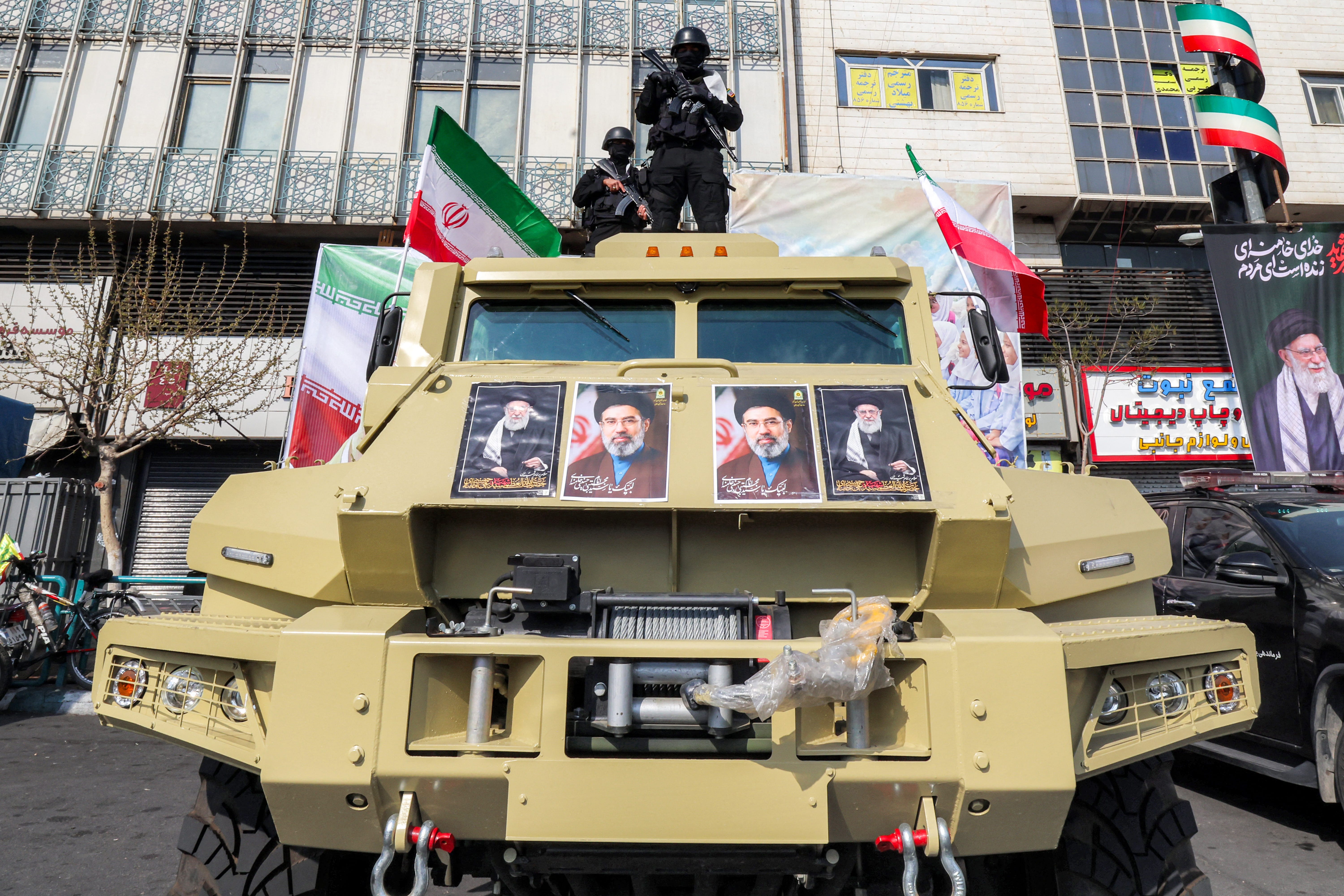
Iran is considering reducing its strikes in most Arab nations that house U.S. military bases while expanding attacks against Israel, a senior Iranian official told Drop Site. Iran’s political and military leaders believe their ballistic missile and drone operations targeting U.S. bases and infrastructure have largely achieved their intended aim of degrading major radar systems and depleting stockpiles of interceptors, said the official, who requested anonymity because he is not authorized to discuss internal deliberations.
“This is a trend we are likely to observe over the course of the coming week in the ongoing conflict,” the senior Iranian official said. “There has been no change to the overall strategy—this continues the previous defensive approach. In the coming days, it is likely that operations will place greater emphasis on targets associated with Israel, while attacks on U.S. bases in the region may decrease to some extent. However, this reduction may not apply to U.S. bases in two particular countries, where such actions could continue.”
The Iranian official declined to name the countries, but over the past two days, Iran has escalated its attacks in Bahrain, which houses the U.S. Navy’s 5th Fleet and plays a central role in the military onslaught against Iran. Tehran has repeatedly said it will continue to target U.S. military infrastructure in countries whose territory is used in attacks against Iran.
“Their territories were used to initiate attacks. We have the right to defend ourselves and this act cannot be interpreted as aggression against other countries,” said Esmail Baghaei, Iran’s Foreign Ministry spokesman, at a press briefing in Tehran Monday. “I hope those countries have learned the lesson. We urge them not to allow their territories to be used by the U.S. or the Zionist entity to stage attacks against Iran.”
The senior Iranian official emphasized that the situation remains fluid and that decisions on which targets to strike, including inside Gulf countries, was subject to ongoing review by Iran’s political and military leadership.
In the early stages of the U.S.-Israeli war against Iran, the Islamic Revolutionary Guard Corps and other Iranian military forces orchestrated a decentralized retaliatory campaign. Within hours of the strike that assassinated Supreme Leader Ayatollah Ali Khamenei, Iran activated a regime of retaliatory strikes based on a bank of targets in Israel and across the Persian Gulf that had been planned in advance. As the war reached the end of its first week, according to the senior Iranian official, military commanders and political leaders shifted to more centrally coordinated operations.
“The political and decision-making system has been restructured. In the military sphere as well, we are witnessing more organized and systematic actions,” the senior Iranian official said. “The military system has been operating in a much more organized way, both in timing and in the choice of targets.” Iran’s overarching military strategy, he said, is aimed at “exerting maximum pressure on U.S. and Israeli interests in the region in order to compel them to move toward halting the war and de-escalating the situation.” President Donald Trump, he said, “has cornered both himself and U.S. interests.”
On Monday, Iran’s Foreign Minister Abbas Araghchi posted an image on X depicting the dramatic increase in oil and gas prices across the world. “9 days into Operation Epic Mistake, oil prices have doubled while all commodities are skyrocketing,” he wrote. “We know the U.S. is plotting against our oil and nuclear sites in hopes of containing huge inflationary shock. Iran is fully prepared. And we, too, have many surprises in store.”
Iran’s New Leader
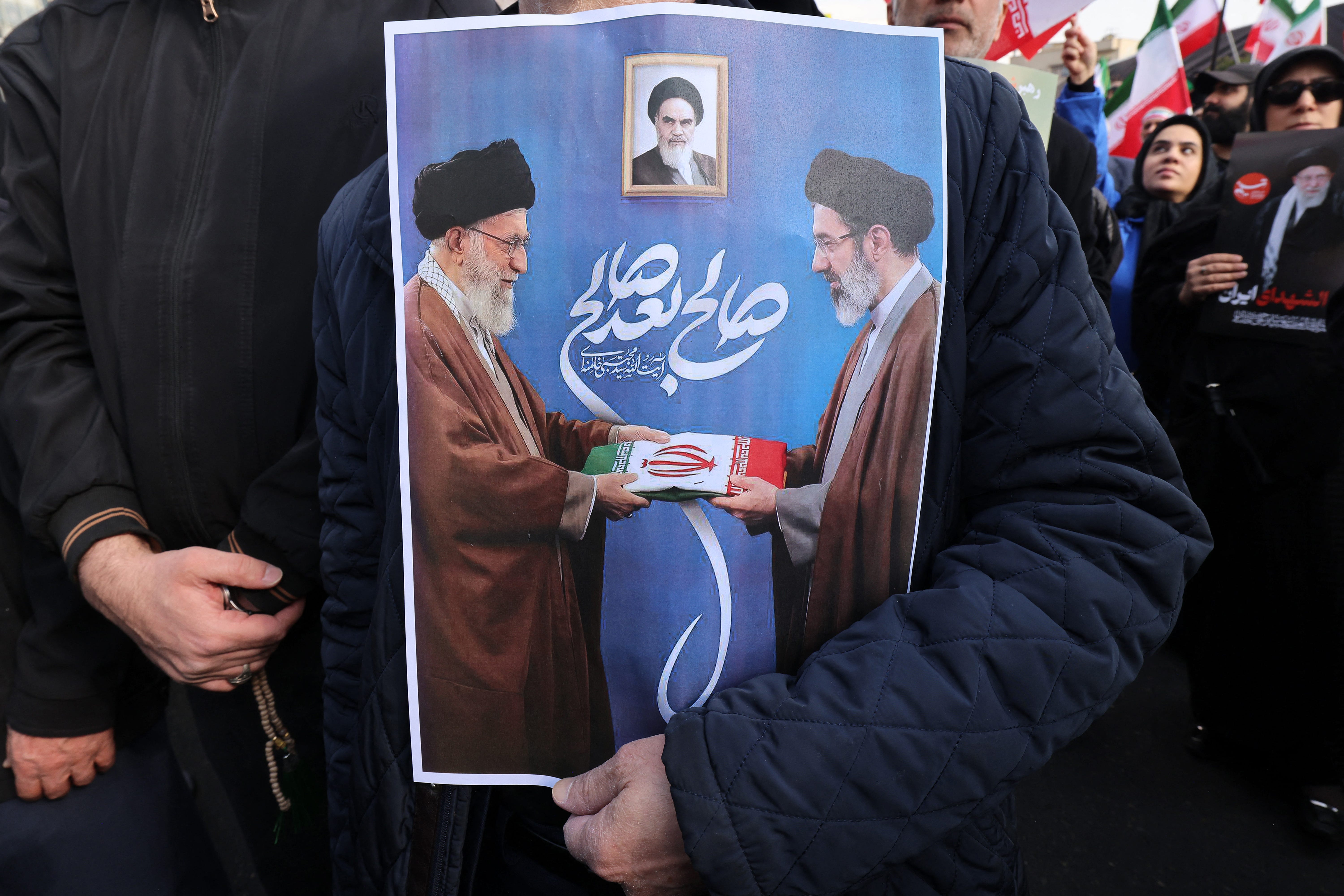
The choice by Iran’s Assembly of Experts to name Ayatollah Khamenei’s son Mojtaba as Supreme Leader was a direct rebuke of Trump’s insistence that he must be involved in choosing Iran’s next leader. Mojtaba Khamenei is known for his close relationship with the IRGC, the most elite military and security force in the country. In addition to the assassination of his father, the U.S.-led war has killed his mother, his wife and one of his children. “He believes in taking a firm and strong stance,” the senior Iranian official said. “This decision will probably escalate the war in the short term.”
The choice of Khamenei was viewed in the upper echelons of power in Tehran as asserting the nation’s sovereignty and continuing the position of no surrender or negotiations based on U.S. or Israeli ultimatums.
“It was not just a symbolic or performative act to defy or spite Trump/Israel but a strategic position in the face of the U.S. and Israeli attempt to break Iran’s will to resist. If any other leader was chosen, this may have been interpreted by Trump as weakness and possibly even surrender to U.S. diktat,” said Amal Saad, a lecturer on international relations and politics at Cardiff University in the UK who is writing a book on Hezbollah and the Axis of Resistance. “For Iran, resistance is itself the source of institutional legitimacy and the entire governing logic of the Islamic Republic is organized around the assertion of sovereignty against imperial pressure, so the threat of escalation does not function as a deterrent but as a consolidating force that reproduces this resistance and sovereignty assertion.”
Khamenei’s succession as Supreme Leader also offers Iran’s military and political system continuity at a moment when both the U.S. and Israel have threatened to assassinate any leader deemed unacceptable by Trump or Netanyahu, said Abdullah Al-Arian, an Associate Professor of History at Georgetown University in Qatar. “There’s also a sense of this being something of a consensus figure who enjoys a tremendous amount of credibility within a lot of the decision-making bodies within the country,” Al-Arian told Drop Site. “But, a lot of that has less to do with just simply the family lineage and more the fact that he was quite active across a number of the key decisions that have been made in recent times and enjoys good relations with a number of different state bodies and institutions, including the IRGC, but not solely the IRGC.”
The internal strategic discussions among the Iranian leadership about its retaliatory strikes in the Persian Gulf seeped into public view on Saturday when President Masoud Pezeshkian released a video statement saying that Iran would end its strikes. “I personally apologize to neighbouring countries that were affected by Iran’s actions,” he said. Pezeshkian’s comments were widely reported as an apology for launching retaliatory strikes in those countries, and Trump celebrated his comments as a sign of weakness and surrender. “Iran, which is being beat to HELL, has apologized and surrendered to its Middle East neighbors, and promised that it will not shoot at them anymore. This promise was only made because of the relentless U.S. and Israeli attack,” Trump wrote on TruthSocial on March 7. “They were looking to take over and rule the Middle East. It is the first time that Iran has ever lost, in thousands of years, to surrounding Middle Eastern Countries.”
Iranian officials moved swiftly to clarify that Pezeshkian’s remarks were misinterpreted, and that the Iranian president was effectively acknowledging collateral damage suffered by Gulf states and that Iran reserves its rights to continue striking any U.S. bases or facilities that initiate attacks against Iran. “The enemy had crude misconceptions about my statements; the enemy wants us and neighboring countries to be at war,” Pezeshkian later said. “If they seek to attack and invade our soil from any country, we are compelled to respond to this aggression.”
Soon after Pezeshkian’s original comments, a desalination plant in Iran was bombed, and Tehran accused the U.S. of launching the attack, saying it was a war crime to target vital civilian infrastructure. “President Pezeshkian expressed openness to de-escalation within our region—provided that our neighbors’ airspace, territory, and waters are not used to attack the Iranian people,” Araghchi wrote on X Saturday after the desalination plant was bombed. “Gesture to our neighbors was almost immediately killed by President Trump’s misinterpretation of our capabilities, determination and intent.”
That night, Iranian forces conducted heavy strikes across the region, including an attack on the U.S. base in Bahrain, which Iran said was the site from which the attack on the desalination plant was launched.
Tactical Shifts, No Surrender
The senior Iranian official maintained that internal discussions about shifting away from strikes inside regional countries and focusing on striking Israel have largely resulted from Iran’s military assessments of the damage inflicted on U.S. capacity in the Gulf. But the possible shift in tactics also coincides with nascent and fragile diplomatic efforts at backdoor diplomacy with countries in the Gulf Cooperation Council. With the exception of Oman, these Gulf states have spent the past week portraying Iran as an aggressor, while almost entirely avoiding any denunciations of the U.S. or Israel. They have characterized Iran’s strikes as attacks on their sovereignty, offering no credence to Iran’s claims to be engaged in retaliation against U.S. military targets.
Over the weekend, Bahrain—with the support of France—circulated a draft UN Security Council Resolution on behalf of GCC countries that “condemns unequivocally in the strongest terms the egregious attacks by the Islamic Republic of Iran.” The draft paints Iran as an unprovoked aggressor flouting international law and deliberately targeting civilian sites. Russia is pursuing its own resolution, which does not name Iran, the U.S., or Israel, but calls on “all parties to immediately stop their military activities and refrain from further escalation” and “condemns in the strongest terms all attacks against civilians and civilian infrastructure.” The Russian draft calls for a return to negotiations “without further delay.”
If Iran does reduce its strikes inside the borders of most Gulf countries, as the senior Iranian official suggested, Tehran would expect those nations to pressure the U.S. to end the war, a political calculation complicated by these states’ reliance on the U.S. military and their deep business ties to Trump and his family. Trump has signed massive business deals in the Gulf and his son-in-law Jared Kushner’s firm is largely bankrolled by Gulf money.
Iran’s Arab neighbors understand they must “walk this tightrope very cautiously” in their approach to Trump, knowing that they could quickly fall out of favor with him, said Al-Arian.
“This comes down to the bigger question about what leverage these states are willing to exert regarding the U.S. and Israel and their maximalist goals and the fact that until the U.S. sees a reason for it to back down from its stated positions, then diplomacy can only go so far between the states of the region,” Al-Arian told Drop Site. “It’s pretty clear that all of this is a result of U.S.-Israeli aggression. The reason that many of these states have probably resisted stating the obvious is in part due to maintaining what they see as a more positive and open direct line to Washington and to the U.S. President. Any words of condemnation in public would be seen potentially as affecting or harming that relationship which they are depending on, in part, to bring this to an end at some point.”
The substantial economic damage that has rocked the region and the global economy over the past week is the most likely pressure point that Trump will face from Gulf nations in any discussions about ending the war, rather than concerns for Iran’s sovereignty or the well being of the Iranian people. “I think the argument that is probably being made is the kind of mutual harm, the broader economic consequences that are now reverberating globally, the shockwaves that are starting to even begin to be felt within the U.S. Economy in a way that’s going to then give the U.S. Administration more domestic considerations going forward,” Al-Arian said. “There’s certainly a fear, based on Trump’s record, of how things could escalate to where countries that are one at one point considered to be staunch allies could all of a sudden find themselves in a different column.”
Iranian officials maintain that they have not reached out in any way to discuss a ceasefire with the Trump administration and that they intend to continue their counterstrikes against Israel and any U.S. bases used in attacks on Iran. “Iran’s position [is] that it will continue to defend itself firmly until a credible and robust framework is established for a ceasefire and for preventing any renewed attacks by the United States or Israel,” said the senior Iranian official.
Saad said she thinks it is unlikely Iran would accept any temporary deal with the U.S. that leaves open the possibility that another war could be launched again in the near future.
“Iran will not accept any ceasefire at this stage because what it is pursuing is not a mere end to hostilities, which can and will be easily broken by Israel and the United States, but a deterrence-restoring outcome that creates the conditions for a lasting and enforceable settlement,” she said. “The strategic logic is that holding out now, despite the costs, is the precondition for an agreement that actually holds—a ceasefire concluded only after Iran has demonstrated sufficient retaliatory capacity to make the cost of violating it prohibitive for the other side.”
Here I am.- wondering from a position of relative luxury in the US - how it is that pedophile in chief Donald and secretary of murder Pete are to be believed by **anyone** - particularly on the current circumstances in Iran and the region. These are serial liars. Proven serial liars. How high are US and Israeli casualty counts, truly? How much of US-Israeli radar capabilities have been destroyed? What is the actual ratio of civilian infrastructure targeted vs Iranian military sites? Neither is legitimate, based on **all** the wildly differing claims for this atrocious killing spree, but the question remains.
I have a learned hunch on all three:
1)"Our" casualty counts are much, much higher than the stated "7" to-date.
2)"Our" early warning and detection systems in the region are severely crippled, if not decimated.
3)"Our" targets are selected not solely on degrading and deterring the Iranian military, but a more systemically inhuman strategy of breaking the very spirit of the Iranian **people**.
After all, nothing says "winning" like scrambling a **third** carrier strike group to the region. Liars and sadists.
Thanks for all the work you guys do at DS News