

New Lawsuit: Do We Have a Right to Know We're Being Surveilled?
Scarsdale, New York didn't want to share its plans for Flock surveillance cameras. A new lawsuit brought by NYCLU seeks to change that.

Do we have a right to know where surveillance cameras are in the town where we live? Police cameras, like the ones used to ticket speeders and track vehicles, are usually easily visible and well marked—at least for now. What happens when they become so small, they’re effectively invisible?
That’s the future of mass surveillance, according to Steven Delbene, the police chief in Scarsdale, New York. Delbene argues this is one of the reasons surveillance camera locations should not be disclosed to the public, in an affidavit opposing the release of surveillance camera locations to the public.
In response, the New York Civil Liberties Union (NYCLU) has now brought a precedent-setting lawsuit against the Village of Scarsdale. After Drop Site reported in 2025 that the surveillance company Flock Safety had surreptitiously landed a $2.1 million contract in Scarsdale, the village board canceled the deal.
“This case is really about democracy and transparency over the ways that people are being surveilled,” the attorney on the case for the NYCLU, Daniel Lambright, told Drop Site.
When Scarsdale resident Josh Frankel found out the village approved a contract with Flock Safety, a $7 billion company, he submitted a request for the cameras’ planned locations.
This information, Frankel believed, would be made available under Freedom of Information Law (FOIL). Frankel’s request was denied. Despite the cancellation of Scarsdale’s contract with Flock, the village didn’t budge. Now, Frankel is suing with NYCLU backing.
The case could set major precedents determining how surveillance companies operate and relate to municipalities in the future:
Are corporations like Flock vendors, selling a product? Or does their work qualify as strategic work for the government, exempting them from certain transparency laws? (Flock is not named in the lawsuit.)
Can the public gain access to the precise locations of their government’s surveillance cameras?
Does the public get to have a say in where surveillance cameras will be placed?
Although cameras like Flock’s are “observable” once installed, Chief Delbene argues that they “may also go unnoticed by many suspects, as it takes some level of sophistication to spot and recognize.” In the village’s response to the lawsuit, he explains that the department may solve more crime if the cameras are unobserved, or, one day, unobservable.
Eventually, even the most sophisticated observer may not be able to spot Automated License Plate Readers (ALPRs). Delbene continued, “I also note that the equipment itself has evolved and generally become smaller and more discrete as technology has improved. I would expect that trend to continue.”
Attorneys for the NYCLU don’t see a legitimate legal defense for withholding this information from the public. Lambright told Drop Site that Scarsdale’s response to the suit “relies on numerous hypotheticals and it’s quite shocking that they would fight so hard to try to keep this from the public.”
The village has argued that correspondence with Flock is not public record, under the “inter-agency” exemption, which Lambright says is “meant to protect communications between government officials,” not vendors.
The lawsuit hinges on the interpretation of FOIL legal jargon, like whether camera locations are “factual” information or “deliberative.” The village argues camera locations are a part of ongoing police strategy, meaning it’s deliberative information. According to the NYCLU, this information is factual. “The locations are just straight data. It’s not something like an opinion,” Lambright explained to Drop Site.
Flock’s recent scandal in Dunwoody, Georgia raises new concerns around camera locations. Flock employees were found viewing live cameras that had been placed in the Marcus Jewish Community Center of Atlanta (MJCCA), as revealed by a Georgia Open Records request for view logs. Flock responded by saying the employees accessed the camera feeds for a sales demo, even though one employee, Bob Carter, had logged into the system, viewed the children’s gymnastics studio, and logged out. Flock’s CEO Garrett Langley apologized in a private email to Jared Powers at the MJCCA, obtained via a records request. Langley wrote, “I want to be direct and apologize for our poor judgement… I apologize on behalf of Flock for the lack of thoughtfulness.”
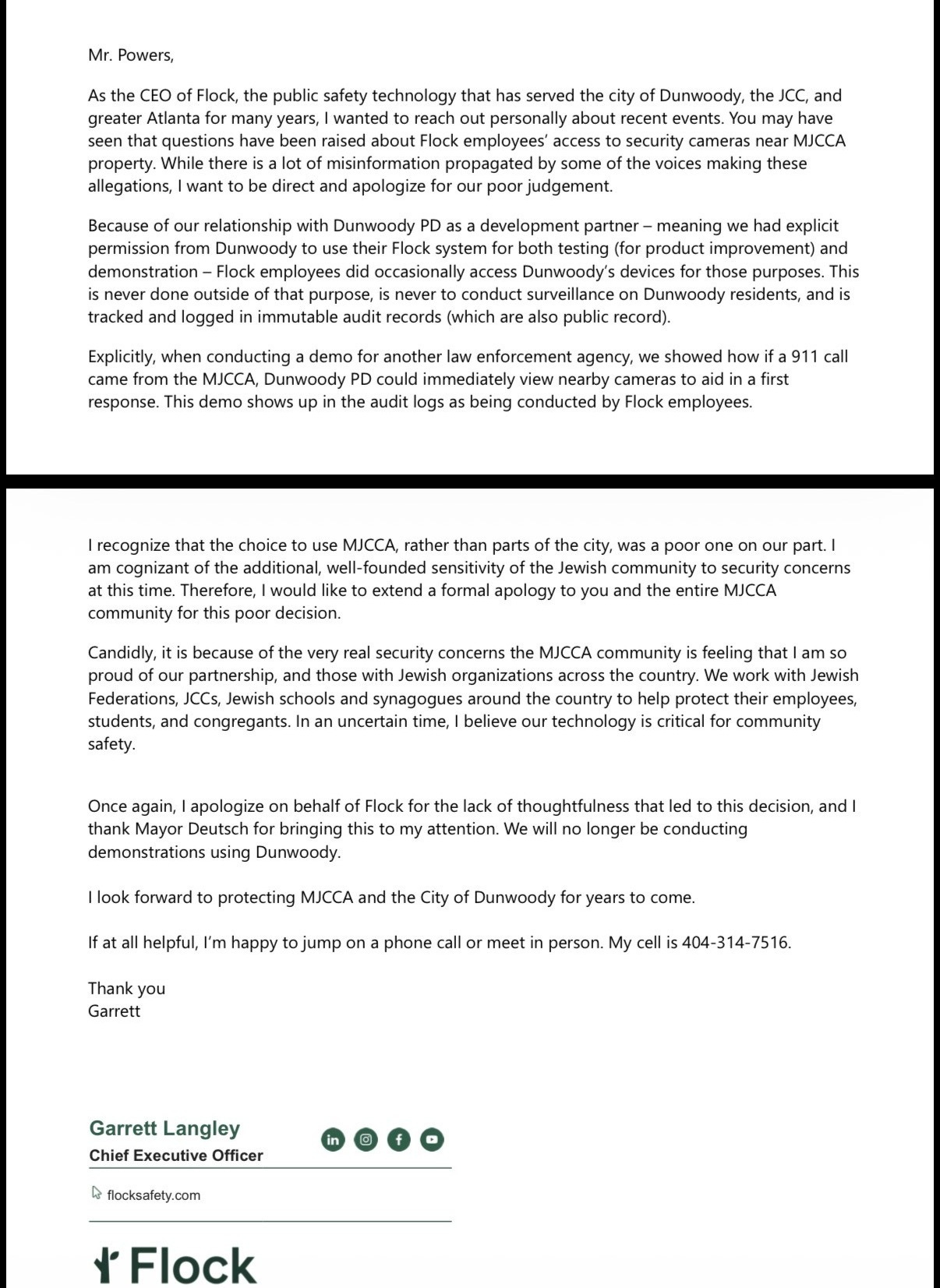
Days after the story broke, the Dunwoody City Council voted unanimously to expand their contract with Flock, despite intense backlash from residents and MJCC parents.
While tech-based policing is often sold as an unbiased solution to human decision makers, camera locations may be a decision that reinforces racial biases, Lambright argues. “We need to know whether these camera locations are reinforcing racial bias… police have said oh, we’re just putting the cameras where the crime is but again, we also know that where the crime is, is determined based on racialized data based on racist policing practices in the past.”
Lambright explained to Drop Site that the goal of the case is to set a precedent for communities across the state and country:
Part of the reason that the NYCLU is involved in this case is because it affects everyone and we want this case to have a precedent… even though Scarsdale is an affluent community, communities in other areas that are less affluent can utilize our case law to fight against law enforcement and municipalities who don’t want to provide them the location against the cameras.
Lambright views the public backlash against companies like Flock as straightforward: “I think people just also don’t want to be surveilled.”
 | A guest post by
|
Thank you Jessica, Later in Benn Jordan's video he talks about Flock's impact on creativity amid mass surveillance and if it's possible? Flock destroys John Cage's #1 Rule to live by.
*SOME RULES AND HINTS FOR STUDENTS AND TEACHERS* BY JOHN CAGE
RULE ONE: Find a place you trust, and then try trusting it for awhile.
Benn Jordan and 404 Media>>>This Flock Camera Leak is like Netflix For Stalkers:
https://www.youtube.com/watch?v=vU1-uiUlHTo
+ ‘Communities are watching’: Atlanta metro area residents increasingly concerned about Flock
From city halls to campus organizing and public records battles, Metro Atlanta residents are joining a growing national movement pushing back against Flock Safety cameras and mass surveillance.
BY TIMOTHY PRATT , APRIL 17, 2026
https://atlpresscollective.com/2026/04/17/atlanta-metro-residents-increasingly-concerned-about-flock-safety/
+ Another concern is voting. My polling place is covered up in flock and so is our early voting location; that’s just great!
"In the village’s response to the lawsuit, he explains that **the department may solve more crime if the cameras are unobserved, or, one day, unobservable**."
Perhaps - from a non-meathead perspective - we could "solve more crime" by addressing **root** causes: poverty, discrimination, wealth disparity, weapons proliferation, poor education, etc etc to infinity.
I remember the original piece from Drop Site when it was first reported and I thought "why the hell aren't people in my own community even bothered by this system?" And I talk to people about it. A lot.