
On the Streets of Havana, Hope That a Lack of Oil to Steal Staves Off a U.S. Attack
Destroying the relationship between Cuba and Venezuela has long been a goal of South Florida hardliners like Secretary of State Marco Rubio

We wanted to take this opportunity to introduce you to a new journalist who has joined our team, and will be helming Drop Site’s expanding coverage of Latin America. José Luis Granados Ceja is a veteran reporter and presenter based in Mexico City. He won’t often join our Tuesday morning livestream, because that’s when he co-hosts his Mexican show Sin Muros, which airs on the largest public television channel there. You’ve probably already read some of the pieces he has written or commissioned or seen him on Breaking Points or elsewhere. You can also catch his weekly English-language podcast covering Mexican politics called Soberanía.
Give him a warm welcome by following him on Twitter if you still use that godforsaken platform. (Speaking of Twitter, last night Vice President J.D. Vance used his account there to come after me as somebody “incapable of not lying” about the killing of Renee Good. Of course, he lied himself in the same post.)
This week on Breaking Points, if you missed it, we talked about the history of Cuba’s defense of Angola against an invasion by apartheid South Africa, their largest foreign intervention by far. U.S. funding for Angolan insurgents wound up becoming an under-appreciated piece of Iran-Contra, where Jeffrey Epstein cut his teeth. Watch our interview with Blowback podcast host Noah Kulwin here.
Today’s story is written by Ed Augustin and Reed Lindsay, and published in collaboration with the news outlet Belly of the Beast, an independent media organization that covers Cuba and U.S.-Cuba relations. Augustin and Lindsay examine the history and future of the relationship between Cuba and Venezuela in the wake of the U.S. kidnapping of Nicolas Maduro. Read some of Ed’s previous reporting for Drop Site here.
In listening to Blowback’s season on the history of the Angolan civil war in order to prepare for the interview with Kulwin, I was struck by how significant a role corrupt news coverage played in allowing U.S. policy there to unfold as it did and how critical it was when good coverage intervened – such as by Seymour Hersh and others, who exposed the CIA’s dirty war or the war crimes and use of child soldiers by Jonas Savimbi, our man in Angola. If the U.S. role had been documented more thoroughly, and if the genuinely deranged nature of Savimbi had been exposed early, hundreds of thousands of Angolan lives may have been saved and the country could have gotten on with its economic development.
Good, honest, and timely journalism can change history. Being reminded of that made me that much prouder of the work we’re doing here at Drop Site, and that much more grateful to the tens of thousands of you who have donated your hard-earned money to make it possible.
Now that it’s a new year, forgive us as we come back asking again. If you haven’t yet become a paid subscriber, please consider doing so.
If you can make a separate tax-deductible contribution of any amount, that helps immensely, too.
The Cuban government has now confirmed that 32 of its nationals were killed in Venezuela trying to protect Maduro and his wife Cilia Flores when they were abducted by U.S. Special Forces on Saturday. Below, we break down what we know so far and talk to Cubans about how they’re reacting to the news.
We also take a deep dive into why these Cubans were in Venezuela in the first place — and why claims that they were an army “propping up” Maduro don’t hold up.
—Ryan Grim
In Havana, Hope That a Lack of Oil Staves Off a U.S. Attack
Story by Ed Augustin and Reed Lindsay
Cubans observed two official days of mourning earlier this week after a contingent of its security forces were massacred guarding Venezuelan President Nicolás Maduro. Flags were flown at half-mast, and concerts were canceled.
“No country has the right to invade another,” one woman told us on the streets of Havana. “Those Cubans were there at the request of the Venezuelan government to protect Maduro…The blood we’ve shed unites us.”
Are people on the island afraid that Cuba could be next?
“I’ll be honest with you…a little,” said one.
“Everyone knows it’s about oil. I don’t think they’ll come and bomb Cuba,” hoped another.
“We’ve lived under threat our entire lives, even [of] an invasion. And we defeated them,” said a third. (Watch the interviews here.)
“What's happening to Venezuela could happen to any Latin American country,” said a 19-year-old studying microbiology at university to work in healthcare. “I want to graduate. But you never know what will happen in three years, even if Donald Trump will still be president.”
One hundred people, including civilians and security forces, were killed in the U.S. attack on Venezuela, according to the country’s interior minister, Diosdado Cabello.
The Guardian reports it took the U.S. two hours and twenty-eight minutes from the time its helicopters touched down in Maduro’s compound in Caracas at 2:01 a.m. to seize the president and his wife. Maduro, the paper reported, had tightened his security measures leading up to his abduction and was relying on Cuban bodyguards.
But the lack of a response from the Venezuelan military and the disparity in the death toll—the U.S. reported no casualties—have fueled speculation abroad about betrayal.
Venezuela’s interim President Delcy Rodríguez fired General Javier Marcano Tábata, who headed the Directorate General of Military Counter-Intelligence and was responsible for Maduro’s security. Rodríguez herself has come under question due to a report that she and her brother and head of the National Assembly Jorge Rodríguez had been leading talks in Qatar with the Trump administration about a “more acceptable” alternative to Maduro in the months leading up to the U.S. attack.
The imbalance in casualties, however, may have more mundane explanations.
“The Americans obviously came in with a great deal of firepower and simply overwhelmed them,” said Hal Klepak, Professor Emeritus of History and Strategy at the Royal Military College of Canada. “That’s an American tactic throughout Latin American history over almost two centuries. You don’t go in with the minimum; you go in with the maximum.”
Venezuela’s Defense Minister Vladímir Padrino on Sunday read a statement from the Bolivarian Armed Forces, accusing the Trump administration of “murdering in cold blood a large part of their security team, soldiers and innocent citizens.”
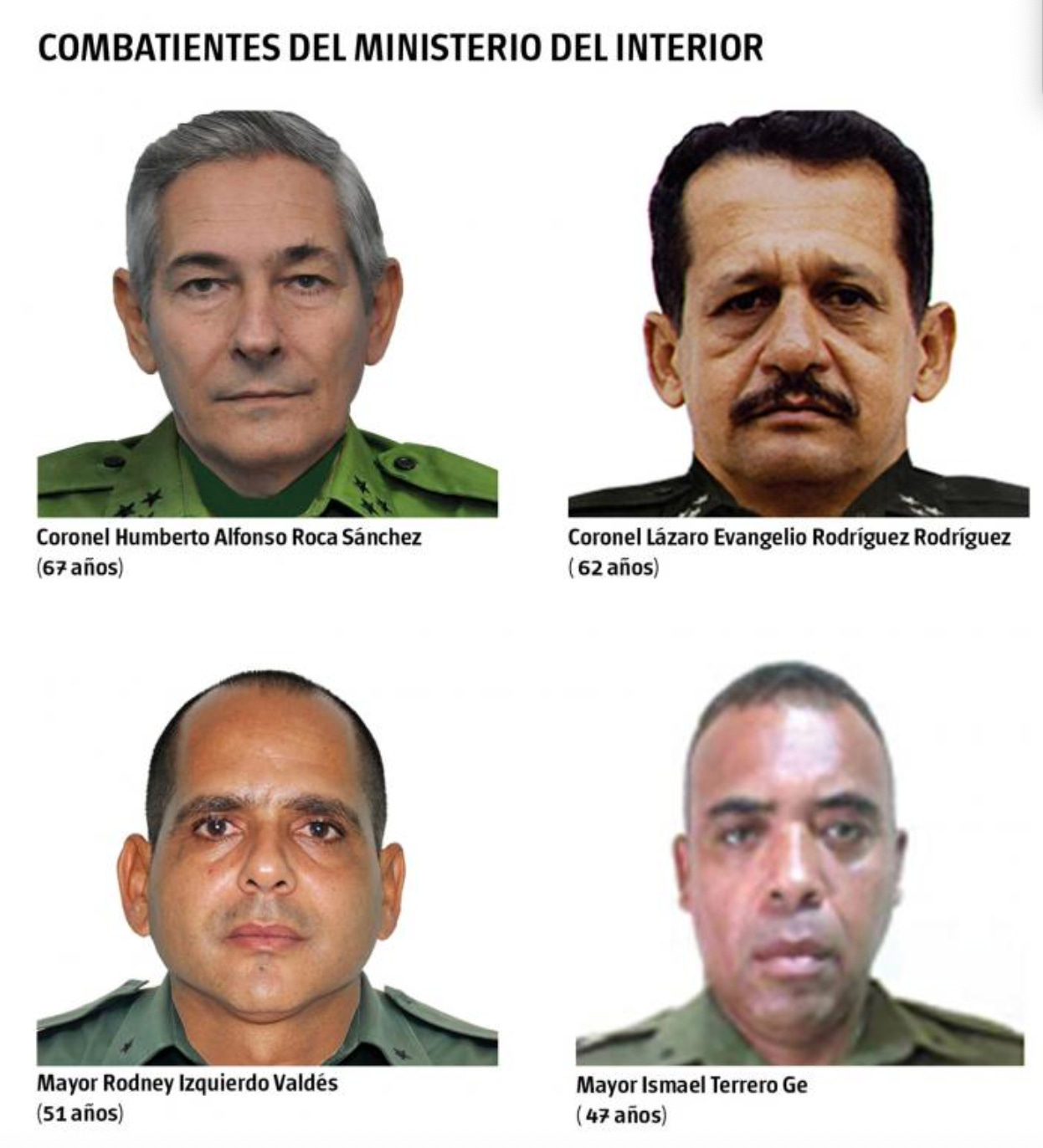
On Tuesday, Cuba published the headshots, names, ranks, and ages of the 32 Cuban officers killed by the U.S. The list included colonels, lieutenants, majors, captains, and reservists ranging in age from 26 to 60.
What Were Cuban Security Forces Doing in Venezuela?
After the election of socialist President Hugo Chávez in 1998, Venezuela quickly became Cuba’s closest ally. Very early in his term, Chávez signed alongside Fidel Castro the Cuba-Venezuela Comprehensive Cooperation Agreement that saw Cuban specialists lend their expertise inside of Venezuela in the fields of culture, education, health, and more. Venezuela has the largest oil reserves in the world, but its healthcare system had always faced medicine and staff shortages. Cuba sent thousands of doctors and nurses to work in Venezuela, where they were paid many times the tiny salaries they earned in Cuba. In exchange, Venezuela shipped oil to Cuba.
This relationship, in the hands of hardline forces in South Florida, became fodder for longtime advocates of regime change in Havana and Caracas. Venezuela was routinely accused of propping up Cuba and, when it was necessary for the narrative, Cuba was accused of doing the same for Venezuela.
U.S. Secretary of State Marco Rubio has tried to depict the Cuban medical missions as “forced labor” and expanded an existing visa restriction policy relating to Cuba’s overseas medical missions targeting foreign government officials to dissuade countries from signing similar agreements with Cuba.
For years, U.S. officials complained that oil-rich Venezuela was propping up Cuba with subsidized oil. Then, in 2019, the first Trump administration flipped the script.
That year, Trump called Maduro a “Cuban puppet.” Then-Vice President Mike Pence accused Cuba of keeping the Venezuelan people “hostage.” U.S. Special Representative for Venezuela Elliot Abrams said Venezuela was a “colony” of Cuba, and Secretary of State Mike Pompeo claimed the island was “the true imperialist power in Venezuela.”
Then National Security Adviser John Bolton, who oversaw a failed effort with Rubio, then a senator, to bring about regime change in Venezuela, claimed there were as many as 25,000 Cuban “thugs” propping up the Maduro government. “Maduro would fall by midnight” if not for the Cubans, Bolton told reporters in April 2019. (For more see the second episode of Belly of the Beast’s award-winning documentary series, The War on Cuba).
Venezuelan opposition leader María Corina Machado likened the presence of Cuban advisors inside Venezuela to an “invasion” and made it part of her push for U.S. military intervention inside her country. No credible evidence was ever presented that Cuba had thousands of troops in Venezuela.
“I don’t think it’s any mystery that we are not big fans of the Cuban regime, who, by the way, are the ones that were propping up Maduro,” Rubio told NBC’s “Meet the Press” last Sunday.
The vast majority of Cubans who have gone to Venezuela have served as doctors and nurses, as well as teachers and sports coaches. One of them is Dr. Lyhen Fernández Baez, a urologist, who was recently interviewed by her daughter, Belly of the Beast journalist Liz Oliva Fernández, about her experience serving on a medical mission in Venezuela.
Manufacturing a Security Crisis
For months, the Trump administration said its deadly boat strikes and military build-up in the Caribbean were aimed at fighting “narcoterrorism.” The Justice Department claimed Maduro was leading a drug cartel called “Cartel de los Soles.”
But this week, the administration quietly dropped that claim in a revised indictment, acknowledging that the so-called cartel isn’t a real drug-trafficking organization—even as Maduro still faces narcoterrorism and drug trafficking charges in a federal court.
Concocting far-fetched accusations to legitimize hostility has been the U.S. government’s playbook for decades when it comes to Venezuela—and Cuba. For example, the island occupies multiple State Department blacklists, accused of carrying out human trafficking via its medical missions and even sponsoring terrorism despite consensus to the contrary in the U.S. intelligence community.
The two countries’ close relationship has also provided fodder for neoconservatives like Abrams and Bolton, who both have decades of experience scheming up ways of overthrowing governments around the world.
Abrams, convicted for “withholding information from Congress” during the Iran-Contra Affair, was “the crucial figure” in Washington during the bungled Venezuela coup d’état that briefly deposed President Hugo Chávez from power in 2002, according to The Guardian. (The New York Times on Wednesday released a 52-minute interview with Abrams to help their readers understand “what is actually happening in Venezuela.”)
Bolton, who once falsely claimed that Cuba was developing biological weapons, argued in 2019 that Cuba, Nicaragua and Venezuela form a “troika of tyranny” and a “triangle of terror” in the Western Hemisphere, reminiscent of the “axis of evil” rhetoric he employed during the George W. Bush years.
Led by Bolton and Abrams, the Trump administration did not abandon the claim that Venezuela propped up Cuba; it simply doubled down on its inverse. U.S. officials have toggled between portraying Caracas as Havana’s benefactor and Havana as Caracas’s puppet master—contradictory narratives that nonetheless converged on the same policy goal: sweeping “maximum pressure” sanctions on both countries, including measures aimed at cutting Venezuelan oil exports.
“Patently False” Claims
Security experts say U.S. government claims about Cuba’s influence in Venezuela are grossly exaggerated. Ben Rhodes, a former U.S. deputy national security advisor who played a key role in negotiating the normalization of U.S.-Cuba relations during President Barack Obama’s second term, has disputed the claim that Cuban military personnel in Venezuela numbered in the tens of thousands.
“The only way you get to those numbers is to count doctors as security officials,” Rhodes told us in an interview back in 2019.
“The number of Cuban security officials alleged by the U.S. government was patently false,” said Fulton Armstrong, who served as the National Intelligence Officer for Latin America from 2000 to 2004. “The vast majority are civilian doctors, teachers, and coaches, and many are women.”
“We know that there were indeed Cubans in Maduro’s security detail, but perhaps now, we can also put to rest that the Cubans ‘ran’ Venezuela’s security plan because they apparently didn’t have any indication of the attack until it was upon them,” he added.
Cuban-Venezuelan cooperation deepened after the 2002 coup, with the Cubans assisting in the creation of security services and military intelligence capacity in Venezuela, according to Klepak, the former NATO analyst who also served as an advisor to the foreign and defense ministers of Canada.
He added that Cuban officers have long been posted in limited numbers within the Venezuelan armed forces’ command system, and that in recent years they’ve been connected to natural disaster relief efforts.
“The UN has often hailed Cuba’s [disaster response] system as the best or one of the best in the world and a model for other countries. Venezuela is prone to natural disasters, but its forces had a dismal record for dealing with them. Thus, asking Cuba for assistance was obvious,” he said. “But the idea that this tiny military presence is in any way an occupying army or that it is anything like 1,000 people, never mind 25,000 people, is simply politically motivated.”
“Bolton’s continued emphasis [of Cuba’s presence] says more about the Trump White House than Venezuela,” Rhodes said in 2019. “They have an agenda to go after both Venezuela and Cuba…their approach seems to be nakedly political and ideological — using regime change in Venezuela as an entry point to pursue regime change in Cuba.”
This approach is unchanged with Rubio steering U.S. policy in the region.
Cuba’s Long History of Resisting U.S. Intervention
It’s not surprising that Venezuela would turn to Cuba for help in defending itself from U.S. aggression.
The island has weathered a U.S.-backed invasion, acts of sabotage, repeated terrorist attacks, and numerous assassination attempts on Fidel Castro. Cuba’s intelligence service is renowned, in particular for repeatedly outmaneuvering the CIA.
Decades ago, Cuba was also known for an “internationalist” military that punched above its weight, sending military contingents to face off against U.S.-backed forces in Africa, the Middle East and Latin America.
While Abrams was secretly arming right-wing paramilitaries to overthrow the left-wing Sandinista government in Nicaragua in the 1980s, Cuba sent their Marxist allies military advisors.
When the leftist New Jewel Movement came to power on the tiny Caribbean island of Grenada after it won independence from Britain, Cuba sent intelligence operatives and troops to support the fledgling government. The Reagan administration called Grenada a “Cuban-Soviet colony” in 1983 and invaded it.
Cuba’s most successful foreign military intervention was in Angola, where Cuban soldiers fought with the left-wing People’s Movement for the Liberation of Angola. From 1975 to 1991, Cuba deployed hundreds of thousands of troops to the country—by far the largest overseas military engagement ever conducted by a Latin American country. Cuba was credited with helping bring about the fall of apartheid in South Africa.
“The Cuban internationalists have made a contribution to African independence, freedom and justice unparalleled for its principled and selfless character,” said Nelson Mandela during a visit to Cuba in 1991.
But when the Soviet Union disintegrated, Cuba’s economy went into a tailspin, and the foreign military interventions ended.
“The Cuban armed forces were cut massively from between 270,000–290,000 in the 1980s to between 55,000–60,000,” said Klepak, adding that the armed forces have been reduced to a home defense force with little to no capacity to project force beyond the island.
An Inconvenient Truth for Regime Changers
Over the years, Cuba has become one of the U.S. government’s most reliable security partners in the Caribbean.
Since the 1990s, Cuban and U.S. armed forces have collaborated closely on counternarcotics operations and efforts to stop illegal migration, according to Klepak. Cuba’s strategy, Klepak argues, has been to build confidence, “to create a body of people in the U.S. government who see Cuba as a natural and effective ally in security issues.”
With the days of large-scale Cuban military internationalism long gone, regime changers are left with an inconvenient truth. According to Klepak, “however much both sides try to downplay it, until the [first] Trump administration, the closest security relationship that Cuba had was with the United States of America.”
Now, with Maduro out of the picture and nearly three dozen Cubans dead, the claims that Cuba is propping up Venezuela appear more absurd than ever.
The opposite claim—that Venezuela is propping up Cuba—may also no longer be true.
In 2025, Venezuela was shipping less than 30,000 barrels a day to the island, about 70% less than what it was sending a decade earlier. This fuel lifeline has been further cut in recent weeks as the Trump administration ordered “a total and complete blockade” of sanctioned oil tankers. In recent years Mexico has become the primary supplier of oil to Cuba, with President Claudia Sheinbaum portraying the shipments as part of her government’s humanitarian efforts in the Caribbean and a longstanding policy of Mexico.
The U.S. is placing extraordinary pressure on the interim administration in Venezuela to cut ties with Cuba and it is not clear yet what will happen to other aspects of the two countries’ relationship, and whether the Cuban doctors, nurses, and teachers who are serving on humanitarian missions in Venezuela will be forced to return home.
If they are, they may be replaced by U.S. oil executives. Rubio said on Wednesday that the administration was about to finalize a deal with the Venezuelan government to “take all the oil,” adding that the U.S. had “a lot of leverage” because of its continuing blockade on Venezuelan oil exports.
Meanwhile, the heads of ExxonMobil, Chevron, and ConocoPhillips met with Trump Friday to discuss his plans to “run” Venezuela and control its oil industry.
At the meeting, Trump continued to vex those looking for an end-game behind his assault. “We are open for business,” he said. “China can buy all the oil they want from us, there or in the United States. Russia can get all the oil they need from us.”
Amba Guerguerian and Liz Oliva Fernández contributed to this article.
This piece makes clear how “security threats” are manufactured to justify the same old regime-change playbook. The whiplash narrative—Cuba as Venezuela’s puppet master one year, Venezuela as Cuba’s lifeline the next—reveals how little truth matters when the real objective is control over oil and political obedience. The deaths of Cuban guards and Venezuelan civilians aren’t abstractions; they’re the human cost of decades of sanctions, disinformation, and militarized diplomacy. If the U.S. truly cared about stability or democracy in the region, it would stop strangling economies and start respecting sovereignty. Independent reporting like this is essential precisely because it punctures the myths used to sell permanent intervention.
Any information about whether Rubio's parents were part of the Batista regime?