

Rubio to brief Congress on Iran before SOTU; Gaza hit by flooding; RSF kills 28 in North Darfur
Drop Site Daily: February 24, 2026


Israeli strikes continue across Gaza, killing one. Flooding hits displacement camps in Gaza. Board of Peace explores dollar-pegged stablecoin. Israel approved tens of thousands of settlement homes while Palestinian construction was largely blocked. Military and intelligence officials size up U.S. operation against Iran. Iran nears deal to acquire Chinese anti-ship missiles. Secretary of State Marco Rubio will brief House and Senate leaders on Tuesday afternoon ahead of President Donald Trump’s State of the Union address. U.S. military kills three in Pacific vessel strike. Supreme Court weighs scope of Helms-Burton Act in Cuba property claims. Former ICE instructor alleges training standards were slashed amid deportation surge. U.S. orders partial embassy drawdown in Lebanon. Islamic State kills four Syrian security personnel; U.S. expects to fully withdraw within a month. Mexico says cartel unrest has eased. RSF attack in North Darfur kills 28. Over a dozen killed in attack in South Sudan. Gulf states back Kuwait after Iraq submits new maritime claims to the United Nations. Attacks on southern Ukraine and possible Ukrainian military advances. Thai Navy seizes Cambodian fishing boat. Former UK ambassador to the U.S. Peter Mandelson released on bail.
New from Drop Site: Iranian officials discuss the “unbelievable flexibility” the country has shown in negotiations with the United States. Drop Site on the Hill. New video about congressional stock trading from Julian Andreone.
This is Drop Site Daily, our free daily news recap. We send it Monday through Friday.
The Gaza Genocide, West Bank, and Israel
Casualty counts: Over the past 24 hours, seven Palestinians were injured in Israeli attacks in Gaza. The total recorded death toll since October 7, 2023 stands at 72,073 killed, with 171,756 injured. Since October 11, the first full day of the so-called ceasefire, Israel has killed at least 615 Palestinians in Gaza and wounded 1,658, while 726 bodies have been recovered from under the rubble, according to the Palestinian Ministry of Health.
Israeli strikes continue across Gaza, killing one: One Palestinian was killed and several others injured in an Israeli strike on Beit Lahiya on Tuesday, in northern Gaza. Two Palestinians were injured by Israeli gunfire in the Shujaiya neighborhood of Gaza City, according to Al Jazeera Arabic. Israeli forces launched airstrikes on areas east of Khan Younis, while Israeli artillery targeted western Rafah in the southern Gaza Strip and east of the Bureij refugee camp in the central part of the Strip.
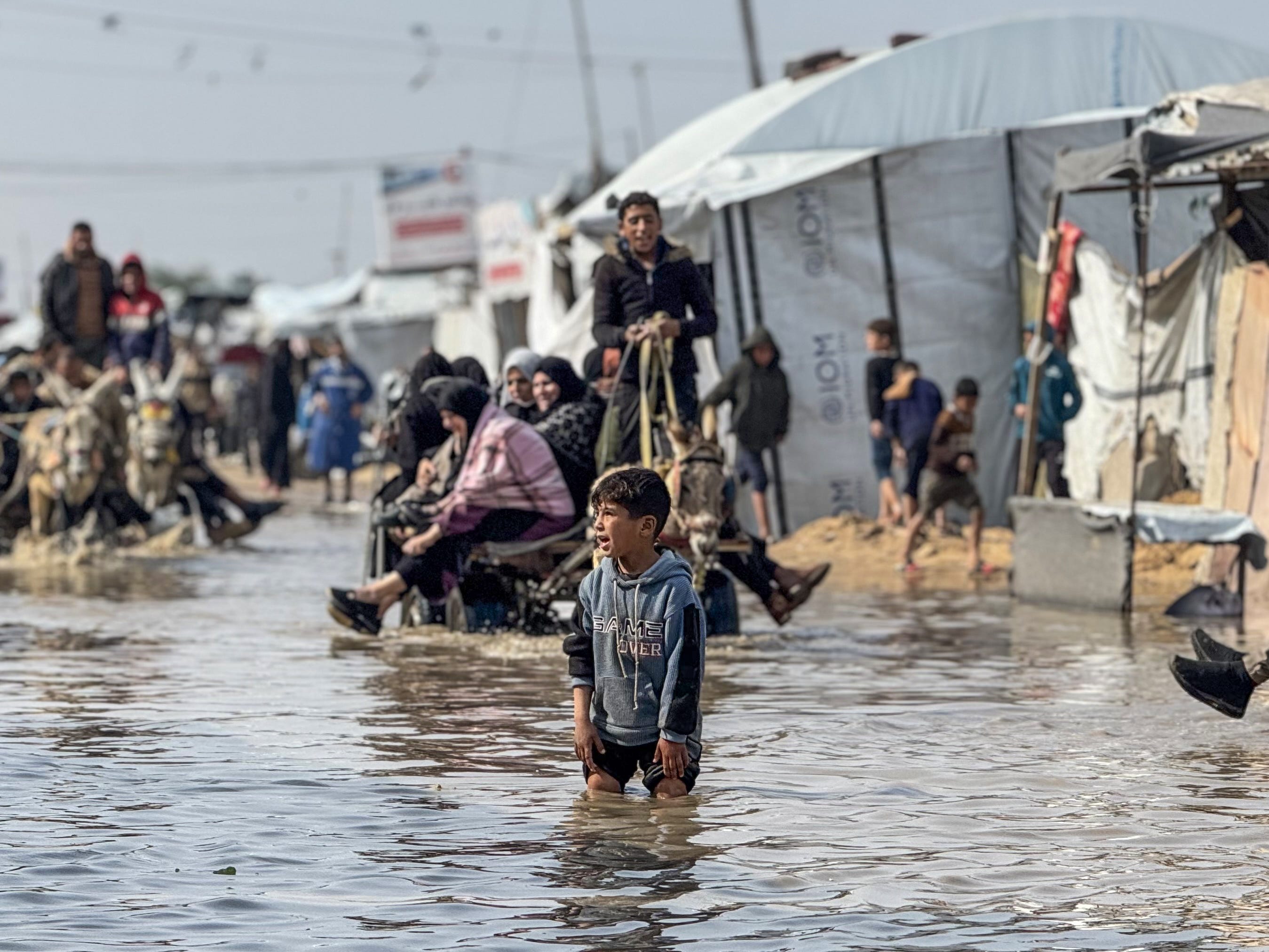
Flooding hits displacement camps in Gaza: Overnight, heavy rains flooded hundreds of displacement tents across the Gaza Strip, with submerged roads in areas like Al-Mawasi prompting urgent rescue calls, according to Civil Defense officials. Israel’s siege is blocking heavy machinery and rescue equipment needed to respond, municipal officials report. UNRWA has warned that shortages of shelter materials have left more than a million displaced people exposed to the rain and cold.
Board of Peace explores dollar-pegged stablecoin: Officials working with President Donald Trump’s “Board of Peace” are considering launching a U.S. dollar–pegged stablecoin in Gaza, the Financial Times reports. Cash circulation and banking systems in Gaza have been severely curtailed since October 2023. Critics warn that a Gaza-only digital currency might further separate the enclave economically from the West Bank and consolidate external financial control. Chronic electricity shortages in Gaza and Israeli restrictions on mobile networks have also raised doubts about the feasibility of the currency alternative.
Israeli prison chief hosts synagogue group at Ramle detention site: Israel’s prison chief Kobi Yaakobi brought around 20 congregants and a rabbi from his synagogue in the illegal Har Homa settlement in East Jerusalem to tour the Nitzan detention center in Ramle on Monday, according to Channel 12. Witnesses said Palestinian detainees were shown handcuffed, shackled, and lying face-down during the visit, which included a religious sermon and lunch. The Israel Prison Service said the rabbi had entered to “bless” the prison’s guards.
Settlers deface West Bank mosque: Israeli settlers torched and vandalized the Abu Bakr Al-Siddiq Mosque in Tell, near Nablus, early Monday during Ramadan, spray-painting insults against the Prophet Muhammad and the words “revenge” and “price tag,” according to the Palestinian Authority. Security footage showed two suspects carrying gasoline and paint. Forty-five West Bank mosques were vandalized or attacked last year, according to the PA’s Ministry of Religious Affairs.
Israel approved tens of thousands of settlement homes while Palestinian construction was largely blocked: Between 2009 and 2020, Israeli authorities issued just 66 building permits to Palestinians in the occupied West Bank’s Area C, while approving roughly 22,000 housing units for Jewish settlers, according to a new report from Haaretz. With construction permits effectively barred, thousands of Palestinian structures have been demolished—including 2,461 over the past two years alone—displacing about 2,500 people, data from the United Nations Office for the Coordination of Humanitarian Affairs show. Israel’s security cabinet recently approved wide-ranging steps aimed at deepening Israeli control in the occupied West Bank and enabling further growth of settlements.
Israel cancels travel authorizations to block foreign activists from entering the West Bank: Israel has begun to revoke electronic travel authorizations under its new visa-free ETA system, intending to deny entry to foreign activists en route to the occupied West Bank, according to +972 magazine. Activists who documented settler violence or provided protective presence said their approvals were abruptly canceled—often after soldiers scanned their passports. The new policy has targeted citizens from countries including the United States, the United Kingdom, France, Germany, Canada, and Australia.
Iran
Iranian officials discuss upcoming talks and state of negotiations: U.S. and Iranian negotiators are set to begin a new round of talks in Geneva aimed at averting a widening conflict on Thursday, even as President Donald Trump demands sweeping concessions on uranium enrichment, ballistic missiles, and regional alliances. Iranian officials told Drop Site that Tehran has shown “an almost unbelievable level of flexibility on the enrichment issue” on the nuclear issue to prevent war, though they warn that Washington’s escalating threats suggest regime change may be the real objective and that Iran will not hesitate to respond. The latest article from Jeremy Scahill and Murtaza Hussain is available in full here.
Iran nears deal to acquire Chinese anti-ship missiles: Iran is close to finalizing an agreement to purchase Chinese-made CM-302 supersonic anti-ship cruise missiles, according to six sources cited by Reuters, as the United States has deployed a major naval force in its vicinity ahead of possible strikes. The missiles have an estimated 180-mile range and are designed to evade ship defenses, and if acquired, would significantly enhance Tehran’s ability to target U.S. vessels. Doubts remain about whether or not Beijing will complete the transfer under the circumstances, but the sale would represent one of China’s most advanced weapons transfers to Iran in decades.
Military and intelligence officials size up U.S. operation against Iran: Gen. Dan Caine, the chairman of the Joint Chiefs of Staff, reportedly warned Trump that the military may face munitions shortages and resistance from U.S. allies, and discussed the possibility that a conflict with Iran could become prolonged and costly, according to a new report from The Washington Post. Trump later called the Post’s account “100% incorrect,” and said that Caine believes any war would be “easily won.” Axios and The Wall Street Journal later confirmed the report from WaPo. An Israeli intelligence official told the Financial Times that, even with the imminent arrival of a major U.S. aircraft carrier, the United States could likely sustain only four to five days of intense air operations—or about a week at lower intensity—against Iran.
United States
State of the Union: President Donald Trump will address the nation on Tuesday evening in his second State of the Union since taking office again. Democratic Reps. Ro Khanna, Jamie Raskin, and Suhas Subramanyam have invited Epstein’s accusers to attend, while another set of Democrats is holding a rally outside. At 3 p.m., hours before SOTU, Secretary of State Marco Rubio is set to brief House and Senate leaders on Iran.
U.S. military kills three in Pacific vessel strike: The U.S. military conducted a strike on a boat in the Caribbean on Monday, killing three people, according to U.S. Southern Command. SOUTHCOM posted video of the strike and claimed without evidence they were engaged in narco-trafficking, saying “Three male narco-terrorists were killed during this action.” The Trump administration’s targeting of vessels has killed over 150 people in dozens of strikes on boats in the Pacific and Caribbean since September.
Supreme Court weighs scope of Helms-Burton Act in Cuba property claims: The U.S. Supreme Court heard arguments on Monday in two cases testing the reach of the 1996 Helms-Burton Act, which codified the U.S. embargo on Cuba and allows Americans to sue over property seized after the 1959 revolution, Reuters reports. ExxonMobil is seeking more than $1 billion from Cuban state firm CIMEX, while Havana Docks Corporation is suing Carnival Corporation, Royal Caribbean Group, Norwegian Cruise Line Holdings and MSC Cruises over their use of Havana port facilities between 2016 and 2019, arguing they “trafficked” in confiscated property. The rulings could affect billions of dollars in claims and clarify how broadly Title III of the law applies.
Democrats introduce bill to condition U.S. arms on Israel’s Gaza ceasefire compliance: On Monday, Democratic lawmakers led by Rep. Sean Casten (Ill.) introduced the Ceasefire Compliance Act, which would require the United States to review every 90 days whether Israel is honoring the Gaza ceasefire negotiated by President Trump, Zeteo reports, including allowing humanitarian aid into the Gaza Strip, halting annexation in the West Bank, and addressing settler violence. If Israel is found in violation, the bill would suspend U.S. weapons sales and restrict the use of previously transferred arms. The bill is backed by J Street.
Former ICE instructor testifies before Congress: A former instructor at the U.S. Immigration and Customs Enforcement academy in Georgia testified before Congress on Monday and accused the agency of cutting roughly 240 hours from its basic training program—including classes on use of force, firearms safety, and arrest procedures WaPo reports. The instructor, Ryan Schwank, said internal documents from the Federal Law Enforcement Training Centers show the course was shortened from 72 days to 42 days, a claim the Department of Homeland Security denied. In light of his testimony, lawmakers have renewed calls for Homeland Security Secretary Kristi Noem to step down.
International News
U.S. orders partial embassy drawdown in Lebanon: On Monday, the United States ordered the departure of nonessential personnel and family members from its embassy in Beirut, citing escalated security risks as Washington weighs possible military action against Iran and prepares for a new round of nuclear talks with the Iranian government in Geneva.
Islamic State kills four Syrian security personnel; U.S. gives exit timeline: Islamic State militants killed four Syrian government security personnel in an attack on a checkpoint west of Raqqa, the Syrian Arab News Agency reported (via Reuters), marking the group’s deadliest strike on government forces since the ouster of former President Bashar al-Assad. The Islamic State has described a “new phase of operations” against the government of President Ahmed al-Sharaa as Damascus attempts to consolidate its control of northern and eastern Syria. Meanwhile, U.S. forces continued their planned exit from the country, pulling out of the Qasrak base in the northeast, with sources telling AFP that the American military is expected to complete a full withdrawal within a month.
Sheinbaum says cartel unrest has eased: Mexican President Claudia Sheinbaum said during a Monday press conference that highway blockades and unrest linked to cartel retaliation had largely eased. Sheinbaum also said that the recent security operation was planned and carried out entirely by Mexico’s federal forces, and, aside from intelligence sharing, saw no direct involvement from the United States. Mexico also announced that gunmen tied to the Jalisco New Generation Cartel killed 25 National Guard troops in six separate attacks following the operation, bringing the total number of deaths to 73.
RSF attack in North Darfur kills 28: An attack by the Rapid Support Forces on Monday on the town of Misteriha, in North Darfur left at least 28 people dead, according to the Sudan Doctors Network. At least 39 people, including 10 women, were wounded in the attack. The town is a stronghold of tribal leader Musa Hilal, who survived an RSF drone strike over the weekend. The RSF then launched a major ground offensive on Monday and took over the town.
Civilians killed in Jonglei attack as South Sudan’s humanitarian crisis deepens: More than a dozen civilians were killed on Monday in Jonglei state, where survivors said fighters allied to the government lured villagers in Pankor with promises of food aid before opening fire, the Associated Press reported. A local commissioner blamed Agwelek militia fighters and said some had been arrested, while disputing claims that victims were tricked with aid.
Gulf states back Kuwait after Iraq claims maritime areas: On Monday, Gulf countries, including Qatar, Bahrain, Oman, Saudi Arabia, and the United Arab Emirates pledged support for Kuwait after Iraq submitted updated maritime coordinates and maps to the United Nations asserting claims over areas Kuwait says are fully under its sovereignty, according to reporting from Al Jazeera.
Four years since Russia began war on Ukraine: Russian drone and missile strikes on Monday night killed at least four people in southern and southeastern Ukraine, including two in the Odesa Oblast and two in Zaporizhzhia, local officials say. Ukrainian Commander-in-Chief Oleksandr Syrskyi claimed on Monday that his forces regained about 400 square kilometres and eight settlements along part of the southern front in the Dnipropetrovsk Oblast. German Chancellor Friedrich Merz praised recent Ukrainian gains as “astonishing,” though Syrskyi’s statement is unclear about whether these gains came at Russian expense (as opposed to being in the “gray zone” which is not held by either side). Tuesday marks four years since the war began.
Hungary blocks new EU sanctions and Ukraine loan: Hungary continued to exercise its veto on a new European Union sanctions package against Russia and a €90 billion loan for Ukraine, as part of its dispute with Kyiv over halted oil deliveries through the Druzhba pipeline. Slovakia supported Hungary’s decision, announcing that it would refuse to provide Ukraine with any emergency electricity until oil resumes its flow through the pipeline.
Thai Navy seizes Cambodian fishing boat: Thailand’s navy intercepted and confiscated a Cambodian fishing vessel it says was operating in its waters on Monday, detaining three crew members, according to The Diplomat. Cambodia’s foreign ministry protested the seizure, saying it occurred within its own waters and constituted a violation of its sovereignty. The incident follows last year’s border clashes between the two countries amid unresolved disputes over land and maritime borders.
Peter Mandelson released on bail: On Tuesday, British police said the former UK ambassador to Washington had been released on bail after his arrest on suspicion of misconduct tied to his past relationship with Jeffrey Epstein, days after Prince Andrew was detained in a related investigation. The Metropolitan Police Service is examining claims that Mandelson shared sensitive U.K. government information with Epstein in 2009, allegations which surfaced following the recent release of millions of pages of Epstein-related documents by the Justice Department.
Drop Site on the Hill
Drop Site’s D.C. reporter Julian Andreone asked members on Monday their position on U.S. war with Iran. Here’s what they said:
Send any congressional tips to Drop Site’s Capitol Hill correspondent Julian Andreone via email at julian@dropsitenews.com or via Signal at julianandreone.2003
Rep. Robert Garcia (D-Calif.): Garcia told Drop Site he will back the resolution to stop Trump from launching a war against Iran without congressional approval, suggesting that talk of invading Iran is about resources and compared it to the recent operation in Venezuela. Garcia, a ranking member of the House Oversight committee, also said that lawmakers are actively probing Jeffrey Epstein’s potential foreign intelligence links. “We’re actually investigating all of that. We’re specifically investigating some of the possible foreign ties to intelligence,” Garcia said. The full exchanges are here and here.
Rep. Sanford Bishop (D-Ga.) “probably will be in favor” of the War Powers resolution, and that he does not know why the United States is considering attacking Iran. Full exchange here.
Rep. Mike Haridopolos (R-Fla.) indicated he would vote against the War Powers resolution, saying he wants the President to have “maximum flexibility” against what he called the “greatest source of evil in the Middle East since 1979.” He argued Iran had launched a “seven-front war against Israel,” and described that as justification for opposing limits on presidential war authority. Their full conversation here.
Rep. Jim McGovern (D-Mass.) said he will vote in favor of the War Powers resolution, warning also that it would be a mistake to attack Iran. He challenged supporters of military action: “If you’re for it, have the balls to come to the floor and actually explain to the American people why you’re voting to go to war.” His comments are available here.
Rep. Suhas Subramanyam (D-Va.) told Drop Site he plans to vote for the War Powers Resolution, saying the administration must explain why diplomacy failed and why war would be the only remaining option. Asked about the Israeli government’s decades-long push for U.S. regime change in Iran, Subramanyam said, “I understand why they want us to go to war. We need to do what’s in the best interests of our country, though.” Subramanyam’s exchange with Andreone is available in full here.
Rep. Gary Palmer (R-Ala.) said he had not yet reviewed the Khanna–Massie WPR but suggested military action against Iran would be justified because Iran was “days away from weapons-grade uranium.” When asked why the U.S. would consider further strikes if President Trump had already declared Iran’s uranium reserves “completely destroyed” in June, Palmer accused Drop Site of “taking Iran’s side.” Full exchange available here.
More from Drop Site
📺 WATCH: Capitol GAINS: Trading Inside Congress: Capitol Hill correspondent Julian Andreone analyzes the most significant stock trades and traders in Congress each week. Episode one is here:
“The biggest fish” Mexican authorities could catch: Drop Site’s José Luis Granados Ceja joined Breaking Points to discuss the killing of Mexican cartel leader Nemesio “El Mencho” Oseguera and the unrest that followed. Ceja discussed the operation, as well as the way that shifts in tariff policy might affect Mexico’s decisions regarding the oil it sends to Cuba. Watch his appearance on Breaking Points:
Programming note: You can sign up here to get updates from us on our WhatsApp channel.
If you want to continue getting this newsletter, you don’t have to do anything. But if this is too much—we do try to be mindful of your inbox—you can unsubscribe from this newsletter while continuing to get the rest of our reporting. Just go into your account here at this link, scroll down, and toggle the button next to “Drop Site Daily” to the off setting. It looks like this:

This “daily recap” reads like a ledger of normalization — normalize permanent war in Gaza, normalize settler expansion, normalize mass displacement, normalize preparing for war with Iran.
While tents flood in Al-Mawasi and over a million displaced people are left without adequate shelter, Israel continues strikes and expands settlements. Since October 7, 2023, more than 72,000 Palestinians have been killed. Even after the so-called ceasefire, hundreds more have died. If this is “security,” it’s security built on rubble and graves.
Now we’re told that Secretary of State Marco Rubio will brief Congress on Iran ahead of Donald Trump’s State of the Union — as military officials quietly warn that a war could be prolonged and costly. Iranian officials are signaling flexibility in negotiations, yet Washington continues military buildups and threats. If diplomacy fails, it won’t be because there was no alternative. It will be because regime change fantasies die hard in this town.
Meanwhile, tens of thousands of settlement units move forward while Palestinian construction permits are effectively blocked. That’s not a peace process — that’s annexation in slow motion.
And beyond Gaza and Iran: 28 killed by the RSF in North Darfur, civilians massacred in South Sudan, migrants targeted at sea, sanctions battles over Cuba. The through-line is impunity — powerful actors escalating while civilians pay the price.
If Congress is serious about preventing another catastrophic war in the Middle East, it should assert its constitutional authority now — not after the bombs fall. And if the U.S. is serious about peace, it should stop underwriting policies that make peace structurally impossible.
History will not be kind to this moment of deliberate blindness.
The people of America deserve alot better than Trump and his stooges.