

Sudan’s El-Obeid Under Siege: “Civilians Should Not Have to Wait for Death”
Drone strikes, water shortages, and blackouts have turned North Kordofan’s capital into a trap for hundreds of thousands—including displaced people who fled there hoping for safety.

As a reader-funded independent news outlet, we operate free from the influence of governments, advertisers, and corporate backers. This is essential to our mission: to report on what matters most, beholden only to the truth. In that spirit, we made a commitment to ensure that our journalism is free for everyone, not locked behind a paywall. But that means we rely on the voluntary support of our community of readers. Please consider making a tax-deductible donation to support our work today.
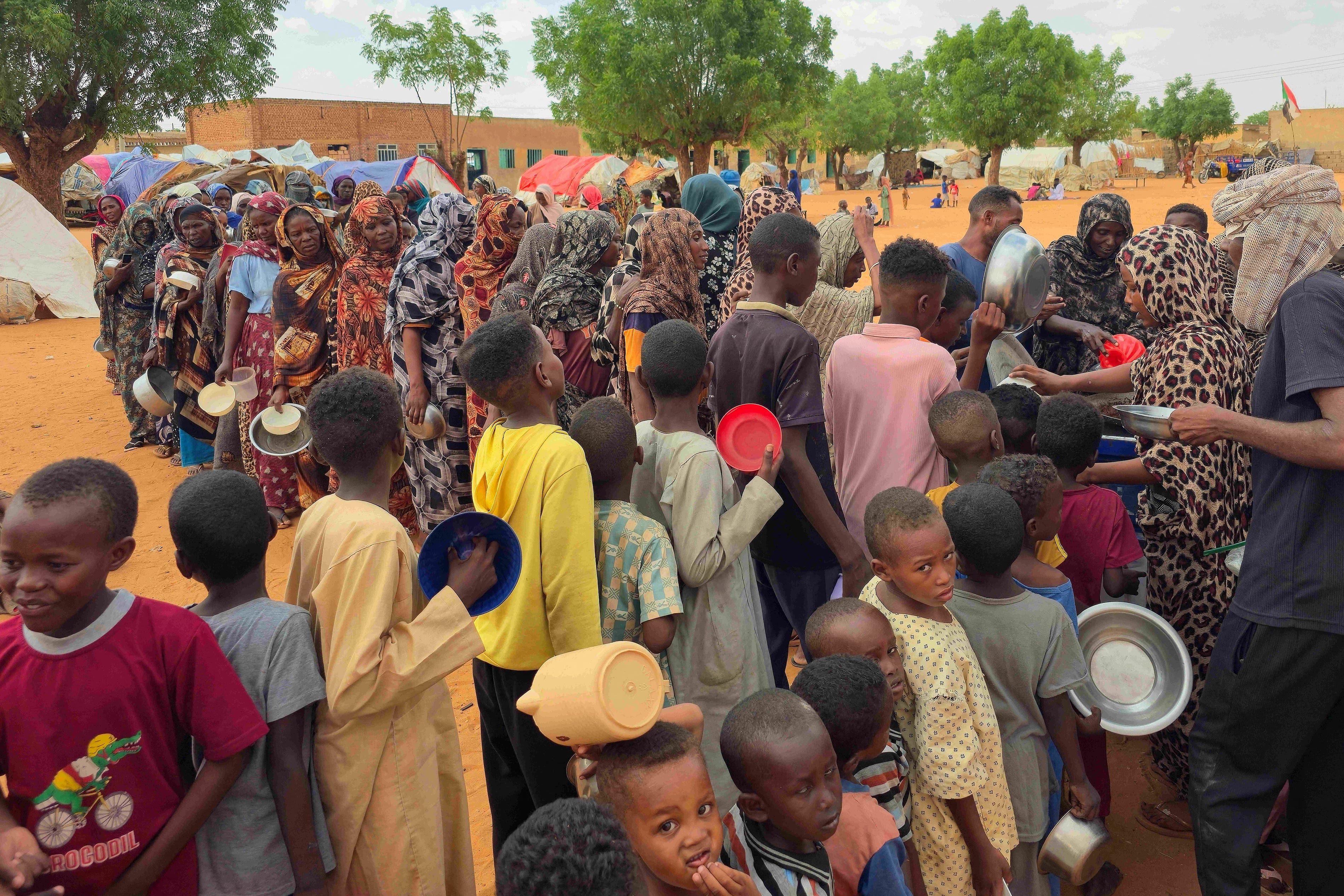
El-OBEID, SUDAN—Masjid Maki had already been displaced once. The 53-year-old schoolteacher fled the city of An-Nuhud with her husband, Hussein Abd al-Baqi, 66, and their three children at the end of May 2025.
When they reached El-Obeid, the capital of North Kordofan state, roughly 220 kilometers from An-Nuhud, they rented a house in the Qubba neighborhood, mistakenly believing they had found safety.
Sudan has been at war since April 2023, when a power struggle between the Sudanese Armed Forces (SAF), led by General Abdel Fattah al-Burhan, and the Rapid Support Forces (RSF) paramilitary group, commanded by General Mohamed Hamdan “Hemedti” Dagalo, collapsed into an open conflict that has since devastated the country and killed and displaced hundreds of thousands.
Since June 9, drone strikes attributed to the RSF have hit El-Obeid repeatedly, killing more than 40 people and wounding dozens, according to the local emergency response team. Most of the city’s fuel stations have been destroyed. The electricity generation plant has been struck.
Water pumps, which depend on electricity to function and have no solar backup, have fallen silent. Bread ovens have gone dark. Markets shutter at the sound of any drone overhead, as traders no longer dare to bring goods into the city, driving up prices on everything from food to medication for chronic illnesses.
By the end of June, Masjid was packing her bags again.
“Civilians should not have to wait for death and war to start inside a besieged city that is on the verge of collapse,” she told Drop Site News.
Members of the UN Security Council issued a statement on June 20 warning of the imminent risk of mass atrocities and demanding that the RSF immediately halt its assault on the city. Five days later, the United Nations Secretary-General’s Personal Envoy for Sudan voiced alarm over escalating violence in and around the city of El-Obeid, warning that further military escalation could put thousands of civilians at risk and deepen Sudan’s already devastating humanitarian crisis.
The envoy drew parallels with previous crises in Sudan, where violence against civilians triggered large-scale humanitarian disasters. “Unfortunately, the situation reminds us a little bit of the earlier developments in Darfur and around El-Fasher and reminds us that there are immediate risks for the civilian population,” he said.
El-Fasher fell to the Rapid Support Forces following a prolonged siege in late 2025. As the last major army stronghold in Darfur, it endured months of encirclement before its fall unleashed mass killings, widespread sexual violence, and the systematic destruction of civilian infrastructure including hospitals.
The RSF originated from the Janjaweed militias that committed genocide in Darfur in the early 2000s. Today the RSF is armed and supported by the United Arab Emirates, which, despite international outcry, has backed the group in its war against Sudan’s central government.
The UN Fact-Finding Mission described the violence in El-Fasher as “a planned and organized operation that bears the defining characteristics of genocide.” Before it ended, civilians inside the city were reduced to surviving on animal feed and peanut shells.
El-Obeid is now following a strikingly similar trajectory, after a long siege that caused a catastrophic humanitarian crisis between 2023-2025, according to locals and observers. Located in North Kordofan and serving as a vital artery connecting the capital Khartoum to the Darfur region, the city is surrounded, bombarded, and being pushed toward humanitarian collapse—with the RSF deploying the same encirclement tactics it used against El-Fasher.
Drone strikes have torn through fuel depots, water stations, and civilian infrastructure. Aid access has been severely restricted, and warnings of famine and mass civilian casualties are mounting as the threat of a full ground offensive grows.
A City Running Dry
The water crisis has become the most acute immediate threat to daily survival, according to residents. Most of the water available in El-Obeid is now extracted from manual pumps, and because it is salty and unfit for drinking has contributed to the spread of stomach and kidney diseases among residents and displaced people alike, according to local residents and aid groups.
Obtaining water requires standing in long lines for limited quantities. A barrel of water now costs up to 30,000 Sudanese pounds—approximately $10—a sum beyond the reach of most families, and far beyond the reach of the displaced population, who arrived with little or nothing after leaving everything behind.
“Disruptions to water, electricity, and fuel in El-Obeid are significantly affecting both displaced and host communities. Limited access to water increases basic survival risks and public health concerns, particularly in congested [displaced person] sites during the rainy season. Power outages affect communication and access to information, while fuel shortages further restrict the ability of people to move to safer areas if they choose to do so,” Assadullah Nasrullah, a UNHCR communications officer in Sudan, told Drop Site in an emailed statement.
Mohammed Abd al-Baqi, 32, a member of El-Obeid’s emergency response team, puts it plainly: “There is a water crisis, a power crisis, a bread crisis—and lives being lost every day. That is the greatest catastrophe. The humanitarian situation is extremely difficult and needs urgent intervention, even if only to ease the water crisis.”
Darkness, Thirst, and Hunger
The drone attack on El-Obeid’s main electricity substation last month shut down the entire city’s power supply. With the pumps silent and the fuel stations destroyed or abandoned, the generators that bakeries depend on cannot be refueled.
“The price of a single loaf has reached around 350 Sudanese pounds,” according to Ismail Ibrahim, 36, a community activist in the city, who calculated what this means for a family: “Roughly 30,000 pounds a day for water, another 20,000 for bread, before any other need is accounted for.”
Khalid Daw al-Bayt, 46, an electronics merchant in El-Obeid’s market, described the rhythm of fear that has reshaped commerce.
“Drones appear in the skies at irregular hours, day and night, sometimes in swarms, three or more sorties in a single day. Each sighting is enough to close the market. Traders will not bring their stock into a city where it might be incinerated. What remains on shelves becomes scarcer and more expensive by the day,” he said.
“The electricity has partially returned to the market area over the past three days,” Khalid added, “but the residential neighborhoods are still without power.”
Transport has effectively collapsed. With fuel scarce, residents move on foot or by tuk-tuk at doubled fares. Government institutions are functioning only partially.
Ismail Ibrahim said that “around 95 percent of El-Obeid’s residents depend on government employment, making them among the most economically exposed to a crisis that has simultaneously eroded their salaries through inflation and destroyed the markets in which they spent them.”
Armed groups moving through the city have brought additional dangers, including armed robbery targeting civilians, and random gunfire in markets, alleyways, and residential areas, resulting in civilian casualties, particularly in neighborhoods near military sites.
“The citizen of El-Obeid today has no recourse,” Ismail said. “He is living under pressure from every direction.”
“The RSF,” he said, “has been laying siege to the city with artillery and heavy weapons, before evolving toward the direct targeting of civilian infrastructure: hospitals, schools, water sources, electricity facilities, fuel stations—including fuel tankers trying to reach the city. At least six fuel stations have been struck by drones, some while civilians were queued in their vehicles to refuel. Cars have burned. People have died.”
Camps are not safe either. A displacement camp north of the city was struck when a drone targeted a nearby military vehicle carrying a Katyusha rocket launcher. The munitions scattered, and displaced people were among the dead and wounded.
Ahmed Tom noted that drones are now reportedly targeting drinking water tankers, one of the few remaining means by which residents can obtain clean water.
The Burden on Women and Children
Masjid described the particular burden falling on women, especially those displaced from South and West Kordofan, in the struggle to secure food and drinking water. She spoke of the collapse of mobile clinics that humanitarian organizations had previously operated, leaving pregnant women and nursing mothers without access to basic healthcare.
“Most of the malnourished children in El-Obeid’s displacement centers are under five years old,” Masjid said. “They need clean water, medical care, and therapeutic nutrition. Most children are now out of school, living in a state of sustained fear—the sound of a drone overhead is enough to send them into panic—and the psychological toll is visible. Safe spaces to play have disappeared.”
Masjid lost everything in An-Nuhud, including her savings, when RSF forces took the city and her home was looted. Now, facing a second displacement, she described families in El-Obeid who cannot afford to leave at all. Those with money have already gone to Khartoum or other cities.
“Most families are now eating one meal a day, if that,” she said. “Most of the humanitarian organizations that had been operating in the area have suspended or severely reduced their assistance. Displaced people who arrived recently from the areas surrounding El-Obeid have received virtually no support.”
“Humanitarian assistance alone cannot keep pace with escalating conflict,” UNICEF representative in Sudan Sheldon Yett told Drop Site. “Children need protection. Civilian infrastructure must be spared. Humanitarian access must be facilitated. Above all, Sudan’s children need an end to the violence that continues to rob them of their safety, their education and their future.”
Ahmed Tom described what he called “a degree of irresponsibility” in the official response to the crisis.
“The state governor has issued statements claiming the situation is normal, that authorities have things under control, and that services will soon be restored,” he said
“These statements do not reflect reality,” Tom said, “and residents do not trust them.” Many have decided to leave the state entirely.
He also flagged a troubling development: videos circulating on social media showing a mobilization official addressing a group of women and urging them to take up arms, while they were shown holding weapons. The push to arm civilians, Tom warned, would only increase the danger they face.
Ismail Ibrahim echoed the demand for transparency, calling on authorities to tell people the truth, about the scale of the danger, about the real state of services, about what is actually happening to the civilians in their care.
Ismail Ibrahim noted that “El-Obeid is a strategic hub connecting several states and cities in western Sudan, and that its fall to the RSF would represent a major military gain and could extend the war considerably, not least because the city contains an international airport that would serve as a critical supply point.”
Masjid knows what happened to El-Fasher. She knows the pattern.
“I hope El-Obeid does not meet the same fate,” she said.
 | A guest post by
|
What if any, are the Great Power interests at play? Do the Americans or Chinese or Russians favor one side or the other?
And which nation(s) could possibly serve as mediators or host efforts at diplomacy?
So Damn Sad 🤬It Hurts My Heart To See People Suffer Over Hate & Crime !! Those People Need Help What The Fuck Is Wrong With People 🤬🤬🤬🤬