

Billionaire Bankrolling Anti-Platner PAC Gutted Maine Mill Towns
Apollo Global Management bankrupt two of Maine’s largest paper mills, selling them for scraps and wiping out more than 1,000 jobs. Now the CEO is cutting checks to keep Susan Collins in office.

Reader support is what makes Drop Site possible. Without it, this journalism wouldn’t exist. If you’re able, please consider making a tax-deductible donation or upgrading to a paid subscription today.
Over the weekend, new FEC filings revealed a billionaire-backed super PAC supporting Republican Sen. Susan Collins has started running attack ads against Democratic U.S. Senate candidate Graham Platner. Pine Tree Results is being funded by a litany of ultrawealthy donors, including Blackstone CEO Stephen Schwarzman ($2 million); Elliott Management CEO Paul Singer ($1 million); Reyes Holdings executives ($1 million); and Palantir CEO Alex Karp ($100,000).
Platner responded, in part, by noting that Collins’s billionaire-backers are all coming from out of state, with no local interest in Maine. That’s mostly true. On June 27, 2025, Blackstone’s Schwarzman gave $2 million to the Pine Tree Super PAC. The next day, Collins cast a critical vote to move Trump’s “Big Beautiful” tax bill forward in the Senate, a bill that was packed with giveaways to the private equity industry. (She eventually voted against final passage, as she often does when there are enough Republican votes to pass legislation without her.)
One benefactor does have a Maine connection—though it’s a sordid one. That donor is Apollo Global Management’s billionaire CEO and founder Marc Rowan, a giant in the world of private equity who has faced scrutiny for his links to sex trafficker Jeffrey Epstein. Rowan contributed $50,000 so far of the $2 million already dedicated to the anti-Platner campaign, and has been a major backer of AIPAC in recent years.
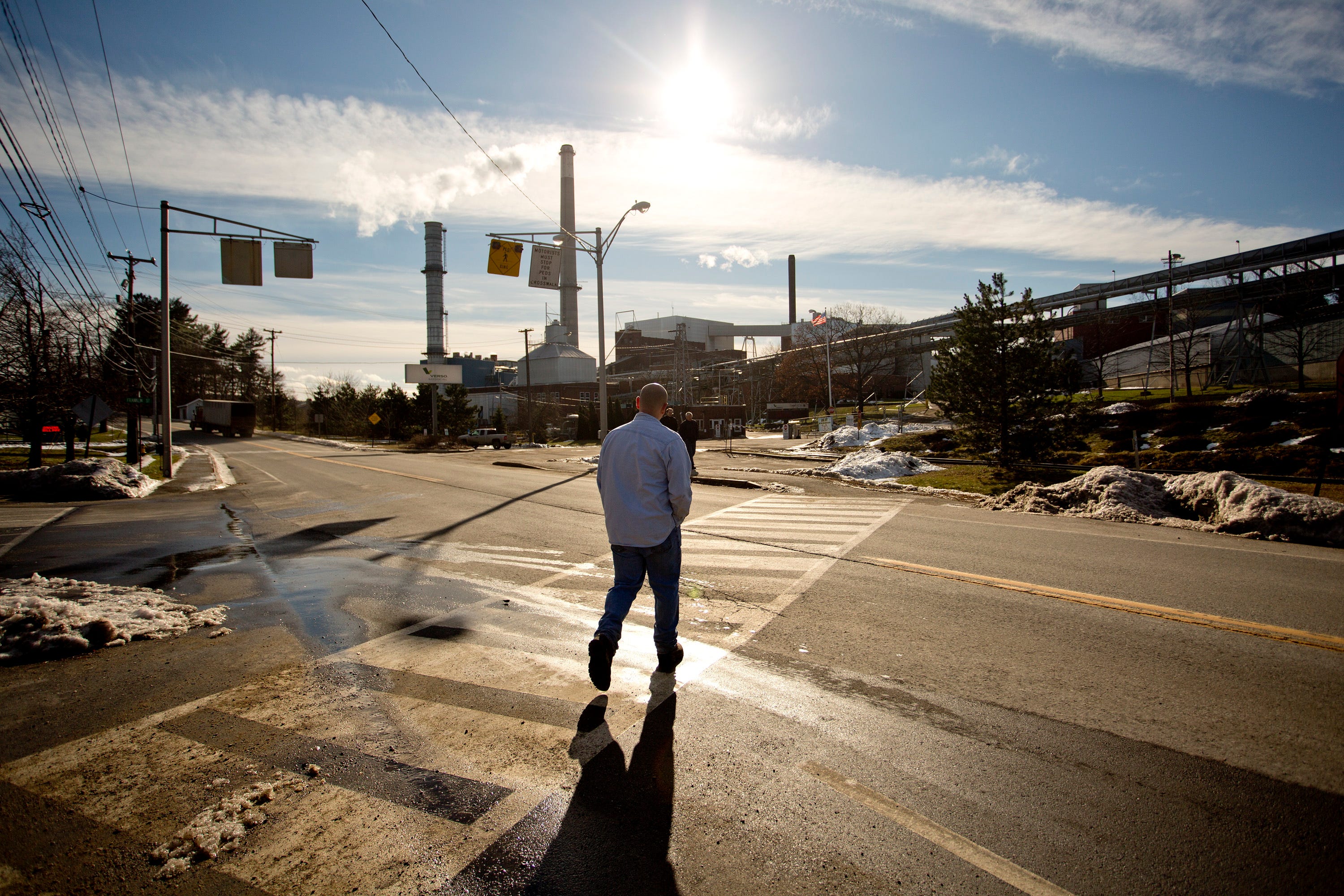
From 2006 to 2020, Apollo Management ran two of Maine’s largest paper mills into the ground, bankrupting them both, selling off their carcasses for scraps, and eliminating more than 1,000 jobs in Bucksport and Jay. That wasn’t a failure on the part of the private equity firm, which is able to profit by extracting wealth from healthy businesses through a process of stacking them with debt, filing for bankruptcy, and looting their assets, including pensions promised to workers.
In the case of the paper mills, they were the flagship properties of International Paper, which Apollo took over and redubbed Verso Paper. Apollo forced the new company it owned to take out $250 million in debt and hand the money over to Apollo, making sure its own investment was covered, in the form of a dividend, and proceeded to slowly bankrupt the company—what the mafia refers to as a “bustout.” The Star Tribune singled out the financial maneuver as “how Apollo got almost all of its money out of Verso.”
The shuttered paper mill in Jay is now the proposed site of a $550 million AI data center project.
Gov. Janet Mills, who is flailing in her campaign against Platner in the Democratic primary, recently used her veto to effectively protect the data center project, nixing a statewide moratorium on data centers that passed with bipartisan support. The bill was approved with 82-62 vote in the Maine House and 21-14 vote in the state Senate. It goes back to the State Legislature on April 29, where it would require a two-thirds majority in both the House and Senate to override Mills’s veto.
Sen. Collins is one of the private equity industry’s strongest allies. In 2017, she drafted an amendment to close the carried-interest loophole, the tax break that funnels billions to private equity executives, then dropped it hours before the vote on Trump’s tax bill. In the following cycle, ProPublica found Collins was the largest Senate recipient of private equity money.
Collins told Bangor Daily News through a spokesperson that she “recognizes that data centers can benefit certain communities like Jay that generate their own electricity by providing critical revenue and jobs.”
“She believes decisions around new data centers should be made at the local level and take into account potential ramifications on electricity costs, which are already far too high in Maine under [Mills],” Kernen said.
Collins has benefited from her advocacy for AI. She has taken $105,350 in donations from Palantir, the data analytics technology company founded by billionaire Peter Thiel. According to Palantir Purge, a website dedicated to monitoring Palantir’s activities, Collins ranks fifth among recipients of contributions from Palantir executives since 2006. The sum includes donations from CEO Karp, and contributions to her campaign committees, leadership committees, and Collins-affiliated super PACs. Since 2009, Palantir has received more than $2.5 billion in taxpayer-funded federal contracts for their services, including powering the mass surveillance apparatus used by Immigration and Customs Enforcement.
Rowan took over as CEO of Apollo Global Management in March 2021 after his co-founder Leon Black resigned amid revelations he paid convicted sex trafficker Jeffrey Epstein more than $150 million. Drop Site previously reported on Rowan’s own extensive relationship with Epstein. The billionaire also serves on Trump’s Gaza Peace Board and Gaza Executive Board alongside Steve Witkoff, Jared Kushner, and Tony Blair.

Apollo entered Maine in 2006 when the firm bought International Paper’s (IP) coated paper division for $1.37 billion. The private equity giant quickly rebranded IP into Verso Paper, a shell company that would oversee four paper facilities including their two Maine-based holdings: the Bucksport Mill and Androscoggin Mill in Jay.
According to the Ellsworth American, at the time of Apollo’s 2006 acquisition, the Bucksport Mill employed about 800 people with wages and benefits totalling $80 million annually. The Androscoggin Mill in Jay employed another 1,000 people, accounting for an estimated 22% of the Town of Jay’s tax base before its closure.
By the time Apollo exited Maine, the Bucksport and Jay mill facilities together employed just 690 workers. Over that same 14-year period, the Star Tribune reported that Apollo extracted almost $273 million from Verso Paper, earning Rowan and his fellow founders immense profits.
The Bucksport mill was Apollo’s first casualty. In October 2014, Apollo’s shell company Verso Paper announced the Bucksport mill would close right before Christmas. Verso president and CEO Dave Paterson said in a 2014 statement that the mill “had not been profitable for a number of years, in spite of our employees’ dedicated efforts to make it so.”
The mill officially closed in December 2014. Five hundred and seventy workers lost their jobs and the town’s unemployment rate spiked to 11.7 percent within weeks. According to an EPA case study, the Bucksport mill paid 47% of the town’s tax revenue at the time of its closure.
The day after Verso ran the last paper machine, the company announced it would sell the 84-year old mill and its 273-megawatt power plant for $60 million to AIM Development, a Montreal scrap dealer that had previously demolished a Verso mill in Minnesota.
“AIM is basically a scrap metal company. They have a history of tearing things down to the ground,” Bucksport Mayor Dave Keene said in a 2014 statement. He had worked at the mill for 23 years. A month later, AIM owner Herbert Black told the Portland Press Herald his business plan called for scrapping the mill.
Black followed through on his plan. In March 2015, AIM held an auction of the mill’s paper-making equipment. The unsold equipment was turned into scrap metal. By September 2015, AIM had acquired a DEP permit to demolish the Bucksport Mill, and by 2017 it was fully demolished.
In the following years, AIM subdivided the 250-acre Bucksport mill property into a four-lot industrial park. The property was sold off in parcels netting the scrap metal dealer more than $100 million. AIM still owns the largest parcel, a 109-acre landfill that once accepted waste from the paper mill. The hundreds of mill jobs never returned to Bucksport.
When the Bucksport Mill shutdown began, Apollo’s shell company Verso claimed it would “in no way affect the Jay mill.” However, ten months after the Bucksport announcement, Verso permanently eliminated 300 jobs at the Jay mill. The following year, Verso filed for Chapter 11 bankruptcy, shedding $2.4 billion in debt and prompting a “comprehensive belt-tightening regimen” at the mill.
“We rented a chicken barn to store machinery,” one former Jay worker recalled to Boston Globe Magazine, “and they asked us to negotiate a rent reduction with the farmer.”
In February 2020, Apollo’s shell company sold the Androscoggin Mill to Pixelle Specialty Solutions for $400 million. Pixelle was owned by another New York private equity firm, Lindsay Goldberg. By the time the sale closed, the Jay mill’s workforce had been cut from 1,000 to roughly 500.
Two months after the sale closed, a wood pulp digester at the Jay mill ruptured and exploded. Pixelle declined to spend the estimated $200 to $300 million required to rebuild the digester. In March 2023, the Jay mill closed permanently, eliminating the final 230 jobs.
The carcass of the Jay mill is now the proposed site of a $550 million data center, the exact kind of AI infrastructure project Apollo’s private credit arm increasingly finances.
“Nearly $3 trillion will be needed to support AI infrastructure through 2028. More than half of that, around $1.5 trillion, will come from external capital,” Apollo said in a 2025 corporate press release. “We’re partnering with companies that are advancing AI and redefining critical infrastructure. Across the value chain, Apollo is delivering capital where it’s needed most.”
Now, the mill that once supported 1,500 paper jobs waits for the same private equity industry that destroyed it to come back and lease the land.
MORE FROM NATHAN BERNARD ON THE MAINE SENATE RACE:
 | A guest post by
|
Excellent report on the shenanigans of private equity firms -- and their stooges, like Susan Collins.
One other takeaway from the billionaire funders of the "Pine Tree Results" SuperPAC: Blackstone CEO Stephen Schwarzman, Elliott Management CEO Paul Singer, Palantir CEO Alex Karp, and others -- these are the corporate pro-Israel billionaires who work in the shadows, especially Palantir.
As anti-Israel sentiment grows among most Americans, AIPAC is funneling money to campaigns under pseuodnyms because the AIPAC name is radioactive. So now we can expect other outfits like Pine Tree to pop up in different states, doing the work that AIPAC does, i.e., shilling for Israel.
I hope Drop Site and others can out these corporate handmaidens of Israel trying to run our country.
Go Platner!