

U.S. Airstrikes, Somali Troops Killed at Least Seven Children in a November Offensive
“We were there before al-Shabaab and we want to remain there after al-Shabaab. We don’t know why we are being targeted.”

U.S. airstrikes and Somali government ground troops, including a militia trained by the U.S., killed at least 11 civilians, including seven children—one as young as seven months—during an operation on an al-Shabaab stronghold in southern Somalia last month.
Drop Site News spoke to four witnesses of the attack from Jaaame, a major town in the Lower Jubba region, that has been under control of al-Shabaab—an al-Qaeda-affiliated militant group—for decades. On November 15, the witnesses said, after hours of aircraft circling overhead, shelling and bombing started, leaving body parts strewn on the ground and caught in trees.
The United States Africa Command (AFRICOM) released a statement confirming that it conducted strikes in the area to support Somali troops. AFRICOM did not respond to requests for comment about the operation it supported killing civilians; neither did the government of Jubbaland.
“The baby was motionless and I was trying to save my wife,” Mohammed Hassan Abdulle said. Nurto Mohamed Hassan, his seven-month-old daughter, died instantly after two pieces of shrapnell hit her head and thigh. Nurto had been wrapped on her mother’s back when the two were hit. Abdulle tried to get his bleeding wife, Farhiya Hassan Omar, help at the local clinic but “the shelling was like rain.” Finally, they managed to hitch a ride in a small Suzuki to get to a hospital in Jilib, alShabaab’s de facto capital, about 40 miles north.
Abdulle held her during the five-hour drive over dunes and flooded roads. Her torso and shoulders were badly injured. At one point, their car broke down. Abdulle was in the middle of donating blood at the hospital when a doctor informed him that Farhiya had died. He says he does not know who carried out the attacks but that he saw mortar shelling from the west, across from the Jubba River, as well as about six bombs from the sky. He said a drone was still hovering overhead as he conducted the interview with Drop Site, about three weeks later. “All the time it is in the sky,” he said.
A combination of forces, including Somali government and regional troops, as well as the U.S.-trained Danab counterterrorism unit with its own Jubbaland regional force, carried out the mid-November attacks backed by U.S. airstrikes, in an effort to bring Jubbaland under its control.
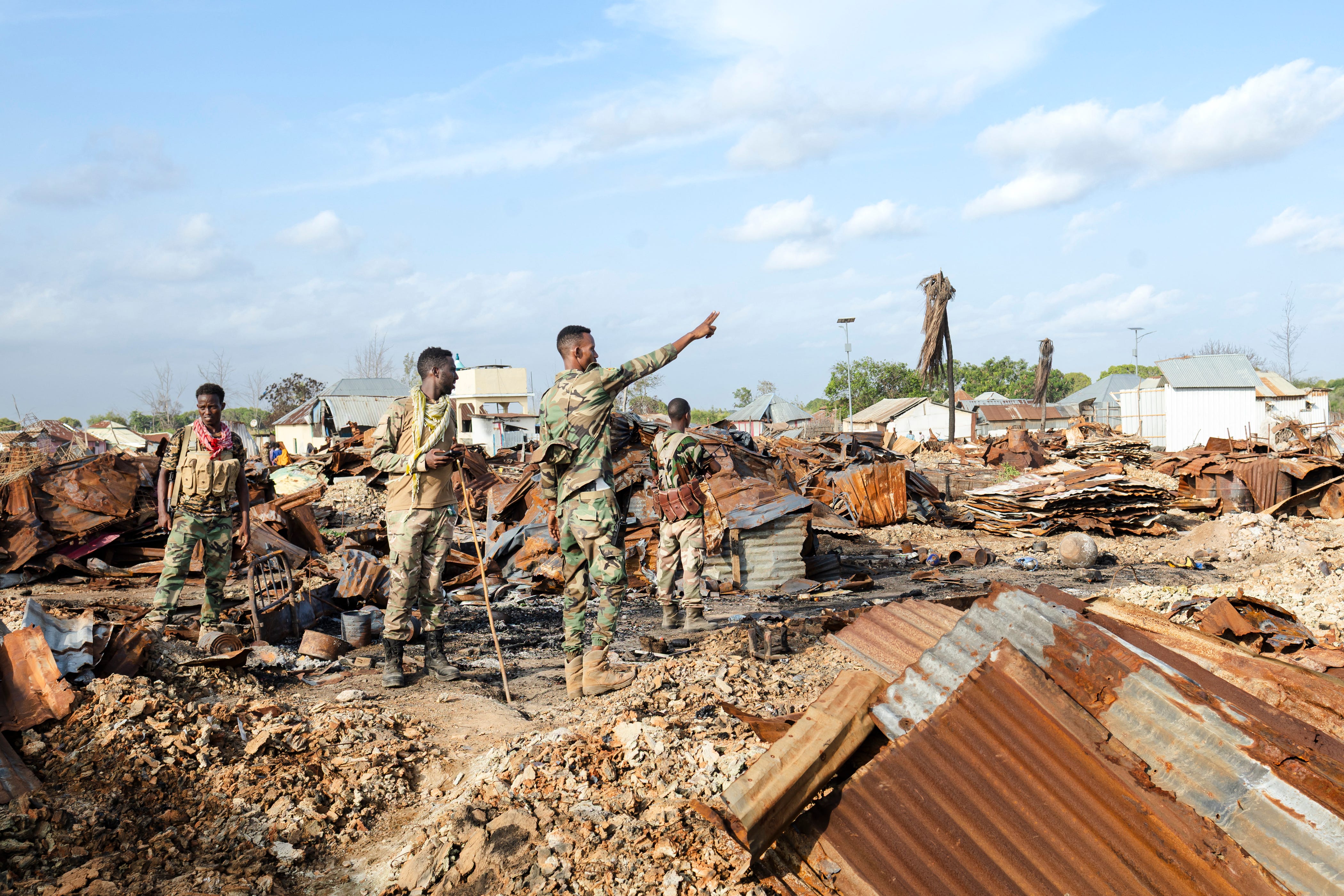
Videos and photos of the aftermath of the mid-November assault have been circulating across social media and regional outlets. Upwards of 50 people were killed, according to media reports, with varying estimates on the numbers of civilians killed. Two community leaders who no longer live in the region separately gathered the names and ages of at least 11 civilians killed and six wounded and shared their lists with Drop Site.
Four of them were siblings, ranging from four years old to ten, who were killed alongside their mother. Their grandfather, Mohamed Abo Sheikh Ali Muudey, said Jamaame is nearly empty of residents, but al-Shabaab is still in control. Muudey was in town during the assault and said he saw the planes come from the “Kismayo-side,” the regional capital where AFRICOM planes and troops are stationed at the airport, and where Danab commandos are trained.
On top of a decades-long civil war, Somalia is in the midst of a years-long political dispute between federal member states. Jubbaland recently formally left the federal structure and announced itself as an independent government. “Due to ongoing political fragmentation in Somalia, regional governments are trying to demonstrate they are a good counterterrorism partner to the U.S. in order to receive direct support. As part of this, you have ongoing operations by Puntland, Jubbaland and the federal government which are not always coordinated,” Omar Mahmood, the senior analyst for Somalia and the Horn of Africa at the International Crisis Group, told Drop Site News.
The attacks were part of a wider offensive on key al-Shabaab bases in the district, about 10 miles away from Jamaame town, on the other side of the river that divides the area that started earlier this year. Significant al-Shabaab bases and strategic footholds surrounding the town have fallen since the offensive was launched, according to local media. This is likely the first time in over a decade that forces besides al-Shabaab have controlled areas in the Jamaame district.
The impacted civilians in Jamaame are from the Biamaal clan, a group that is not well represented in Jubbaland’s government and is indigenous to the area. A leader from the clan, known as Ugaas, who lives in Mogadishu spoke to Drop Site News. “We were there before al-Shabaab and we want to remain there after al-Shabaab,” Ugaas Ahmed Ugaas Said Ali said. “We don’t know why we are being targeted unless someone wants to grab our land and take our resources.”
“It was a very shocking day,” Maria Abdi Haji Guled, a mother of eight, said. “So many people died. Children were running around. Everything was a mess.”
Guled was in the kitchen feeding five of her children breakfast after their morning session at school when the carnage began. Her husband was on their farm, outside of town. She stressed that al-Shabaab was not present when the shelling and bombing unleashed mayhem on the ground. She had observed a plane in the sky, and never seen one like that before, but “we did not expect it to bomb us,” she said. There had never been fighting around Jamaame, according to her. Guled also witnessed baby Nurto and her mother get hit, and the seven-month old die on the spot; they lived nearby.
It took Guled multiple days to take two of her wounded children to get medical care in Mogadishu, the national capital. Her youngest child, a seven-year-old, has shrapnel in two places in his back and waist. He was unable to walk for over two weeks. He is able to move now, but Guled cannot afford the $1,000 charge to have the metal removed from his body.
“It is well known what happened in Jamaame. There was a massacre and bombardment of residential areas,” Ugaas Ali said.
In late November, AFRICOM told FOX News that it had conducted 100 strikes on Somalia this year. The media outlet Stars and Stripes observed “strikes are occurring at a faster clip than the Pentagon’s campaign against suspected drug traffickers in the Caribbean Sea.”
“We are dying for nothing,” Mariam Omar Nur Buruji, another resident of Jamaame said. Buruji was not in Jamaame during the attack but on her family farm in an area called Bugeey, less than an hour’s walk from town. From there she could see burning houses and bombardment. Today, Buruji is staying in a village called Hongore with her three grandchildren. Their mother was killed in the offensive. Her son, their father, is back on the farm. She told Drop Site News that can still hear the aircraft, but cannot see them. The children are scared.
 | A guest post by
|
Reporting like this makes it impossible to hide behind euphemisms like “precision” or “counterterrorism.” When airstrikes kill infants, wipe out families, and leave entire towns emptied of civilians, something is profoundly wrong—regardless of who the intended target was. AFRICOM’s silence only deepens the sense that Somali lives are treated as disposable. Accountability, transparency, and an end to collective punishment should be the bare minimum, not an afterthought.
Everything than peace in the world