

Palestinians Are Being Denied Return to West Bank Refugee Camps After Israel Bulldozed Their Homes
In Jenin, Israel is building the first permanent military base in Area A since the Oslo Accords in the 1990s.

Drop Site is a reader-funded, independent news outlet. Without your support, we can’t operate. Please consider becoming a paid subscriber or making a 501(c)(3) tax-deductible donation today.
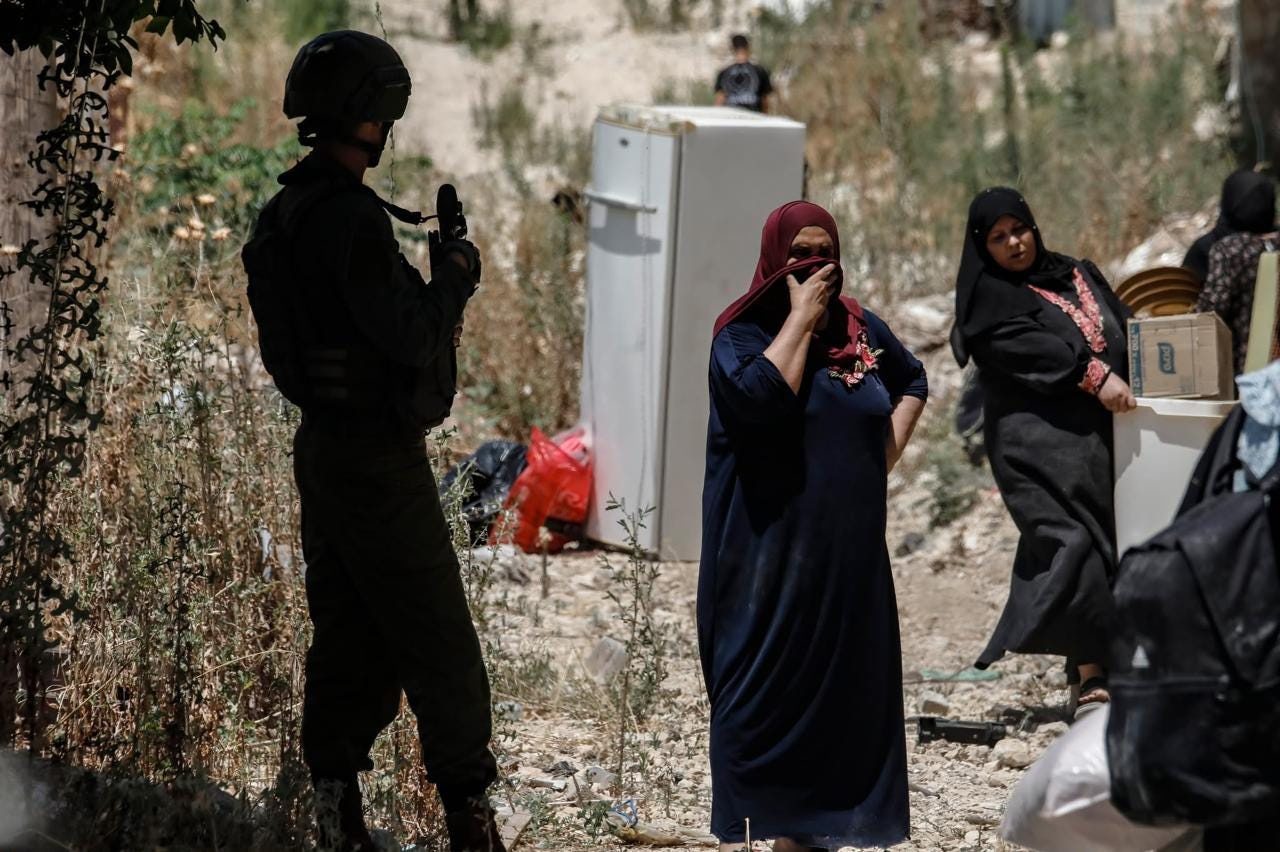
JENIN, Occupied West Bank—It took Omar Qalib more than a decade to finish his family’s three-story house in Jouret al-Dahab, a neighborhood in the heart of the Jenin refugee camp. A construction worker, he built it himself, brick by brick. But it was worth it, he thought. The property fell within Area A, a zone within the occupied West Bank where the Palestinian Authority nominally controls both civil and security affairs.
But in January 2025, Qalib was forced from his home, along with tens of thousands of other Palestinians, as Israel launched a large-scale military operation dubbed “Iron Wall” targeting refugee camps in Jenin, Tulkarm, and Nur Shams. More than 30,000 Palestinians were forced from their homes over the ensuing months, in the largest displacement of Palestinians in the West Bank in a single operation since the 1967 war.
After invading and occupying the camps in February 2025, the Israeli military campaign flattened entire neighborhoods, turning them into wastelands. Where narrow alleys once ran between tall buildings so close they blocked the light, wide dirt roads now cut through the heart of the camps, carved out by Israeli military bulldozers.
As part of the campaign, the camps have been cordoned off. Just to see what’s left of his home, Qalib needs a permit from the Israeli military. Few Palestinians are able to obtain them. And the permits only grant one-time, temporary access. Two weeks ago, Qalib was one of the lucky few who obtained a permit to visit his destroyed home.
“The house is gone,” said Qalib “My house and my son’s house. A whole life of work, gone.”
Qalib, 56, now shares two rooms with his wife, two adult sons and their families, packed together in a dormitory connected to the Arab American university in the city of Jenin. “I had a whole family in that house,” he said. “Now we are all in two rooms waiting for something we don’t know when will end.”
Every morning Qalib heads out looking for work as a day laborer, the principal breadwinner responsible for rent, food, electricity, water, and transportation costs for an entire household. Those costs have nearly doubled since they were displaced.
Both of Qalib’s sons were shot by Israeli soldiers during the military invasion of the camp. One was left half paralyzed, with damage to his kidney, spleen, and lung, and is unable to work. His other son recovered from his injuries and is able to physically work though he has been able to find a job since they left their home, nearly a year and a half ago.
Recently, some Palestinians have been granted limited access to enter their old neighborhoods, mainly to scavenge in their destroyed or heavily damaged homes for items they left behind. What they described to Drop Site are neighborhoods made unrecognizable: men who spent their lives in these alleys wander in the middle of emptied out dirt roads, looking for a mosque that used to mark the turn, the building that used to anchor their route. The landmarks are gone. Some cannot even locate where their own homes once stood.
The First Permanent Israeli Military Base in Area A Since Oslo
Alongside the large-scale destruction, the Israeli military is engaged in unprecedented construction. In May, the commander of Israel’s Central Command signed an order to seize land in the city of Jenin, near the Jenin refugee camp, and construct a permanent military base, according to documents first revealed by Haaretz. It marked the first time since the Oslo Accords in 1993 that the Israeli military has built a permanent post in Area A.
While the Israeli military has staged regular incursions into cities and towns in Area A for years, despite it technically being under Palestinian civil and security control, the establishment of a permanent Israeli military base represents a major shift. “The Area A designation was the foundational pillar of the concept of Palestinian self-governance,” said Ibrahim Abras, a political analyst and academic. “A permanent military base inside these areas signals a shift in the nature of Israeli control, a gradual transition from managing the conflict through temporary incursions to imposing a long-term field presence that raises serious questions about the future legal and political status of these areas.”
Putting a base in Jenin is “a mechanism for reshaping control over the land,” said Ismat Mansour, a specialist in Israeli affairs. “A permanent base near Jenin gives Israel far greater leverage over the security and political landscape of the entire region.”
Meanwhile, tens of thousands of Palestinians in the West Bank remain displaced from their homes, with no legal justification offered for blocking their return, according to ACRI, the Association for Civil Rights in Israel, which has described the situation as a systematic violation of the rights of an entire displaced population.
In late March, the Israeli security cabinet secretly approved 34 settlements across the West Bank, including six of them that form a ring around Jenin. It marked the largest number of settlements and outposts approved by any Israeli government at one time.
“Many of the current settlements began as military positions or outposts before being converted into permanent civilian communities,” said Khalil Tufakji, a settlements expert who has spent decades mapping the relationship between military infrastructure and settlement expansion.
The pattern, said Tufakji, is not new. “Reactivating evacuated outposts in the northern West Bank simultaneously with a permanent military base demands a wider reading about the future of the entire area.”
The establishment and fortification of new Israeli settlements comes in parallel with the all but total restriction of permits for Palestinians to return to their homes. To enter a refugee camp a Palestinian was born in, grew up in, and subsequently displaced from, now requires Israeli military authorization. Palestinians who have managed to obtain a permit describe it as a one-time authorization that comes with no guarantee it will be granted again. The displacement has effectively become permanent.

“When will we go back to our house?”
Um Faris, 42, left Nur Shams camp in January 2025 with her five children, each carrying a piece of home in their hands.
Faris, 17, carried a small bag with the family’s documents. His mother warned him not to lose it no matter what. The younger children each held onto something too: Ahmed, 14, keeps photos of the camp on his phone and spends hours looking at them. Layan, 8, brought a small cloth doll, the last piece of her old room. She goes to sleep every night holding it.
They left a big house with a backyard and now live in a small rented apartment with thin walls on the outskirts of Tulkarm. Before being displaced, her husband worked in construction. The road closures and movement restrictions ended that. Faris was forced to drop out of school to find work; he has stopped talking about finishing school and going to university. His younger siblings also eventually dropped out because they were unable to attend classes as a result of the severe restrictions on movement imposed by the Israeli army.
Um Faris has documents proving ownership of her home. But she does not have the permit to enter the area where it once stood. She’s not sure what is even left of it. Every morning, her youngest child asks the same question: “When will we go back to our house?”
In Fahma, south of Jenin, 35-year-old Ahmed lives in a rented house with his family. He declined to give his last name for fear of Israeli retribution. Six of them share just two rooms, a space half the size of the home they left in the Jenin camp. The family shop that provided part of their household income is gone. Lately rents have been rising, and humanitarian assistance is being reduced. With no stable income, covering rent, food, and other household expenses has become a daily struggle.
Ahmed keeps the key to his old house in his pocket, hoping to return. On one of the rare occasions when he was briefly granted access, Ahmed walked through the alleys he grew up in.
Or, he tried to. “I thought I knew every stone,” he said. “But I felt like a stranger. The streets I had memorized were gone. Buildings that had been fixed points in my memory had disappeared. Entire neighborhoods looked like they had been erased.”
“The continued prevention of thousands of Palestinians from returning to their camps for months creates a new reality on the ground,” said Ashraf al-Akka, a political analyst. “The social and economic fabric begins to break down gradually while physical changes inside the emptied areas continue. The prolonged displacement cannot be separated from broader Israeli policies aimed at reshaping Palestinian geography in the West Bank.”
Worse yet, the periodic orders forcing displacement show no signs of stopping. In Qalandia and other camps across the West Bank, multiple residents told Drop Site that Israeli soldiers used loudspeakers to blare out a chilling warning during raids: “Prepare yourselves. What happened in Jenin and Tulkarm will happen to you.”
This story was reported and produced in collaboration with Egab.
 | A guest post by
|
Israel isn’t just demolishing homes in Jenin and Tulkarm — it’s erasing entire communities and replacing them with permanent military infrastructure. When a refugee needs a one‑time permit to stand where his house used to be, displacement stops being “temporary.” It becomes policy.
Evil bastards. I’m referring to the US and Israeli governments. Our tax dollars at work.