

Commonwealth Summons Pakistan's Leadership to Answer for Authoritarian Measures
Leaked letter: The Commonwealth will ask Pakistan about the use of military courts, the neutering of the judiciary, restrictions on speech, and the continued imprisonment of Imran Khan.


Drop Site’s journalism is free to read because thousands of readers choose to fund it. If our work matters to you, please consider making a tax-deductible donation today.
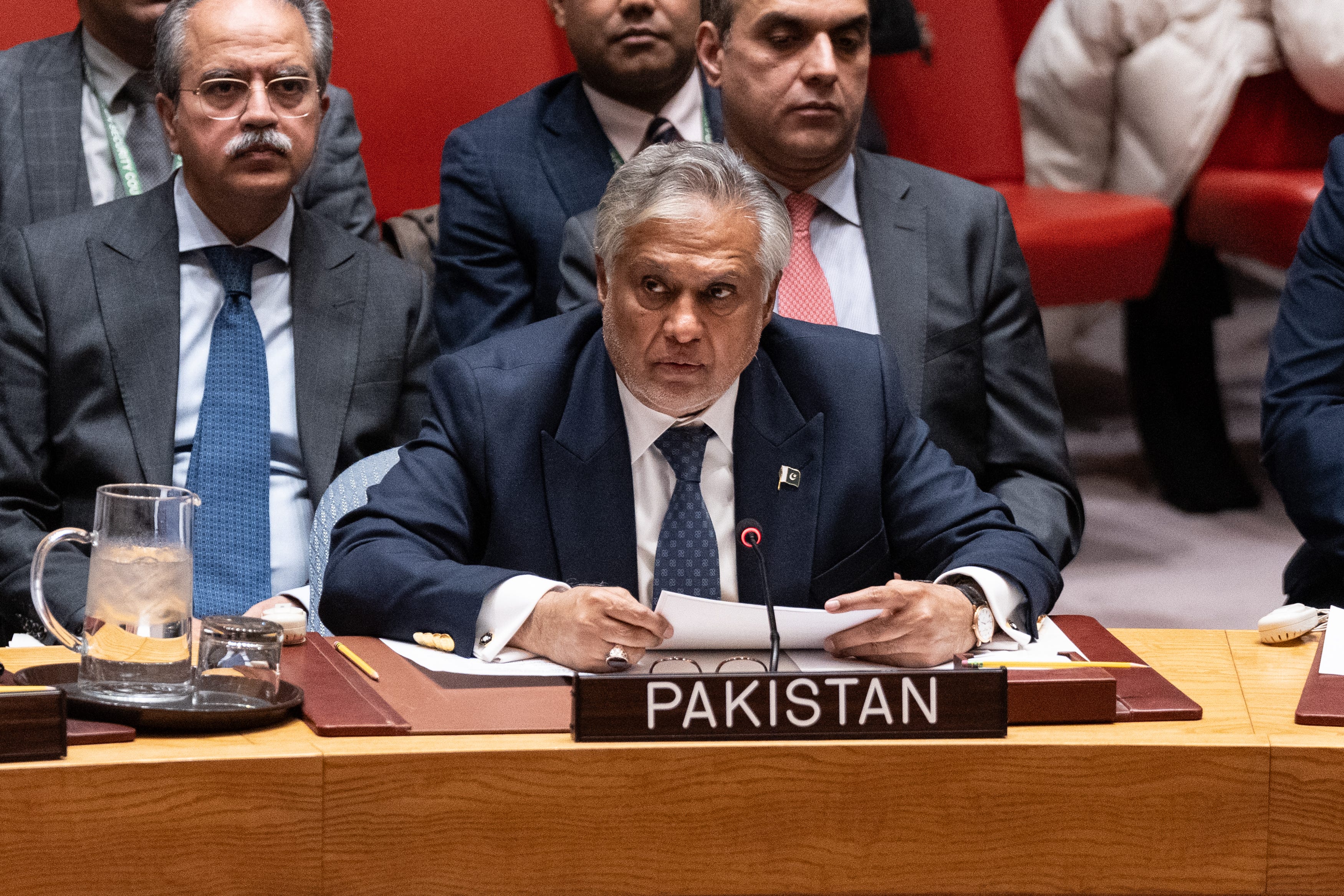
Commonwealth Secretary-General Shirley Botchwey has summoned the Pakistani Prime Minister Shehbaz Sharif to appear before the Commonwealth Ministerial Action Group (CMAG) on March 7 in London, according to an internal Commonwealth document leaked to Drop Site News. In the meeting, the CMAG will formally interrogate Islamabad’s military-backed government on “developments in regard to the rule of law and other principles enshrined in the Commonwealth Charter”—specifically, the recent constitutional amendments designed to neuter the judiciary, the reinstatement of military courts for civilians, the ongoing imprisonment of former Prime Minister Imran Khan, and what the letter diplomatically calls “allegations around restrictions on media and political freedoms.”
Pakistan’s foreign minister, Ishaq Dar, was scheduled to represent the Pakistani prime minister for the hearing but has excused himself from appearing citing the Iran war days before the meeting. He is likely to send the Pakistani High Commissioner Dr. Muhammad Faisal in his place.
CMAG has the power to censure, formally investigate, and recommend suspension of any member state that commits “serious or persistent violations” of the foundational charter of Commonwealth values. It has suspended Pakistan’s membership twice in the past—first in 1999 after the military coup by General Pervez Musharraf, and then again in 2007 when General Musharraf declared emergency rule.
In November, the Commonwealth had written a letter to the Pakistani government lodging its dissent against escalation of state repression in the country. It was the first time the Commonwealth had mentioned Imran Khan’s detention since he was arrested more than two years ago. Ministers at CMAG’s September 2025 meeting had already formally asked for updates on developments related to rule of law. Pakistan apparently didn’t provide a satisfactory answer.
Last year, the Commonwealth Secretary General did not release a report on Pakistan’s February 2024 elections that found evidence of widespread fraud—effectively providing cover for the Pakistani government. The report was leaked to Drop Site last September and then released by the Commonwealth. The CMAG’s summons indicates that Pakistan’s authoritarian trajectory is now becoming impossible for even its allies to ignore.
“I invite Pakistan to send a written submission ahead of the meeting to CMAG and to attend CMAG to directly engage with Ministers on the following matters,” the letter, dated February 5, reads. Despite the invitation, Pakistan has failed to provide a written submission, and the level of representation has been steadily downgraded.
Pakistan continues to arrest people for social media posts
Among the “restrictions on media and political freedoms” alluded to in the letter are a growing number of people arrested for social media posts.
On February 19, Hamza Ahmad Khan, a 37-year-old Pakistani-Canadian PhD student at the University of Toronto who was visiting Pakistan to conduct field research for his dissertation, disappeared while going to a friend’s house, where he was staying, in a taxi. For three days, his family didn’t know what happened to him. Police in Lahore refused to file a report of his kidnapping till the Canadian government took an interest in the case, after which they filed a First Investigation Report (FIR). Hours after the police filed the report, Pakistan’s National Cyber Crime Investigation Agency (NCCIA) claimed that they had taken Ahmad Khan under custody.
NCCIA claimed that they had come across Ahmad Khan’s social media posts during a “routine cyber patrol” and found that he was “actively spreading misinformation and disinformation targeting state institutions.” According to his family, however, Ahmad Khan had been picked up by the Pakistani intelligence services and was only produced by the NCCIA due to the pressure from the Canadian government—another Commonwealth member.
Since Pakistan’s 2024 elections, several people have been targeted for posts on social media by the Pakistani government. On January 24, a sessions court sentenced human rights lawyers Imaan Mazari and her husband Hadi Ali Chattha to a combined 17 years in prison under the same law. They received ten years each for “cyber terrorism,” five for “glorification of an offence,” and two for spreading “fake and false information.” They were convicted for tweets posted between 2021 and 2025, many of them expressing solidarity with Baloch and Pashtun activists and criticizing the military’s role in human rights abuses.
Since Pakistan’s February 2024 elections, thousands of Pakistanis have disappeared, some later appearing in military courts and others remaining unaccounted for. These military courts and the constitutional amendments that made the trial of civilians in these courts legal is one of the topics of the Commonwealth hearing in March.
Khan discussed in the House of Lords
The CMAG will also ask about the treatment of former Prime Minister Imran Khan, who remains under solitary confinement after almost 3 years in prison.
In February, after Khan suffered a health crisis in solitary confinement, he was briefly hospitalized. On February 25, Khan was again taken to the hospital secretly in the middle of the night as his health continued to deteriorate. He has almost completely lost vision in one of his eyes, according to Khan’s sisters, and the government has been refusing to allow him to see his personal physician.
On Tuesday afternoon, February 25, the British House of Lords took up a question that the UK government has avoided for the past few years: what exactly is it prepared to do about the imprisonment and deteriorating health of Imran Khan? During the question, one peer after another pressed the British government about Khan’s imprisonment and human rights abuses in Pakistan.
Zac Goldsmith, a former UK Foreign Office minister and Khan’s former brother-in-law, called Khan’s treatment “an international outrage” and urged the Foreign Office to intensify diplomatic engagement.
“He’s been denied access to his family, including his two sons, my nephews. He has been denied access even to doctors. We understand that he has spent much of his time in prison in solitary confinement, and that his health is deteriorating rapidly,” Goldsmith said.
Another peer, Lord Prem Sikka, pointed out the British government’s hypocrisy: “Successive governments show selective outrage at repression by authoritarian states such as China, Iran, Russia, and North Korea, but offer very soft criticism when identical acts are committed by trade and defence partners,” he said. “The government have the tools: they can exert pressure on the army generals controlling Pakistan by ending aid and imposing trade sanctions, but they have not. Can the minister refer me to any moral principle guiding the government’s foreign policy?”
Lord Hannan of Kingsclere delivered what may have been the session’s most clarifying remark.
“I do not think that any British Government can be indifferent to the fate of Pakistan, a Commonwealth ally to which we are intimately linked—there are nearly 1.5 million Brits of Pakistani origin. The reason why Imran Khan is in prison is that he would win a free election, and Pakistan cannot begin to have stability and the investment that would flow from that until there is a restoration of democracy.”
Pakistan has been asked to submit a written response and send a delegation to engage directly with Ministers and explain why none of this constitutes a “serious or persistent violation” of Commonwealth values. Ishaq Dar, the same Foreign Minister who spent last summer trying to convince the Commonwealth’s former secretary general, Patricia Scotland, not to release its own election observer report, has reportedly been in contact with Botchwey’s office.